SBP Banking on Equality Policy 2026: Women Staff to 22% and Gender Gap to 25% by 2028 in Pakistan
The State Bank launched Banking on Equality 2026 on 13 October: a 25% gender gap goal, 22% women bank staff and 35,000 women agents by 2028. See the targets.
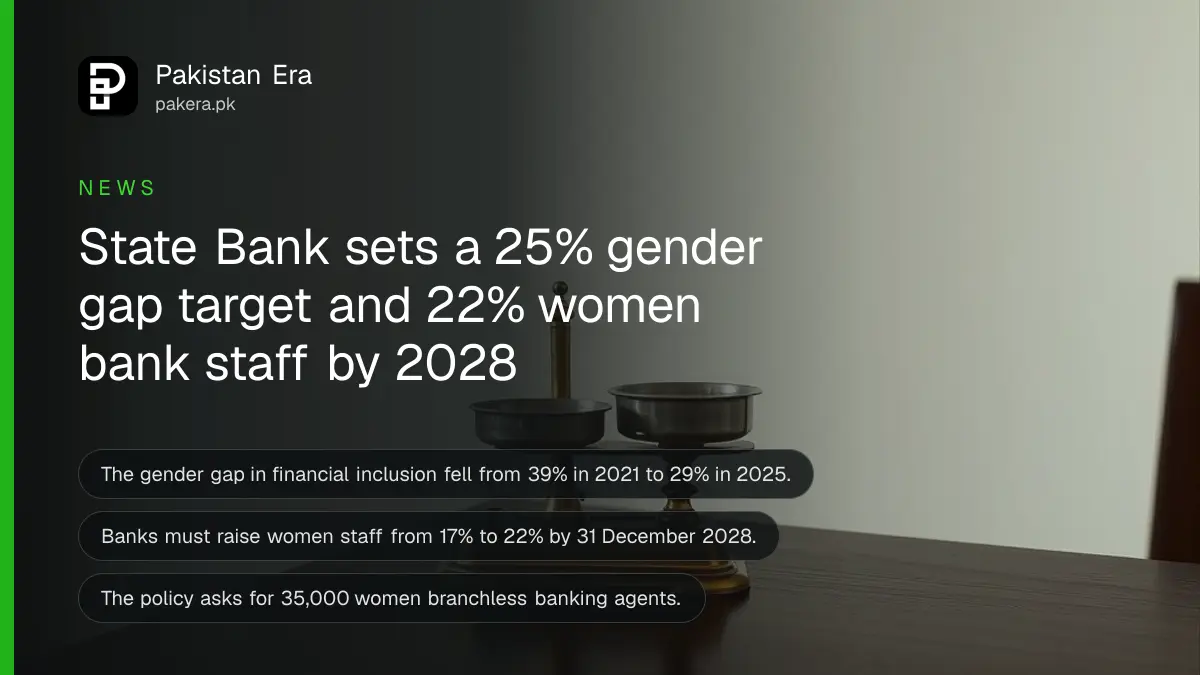
Short answer: The State Bank of Pakistan launched its Banking on Equality Policy 2026 on 13 October 2026. It sets a goal to cut the gender gap in financial inclusion from 29 percent to 25 percent by 2028. Banks must raise women's staff share from 17 to 22 percent by 31 December 2028.
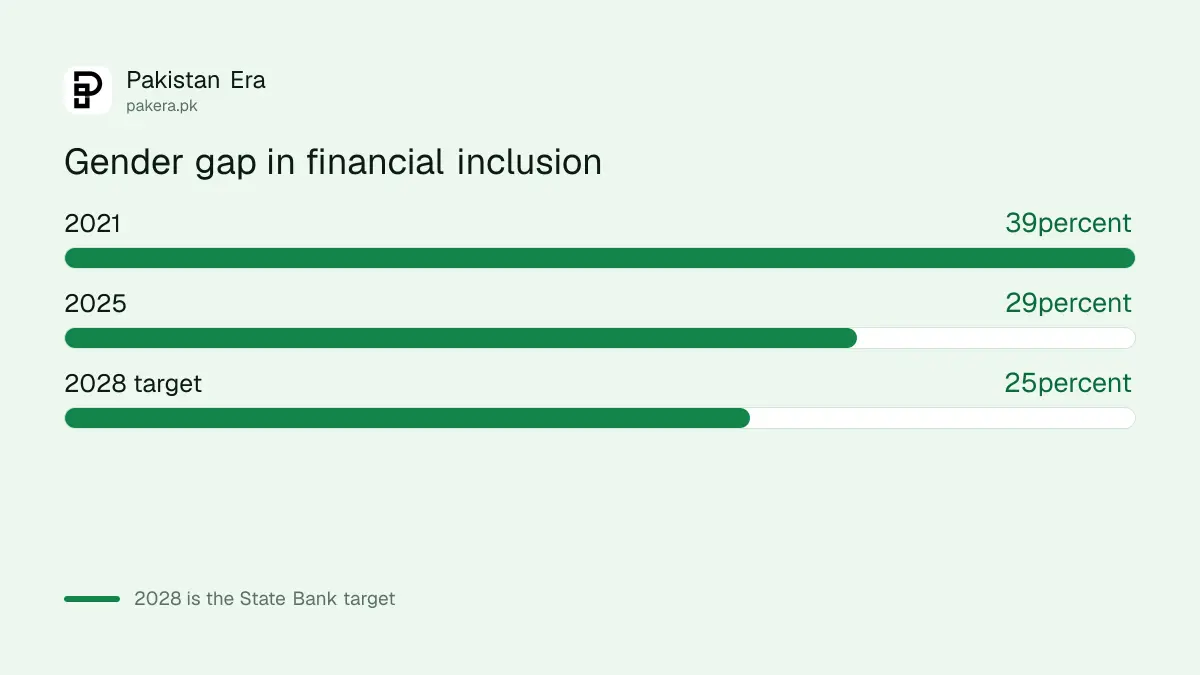
The State Bank of Pakistan (SBP) has issued the second edition of its policy for women's access to money. It follows a first policy from 2021. The gender gap in financial inclusion means the difference between how many men and how many women use formal financial services. SBP says that gap fell from 39 percent in 2021 to 29 percent in 2025.
We read SBP's press release dated 13 October 2026 and the full policy document it links to on sbp.org.pk. The rules apply to banks and other financial institutions that SBP regulates.
The policy sets a 25 percent gap target for 2028
SBP wants the gender gap in financial inclusion to fall to 25 percent by 2028. The policy supports the National Financial Inclusion Strategy goal. It builds on the first policy, under which the gap narrowed from 39 percent in 2021 to 29 percent in 2025.
SBP also says the first policy helped banks hire over 17,500 women. The share of women among bank staff rose from 13 percent to 17 percent in that time. The policy is also part of SBP's Vision 2028. SBP says it won the Alliance for Financial Inclusion's Policy Achievement Award for Gender Inclusive Finance 2026 for the earlier work.
Banks must raise women staff from 17 to 22 percent
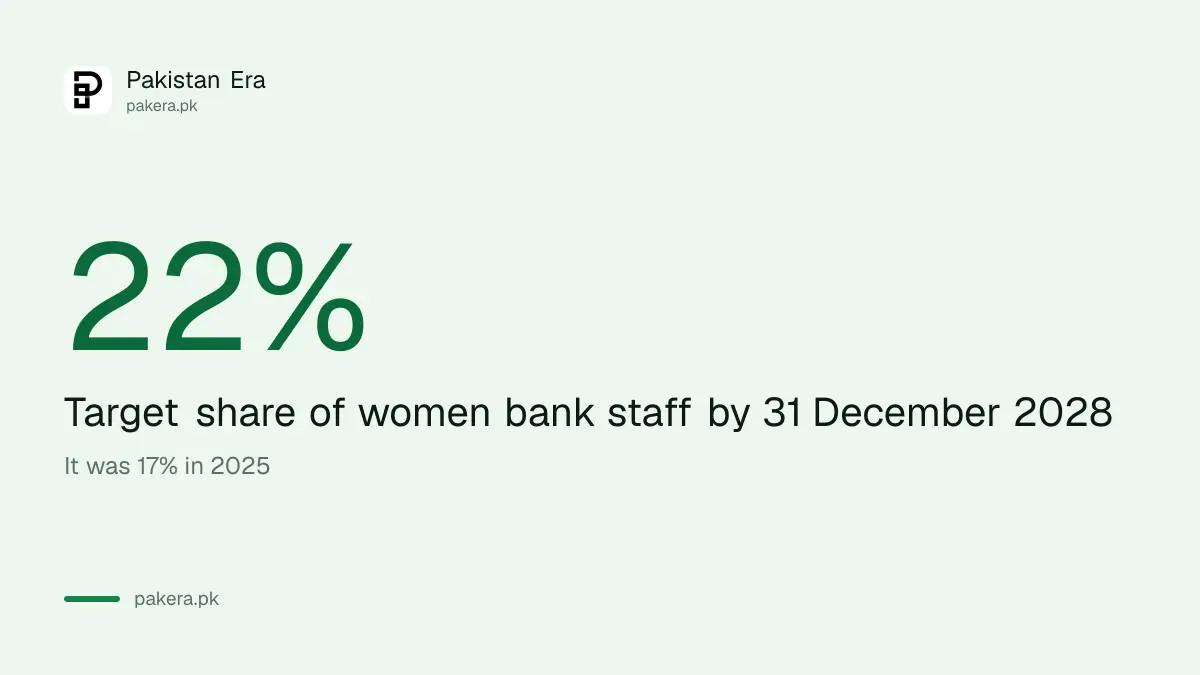
The policy tells financial institutions to make action plans with timelines to lift the share of women staff from 17 to 22 percent by 31 December 2028. It also asks banks to promote mid-career women into senior jobs and to offer mentoring.
Other staff measures in the policy document are plain and practical. Banks are advised to provide day care facilities or an allowance for working mothers. They should allow maternity, miscarriage and iddat leave as the law provides. They should also follow the Protection against Harassment of Women at the Workplace Act, 2010. A bank should have more than one woman on its board, and it should name a senior officer as the policy champion who reports to SBP.
Women customers get digital accounts and more agents
For customers, the policy tells banks to run campaigns to open Asaan Mobile Accounts and Asaan Digital Accounts for women who do not work in jobs with pay slips. It also asks for simple Women Digital Business Accounts with minimal papers.
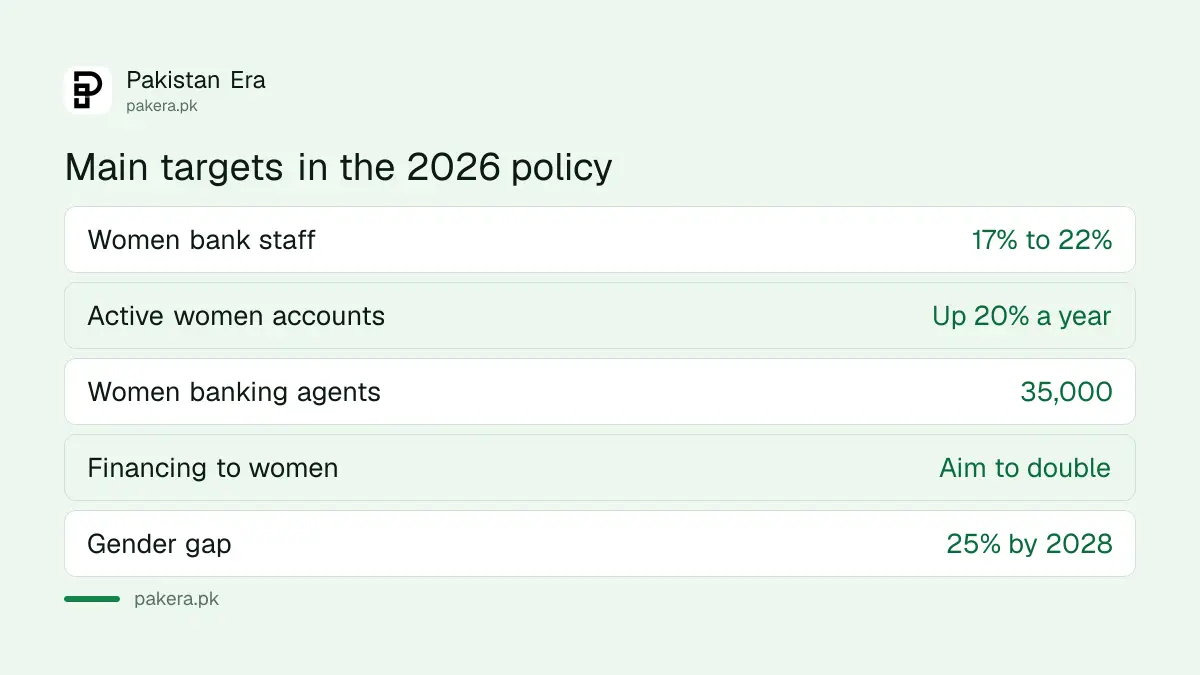
The targets are specific. Banks should increase women's active account ownership by at least 20 percent every year. They should raise the number of women branchless banking agents to 35,000. A branchless banking agent is a local shop or person who handles deposits and withdrawals for a bank or wallet. The policy also asks banks to encourage women-run shops and businesses to take payments digitally.
| Area | What the policy asks | Date |
|---|---|---|
| Gender gap | Narrow to 25 percent | 2028 |
| Women bank staff | Raise from 17 to 22 percent | 31 December 2028 |
| Active women's accounts | Grow at least 20 percent a year | Every year |
| Women branchless banking agents | Reach 35,000 | Not dated in the text we read |
| Financing to women and their businesses | Aim to double | 31 December 2028 |
Lending to women businesses should double by 2028
The policy says banks should aim to double their total financing to women and women-owned or women-led businesses by 31 December 2028. It also asks for end-to-end digital loan journeys and credit scoring that uses other data than collateral.
Many women own no property to pledge. The policy therefore encourages other ways to judge a borrower, using "alternate data" such as payment history. A business counts as women-owned in the policy if women hold more than 50 percent of it. Banks are also told to set up units that help women entrepreneurs with business advice and financial literacy.
A separate step already exists for small borrowers. Read about the new SBP guarantee for women's business loans for how a guarantee can help a woman who has no collateral.
SBP will check banks with data and mystery shopping
SBP says it will track the policy through quarterly data reports, a monitoring and evaluation framework and regular mystery shopping. Mystery shopping means SBP staff pose as customers to test how a branch really treats women.
Banks must also report data split by gender for accounts, loans and the number of payments. The policy document asks them to watch account activity at 30, 60 and 90 days after opening. That helps SBP see which new accounts women actually use. An account that sits empty does not count as inclusion in the policy's own logic, which is why it speaks of active accounts.
The wider picture is in SBP's Financial Inclusion Index for 2025, which put Pakistan at 59.5.
What a woman can ask her bank now
A woman can ask her bank which Asaan Digital Account or women-focused product it offers, and whether a business account needs fewer papers. If the branch refuses or delays, she can complain to SBP through the Sunwai portal or to the Banking Mohtasib.
- Ask the branch or call centre whether it has a Women Financial Services team.
- Ask which simplified digital account the bank offers women.
- Ask what papers a women-led business needs to open an account.
- Note the date, the staff name and the answer.
- Complain on SBP's Sunwai portal if the bank does not respond.
Our guide to the Asaan Mobile Account on *2262# shows how a basic account opens without internet.
What the policy does not say
The press release and policy text do not give a start date for each bank target. They also do not give a penalty for a bank that misses a target. The women agent target of 35,000 has no date in the text we read. Treat these as directions to banks, not new rights you can enforce in court.
The policy does not change your account fees or limits today. It tells banks what to build over the next two years. Watch your own bank for new women-focused accounts through 2027 and 2028.
Common questions
What is the Banking on Equality Policy 2026?
It is the State Bank's second policy to cut the gender gap in financial inclusion. It was launched on 13 October 2026 and sets targets for women's staff, accounts, agents and loans.
What is the gender gap in financial inclusion?
It is the difference between the share of men and the share of women who use formal financial services. SBP says it narrowed from 39 percent in 2021 to 29 percent in 2025.
Who must follow the policy?
The policy applies to the financial institutions regulated by SBP, which include banks. It is not a rule for customers.
What is the target for women bank staff?
Banks should raise the share of women staff from 17 percent to 22 percent by 31 December 2028, according to the policy document.
Will women get a special account?
The policy tells banks to offer simplified women-centred digital accounts and Women Digital Business Accounts with minimal papers. It does not name a product or a launch date.
How we verified this
What we checked, where we read it, and what we could not confirm.
We read SBP's press release of 13 October 2026 (ECD/M&PRD/PR/01/2026-76) and the Banking on Equality Policy 2026 document, both on the State Bank of Pakistan's website, sbp.org.pk. We checked them on 14 October 2026. The 35,000 agent figure and the 22 percent staff figure come from the policy document itself. We have not tested any bank's new product.
About the author

Global Affairs & Political Economy Writer
Muhammad Hatim is a book lover who started writing because he enjoys it. At Pakistan Era he writes about international relations, geopolitics and the global economy, with a particular interest in South Asia and the forces behind current events.