How to Contest an Overstayed Cargo Penalty in Pakistan Customs WeBOC
Customs now issues overstayed cargo penalties through WeBOC from 1 October 2026. See the 5 working day decision, the 15 day appeal and the Rs 1 million cap.
Short answer: Since 1 October 2026, the WeBOC system works out an overstayed cargo penalty by itself and sends an electronic notice. You can pay it in the system or contest it. If you contest, the Collector must decide within five working days. If you disagree with the order, appeal in the system within 15 days of the order, and the Chief Collector decides within five working days.
A container can sit at a port for a week because a bank has not cleared the payment. The clock does not stop. Under new Customs Rules, the late days now turn into a penalty automatically. We read the two notifications that set this up on the FBR website.
The rules apply to sea cargo from 1 October 2026
The Overstayed Cargo Management Rules, 2026 were added as a new Chapter XLIX of the Customs Rules, 2001. They take effect from 1 October 2026. A companion notification, S.R.O. 1346(I)/2026, sets the penalty amounts and also takes effect on 1 October.
The rules do not apply at land customs stations or airports. Section 82(1) of the Customs Act also does not apply to goods under Chapter 99 of the First Schedule, goods in transit or transshipment, personal baggage, LCL export cargo (less than container load), and bulk cargo.
The amounts themselves are covered in the Rs 25,000 a day late customs filing penalty. This page covers the process, which matters once a notice reaches you.
The system sets the penalty and sends a notice
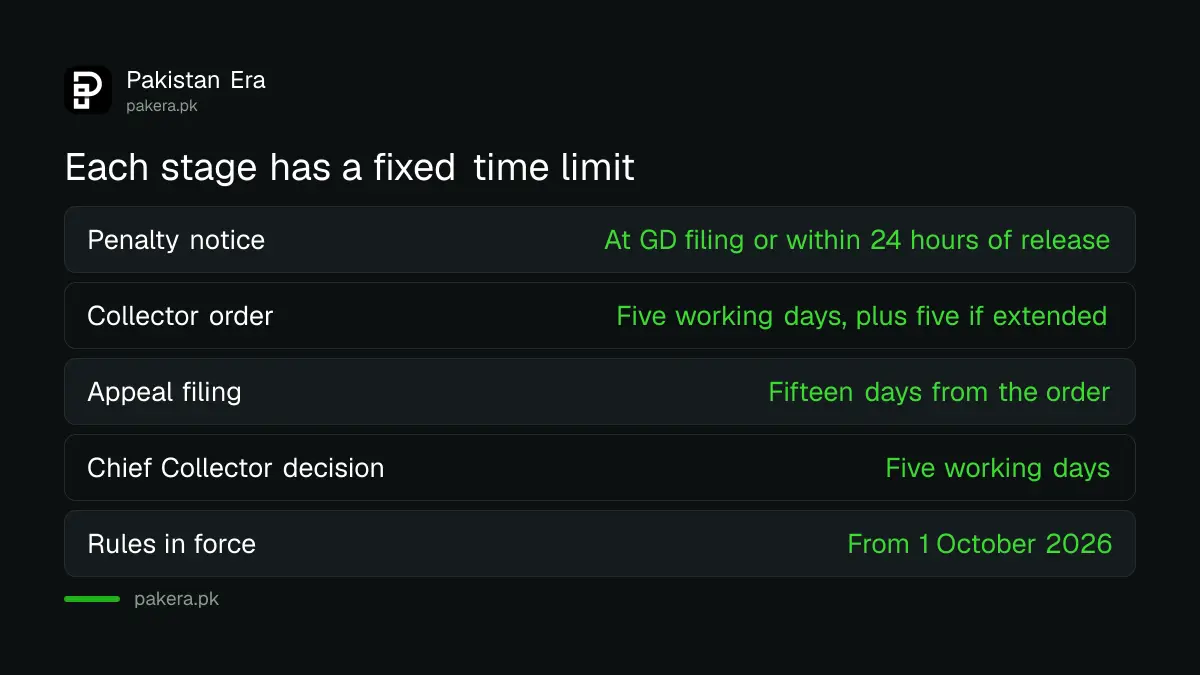
The computerised system works out the penalty when the goods declaration (GD) is filed, or within 24 hours of the GD release message. It then sends an electronic notice to the owner of the goods or the authorised clearing agent, stating the amount.
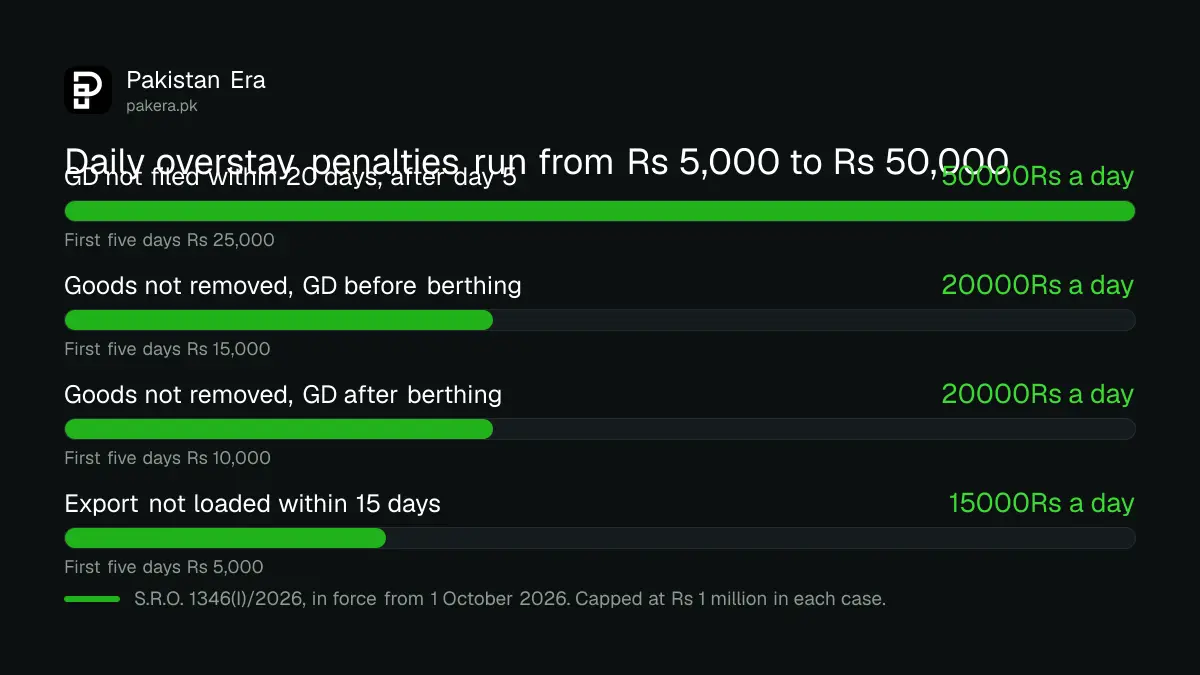
| Trigger in S.R.O. 1346(I)/2026 | First five days | Each later day | Cap per case |
|---|---|---|---|
| GD not filed within 20 days of arrival | Rs 25,000 | Rs 50,000 | Rs 1 million |
| GD filed before berthing, goods not removed within 5 days of assessment and berthing | Rs 15,000 | Rs 20,000 | Rs 1 million |
| GD filed after berthing, goods not removed within 5 days of GD clearance | Rs 10,000 | Rs 20,000 | Rs 1 million |
| Export goods not loaded within 15 days of entry in the port | Rs 5,000 | Rs 15,000 | Rs 1 million |
The amounts are per day. The notification says they are subject to adjudication proceedings or voluntary deposit, as the rules provide.
You have two options: accept and pay, or contest
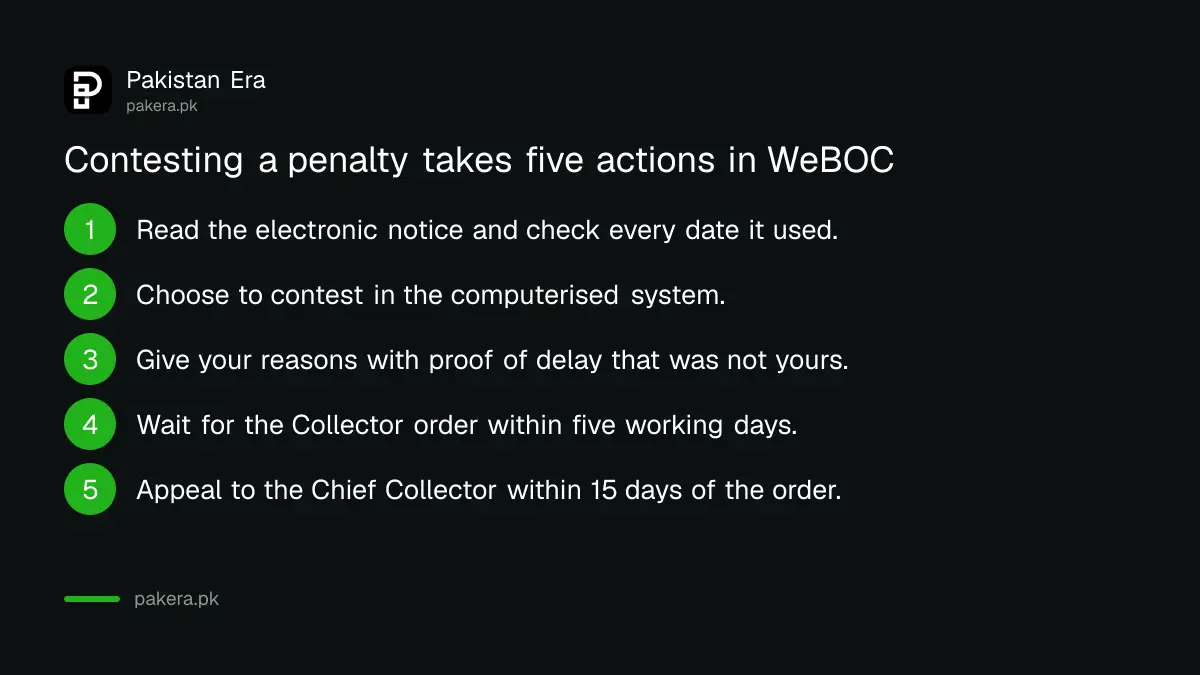
The trader or the clearing agent can accept the penalty in the system and deposit it through the WeBOC payment module. Or they can contest it. If you contest, the system sends the case to the Collector, or an officer authorised by the Collector.
- Read the electronic notice and check the dates it used: arrival, berthing, GD filing and clearance.
- Decide whether to accept or contest, in the computerised system.
- If you accept, pay through the WeBOC payment module as for any other charge.
- If you contest, give your reasons in the system, with proof of any delay that was not yours.
- The Collector passes an order within five working days. The Chief Collector can add five more working days, for written reasons.
- If the notice is vacated, the system lets you file the GD or deletes the penalty. If not, the penalty is processed in the payment module.
An appeal must be filed within 15 days of the order
A person unhappy with the Collector's order can file an appeal in the computerised system before the Chief Collector with jurisdiction. The time limit is fifteen days from the date the order is issued. The Chief Collector must decide it within five working days.
Count the 15 days from the order, not from the notice. If you contested and lost, the order is the date that matters. Keep the screen print of the order date for your file.
Preparing paperwork early avoids most penalties
Most overstay penalties begin with a document gap, such as a payment not cleared by the bank or a licence not ready. Import and export traders who register early and match their bank and price details will file sooner. The steps for exporters are in registering as an exporter in WeBOC, and the bank checks are in preparing the bank and price check on PSW.
If delay comes from the port, the shipping line or the system being down, say so in your contest and attach the evidence. The rules do not list valid reasons, so a clear record of dates helps most. Ask your clearing agent to give you the notice the day it is issued.
Common questions
When did the new overstayed cargo penalties start?
Both notifications say they take effect from 1 October 2026.
Who gets the penalty notice?
The electronic notice goes to the owner of the goods or his authorised agent, such as a clearing agent.
How long does the Collector have to decide a contested penalty?
The Collector has five working days, and the Chief Collector may extend that by five working days with written reasons.
How long do I have to appeal?
You have 15 days from the date the order is issued, and the Chief Collector decides within five working days.
Do the rules apply at airports and land borders?
No. The rules do not apply to land customs stations or airports.
Is there a maximum penalty?
Yes. Each of the four penalty types in S.R.O. 1346(I)/2026 is capped at Rs 1 million in each case.
How we verified this
What we checked, where we read it, and what we could not confirm.
Last checked on Sunday 11 October 2026. We read S.R.O. 1347(I)/2026 and S.R.O. 1346(I)/2026 on the FBR customs SROs page. We did not file or contest a notice in WeBOC, so we cannot describe its screens. The FBR's list shows both notifications dated 13 August 2026.
About the author

Senior Writer, Public Services and Technology
Shahid joined us in 2024 as an author. He is a senior contributor to Pakistan's leading technology websites. He writes detailed articles, mostly covering his expertise in the latest tech, mobiles, apps, gadgets, and step-by-step guides. His ideology is to help people understand the latest trends and explain complex methods through very easy-to-understand guides.