Pakistan Courier Parcels Over Rs 1,000 Now Pay Customs Duty
A parcel from AliExpress, Amazon or Temu worth over Rs 1,000 now owes customs duty in Pakistan. See how TCS, Leopards, DHL and FedEx collect it on delivery.
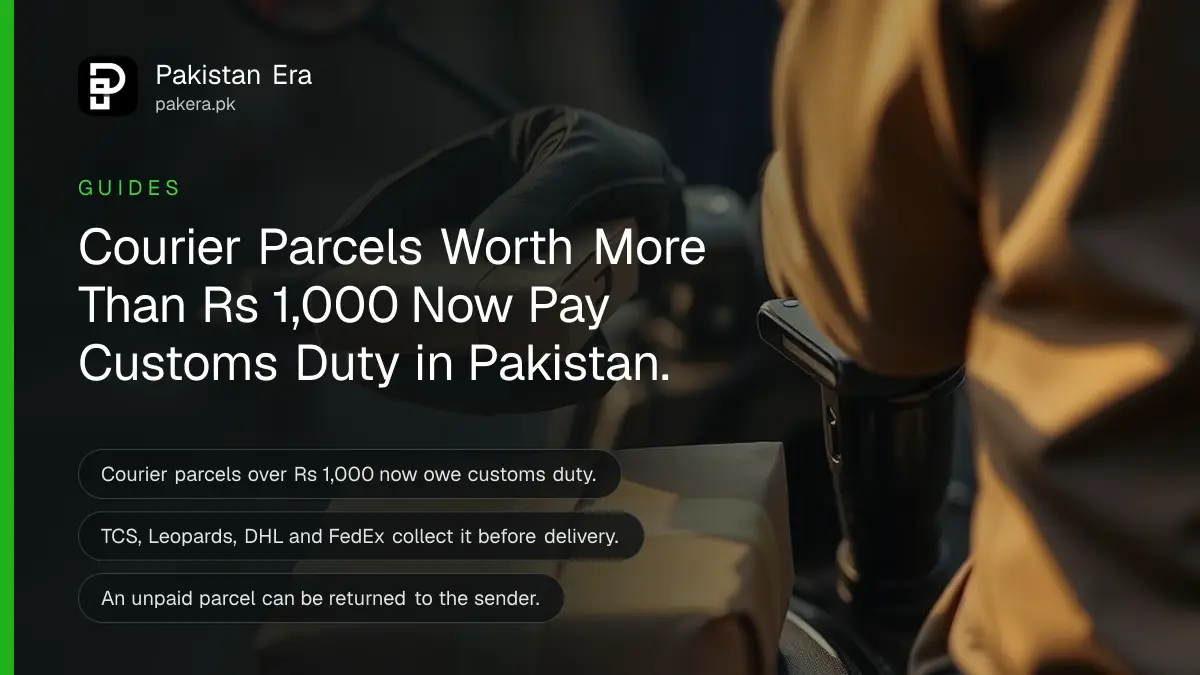
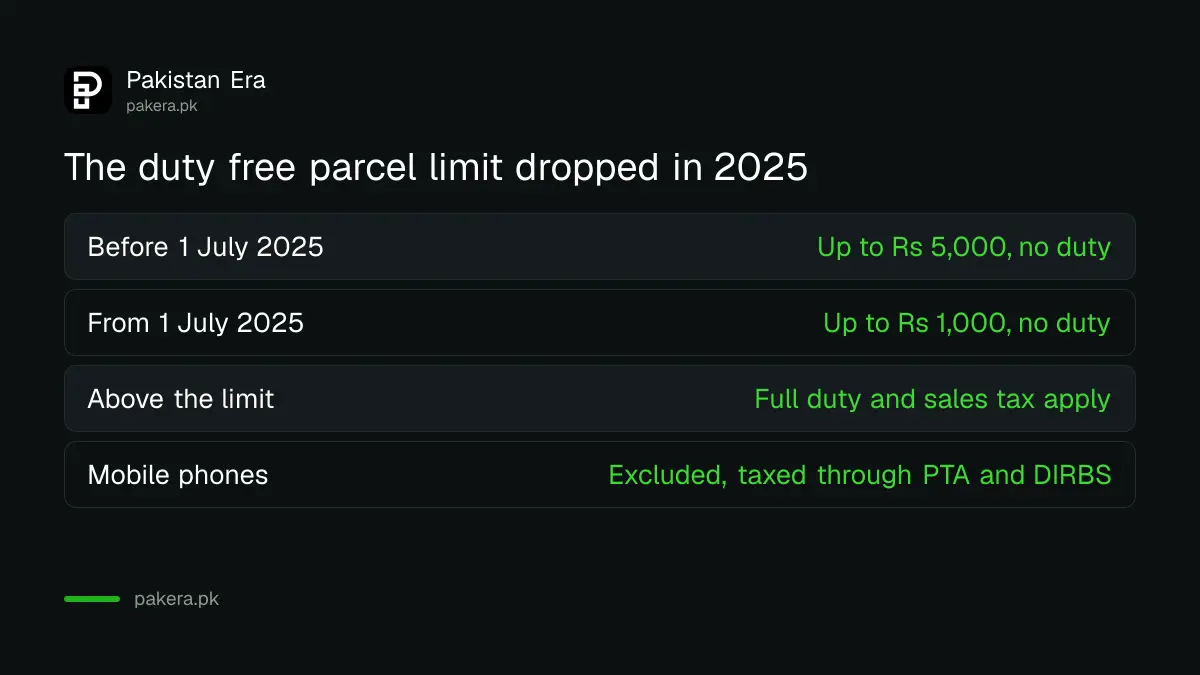
Order something from AliExpress, Amazon, eBay or Temu worth more than Rs 1,000, and the parcel now owes customs duty in Pakistan before your courier will hand it over. We read the Federal Board of Revenue's own Customs Act text, and the free limit for post and courier parcels dropped from Rs 5,000 to Rs 1,000 from 1 July 2025.
Update, 11 October 2026: Some imports also carry anti-dumping duty from the NTC list.
That number surprises a lot of shoppers, because the old Rs 5,000 figure is still what most people quote. It changed. Section 19C of the Customs Act now reads that no duty is demanded only where the parcel's value "does not exceed one thousand rupees". Above that, the courier collects before it releases your box.
Parcels over Rs 1,000 owe customs duty in Pakistan
Any parcel brought in by post or courier that is worth more than Rs 1,000 loses its duty free status under section 19C of the Customs Act. Below that figure, nothing is charged. Above it, the full duty and tax bill applies to the whole parcel, not just the amount over Rs 1,000.
This is a steep drop. A Rs 4,000 phone case or a Rs 3,500 pair of shoes used to clear free. From 1 July 2025 they don't. The Finance Act 2025 made the change to close what the government called misuse of the de minimis facility, where sellers were splitting orders or under-declaring value to dodge duty on higher value goods.
Mobile phones sit outside this whole system anyway. A phone shipped in from abroad gets taxed separately through PTA's registration system, no matter what it costs, so the Rs 1,000 limit never helps there. If you are bringing one in yourself rather than ordering it online, the rules for registering a phone on DIRBS within 60 days are a different process entirely.
Pakistan Customs sets the bill, your courier collects it
Customs calculates what you owe using the parcel's declared value and the item's tariff code. Your courier does not set the duty rate. It pays customs on your behalf through its own clearance system, then recovers that money from you, usually in cash, when the parcel arrives.
The bill is rarely one flat number. Customs duty depends on the tariff heading, so a watch and a kitchen gadget can sit on different rates. On top of that, the standard sales tax, reported at 18 percent, applies to the duty-paid value, and some categories carry an extra regulatory duty too. There is no single percentage that covers everything.
Couriers clear parcels through Pakistan's WeBOC customs system, filing a goods declaration the same way a commercial importer would, just scaled down. That is why a parcel can sit at "customs clearance" status for a few days: an officer has to assess it first.
TCS, Leopards, DHL and FedEx each handle payment differently
Every major courier collects the same government duty, but the way they ask for it on your end is not identical. Know which one is carrying your parcel before you argue about the number.
| Courier | How it usually collects duty |
|---|---|
| TCS | Clears through WeBOC and adds the duty to a cash on delivery charge |
| Leopards Courier | Runs its own customs brokerage and bills duty on the delivery slip |
| DHL Express | Usually calls or emails for payment before the final delivery run |
| FedEx | Invoices duty separately, and sometimes only after the parcel is delivered |
Ask for a breakdown every time. A rider who only says "Rs 3,200 total" on your doorstep is not giving you enough to check anything. You want three separate lines: customs duty, sales tax, and whatever handling or clearance fee the courier itself is charging, because that last one is the courier's own charge, not a government tax, and it is where most of the padding happens.
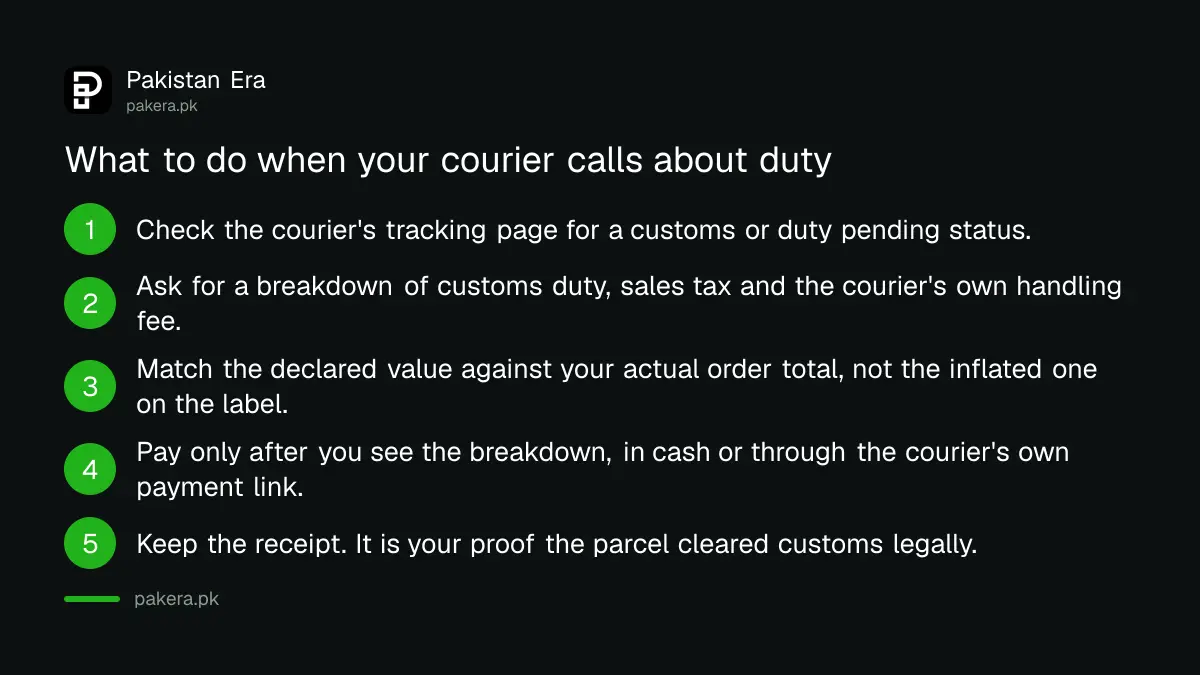
- Check the courier's tracking page for a customs or duty pending status before it arrives.
- Ask for a breakdown of customs duty, sales tax and the courier's own handling fee.
- Match the declared value against your actual order total, not an inflated figure on the label.
- Pay only after you see the breakdown, in cash or through the courier's own payment link.
- Keep the receipt. It is your proof the parcel cleared customs legally.
What happens if you do not pay
Refusing to pay does not make the duty disappear, it only stalls your parcel. Couriers generally hold it for a short window, then either send it back to the sender, usually at your cost, or mark it abandoned so Customs can deal with it as unclaimed cargo.
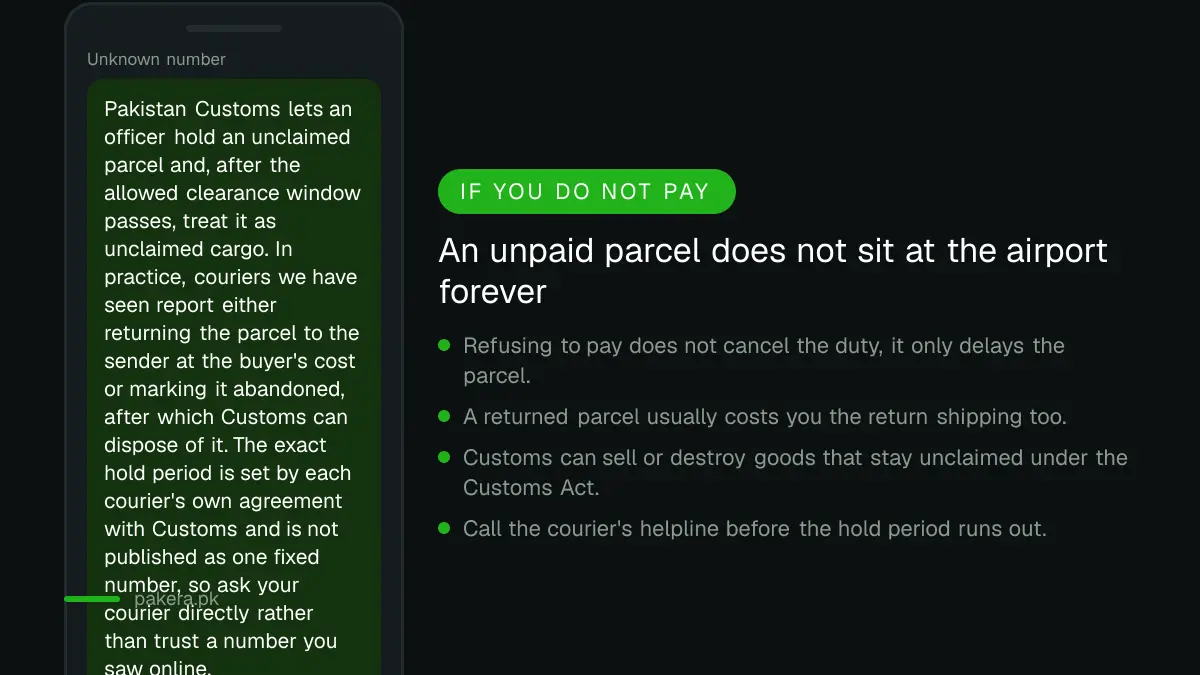
We could not find one published number of days that applies to every courier, because the hold period comes from each courier's own operating agreement with Customs. Treat any specific day count you see online with caution and ask your own courier's helpline instead. What stays consistent is the outcome: an abandoned, unclaimed parcel can legally be disposed of, and a returned one rarely comes back to you for free.
A courier parcel is not the same as baggage you carry yourself
These are two separate systems under the same Customs Act, and mixing them up is where most confusion starts. A courier parcel is assessed against the Rs 1,000 de minimis in section 19C. What you personally carry through the airport falls under the Baggage Rules instead, with its own duty free items like clothes and one laptop, which we cover in the rules for personal baggage brought in by a traveller.
Don't assume one set of numbers applies to the other. A friend flying in with your parcel in their suitcase is governed by the baggage allowance, not the Rs 1,000 courier limit.
Mistakes that push your bill higher than it should be
Most overpayment complaints we see trace back to the same handful of errors, not to the courier cheating anyone outright.
- Trusting the seller's declared value. Some sellers mark goods lower than the actual price, and Customs can reassess it upward anyway, leaving you with a surprise bill. It helps to check an unfamiliar seller before you pay, not just after something goes wrong with a parcel.
- Not separating the courier's own fee. A handling charge of a few hundred rupees is normal. One that matches or exceeds the duty itself is worth questioning.
- Paying before checking the item code. A gadget wrongly coded under a high duty tariff heading costs more. Ask the courier to recheck if a bill looks unusually high.
- Splitting one order into several small parcels to stay under Rs 1,000. This is exactly what the Finance Act 2025 change targeted, and Customs can treat split shipments from one sender as one import.
Common questions
Do I pay customs duty on every parcel from AliExpress or Amazon?
Only if its value is over Rs 1,000. Below that figure, section 19C of the Customs Act exempts it from duty and tax entirely.
How much is customs duty on a courier parcel in Pakistan?
It depends on the item's tariff code, plus the standard sales tax, reported at 18 percent, on the duty-paid value. There is no single flat rate for every parcel.
Can I pay the duty online before my parcel arrives?
Some couriers send a payment link once the parcel clears customs, but most still collect in cash at the door. Ask your specific courier's helpline what it supports.
What happens if I refuse to pay the duty on delivery?
Your parcel does not get released. It is normally returned to the sender at your cost, or treated as unclaimed cargo that Customs can dispose of after a hold period set by the courier.
Does the Rs 1,000 limit apply to mobile phones shipped from abroad?
No. A phone is taxed through PTA's own registration system regardless of its price, so the courier de minimis limit does not help it clear free.
Is customs duty different for a parcel and for baggage I carry myself?
Yes. A courier parcel falls under the Rs 1,000 de minimis in section 19C. What you carry in your own luggage is assessed under the separate Baggage Rules instead.
How we verified this
What we checked, where we read it, and what we could not confirm.
Last checked on 5 October 2026. We downloaded FBR's own consolidated Customs Act, 1969 from fbr.gov.pk and read section 19C directly, along with its footnote recording that the Finance Act 2025 substituted the current "one thousand rupees" figure. We also read FBR's Notes on Clauses for the Finance Bill 2025-26, which independently describes the same amendment to section 19C. The 18 percent sales tax figure and the courier unclaimed-parcel hold period are reported rather than read on an FBR page naming them specifically, and the article says so. This is general information, not a substitute for your own courier's final assessment.
About the author

Tax, Bills and Technology Writer
Ali Akhtar is a young and curious voice here at Pakistan Era. He is currently pursuing his A-Levels and has a growing interest in Pakistan’s changing industrial landscape and educational trends. Ali likes to write in a way that helps him explain and explore the world around him. His writing reflects the perspective of the new generation navigating the evolving trends of Pakistan where technology, youth innovation, and shifting opportunities are reshaping the country’s future.