Reko Diq Explained: The $1.25 Billion US Financing Review, and What the Project Actually Is
US EXIM is revisiting its $1.25 billion package as costs are recalculated. Who owns Reko Diq, what it holds, and when production is targeted.
The US Export-Import Bank will revisit its proposed $1.25 billion financing package for Reko Diq while project costs are recalculated and the final financing structure is assembled.
US Embassy officials describe the project as still moving forward, though slower than initially planned. Since Reko Diq is one of the largest things Pakistan's economy is currently betting on and most coverage assumes you already know what it is, here is the whole picture.
What Reko Diq is
Reko Diq is a copper and gold deposit in Chagai District, Balochistan, near the Afghan and Iranian borders. It is widely described as one of the world's largest undeveloped copper and gold resources, which is the reason a mine in a remote corner of Balochistan attracts American, Asian and multilateral lenders at once.
Two things follow from copper specifically. Copper is the metal of electrification, wiring, grids, motors and everything the energy transition needs, so demand projections for it are structural rather than cyclical. And a producing copper mine generates export dollars for decades, which is the part that matters to a country with Pakistan's balance of payments history.
Who owns it
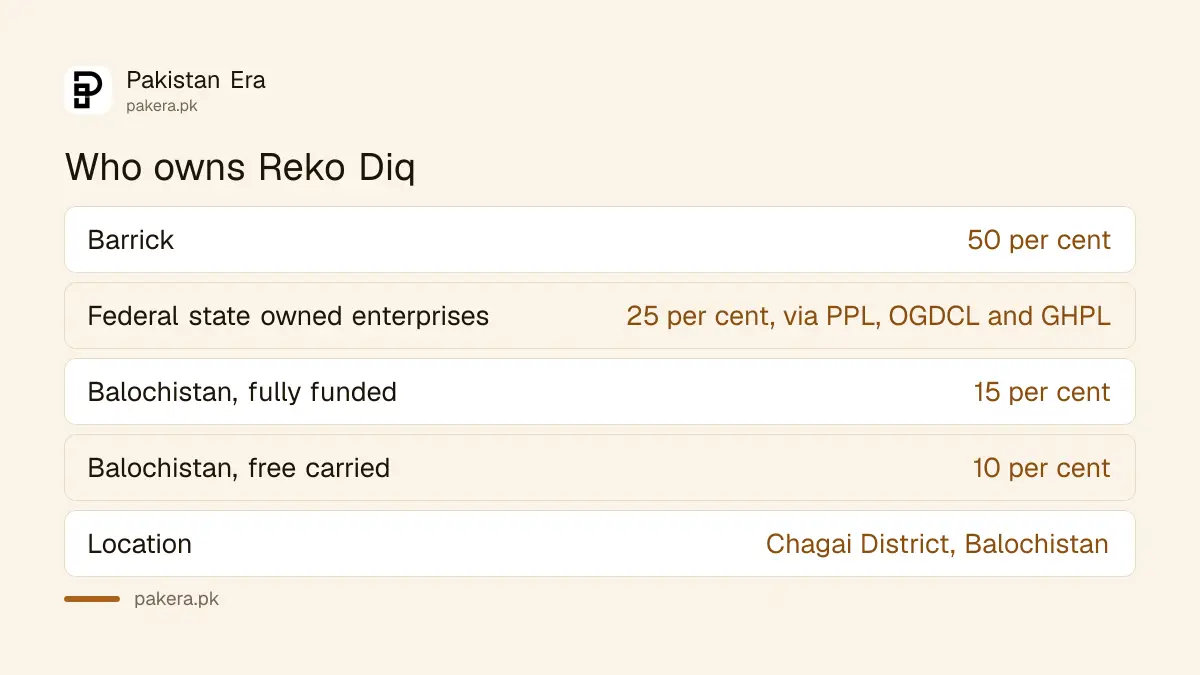
| Shareholder | Stake |
|---|---|
| Barrick | 50 per cent |
| Federal state owned enterprises, through PPL, OGDCL and GHPL | 25 per cent |
| Government of Balochistan, fully funded | 15 per cent |
| Government of Balochistan, free carried | 10 per cent |
The Balochistan split is the detail worth understanding. The province holds 25 per cent in total, but only 15 of that is a funded stake where it contributes capital. The other 10 is free carried, meaning the province pays nothing toward development and still receives its share of proceeds. That structure exists because a province with limited fiscal room could not otherwise afford to participate in its own resource.
The financing, and why it is being reviewed
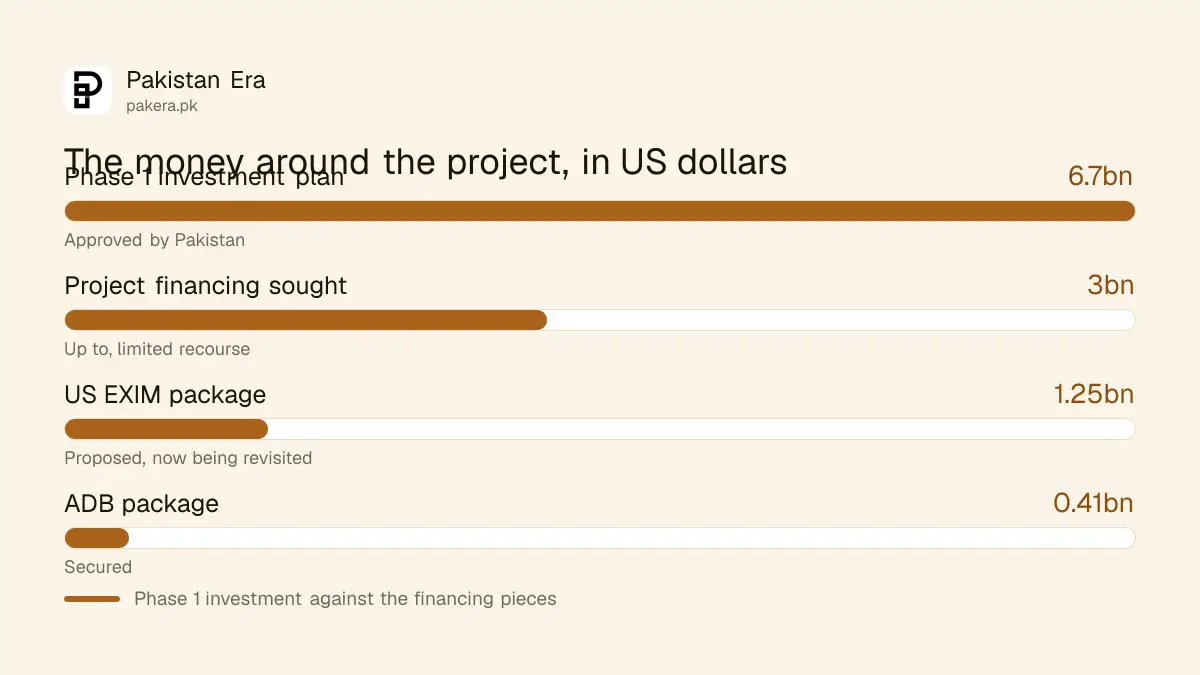
Phase 1 carries a $6.7 billion investment plan approved by Pakistan. That is assembled from many sources rather than one, and shareholders approved the revised feasibility study with Phase 1 capital conditional on closing up to $3 billion of limited recourse project financing.
The pieces so far: a $410 million package secured from the Asian Development Bank, the $1.25 billion proposed by US EXIM that is now being revisited, and the International Finance Corporation expected to join the final discussions.
A review at this stage is not a withdrawal, and it would be wrong to read it as one. Costs on projects of this size get recalculated as engineering firms up, and lenders reprice against the revised number before signing. What it does mean is that the timetable has slipped from what was planned, which the US Embassy has said plainly rather than obscured.
Limited recourse is the term to understand in that sentence. It means lenders are repaid primarily from the project's own cash flows rather than by claims on the sponsors' other assets, which is why they scrutinise the cost base so closely: if the mine underperforms, the loan is what suffers.
Where the project actually stands
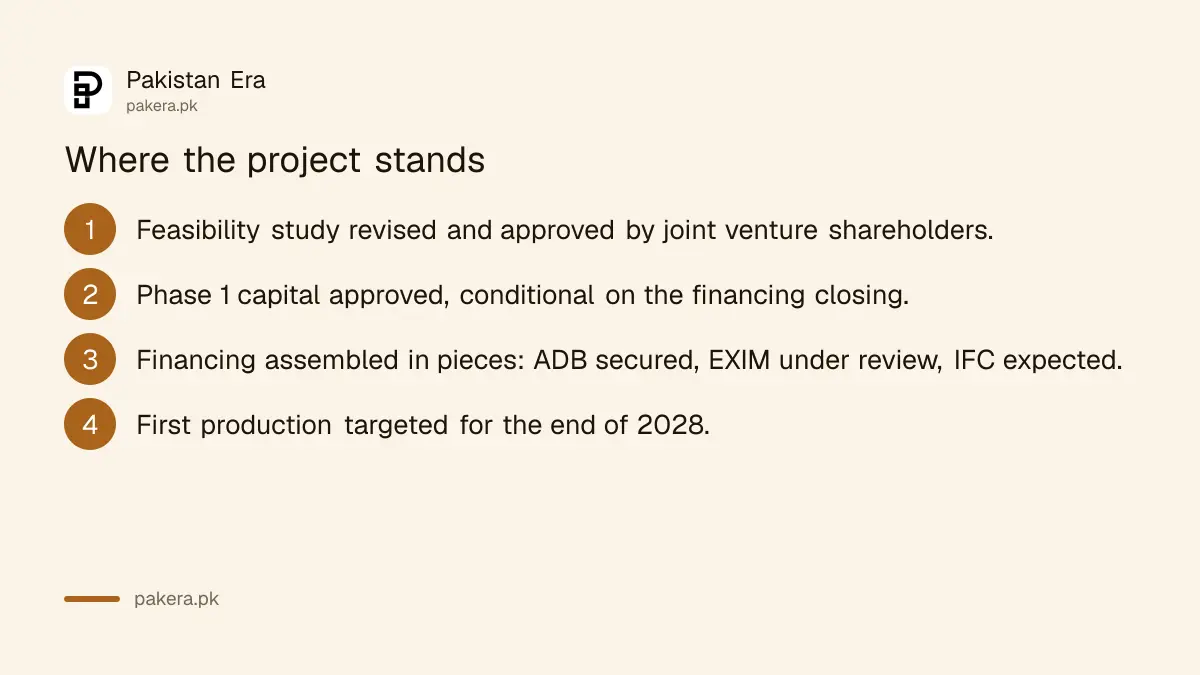
- Feasibility study revised and approved by joint venture shareholders.
- Phase 1 capital approved, conditional on the project financing closing.
- Financing assembled in pieces, with ADB secured, EXIM under review and the IFC expected.
- First production targeted for the end of 2028, a date Barrick has publicly reiterated.
Treat 2028 as a target rather than a promise. Large mines slip, this one has already slipped, and a financing review in 2026 is the kind of event that tests a 2028 date rather than confirming it.
The question that decides whether this works
Reko Diq sits in Balochistan, and any honest account of the project has to say that the province has an active insurgency, that mining projects there have been targets, and that the political argument about who benefits from Balochistan's resources is not settled.
We wrote about the wider argument in the 11 August explainer, and it bears directly here: a resource project is exactly the thing that argument is about. The 25 per cent provincial stake and the free carried structure exist as answers to it. Whether they are sufficient answers is a political question rather than a financial one, and it is the question that most affects whether a mine operates for forty years without interruption.
Lenders price that risk too, quietly, inside the terms they offer.
What Reko Diq would mean if it works
Export earnings in dollars, over decades, from a sector Pakistan barely participates in. That matters against the position we keep describing in our economic coverage: exports concentrated in a narrow band of textiles, an energy import bill that spikes with other people's conflicts, and a revenue target that assumes growth from somewhere.
A large copper exporter changes that arithmetic in a way that no single policy can. Which is also why the timeline matters: 2028 first production means the effect on the balance of payments arrives in the 2030s, and nothing about it helps the current account this year or next.
Questions readers are asking
What is Reko Diq?
A copper and gold deposit in Chagai District, Balochistan, widely described as one of the world's largest undeveloped copper and gold resources, being developed as a mine by a joint venture.
Who owns Reko Diq?
Barrick holds 50 per cent, federal state owned enterprises 25 per cent through PPL, OGDCL and GHPL, and the Government of Balochistan 25 per cent, of which 15 is fully funded and 10 is free carried.
What is the US reviewing?
The Export-Import Bank will revisit its proposed $1.25 billion financing package while project costs are recalculated and the final financing structure is prepared. It is a review, not a withdrawal.
How much does the project cost?
Pakistan approved a $6.7 billion investment plan for Phase 1, with Phase 1 capital conditional on closing up to $3 billion in limited recourse project financing.
When will Reko Diq start producing?
First production is targeted for the end of 2028. Progress has already been slower than initially planned, so treat the date as a target.
What does Balochistan get from it?
A 25 per cent shareholding, split between a 15 per cent funded stake and a 10 per cent free carried stake on which the province contributes no development capital but still receives proceeds.
About the author

Senior Writer, Public Services and Technology
Shahid joined us in 2024 as an author. He is a senior contributor to Pakistan's leading technology websites. He writes detailed articles, mostly covering his expertise in the latest tech, mobiles, apps, gadgets, and step-by-step guides. His ideology is to help people understand the latest trends and explain complex methods through very easy-to-understand guides.