Why 11 August Keeps Trending About Balochistan: The 1947 History Behind the Claim
A viral declaration names 11 August as Balochistan's independence day. What that date actually was in 1947, who is claiming what, and why now.
Every year, a few days before 14 August, the date 11 August starts trending with Balochistan attached to it, and this year the noise is louder than usual: a declaration naming 11 August as Balochistan's independence day, appeals to the United Nations, flag images, maps.
Most of what circulates answers nothing. So we went back to what 11 August 1947 actually was, who is claiming what in 2026, and why this particular date does the work it does. This is a history explainer, not a position, and everything in it is attributed.
What is actually being announced in 2026
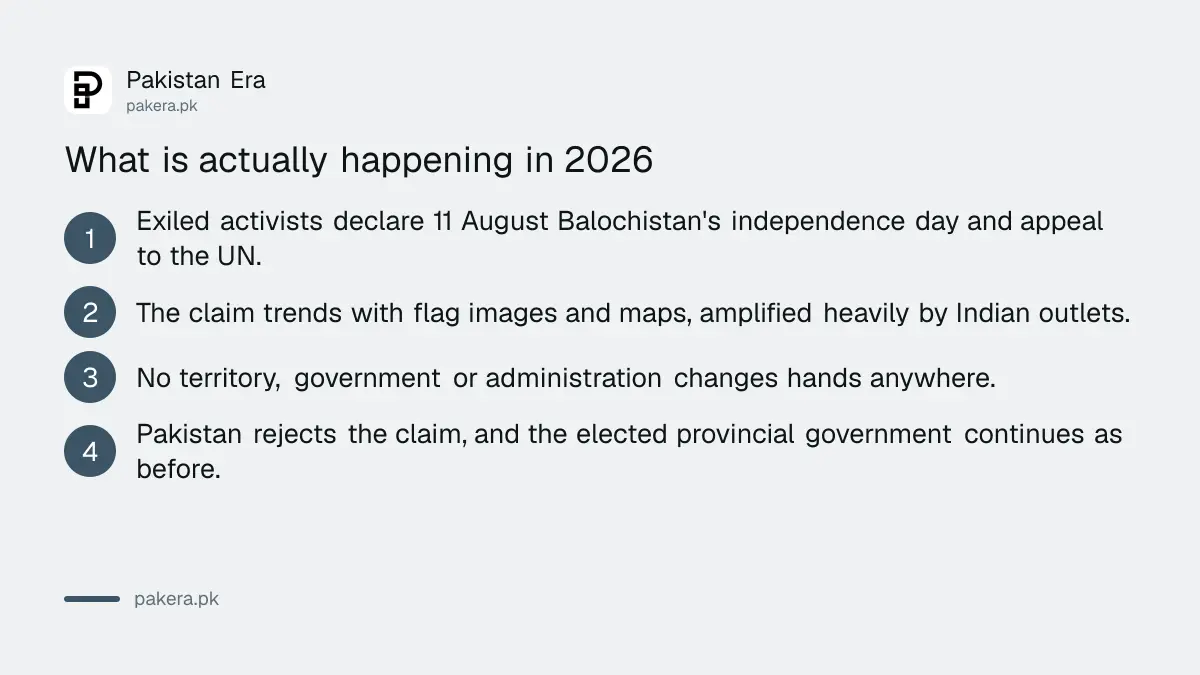
The declaration comes from exiled Baloch activists and self styled representatives, who announced that 11 August would be observed worldwide as the independence day of a "Republic of Balochistan" and appealed to the UN and foreign governments for recognition.
Three factual observations about it, before the history.
First, it is a statement, not an event on the ground. No territory, administration or institution in Balochistan changed hands. The elected provincial government in Quetta continues to sit, and Pakistan rejects the claim entirely.
Second, the people making it hold no governmental office anywhere. Declarations of this kind have been issued before, including a widely circulated one in 2025, and their force is rhetorical.
Third, the amplification is not organic alone. A large share of the coverage pushing the claim comes from Indian outlets, including state linked ones, which is worth knowing when the same screenshots reach your family group. Where a story is loudest tells you something about who benefits from its volume, and we made the same point about unverifiable viral content in the fake satellite imagery piece.
What 11 August 1947 actually was
Here is where it gets more interesting than either side's slogan, because the date is real and so is the argument about it.
Balochistan in 1947 was not one thing. It was British Balochistan, directly administered territory including Quetta, plus princely states, the largest and most senior of which was Kalat, ruled by Khan Mir Ahmad Yar Khan.
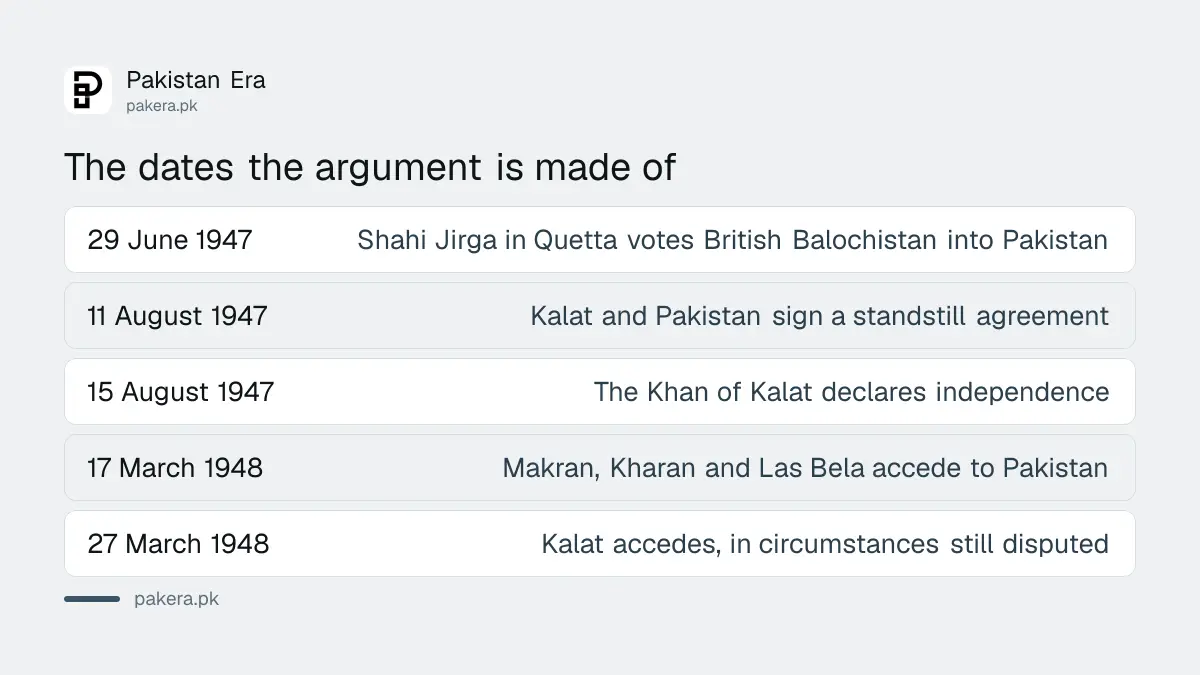
| Date | What happened |
|---|---|
| 29 June 1947 | The Shahi Jirga and Quetta's municipal body vote British Balochistan into Pakistan |
| 11 August 1947 | Kalat and Pakistan sign a standstill agreement, with Kalat's special status recognised while defence, external affairs and communications are deferred |
| 15 August 1947 | The Khan of Kalat declares independence |
| 17 March 1948 | Makran, Kharan and Las Bela, Kalat's feudatory states, accede to Pakistan |
| 26 to 27 March 1948 | The army moves into the coastal region; the Khan signs the instrument of accession |
| 31 March 1948 | Jinnah accepts the accession |
Notice the detail almost every viral post gets wrong: 11 August was not a declaration of independence. It was the standstill agreement, a negotiating document that recognised Kalat's distinct status while the big questions were parked. The declaration came on 15 August, and activists use the 11th at least partly because the 15th is awkward, being the day the rest of British India's transfer completed.
The seven months the whole argument lives in
From August 1947 to March 1948, Kalat existed in a negotiated limbo, and the accession that ended it is the genuinely contested part of this history.
The nationalist reading: Kalat was a sovereign state whose houses of assembly had resisted accession, the feudatory states were peeled away in violation of the standstill agreement, the army's movement into the coastal region on 26 March was coercion, and the Khan's signature the next day was extracted, not offered.
The official reading: the accession was signed by the Khan, accepted by Jinnah, and the Khan's own later account described acceding to Pakistan; British Balochistan had voted its way in democratically through the Shahi Jirga the previous June, and the state that emerged has been Pakistan's largest province ever since.
Both readings are built from real documents and real events, they disagree about meaning rather than mostly about facts, and honest historians still argue them. We are not going to resolve in a blog post what they have not, and anyone online who resolves it in a paragraph is selling you their conclusion, not the history.
Why this trends every August, and harder this year
The mechanics are almost seasonal. The 11th sits three days before the 14th, so the claim rides Pakistan's own independence day traffic, when the words independence and 1947 are already in every feed. Anniversary maths does the rest: each year adds a round number to somebody's banner.
This year's extra volume has identifiable causes: a fresh declaration cycle since 2025, sustained unrest and protest movements in the province giving the date a live context, and the regional information contest, in which Balochistan is one of the standing subjects that outlets across the border push hard. None of that tells you the claim is true or false. It tells you why your feed is full of it in the first week of August.
How to read the next viral post about it
- Check what actually changed. A declaration with no administration, territory or recognition behind it is a press release, whoever issues it.
- Check the date being cited. Posts claiming 11 August 1947 was a declaration of independence have the record wrong by four days, which is a useful reliability test for everything else they claim.
- Check who is amplifying. When one country's state media is the loudest carrier of another country's separatist claim, that is geopolitics, and it should be read as such.
- Expect connectivity noise around the date. Protest anniversaries in Pakistan have repeatedly come with local network restrictions, a pattern we covered in the internet shutdowns piece.
The history deserves better than both the slogan and the dismissal. Sixty million people's province, a genuinely disputed founding episode, and a date that was a treaty rather than a trumpet: that is the story behind the trend, and it is more interesting than the trend.
Questions readers are asking
Did Balochistan declare independence?
Exiled activists issued a declaration and named 11 August as an independence day. No territory or administration changed hands, the provincial government continues to function, and Pakistan rejects the claim. As a matter of ground reality, nothing changed.
What happened on 11 August 1947?
Kalat and Pakistan signed a standstill agreement recognising Kalat's distinct status while deferring defence, external affairs and communications. The Khan's declaration of independence came on 15 August, four days later.
Was all of Balochistan part of Kalat?
No. British Balochistan, including Quetta, voted into Pakistan through the Shahi Jirga on 29 June 1947. Kalat and its feudatory states, Makran, Kharan and Las Bela, were a separate princely question settled in March 1948.
Was Kalat's accession voluntary or forced?
That is the contested heart of this history. The instrument was signed by the Khan and accepted by Jinnah, and his own later account described acceding; nationalists point to the army's movement into the coastal region the day before the signature. Both readings cite real events, and we present both rather than adjudicate.
Why do Indian channels cover this so heavily?
Balochistan is a standing subject in the India and Pakistan information contest, and separatist claims about it receive sustained amplification from Indian outlets including state linked ones. That context is part of reading any viral post on the subject accurately.
Is 11 August a holiday anywhere?
No. It is not observed by any government. Pakistan's independence day is 14 August, and the proximity of the two dates is a large part of why the claim trends when it does.
About the author

Senior Writer, Public Services and Technology
Shahid joined us in 2024 as an author. He is a senior contributor to Pakistan's leading technology websites. He writes detailed articles, mostly covering his expertise in the latest tech, mobiles, apps, gadgets, and step-by-step guides. His ideology is to help people understand the latest trends and explain complex methods through very easy-to-understand guides.