Pakistan Sets Rs 6.8 Billion for Diabetes Screening, PM Says on World Diabetes Day 2026
PM Shehbaz Sharif says Rs 6.8 billion is set for a national diabetes programme. The President says 34.5 million adults have diabetes, a quarter undiagnosed.
یہ صفحہ اردو میں پڑھیں
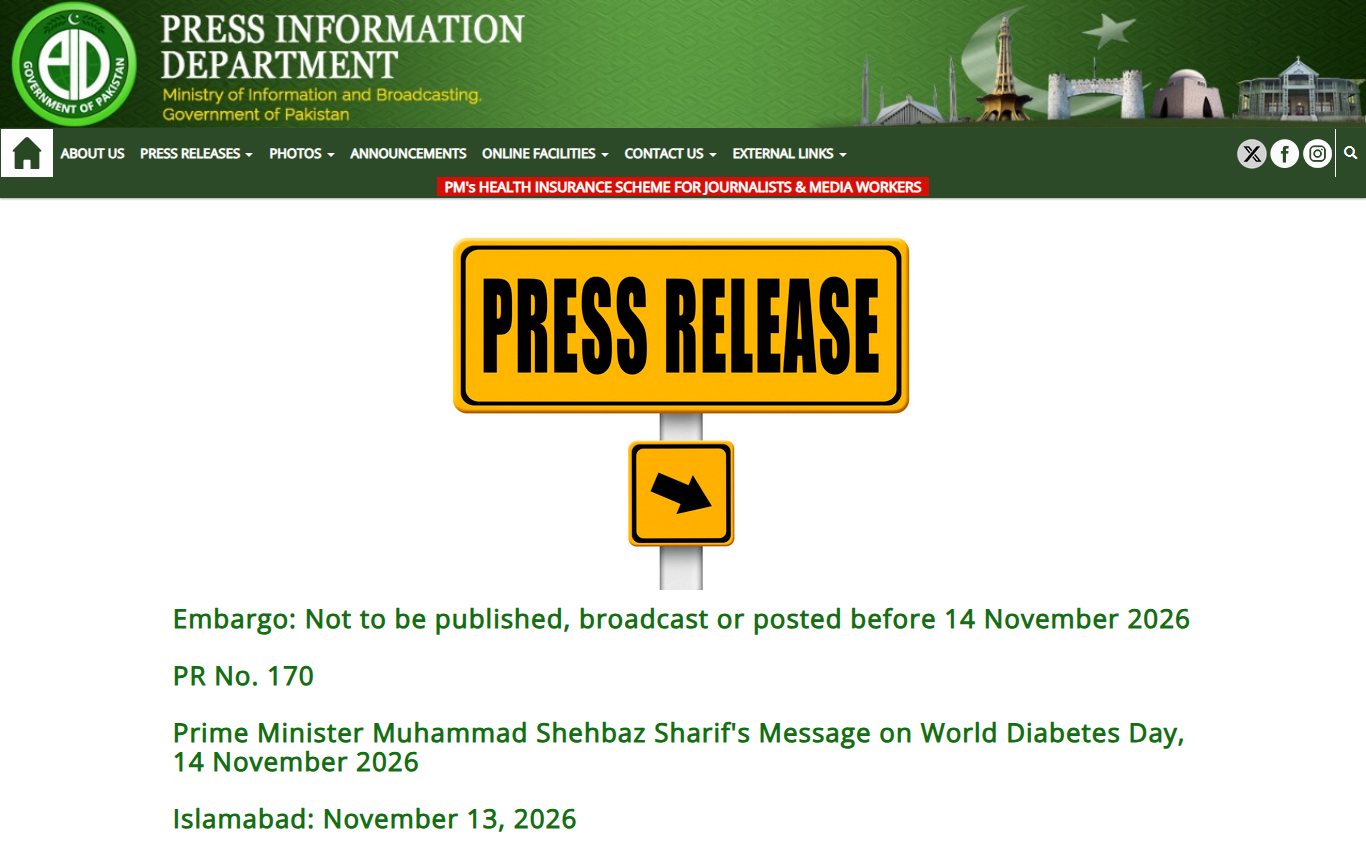
Short answer: Prime Minister Shehbaz Sharif said on World Diabetes Day, 14 November 2026, that the federal government has allocated Rs 6.8 billion to the Prime Minister's Programme for Prevention and Control of Diabetes Mellitus. The money is for wider screening, better primary health care and easier diagnosis and treatment. President Asif Ali Zardari's message the same day said 34.5 million adults in Pakistan had diabetes in 2024, and more than a quarter of them did not know it.
This year's World Diabetes Day theme is "Early Action on Diabetes". Both messages were issued by the Press Information Department on the evening of 13 November for release on 14 November. Below is what each one says, what it means for a family, and the simple checks you can do now without waiting for the programme to reach your area.
The federal government has set aside Rs 6.8 billion for diabetes
The Prime Minister's message says the federal government has allocated Rs 6.8 billion to a national diabetes programme. Its three stated aims are more screening for early detection, stronger primary health care, and better access to diagnosis and treatment across Pakistan.
The message names the scheme as the Prime Minister's Programme for Prevention and Control of Diabetes Mellitus. It also lists healthy lifestyles, public awareness and coordination between the federal and provincial governments as priorities. Health is mostly a provincial subject in Pakistan, so the clinics and hospitals that do the testing are run by the provinces. That is why the message stresses coordination.
The Prime Minister asked citizens to exercise regularly, eat a balanced diet, get regular check-ups and consult qualified doctors. The message did not give a start date, a list of districts or an enrolment route. Until those are announced, there is nothing to register for, and nobody can charge you a fee to "join" the programme.
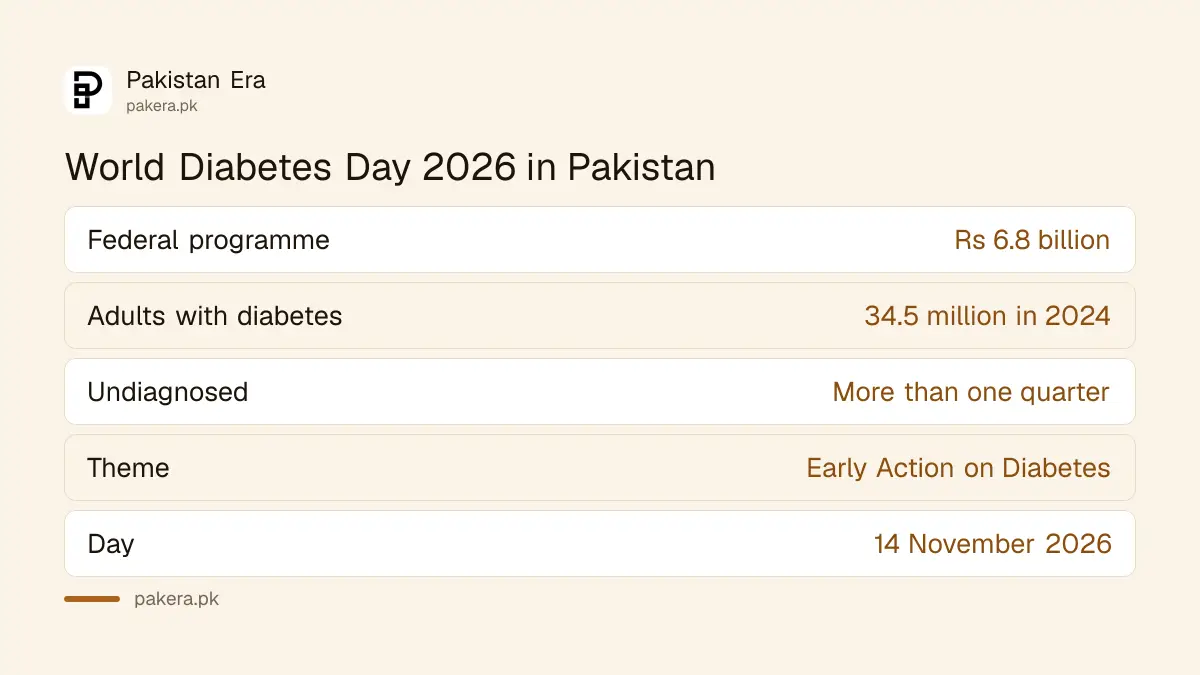
| Item | What the 14 November messages say |
|---|---|
| Programme | Prime Minister's Programme for Prevention and Control of Diabetes Mellitus |
| Federal allocation | Rs 6.8 billion |
| Aims | Screening for early detection, primary health care, diagnosis and treatment |
| Adults with diabetes in Pakistan | 34.5 million in 2024, International Diabetes Federation estimate |
| Undiagnosed | More than one quarter |
| 2026 theme | Early Action on Diabetes |
The President says 34.5 million Pakistani adults have diabetes
President Zardari's message quotes the International Diabetes Federation (IDF), which estimates that 34.5 million adults in Pakistan were living with diabetes in 2024. More than one in four of them had not been diagnosed, so they did not know they had it.
By our own sum, a quarter of 34.5 million is more than 8.6 million adults. That is roughly the population of a large city living with high blood sugar and no treatment. Type 2 diabetes often shows mild signs or none for years, which is how so many people miss it.
The President called for awareness campaigns in Urdu and regional languages, run by the federal and provincial governments, doctors, schools, the media and civil society. He asked for screening and prevention through Lady Health Workers, basic health units and community groups. He also called for affordable treatment and care after diagnosis, and for policies on healthy, affordable food, better school meals, safe drinking water and safe places to walk.
Early action means a blood test before symptoms start
"Early Action on Diabetes" means finding high blood sugar before it damages the eyes, kidneys, heart or feet. In practice that is a simple blood glucose test, which most labs and many government clinics offer, followed by a doctor's advice if the result is high.
The World Health Organization lists four tests that diagnose diabetes: a fasting blood glucose test, a two hour glucose tolerance test, an HbA1c test and a random blood glucose test when symptoms are present. WHO says a fasting result of 126 mg/dl or above, or an HbA1c of 6.5 per cent or above, points to diabetes. If you have no symptoms, WHO advises repeating the test on another day to confirm it.
The signs to watch are thirst, passing urine often, blurred vision, tiredness and weight loss you did not plan. Our guide to spotting type 2 diabetes early explains each one and the damage untreated diabetes can do.
Four things to do this week
You do not need to wait for the federal programme. A test, a doctor's reading of the result and a few habits make the biggest difference. These four steps take little time and money, and they work whether or not the new programme has reached your district yet.
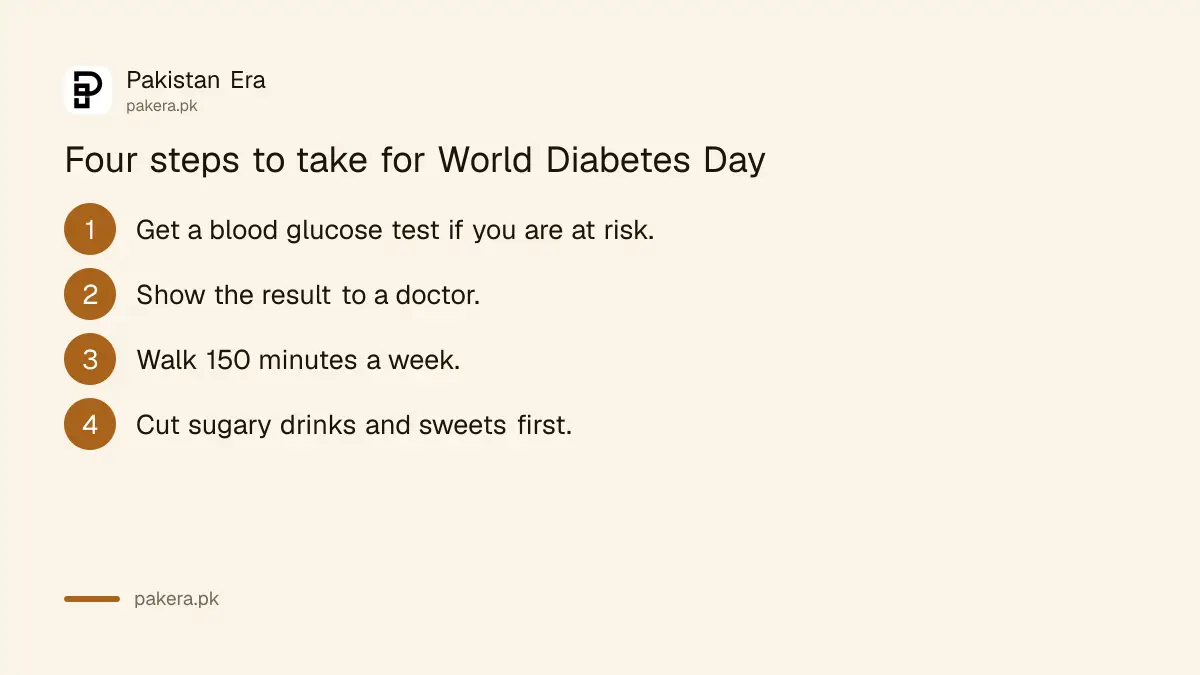
- Get a blood glucose test if you are over 40, overweight, or have a parent or sibling with diabetes. A fasting test means no food for at least eight hours before it.
- Show the result to a doctor. Do not diagnose yourself from a lab printout. A high reading with no symptoms needs a second test on another day.
- Walk for 30 minutes on five days a week. WHO's target is 150 minutes of moderate activity a week.
- Cut sugary drinks and sweets first. They are the easiest change and among the most useful.
Free diabetes care already exists in some provinces
Some free care is already running through provincial programmes. Punjab runs non-communicable disease clinics and an insulin card scheme, and government hospitals in every province treat diabetes patients in their medicine departments. Start with your nearest government hospital or basic health unit.
Our guide to free diabetes care in Punjab lists the clinics and the insulin card. In Khyber Pakhtunkhwa, the Sehat Card Plus pays for hospital admission, not routine outpatient visits; see how to check Sehat Card Plus eligibility. For what the federal and Punjab health cards now pay for, see what the Sehat Card covers now.
If you buy insulin or tablets yourself, check the price printed on the pack against DRAP's list before you pay. Our guide to checking a medicine price with DRAP shows how.
What to watch for next
The key details still to come are where screening will happen, who runs it in each province and when it starts. Watch the federal health ministry and your provincial health department for those announcements, and ignore any message asking for money to register.
Fake scheme messages often follow a government announcement. A real health screening camp does not ask you to pay to be listed, and it does not ask for your CNIC over WhatsApp. If a message promises free insulin or cash in return for a fee, do not reply.
We will update this page when the programme's rollout is announced.
Common questions
How much has the government set aside for diabetes?
The Prime Minister's World Diabetes Day message says the federal government has allocated Rs 6.8 billion to the Prime Minister's Programme for Prevention and Control of Diabetes Mellitus.
How many people in Pakistan have diabetes?
The President's message quotes the International Diabetes Federation: 34.5 million adults in 2024, with more than a quarter undiagnosed.
Do I need to register for the diabetes programme?
No route has been announced. Nobody can enrol you for a fee. Ignore messages that ask for money or your CNIC to join.
What is the theme of World Diabetes Day 2026?
The theme is "Early Action on Diabetes", which both messages link to timely screening and treatment.
What blood sugar level means diabetes?
WHO says a fasting blood glucose of 126 mg/dl or above, an HbA1c of 6.5 per cent or above, or a two hour glucose test of 200 mg/dl or above points to diabetes. A doctor must confirm it.
How we verified this
What we checked and where we read it.
We read both messages on the Press Information Department site on 14 November 2026: the Prime Minister's World Diabetes Day message, PR No. 170, and the President's World Diabetes Day message, PR No. 167, both dated 13 November 2026 and embargoed until 14 November. Test thresholds are from the World Health Organization's Classification of Diabetes Mellitus 2019.
About the author

Public Services and Education Journalist
Fajr Riaz is a journalist and content writer at Pakistan Era, based in Lahore. She covers the questions people meet in everyday life in Pakistan: how a public service works, what a change in the rules means, and where to find a reliable answer.