Petrol Price Goes Up to Rs 333 Today, Diesel Comes Down
Petrol is up Rs 4.45 to Rs 333.01 and diesel down Rs 2 to Rs 383.86 from today. It is the third price change in three days.
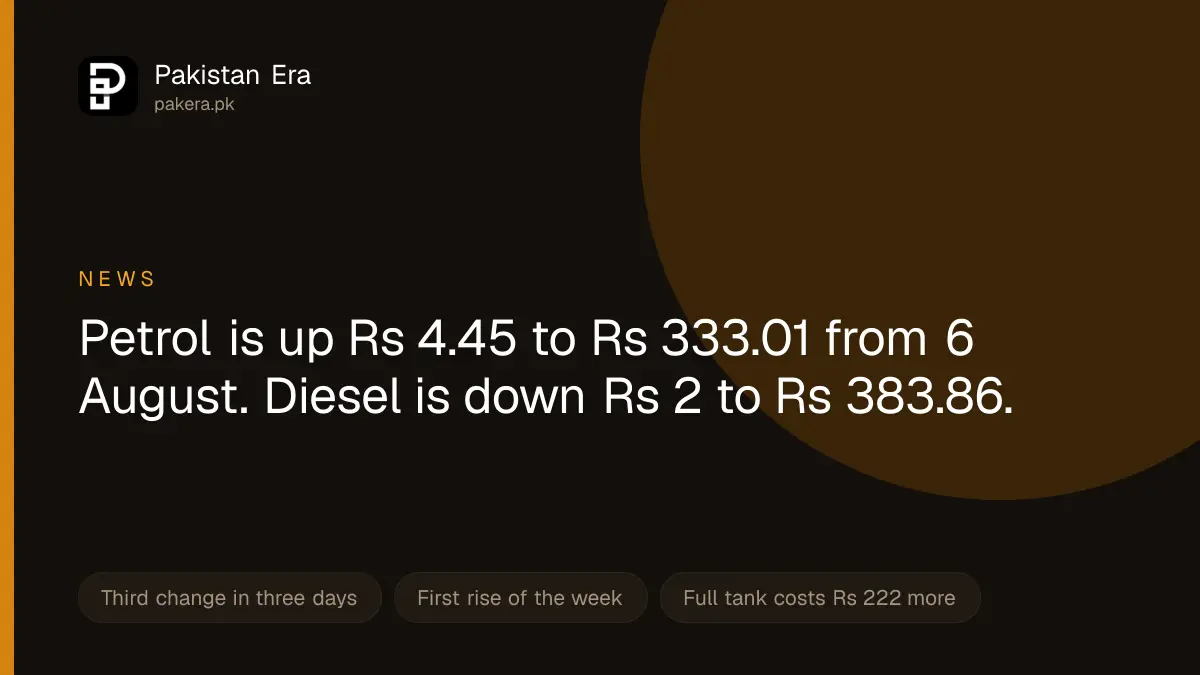
Petrol has gone up Rs 4.45 to Rs 333.01 a litre from today, 6 August 2026.
Diesel went the other way. High speed diesel is down Rs 2.00 to Rs 383.86.
Both changes are in the same notification, on the same day. That is not a mistake, and this article explains why it happens now and did not before.
Today's prices
| Fuel | New price | Change |
|---|---|---|
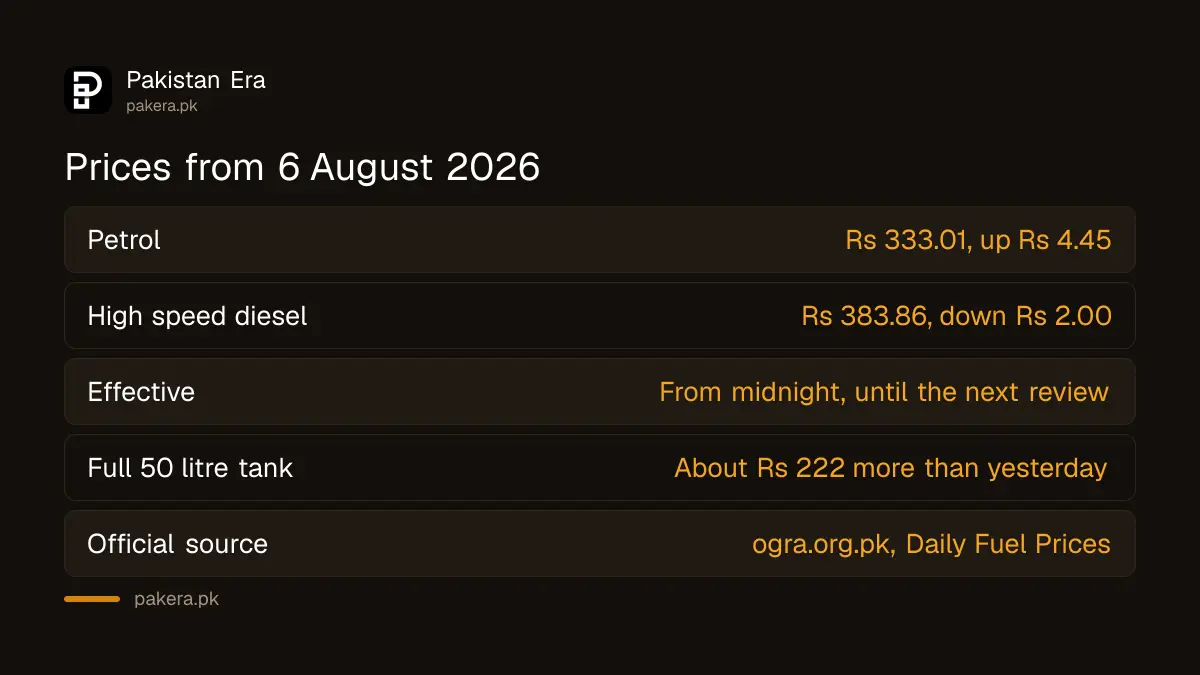
| Petrol | Rs 333.01 | Up Rs 4.45 |
| High speed diesel | Rs 383.86 | Down Rs 2.00 |
The prices took effect from midnight and hold until the next review.
One note on the figure. Some outlets reported petrol at Rs 333.10. Yesterday's rate was Rs 328.56, and Rs 328.56 plus the announced Rs 4.45 is Rs 333.01. So we have used that.
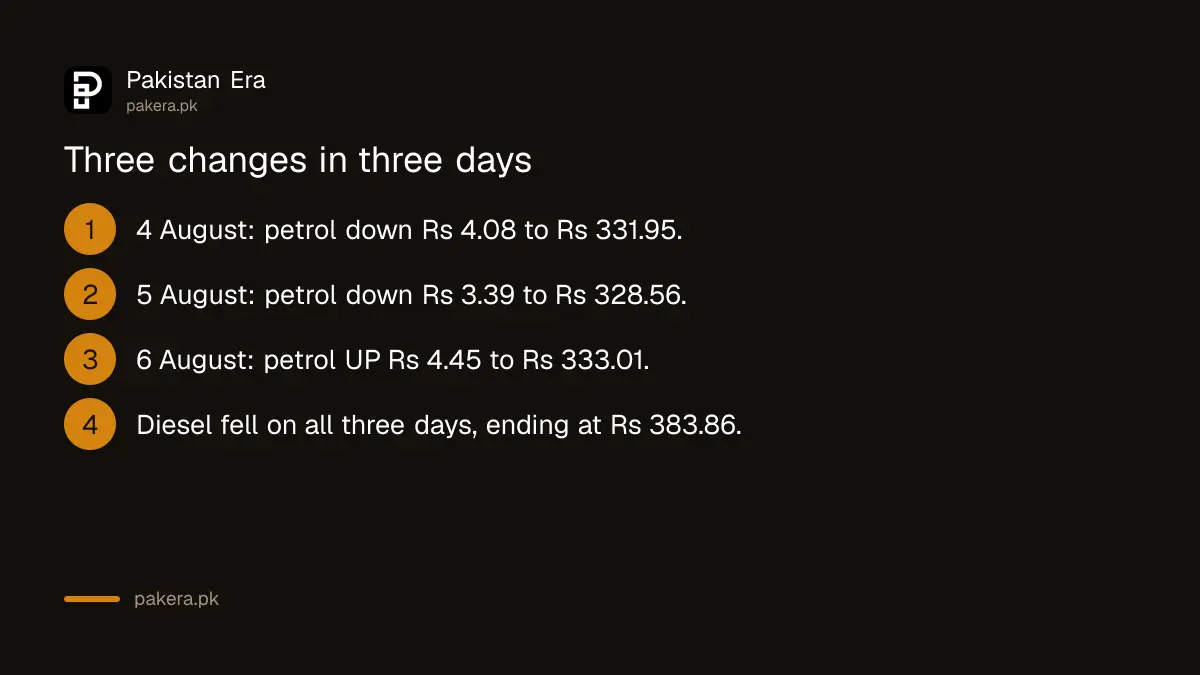
This is the third change in three days
Look at the week so far.
| Date | Petrol | Diesel |
|---|---|---|
| 4 August | Down Rs 4.08 to Rs 331.95 | Down Rs 2.45 to Rs 389.93 |
| 5 August | Down Rs 3.39 to Rs 328.56 | Down Rs 4.07 to Rs 385.86 |
| 6 August | Up Rs 4.45 to Rs 333.01 | Down Rs 2.00 to Rs 383.86 |
Three days, three price changes. That is the new normal, and today is the first rise in the run.
Why the price now changes every day
This is the part worth knowing, and it was decided at the top.
The Petroleum Minister said the cabinet and the Prime Minister decided to give OGRA the job of setting fuel prices every day, in line with global trends. The reason given was volatility in international oil markets.
So the daily system is not a technical tweak by the regulator. It was a political decision to stop setting prices on a fixed date and let them follow the market as it moves.
Before this, prices changed on the 1st and the 16th of each month. Now they can change any working day. We set out how the whole system works, including the weekend rule and where OGRA publishes the official number, in the guide to daily fuel pricing.
Why petrol rose while diesel fell
Petrol and diesel are different products with different world prices. They are refined differently, shipped differently and taxed differently.
Global demand for the two also moves apart. Diesel follows freight, farming and industry. Petrol follows private cars. When those pull in different directions, the two prices can move in different directions in the same week.
Under the old fortnightly system this was hidden. Two weeks of movement got averaged into one announcement, so both usually moved the same way. Daily pricing shows the split that was always there.
What this means for you
- A full 50 litre tank costs about Rs 222 more than yesterday. That is the whole practical effect of today's rise for a car owner.
- Diesel falling is the better news, even if you drive a petrol car. Diesel moves trucks, tractors and buses, so it feeds food and transport costs.
- There is no date to fill up before. Queueing ahead of an announcement does not work when there is no announcement.
- Check before you assume. Any price you read, including this one, is only right for the day it was published.
Who this hurts most
A rise of Rs 4.45 is a small number on its own. It does not land evenly.
For a household with one car, it is a few hundred rupees a month. Annoying, not serious.
For anyone who drives for a living, it is different. A ride hailing driver, a delivery rider or a small haulier buys fuel every day and cannot change the fare they already quoted. When the price moves daily, the cost moves daily but the fare does not. That gap comes out of their own earnings.
This is the part of daily pricing that gets least attention. Households get smaller, gentler changes. People who price their work in advance lose the ability to plan, and there is no mechanism that compensates them for it.
Where to see the official price
OGRA publishes it. The regulator's site is ogra.org.pk, and it now has a Daily Fuel Prices section.
Be careful with the address. There is a site on ogra.com.pk that ranks well in search and is not the regulator. The real one ends in .org.pk. If you are checking a price to act on, check the domain first.
Why diesel is still Rs 50 dearer than petrol
Rs 383.86 against Rs 333.01 is a gap of about Rs 51 a litre. The gap is not about the fuel itself. It is tax.
Diesel carries a heavier levy, and it has for years, because freight, farming and public transport cannot easily stop buying it. That makes it a reliable source of government revenue.
It also means diesel prices reach your grocery bill even if you never buy diesel. Petrol changes affect people who buy petrol. Diesel changes affect the cost of moving vegetables to your market.
Questions readers are asking
What is the petrol price in Pakistan today?
Rs 333.01 a litre from 6 August 2026, up Rs 4.45. High speed diesel is Rs 383.86, down Rs 2.00.
Why did petrol go up and diesel go down on the same day?
They are different products with different world prices and different demand. Daily pricing shows that split, which the old fortnightly average used to hide.
Who decided to change prices daily?
The Petroleum Minister said the cabinet and the Prime Minister assigned OGRA the task of setting prices each day in line with global trends, because of volatility in international oil markets.
How much more does a full tank cost?
About Rs 222 more for 50 litres, compared with yesterday.
How long will these prices last?
Until the next review. Prices can change on any working day, and a price notified on a Friday holds through Saturday and Sunday.
Where can I check the official rate?
On ogra.org.pk, under Daily Fuel Prices. Note that ogra.com.pk is a different site and is not the regulator.
About the author

Tax, Bills and Technology Writer
Ali Akhtar is a young and curious voice here at Pakistan Era. He is currently pursuing his A-Levels and has a growing interest in Pakistan’s changing industrial landscape and educational trends. Ali likes to write in a way that helps him explain and explore the world around him. His writing reflects the perspective of the new generation navigating the evolving trends of Pakistan where technology, youth innovation, and shifting opportunities are reshaping the country’s future.