Vision Pakistan 2047: The $3 Trillion Target Explained
The government launches Vision Pakistan 2047 on 12 August. What it targets, and what happened to the last plan that promised 8 per cent growth.
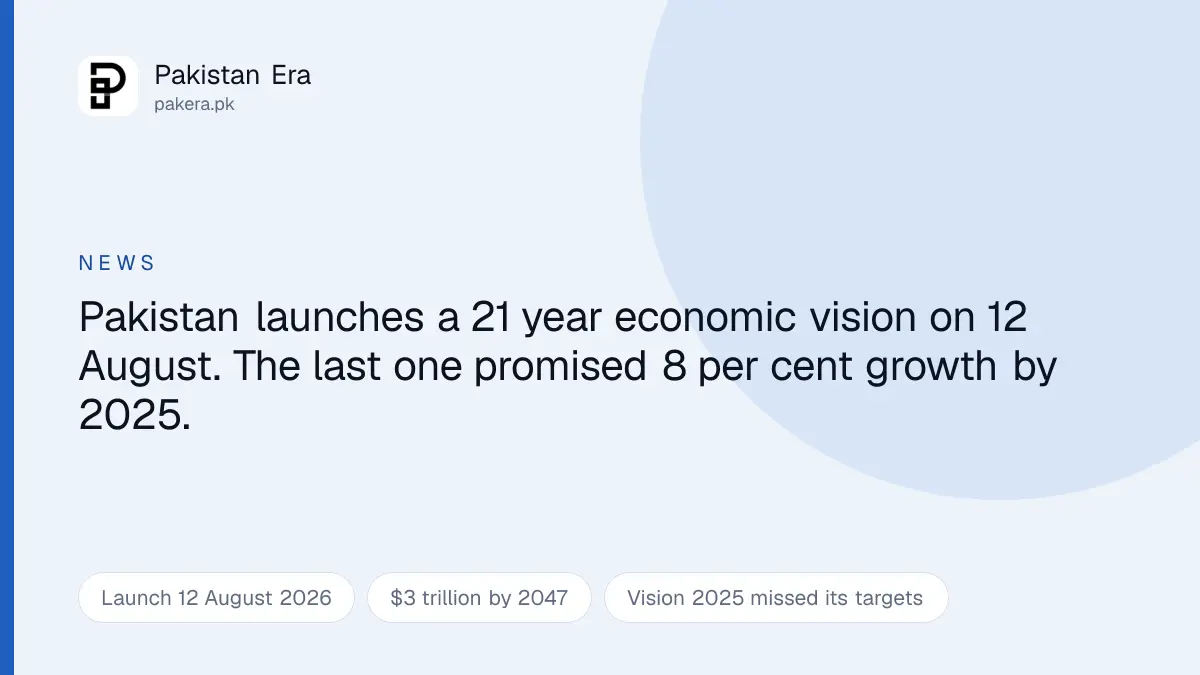
The government plans to launch Vision Pakistan 2047 on 12 August 2026, International Youth Day. The Prime Minister is expected to unveil it. It sets national targets out to 2047, the centenary year, and the headline figure being reported is a $3 trillion economy on 9 per cent annual growth.
Before anything else, be clear what this is. It is an announced launch, not a published document. Nothing has been notified, nothing has been legislated, and the plan itself is not yet public. We are writing this ahead of the launch so you know what to look for on the day.
There is one piece of context that matters more than any target in the document, and it is that Pakistan has done this before.
Vision 2025 promised 8 per cent growth. Pakistan got 3.7.
Pakistan Vision 2025 was published by the Planning Commission and aimed to make Pakistan an upper middle income country by 2025. It targeted 8 per cent annual GDP growth and entry into the world's 25 largest economies.
| Vision 2025 promised | What happened |
|---|---|
| 8 per cent GDP growth a year | 3.7 per cent recorded in FY2025-26 |
| Upper middle income status | Not achieved |
| Top 25 economy | 40th largest in 2025, per the IMF |
| Doubled per capita income | Not achieved |
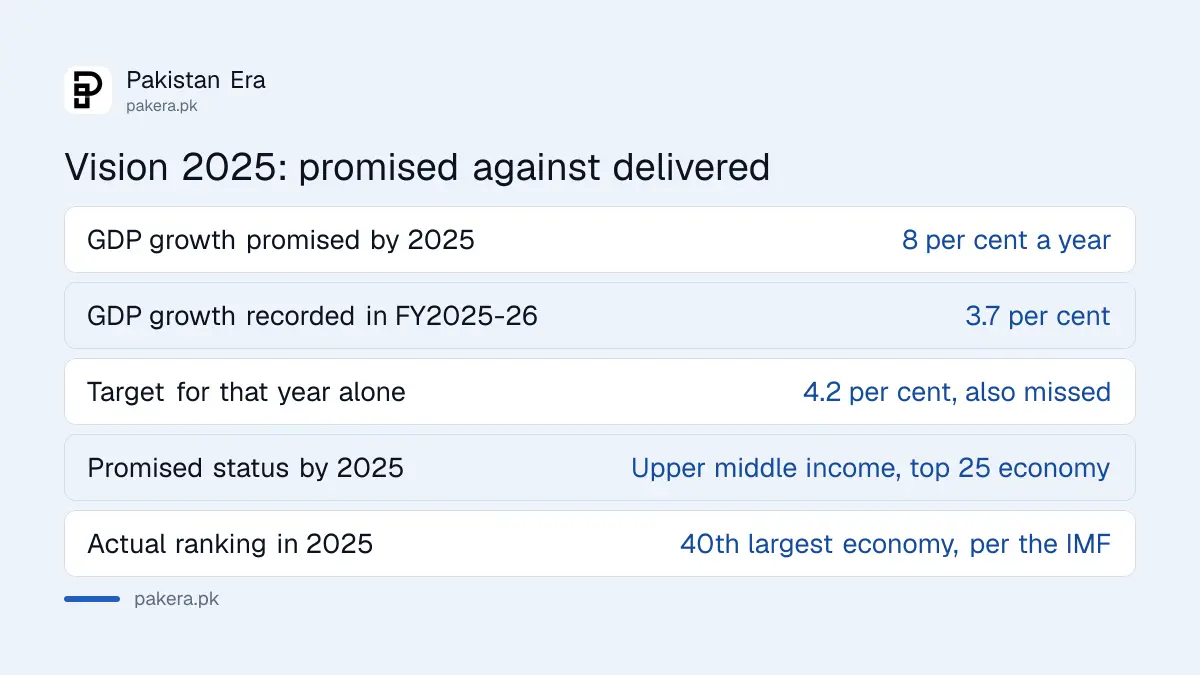
Even the modest annual target was missed. The government aimed for 4.2 per cent growth in FY2025-26 and recorded 3.7 per cent.
We are not saying this to be cynical. We are saying it because a 21 year target published in 2026 asks you to believe something about 2047, and the only evidence available for judging that is what happened to the last one.
Why Vision 2025 fell short
The reasons are not mysterious, and several were outside anyone's control.
- Funding. Public sector investment fell to 3.1 per cent of GDP. Private sector investment reached 9.6 per cent. Investment to GDP sat at 14.4 per cent and savings at 14 per cent, which is a thin base to grow from.
- Political instability across the period, with repeated changes of government and priorities.
- Institutional capacity, meaning the machinery to actually deliver what was written down.
- Shocks. The floods of August and September 2025, and a regional conflict in March 2026.
The first three are the ones to watch, because they are the ones a new plan can address. A vision document that does not change funding, stability or delivery capacity is a list of numbers.
What has actually been announced so far
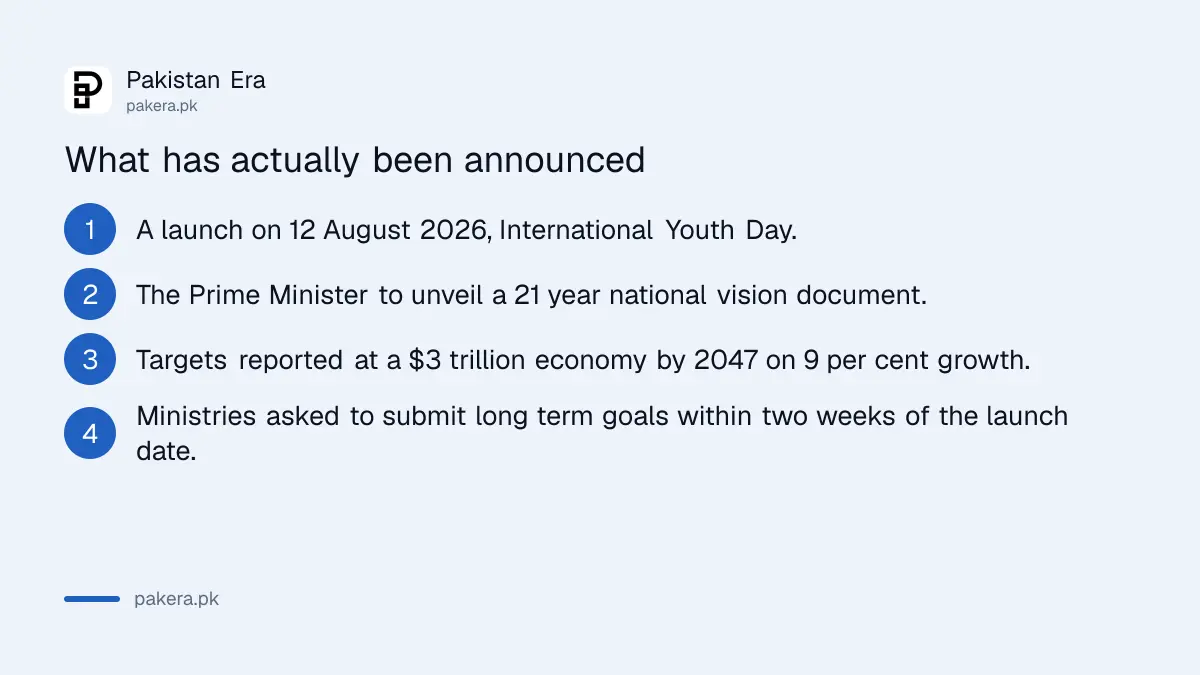
- A launch date of 12 August 2026, chosen to fall on International Youth Day and two days before Independence Day.
- A 21 year horizon, running to Pakistan's centenary in 2047.
- A focus on youth as the driver of growth, innovation and human capital.
- Reported targets of a $3 trillion economy by 2047, supported by around 9 per cent growth.
- A two week window in which ministries and divisions were asked to submit their long term goals, flagship reforms and commitments.
That last point has drawn comment, and fairly. Asking every ministry to produce its twenty year commitments inside two weeks tells you something about how much of the document is being assembled shortly before it is presented.
Four questions to ask on 12 August
When the document appears, these are the tests that separate a plan from an aspiration.
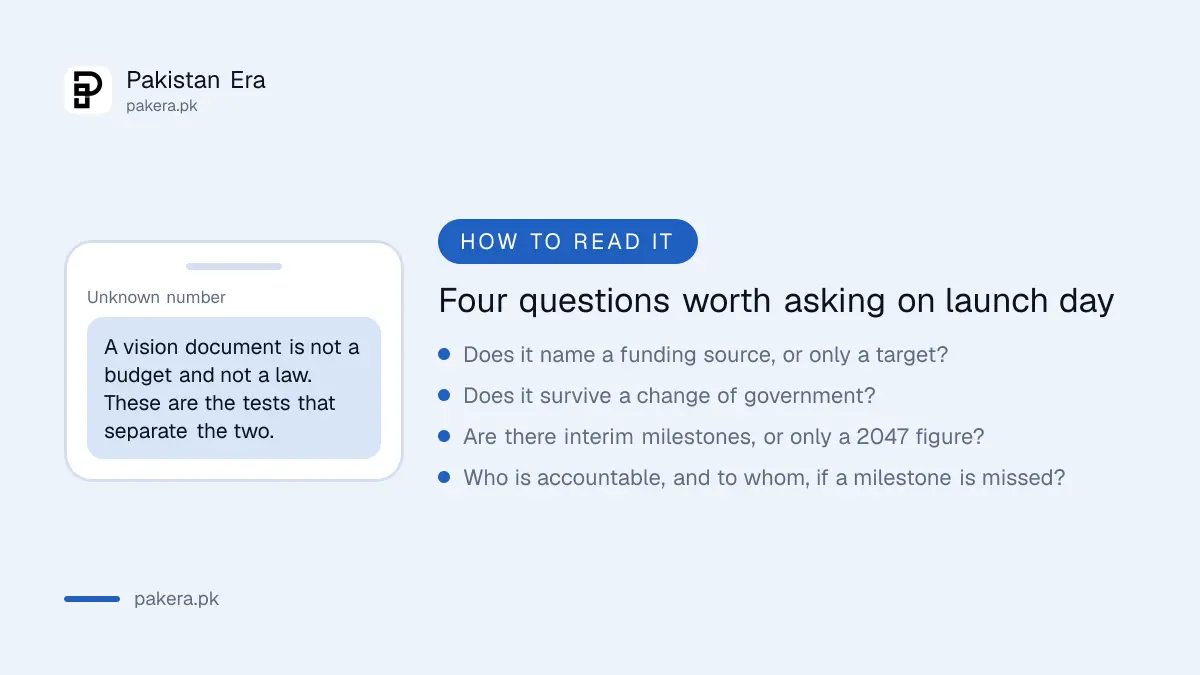
- Does it name a funding source? A growth target without a financing plan is a wish. Vision 2025 had targets and Pakistan's investment rate never rose to support them.
- Does it survive a change of government? Pakistan's planning documents have historically been abandoned by successors. Cross party buy in is the difference.
- Are there interim milestones? A single 2047 number cannot be held to account by anyone alive in the current parliament. Five year checkpoints can.
- Who is accountable? Named institutions with reporting duties, or nobody.
What it means for you
Honestly, in the short term, very little. Vision documents do not change tax rates, tariffs or prices on the day they are published. The things that will affect your household in the next twelve months are the ones already notified, and those are usually less dramatic and more specific.
Electricity is the clearest example. The relief sitting in bills right now ends this month, which changes what households pay in September, and we set out the arithmetic in the piece on the Rs 1.9857 discount ending. That is a real, dated, notified change. A 2047 target is not the same kind of thing, and it is worth keeping the two apart.
The industrial policy under preparation is closer to the middle of that range, with tariff changes that would take effect on a defined schedule, and we covered what is proposed in the piece on the industrial policy and tariff cuts.
Questions readers are asking
What is Vision Pakistan 2047?
A 21 year national planning document the government intends to launch on 12 August 2026, setting targets for development, economic transformation and human capital to Pakistan's centenary in 2047.
When is Vision Pakistan 2047 being launched?
12 August 2026, International Youth Day. The Prime Minister is expected to unveil it. The document itself has not been published yet.
What is the $3 trillion target?
Existing projections carried by the Planning Commission put Pakistan at a $3 trillion economy by 2047 on a 9 per cent growth rate. Whether the launched document adopts that figure will only be clear when it is published.
Did Pakistan Vision 2025 succeed?
No. It targeted 8 per cent annual growth and upper middle income status by 2025. Growth was recorded at 3.7 per cent in FY2025-26 and Pakistan was the 40th largest economy in 2025 according to the IMF.
Is Vision 2047 a law?
No. A vision document sets targets. It is not legislation, it is not a notified policy, and it does not by itself change any rule, rate or price.
Will this change taxes or bills?
Not on its own and not immediately. Changes to what you pay come through budgets, notifications and regulator determinations, not through a planning document.
About the author

Tax, Bills and Technology Writer
Ali Akhtar is a young and curious voice here at Pakistan Era. He is currently pursuing his A-Levels and has a growing interest in Pakistan’s changing industrial landscape and educational trends. Ali likes to write in a way that helps him explain and explore the world around him. His writing reflects the perspective of the new generation navigating the evolving trends of Pakistan where technology, youth innovation, and shifting opportunities are reshaping the country’s future.