Pakistan to Cut Import Taxes to Half by 2030
Average tariffs fall from 20.19 per cent to 9.7 per cent by 2030, and the World Bank models exports rising 10 to 14 per cent.
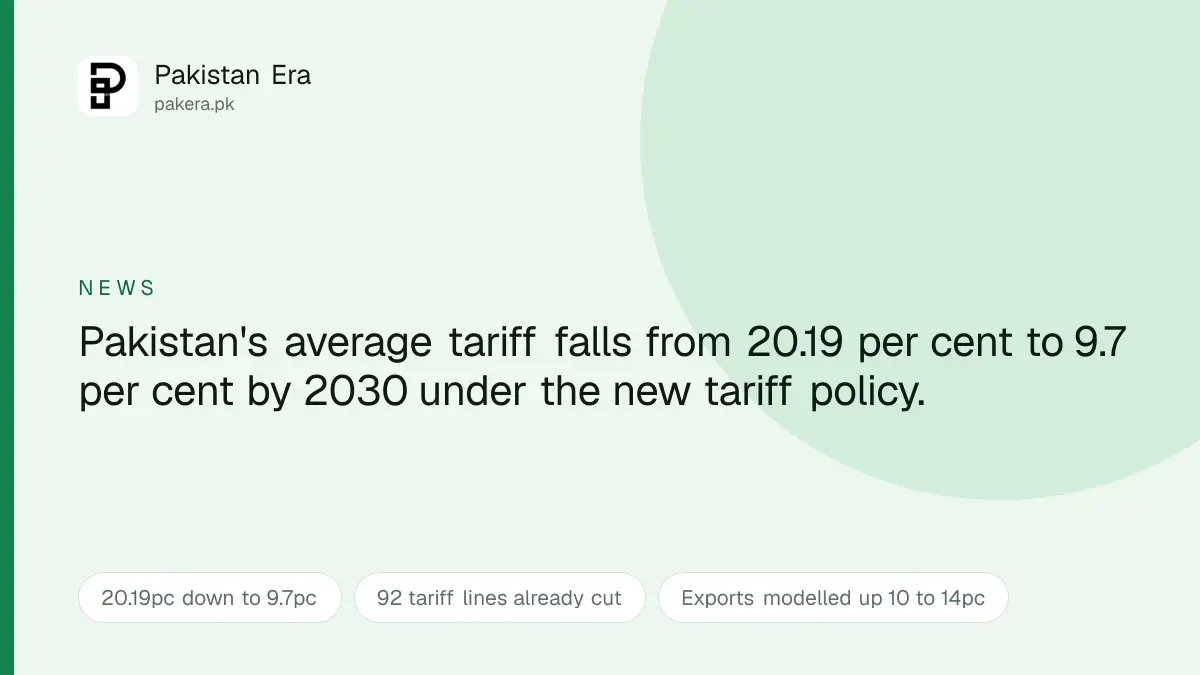
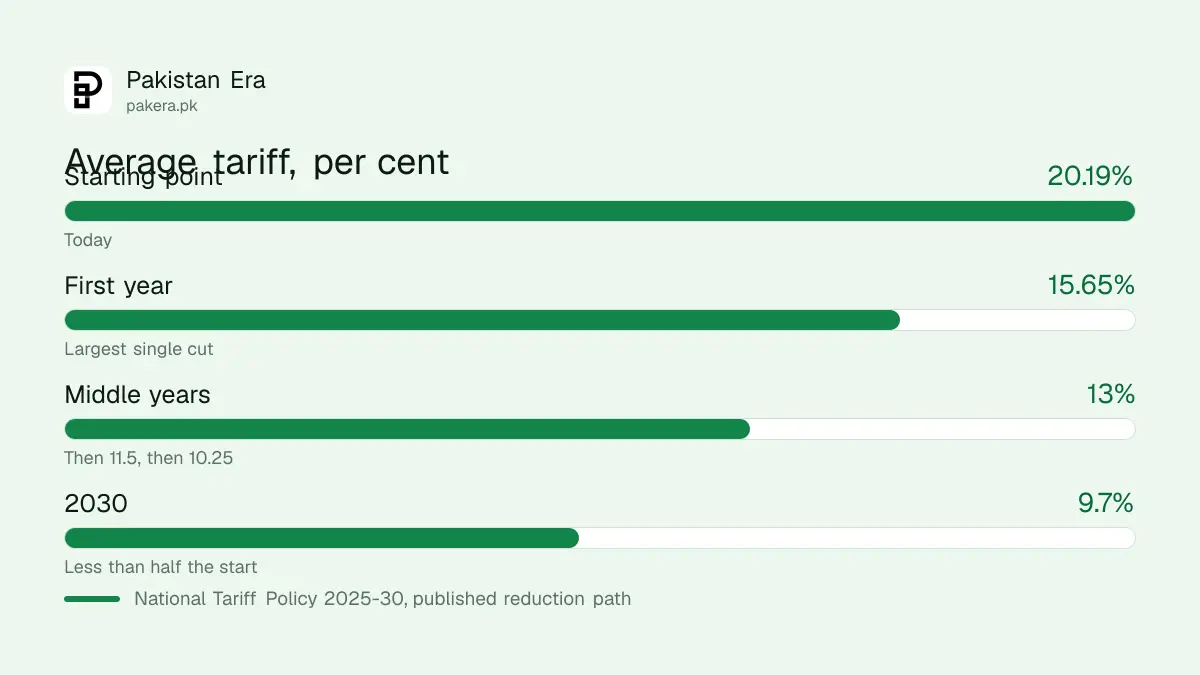
Pakistan is cutting its average tariff from 20.19 per cent to 9.7 per cent by 2030. That is less than half, over five years. It is the biggest change to how Pakistan taxes imports in many years.
A new industrial policy is being finalised on top of it, aimed at exports and at investment from China, Türkiye and Central Asia, and announced by the Special Assistant to the Prime Minister on Industries and Production, Haroon Akhtar.
The plan is to make Pakistan a place that builds things and sells them abroad. It wants simpler rules, lower import taxes and stronger factories. Whether it happens depends on a fight that has already stopped one policy this year.
Tariffs drop from 20.19% to 9.7%
This is the part with actual numbers, from the National Tariff Policy 2025-30.
| Stage | Average tariff |
|---|---|
| Starting point | 20.19 per cent |
| First year | 15.65 per cent |
| Then | 13 per cent |
| Then | 11.5 per cent |
| Then | 10.25 per cent |
| 2030 | 9.7 per cent |
Alongside the headline average, the plan phases out additional customs duties and regulatory duties, which are the layers stacked on top of the basic rate and are usually where the real protection sits. In the 2026-27 budget, customs duties were already reduced on 92 tariff lines covering industrial input goods.
Exports could rise 10 to 14 per cent
Commerce officials cite World Bank modelling that exports could rise 10 to 14 per cent and imports 5 to 6 per cent if the policy is fully implemented.
Read the second number too. Lower taxes raise imports as well. The plan only works if exports grow faster than imports. On these numbers they do, but not by much, and only if the policy is carried out in full. Full is the hard part.
High import taxes make our own exports costly
The logic is not obvious unless you have watched Pakistani manufacturing up close, so it is worth setting out.
A high tariff on an imported input is a tax on your own exporter. A firm making shirts for export pays more for imported dye, buttons, machinery and spare parts than a competitor in Bangladesh or Vietnam does, and then has to sell the shirt at a world price. So a rule meant to protect local industry ends up taxing the factories that earn dollars.
That is the case for cutting input tariffs, and it is why the reductions have targeted industrial inputs rather than finished consumer goods.
It also explains the urgency. We set out the position in the piece on record remittances: Pakistan earned $41.6 billion from its people abroad against projected exports of $32.9 billion. An economy where transfers exceed everything the country sells has a production problem, not a marketing one.
Two ministries disagree, and that is the delay
Here is the reason to treat the timetable with caution rather than take it at face value.
The Auto Policy 2026-31 has been finalised, sent to the Prime Minister's Office and left unpublished for months, and one of the three reasons is precisely this argument. The Ministry of Industries has been weighing a large tariff cut paired with a high federal excise duty, which lowers the headline number while keeping effective protection roughly where it was. Commerce has been holding to the National Tariff Policy's commitments.
We went through that standoff in the piece on the Auto Policy delay. The same two ministries, the same disagreement, now applied across the whole industrial base rather than one sector.
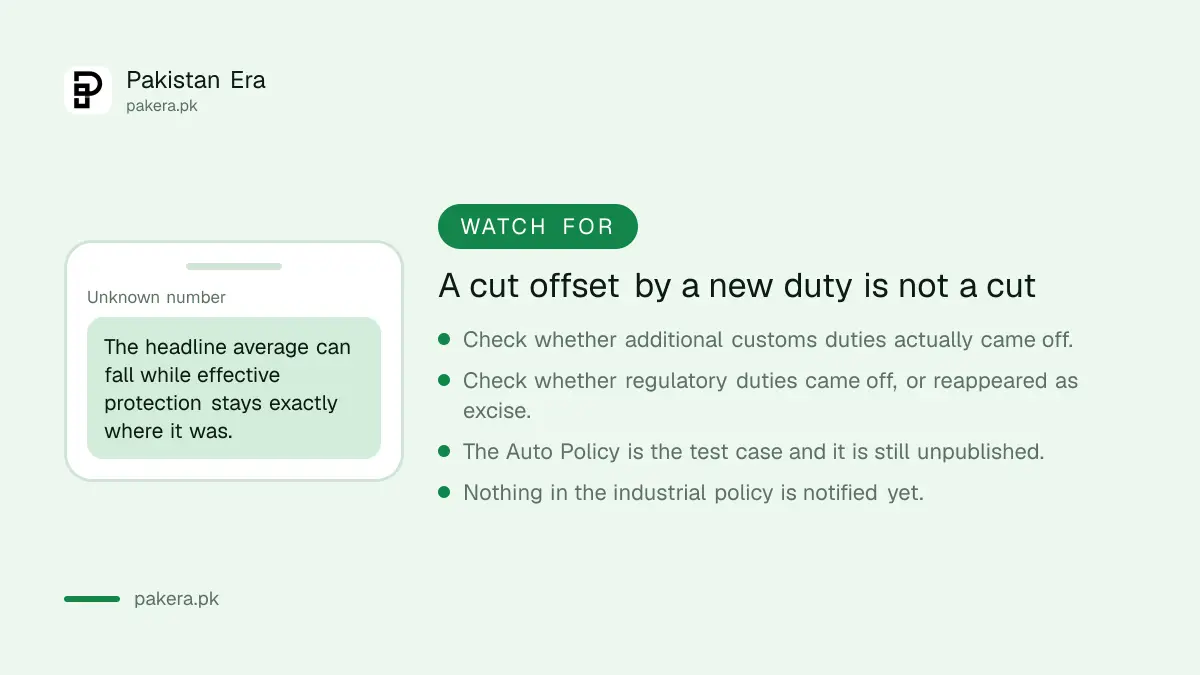
A headline tariff cut offset by a new duty is not liberalisation. It is the same protection wearing a different label, and it would still be reported as a reduction. When the industrial policy is published, that is the thing to look for: not the average tariff, but whether additional and regulatory duties genuinely came off, or reappeared under another name.
Some factories and some tax money will be lost
Tariff liberalisation has losers and pretending otherwise is how these policies get reversed halfway through.
Industries built behind protection face cheaper imported competition. Some will modernise, some will shrink, and the jobs in the ones that shrink are real jobs held by real people, usually before any export gains arrive. The pain comes first and it lands in one town. The benefit comes later and is spread thin.
Government revenue is the other loser. Customs duties are a significant collection line precisely because they are easy to collect at a port, and cutting them puts more weight on income and sales tax at a time when FBR collection is already under pressure.
Neither point is an argument against the policy. They are the reasons it has been attempted and abandoned before.
Four things to watch
- Publication of the actual industrial policy text. It is being finalised, not notified, and nothing in it is in force.
- Whether additional and regulatory duties actually fall, or are replaced by excise.
- The Auto Policy, which is the test case. If that one resolves toward Commerce, the industrial policy has a chance. If it resolves toward protection, expect the same everywhere.
- Export numbers against the 10 to 14 per cent claim, measured a year after implementation rather than at announcement.
The honest summary: the direction is right, the arithmetic is published, and the obstacle is not economics but which ministry wins. That has not been settled, and until it is, this is a plan rather than a policy.
Questions readers are asking
What is Pakistan's new industrial policy?
A policy being finalised by the government, announced by SAPM on Industries and Production Haroon Akhtar, aimed at boosting exports and attracting investment from China, Türkiye and Central Asia through simpler regulation, tariff rationalisation and improved industrial competitiveness. It has not been notified.
How much are tariffs being cut?
Under the National Tariff Policy 2025-30 the average tariff falls from 20.19 per cent to 9.7 per cent by 2030, passing through 15.65, 13, 11.5 and 10.25 per cent along the way, with additional customs duties and regulatory duties phased out.
Will this make imported goods cheaper?
The cuts have been targeted at industrial input goods rather than finished consumer products, including 92 tariff lines in the 2026-27 budget. Consumer prices are not the primary aim.
What effect is expected on exports?
Commerce officials cite World Bank modelling of exports rising 10 to 14 per cent and imports 5 to 6 per cent, conditional on full implementation.
Why do lower tariffs help exporters?
Because tariffs on imported inputs are a cost to the exporter using them. A manufacturer paying more for dye, machinery and spare parts than a foreign competitor still has to sell at a world price.
Is any of this in force?
The tariff reductions in the budget are. The industrial policy itself is being finalised and has not been published, so treat its contents as reported rather than settled.
About the author

Senior Writer, Public Services and Technology
Shahid joined us in 2024 as an author. He is a senior contributor to Pakistan's leading technology websites. He writes detailed articles, mostly covering his expertise in the latest tech, mobiles, apps, gadgets, and step-by-step guides. His ideology is to help people understand the latest trends and explain complex methods through very easy-to-understand guides.