Pakistan Reports 112,030 Suspected Diarrhoea Cases in One Week, Sindh 56,034
NIH's week 38 bulletin counts 112,030 suspected acute diarrhoea cases in Pakistan, down from 119,045. See the busiest districts and the first step for a child.
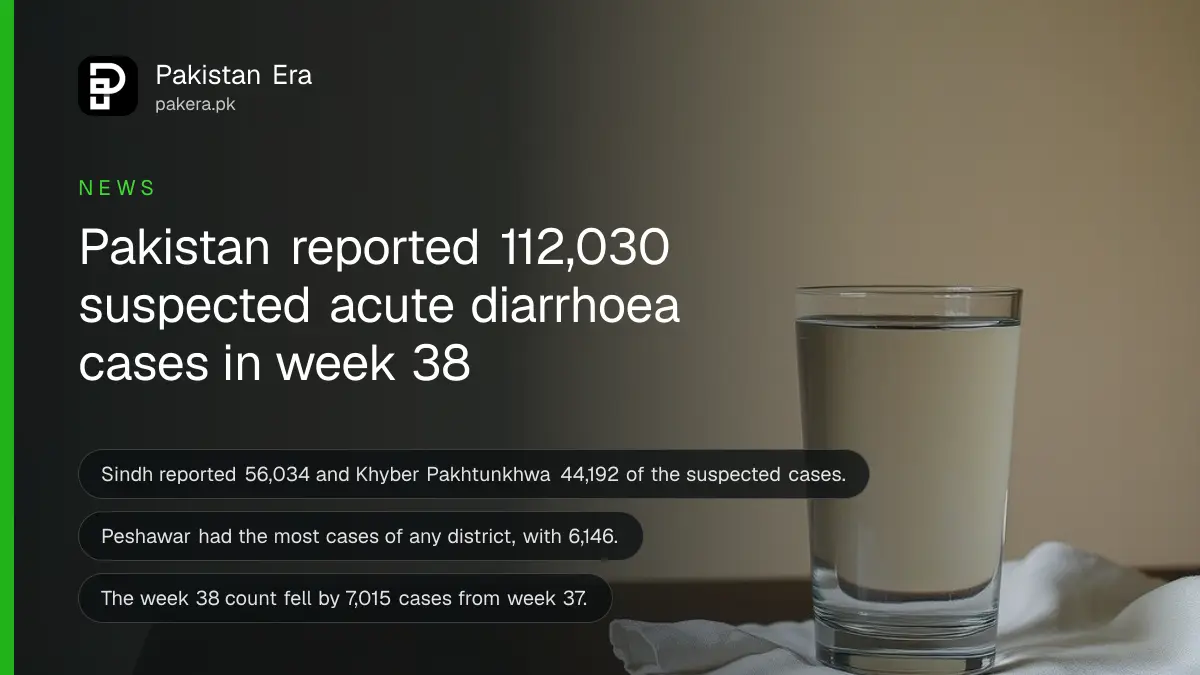
Short answer: Pakistan reported 112,030 suspected cases of acute diarrhoea in week 38 of 2026, the most of any disease in the National Institutes of Health (NIH) weekly bulletin. That is down from 119,045 the week before. Sindh sent 56,034 and Khyber Pakhtunkhwa 44,192. Punjab did not report. Children with diarrhoea need fluids first.
The NIH put the week 38 bulletin online on Friday 9 October 2026. We read its tables and compared them with the week 37 bulletin. The figures are suspected cases sent in by clinics, not lab-confirmed ones.
Acute diarrhoea was the most reported illness in Pakistan in week 38
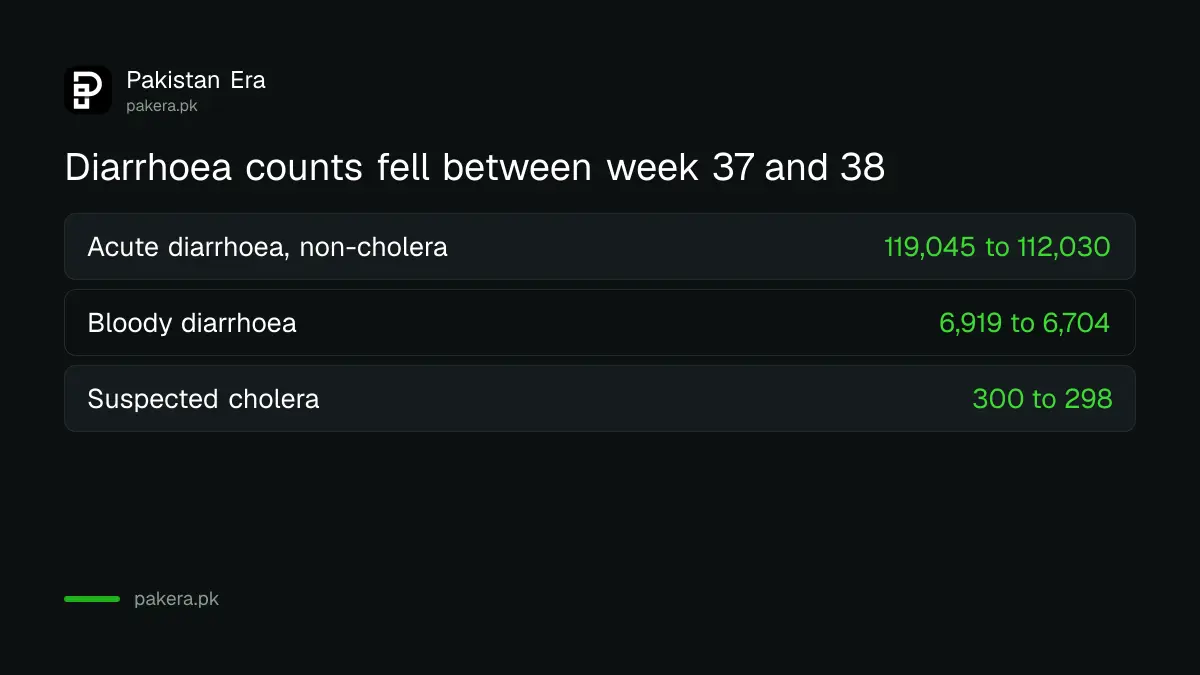
The NIH counted 112,030 suspected cases of acute diarrhoea (non-cholera) in week 38, ahead of malaria with 76,459 and influenza-like illness with 44,336. The count fell by 7,015 cases, or about 6 per cent, from 119,045 in week 37.
The NIH collects these numbers through its Integrated Disease Surveillance and Response system, called IDSR. Clinics in 158 districts send weekly forms. The national reporting rate was 86 per cent in week 38, up from 84 per cent. Punjab is marked NR, for not reported, in the national table, so the true national total is higher.
Bloody diarrhoea, which the NIH counts as a separate line, reached 6,704 cases, down from 6,919. Sindh sent 3,915 of them, Balochistan 1,487 and Khyber Pakhtunkhwa 1,191.
Sindh and Khyber Pakhtunkhwa sent nine in every ten cases
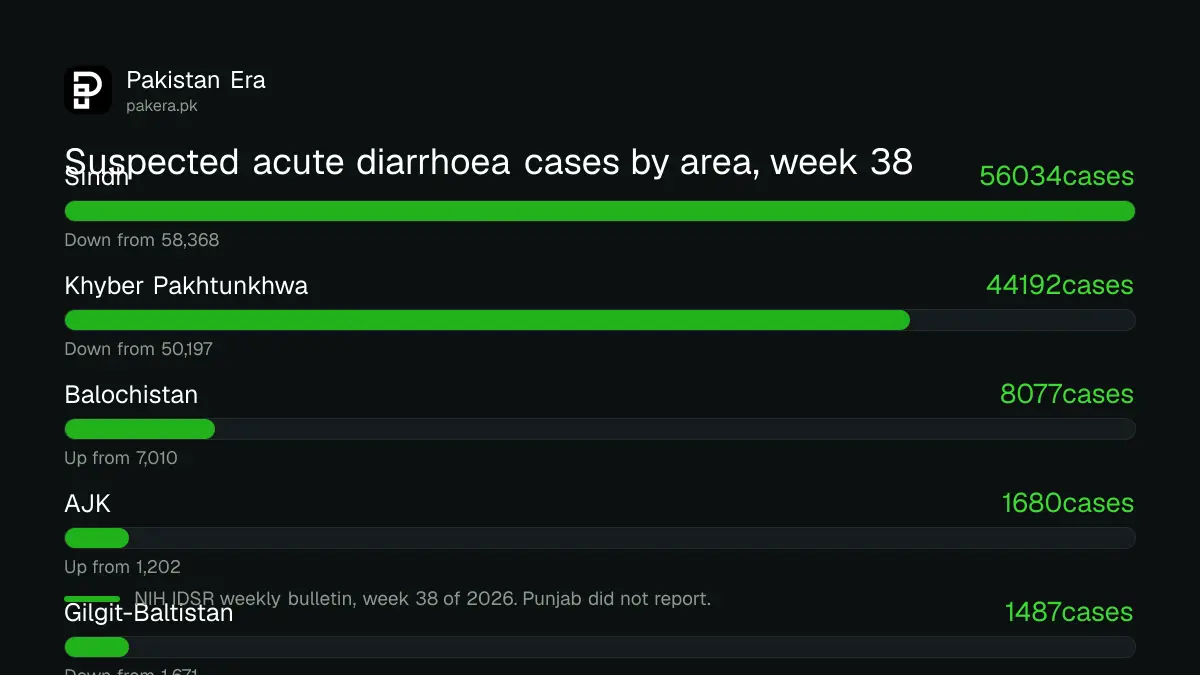
Sindh reported 56,034 cases and Khyber Pakhtunkhwa 44,192, together 100,226 of the 112,030, or about 89 per cent. Both fell from the week before. Balochistan and Azad Jammu and Kashmir (AJK) went the other way and rose.
| Area | Week 37 | Week 38 |
|---|---|---|
| Sindh | 58,368 | 56,034 |
| Khyber Pakhtunkhwa | 50,197 | 44,192 |
| Balochistan | 7,010 | 8,077 |
| Azad Jammu and Kashmir | 1,202 | 1,680 |
| Gilgit-Baltistan | 1,671 | 1,487 |
| Islamabad | 597 | 560 |
| Punjab | NR | NR |
| Pakistan | 119,045 | 112,030 |
One note on AJK. The bulletin's text for AJK says diarrhoea cases fell, but its own Table 1 shows 1,680 against 1,202 the week before. We use the table.
Peshawar and Badin reported the most cases of any district
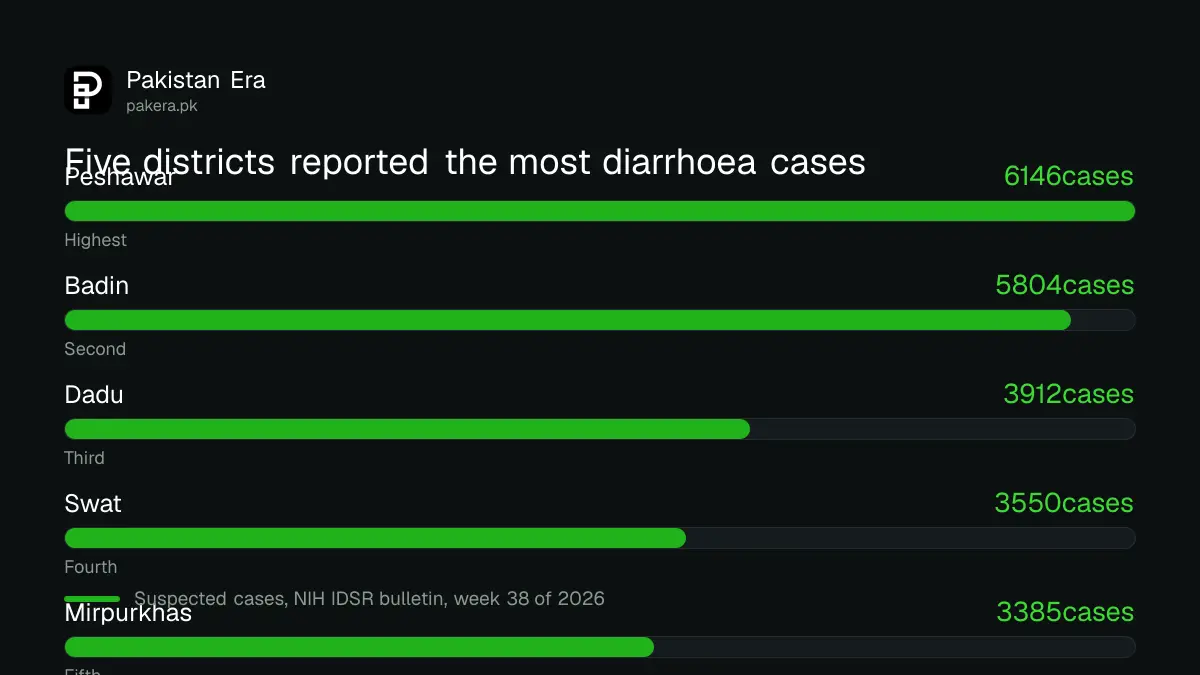
Peshawar reported 6,146 suspected diarrhoea cases in week 38, the most of any district in Pakistan. Badin in Sindh followed with 5,804, then Dadu with 3,912, Swat with 3,550 and Mirpurkhas with 3,385.
The list changes by province. In Khyber Pakhtunkhwa, Swabi had 3,199, Nowshera 2,998 and Charsadda 2,713. In Balochistan the highest were Usta Muhammad with 912, Quetta with 586 and Lasbella with 536. A big district count can reflect a big population and a busy reporting clinic, so it is not a ranking of which place is worst.
Acute diarrhoea and cholera are counted on separate lines
The NIH reports non-cholera diarrhoea and acute watery diarrhoea with suspected cholera as two lines. Week 38 had 298 suspected cholera cases, mostly in Balochistan with 247. Most of the 112,030 cases are ordinary diarrhoea, not cholera.
The cholera line is much smaller, and a lab test is needed to settle it. Our separate report on Balochistan's cholera cases in week 38 has the district detail.
What the official health pages say to do when diarrhoea starts
The World Health Organization says diarrhoeal disease is preventable and treatable, and that much of it can be prevented with safe drinking water, sanitation and hygiene. For a child, replace lost fluid first and watch for danger signs.
Our own step-by-step guide, how to treat a child's diarrhoea with ORS and zinc, explains the home steps and when to go to hospital. The short version is below. It is general information. A doctor or a health worker at your nearest clinic should decide treatment for any sick child.
- Give oral rehydration salts (ORS) in small, frequent sips from the first loose stool.
- Keep feeding or breastfeeding the child as normal.
- Wash hands with soap after the toilet and before preparing food.
- Drink boiled or otherwise safe water and keep food covered.
- Go to a clinic the same day if there is blood in the stool, repeated vomiting, or the child is very sleepy or will not drink.
The weekly count fell but the bulletin does not say why
The NIH does not explain why diarrhoea fell by 7,015 cases in one week. A weekly figure can move because fewer clinics sent forms, because the weather changed, or because fewer people fell ill. The bulletin gives no cause.
Sindh reported 100 per cent of its expected forms, so missing forms do not explain its fall. Khyber Pakhtunkhwa's reporting rate was 81 per cent. For the other diseases in the same bulletin, see our reports on typhoid in week 38 and on measles, mumps and diphtheria.
Common questions
How many diarrhoea cases did Pakistan report in week 38 of 2026?
Pakistan reported 112,030 suspected cases of acute diarrhoea (non-cholera) in week 38, according to the NIH IDSR bulletin. That is down from 119,045 in week 37. Punjab did not report.
Is acute diarrhoea the same as cholera?
No. The NIH counts non-cholera diarrhoea and suspected cholera on separate lines. Week 38 had 298 suspected cholera cases against 112,030 cases of non-cholera diarrhoea. Only a stool test can confirm cholera.
Which district reported the most cases?
Peshawar, with 6,146 suspected cases. Badin in Sindh was second with 5,804. The count depends on population and on how many clinics report, so it is not a measure of which district is worst.
Why is the national figure not complete?
Punjab is marked NR, not reported, in the national table. The NIH figure therefore covers the provinces and regions that sent data, and the real national count is higher.
What should I do first if my child has diarrhoea?
Give ORS in small sips and keep feeding. Go to a clinic the same day if there is blood in the stool, repeated vomiting, or the child is drowsy or cannot drink. Our ORS and zinc guide has the full steps.
Where can I read the bulletin myself?
The NIH publishes it each week on its Public Health Bulletin page. Our guide to checking disease cases in your district shows how to find your district's row.
How we verified this
What we checked, where we read it, and what we could not confirm.
Last checked on Sunday 11 October 2026. We read the NIH IDSR Public Health Bulletin for week 38 and week 37 of 2026 from the National Institutes of Health weekly bulletin page, and the World Health Organization's diarrhoeal disease fact sheet. All counts are suspected cases as the NIH prints them. Week 38 is the week the NIH numbers 38 in its own calendar.
About the author

Tax, Bills and Technology Writer
Ali Akhtar is a young and curious voice here at Pakistan Era. He is currently pursuing his A-Levels and has a growing interest in Pakistan’s changing industrial landscape and educational trends. Ali likes to write in a way that helps him explain and explore the world around him. His writing reflects the perspective of the new generation navigating the evolving trends of Pakistan where technology, youth innovation, and shifting opportunities are reshaping the country’s future.