State Bank Profit of Rs 2.43 Trillion Was 12% of Pakistan's Revenue in 2025-26
The State Bank's surplus profit of Rs 2,428 billion was 12% of Pakistan's 2025-26 revenue, and Rs 1,567bn from fuel levy. See the Finance Division table.
The State Bank of Pakistan's surplus profit of Rs 2,428.4 billion, about Rs 2.43 trillion, made up 12 percent of all government revenue in 2025-26. That is more than a third of what the whole country paid in income tax and similar direct taxes. The Finance Division's provisional table shows the transfer in the first quarter and unchanged to June.
When the central bank earns more than it needs, it hands the surplus to the government. That money is not a tax. It is counted as non-tax revenue. We read the Finance Division's consolidated revenue table on 13 October 2026 and set out what it says about where the state's money came from.
Total revenue was Rs 19.77 trillion
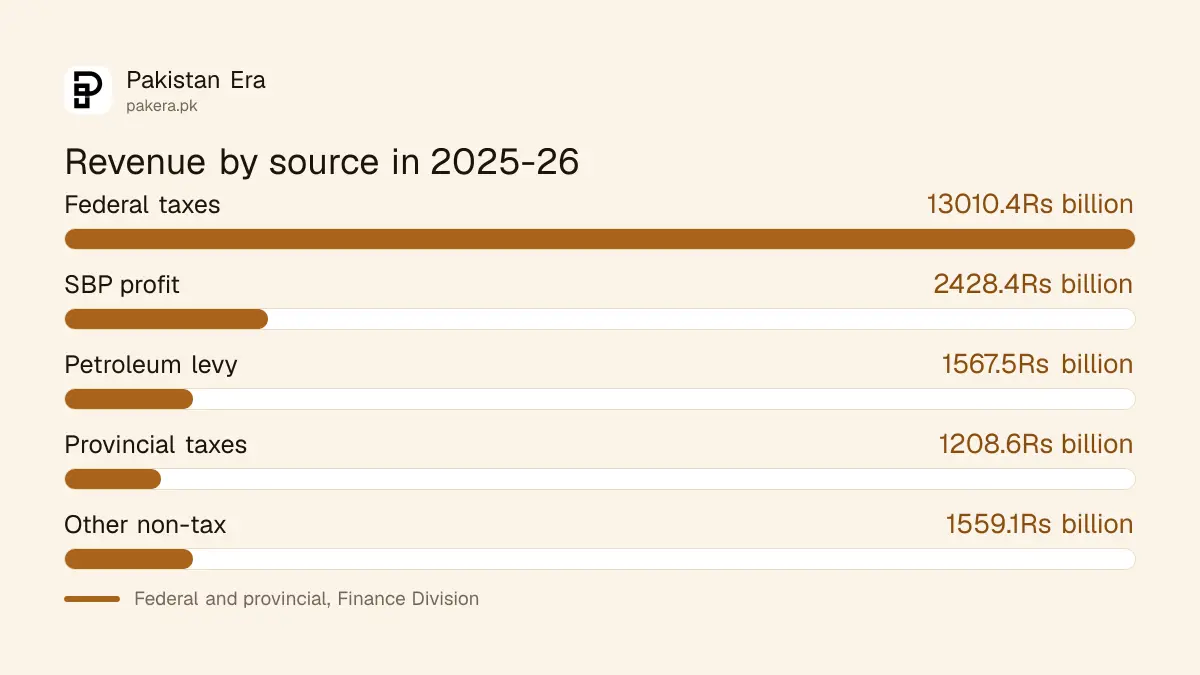
Federal and provincial revenue together was Rs 19,773.9 billion in July 2025 to June 2026, 15.6 percent of GDP. Tax revenue was Rs 14,219.1 billion and non-tax revenue was Rs 5,554.9 billion.
| Revenue, 2025-26 | Rs billion | Share of total |
|---|---|---|
| Federal taxes | 13,010.4 | 65.8% |
| Provincial taxes | 1,208.6 | 6.1% |
| SBP surplus profit | 2,428.4 | 12.3% |
| Petroleum levy | 1,567.5 | 7.9% |
| Other non-tax revenue | 1,559.1 | 7.9% |
| Total | 19,773.9 | 100% |
The shares are our own arithmetic. "Other non-tax revenue" is what is left after we take out the two largest items.
The State Bank transfer was 44 percent of non-tax revenue
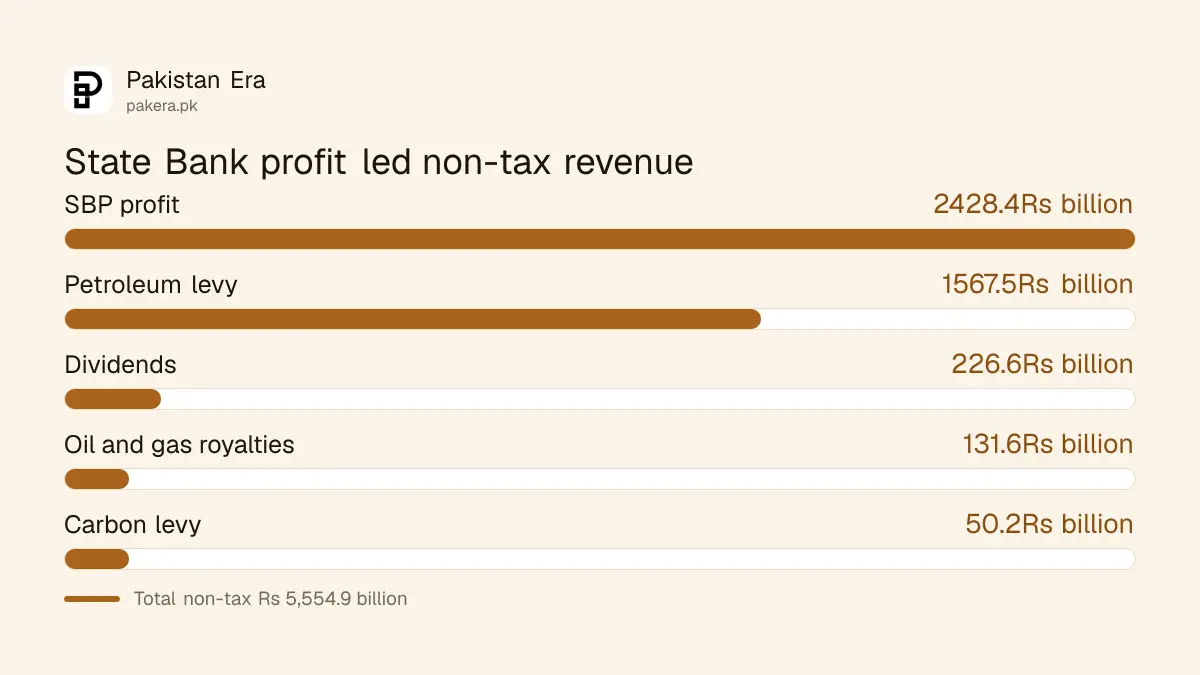
Non-tax revenue is everything the state earns outside taxes. The State Bank surplus of Rs 2,428.4 billion is 43.7 percent of it. Petroleum levy is the next largest, at Rs 1,567.5 billion, 28.2 percent.
The table lists the same Rs 2,428.4 billion in July to September and in every later period. That means the transfer was booked early in the year and did not grow afterwards. The Finance Division table does not say how the bank calculated it. We did not read the State Bank's own annual accounts for this article.
Direct taxes brought in Rs 6.59 trillion
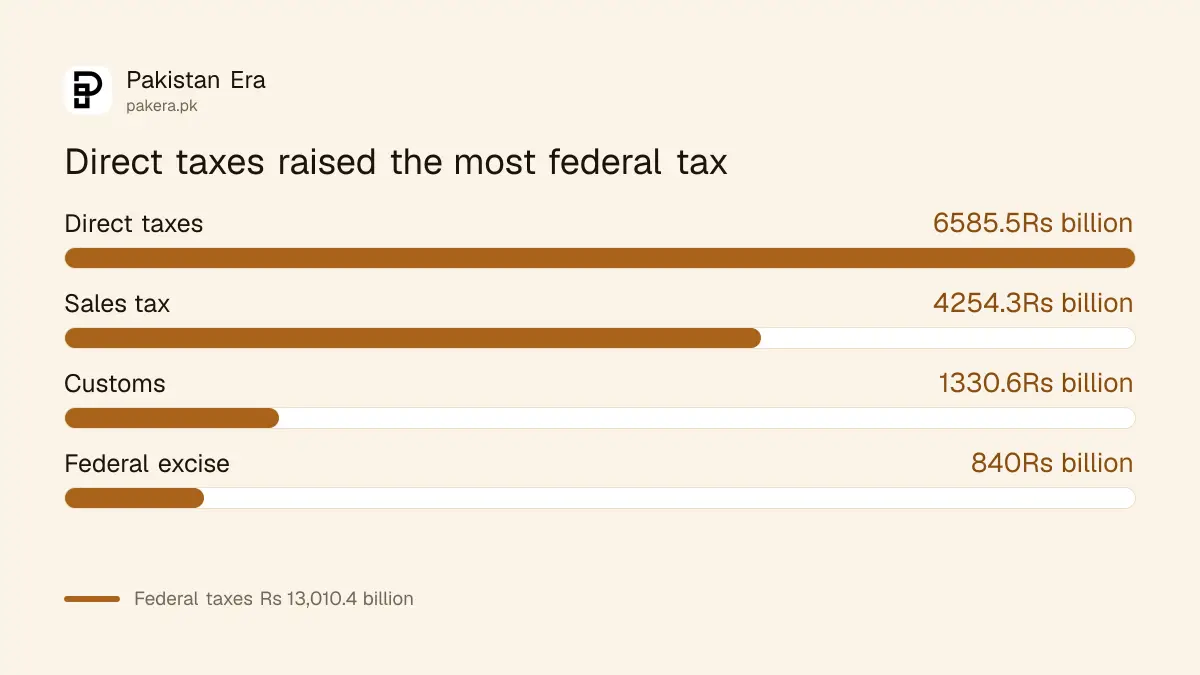
Among federal taxes, direct taxes such as income tax gave Rs 6,585.5 billion. Sales tax gave Rs 4,254.3 billion, customs duties Rs 1,330.6 billion and federal excise Rs 840.0 billion.
Put next to those, the central bank's one transfer was equal to 37 percent of direct tax collection and 57 percent of sales tax. For a worker who pays income tax on a salary, the lesson is plain. A large part of the year's income was not from taxpayers at all. The tax side of the year, from the FBR's own accounts, is in the FBR first-quarter collection report.
Fuel levy added another 8 percent
The petroleum levy is the per-litre charge added to petrol and diesel. It raised Rs 1,567.5 billion, which matches the figure we reported in the record fuel levy collection. It was 7.9 percent of total revenue.
Together the central bank profit and the fuel levy gave Rs 3,995.9 billion, or 20.2 percent of revenue. The bank's transfer depends on its earnings in the year. The levy depends on how much fuel Pakistan sells.
The same table lists smaller items: dividends of Rs 226.6 billion, oil and gas royalties of Rs 131.6 billion, the carbon levy of Rs 50.2 billion and passport fees of Rs 48.5 billion.
Why a one-off transfer is hard to repeat
Central bank profit changes from year to year with interest rates, exchange rates and the size of its holdings. We cannot say what next year's transfer will be, and the budget papers give their own plan. The Finance Division has not said, in the pages we read, that Rs 2.43 trillion is the new normal.
A reader should treat it as helpful but not guaranteed. A budget that relies on it needs another source if the transfer is smaller.
How to find these revenue lines yourself
The revenue tables are on the Finance Division website and need no login. The unit is Rs million, so divide by 1,000 to get Rs billion.
- Open the Finance Division website and choose "Pakistan Fiscal Operations".
- Open the July to June 2025-26 file.
- Go to Table 3, the detailed revenue table.
- Find "Surplus Profit of State Bank of Pakistan" under federal non-tax revenue.
- Read the last column, July to June, for the full-year figure.
The same table shows provincial taxes too. Sales tax on services raised Rs 774.8 billion for the provinces, and stamp duties raised Rs 85.9 billion.
Revenue would have been Rs 17.35 trillion without the State Bank transfer
Take the State Bank surplus of Rs 2,428.4 billion out of total revenue of Rs 19,773.9 billion and Rs 17,345.5 billion is left. If the petroleum levy of Rs 1,567.5 billion is also removed, the total falls to Rs 15,778.0 billion.
Taxes alone were Rs 14,219.1 billion, or 71.9 percent of total revenue. These sums are our own arithmetic on the printed rows.
The example shows how much the year's revenue depended on two items that are not taxes. Non-tax revenue is money the state earns from sources such as central bank profit, levies and dividends.
Common questions
How much did the State Bank give the government in 2025-26?
The Finance Division table shows a surplus profit of Rs 2,428.4 billion.
Is the State Bank profit a tax?
No. It is non-tax revenue. The central bank pays its surplus to the government.
What share of revenue was it?
About 12.3 percent of total revenue, by our calculation, and 43.7 percent of non-tax revenue.
What was the largest tax?
Direct taxes, which include income tax, gave Rs 6,585.5 billion. Sales tax was next at Rs 4,254.3 billion.
How much did the petroleum levy raise?
Rs 1,567.5 billion, 7.9 percent of revenue.
Are the figures final?
No. The Finance Division marks the table provisional.
How we verified this
What we checked, where we read it, and what we could not confirm.
Last checked on 13 October 2026, Pakistan time. We read Table 2 and Table 3 of the July to June 2025-26 file on the Finance Division's Pakistan Fiscal Operations page. The file's modified date is 13 August 2026. We did not check the State Bank's own accounts. Shares are our own arithmetic.
About the author

Global Affairs & Political Economy Writer
Muhammad Hatim is a book lover who started writing because he enjoys it. At Pakistan Era he writes about international relations, geopolitics and the global economy, with a particular interest in South Asia and the forces behind current events.