Pakistan's FY2027 Borrowing Plan: Rs 28,647 Billion Needed, T-Bills to Be Repaid
Pakistan's FY2027 borrowing plan puts financing needs at Rs 28,647 billion, with Rs 6,046 billion of net home borrowing. See the T-bill and PIB split.
Short answer: Pakistan's Finance Division says the government needs Rs 28,647 billion in the 2026-27 financial year (FY2027). That is Rs 7,020 billion for the budget deficit plus Rs 21,627 billion of debt that falls due. The plan is to borrow Rs 6,046 billion net at home, mostly through longer bonds, and to repay more Treasury bills than it sells.
Every year the government publishes a plan for how it will borrow. Most people never read it. It matters because it decides where the money comes from, and which savers and banks are asked to lend it.
We read the Annual Borrowing Plan FY2027 on the Finance Division website on 12 October 2026. The Finance Division listed it on 29 September 2026. Every figure below is from that document. A plan is a target, not a promise, and the document says its numbers depend on market conditions.
The government needs Rs 28,647 billion in FY2027
Gross financing needs are the deficit plus all debt that must be repaid or rolled over in the year. For FY2027 the Finance Division puts them at Rs 28,647 billion, about 20 per cent of GDP. The deficit is only a quarter of that sum.
| Item | Rs billion | Share of GDP |
|---|---|---|
| Gross financing needs | 28,647 | 20% |
| Federal fiscal deficit | 7,020 | 5% |
| Debt maturities | 21,627 | 15% |
| of which domestic debt | 17,096 | 12% |
| of which external debt | 4,531 | 3% |
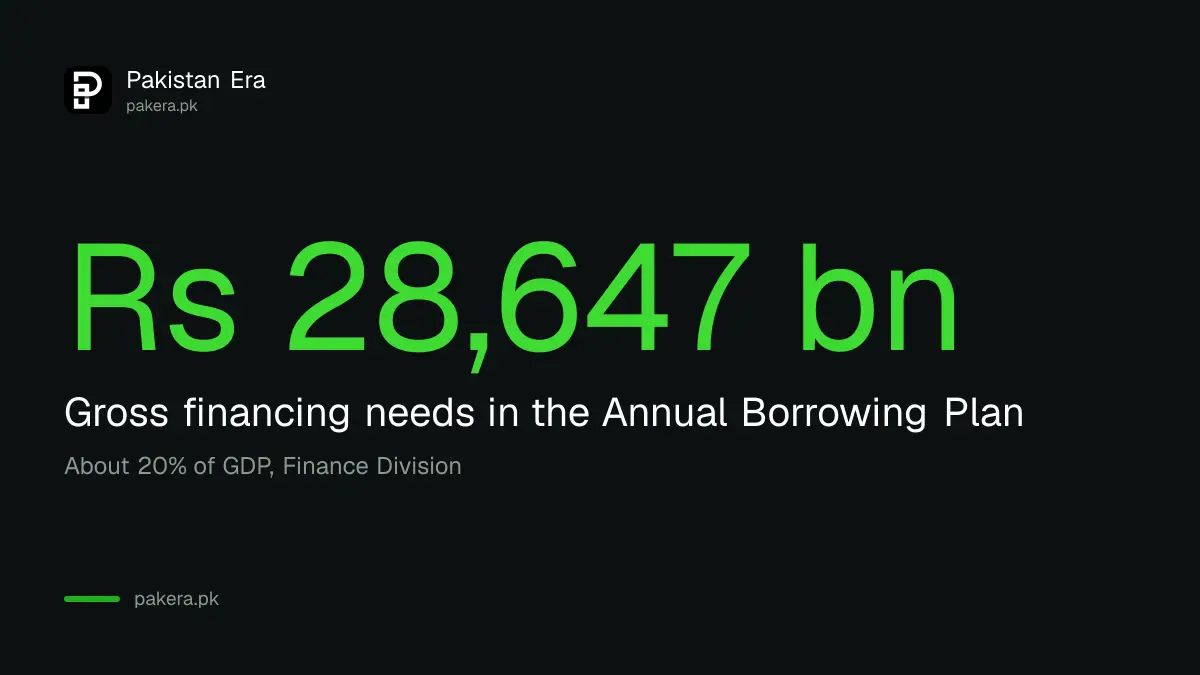
The plan uses a nominal GDP of Rs 143,670 billion for FY2027. It also says gross needs stay near 20 per cent of GDP, against 21 per cent the year before. The interest bill inside the deficit is Rs 8,054 billion, of which Rs 6,983 billion is on domestic debt.
Net domestic borrowing is Rs 6,046 billion, led by bonds
The deficit is to be paid for with Rs 6,046 billion of net domestic borrowing, Rs 813 billion from abroad and Rs 161 billion from privatisation. The home money comes mainly from Pakistan Investment Bonds (PIBs) and Sukuk, not from Treasury bills.
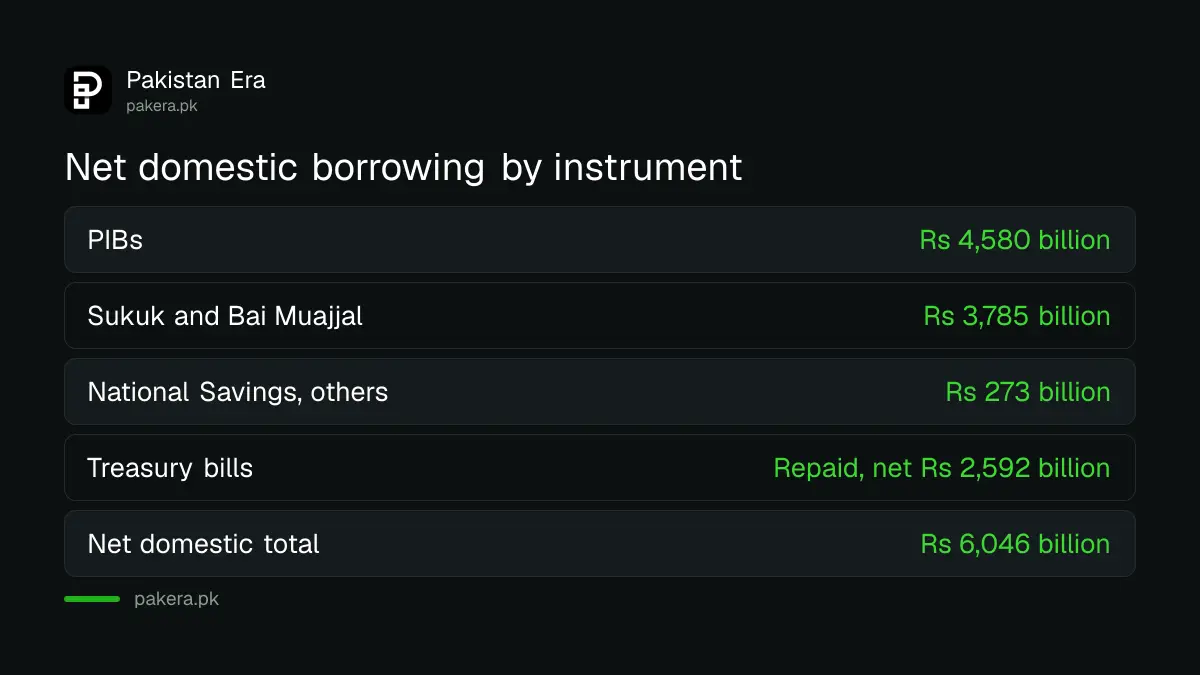
A PIB is a government bond that runs for years and pays a fixed or floating profit. A Sukuk is the Islamic version, tied to an asset. The plan expects PIBs to add a net Rs 4,580 billion and Government Ijara Sukuk, Bai Muajjal and short-term Sukuk to add a net Rs 3,785 billion. National Savings and other schemes add Rs 273 billion.
Gross Sukuk sales are targeted at about Rs 6,600 billion. The plan also says fixed-rate PIBs should be more than half of new issues, and a 20-year fixed coupon bond is planned after talks with market players. Floating-rate exposure is to be limited to the 10-year Sukuk only.
The plan repays more Treasury bills than it sells
Treasury bills are short loans of one to twelve months. The plan sells Rs 16,908 billion of them and repays Rs 19,500 billion, so the stock falls by Rs 2,592 billion. Bills worth Rs 11.1 trillion fall due, mostly in the first half.
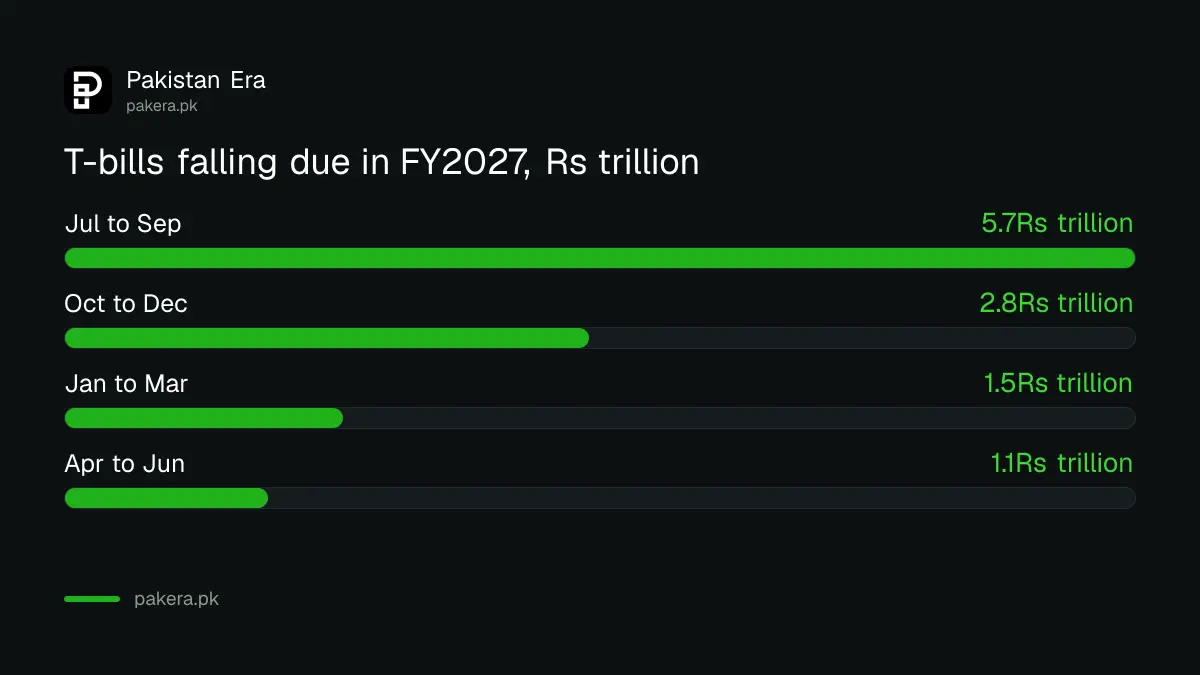
Of the Rs 11.1 trillion due, Rs 5.7 trillion falls in July to September and Rs 2.8 trillion in October to December. That is why the State Bank's T-bill auction calendar to December is so large. Most of each auction replaces bills that are maturing. Only the net figure is new borrowing.
The aim, in the plan's words, is to replace bill maturities with medium to long term instruments. The average time to maturity of public debt rose from 2.7 years in June 2024 to 3.8 years in June 2026. The target is 4.2 years by FY2028. The plan also says the interest bill fell 22 per cent in FY2026.
External borrowing is planned at USD 2,804 million net
The plan expects net external financing of USD 2,804 million, or Rs 813 billion at its assumed rate of Rs 290 a dollar. Multilateral lenders and bond sales supply most of it. Bilateral lenders and commercial banks are repaid more than they lend.
| Source | Net flow, USD million |
|---|---|
| Multilateral lenders | 1,580 |
| Bonds, including Eurobonds | 2,000 |
| Naya Pakistan Certificates and other | 886 |
| Commercial banks | (186) net repayment |
| Bilateral lenders | (1,409) net repayment |
| IMF | (67) net repayment |
| Total | 2,804 |
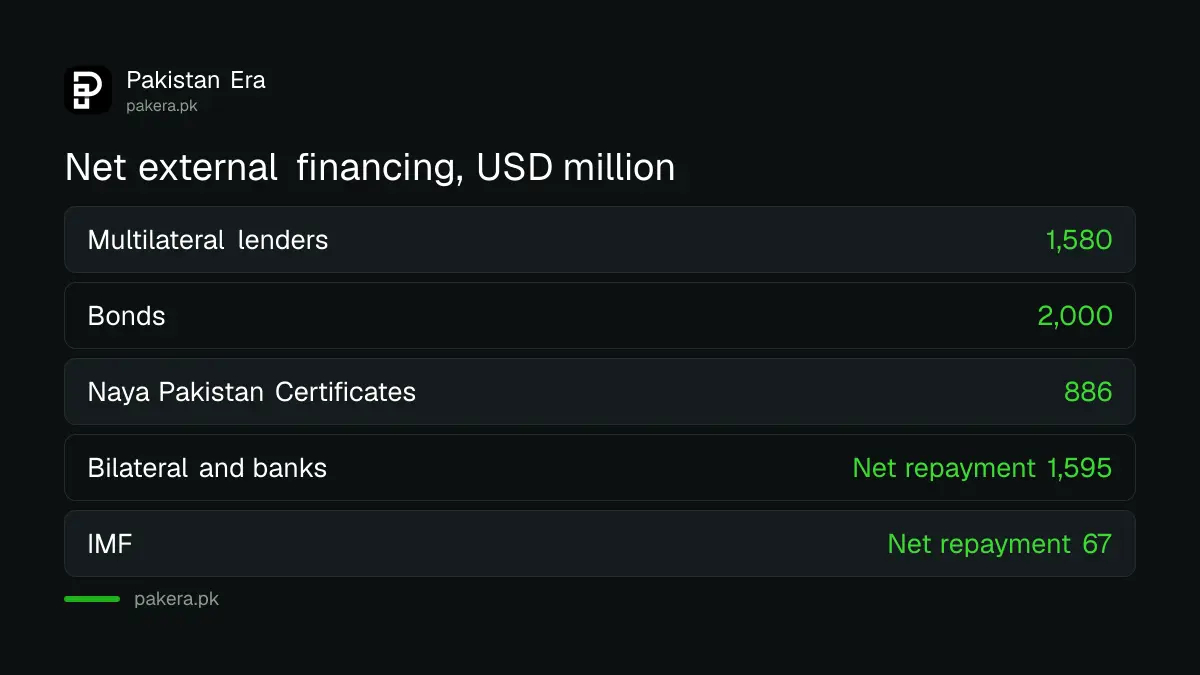
External principal due is USD 15.6 billion. About USD 7 billion of that is bilateral deposits, which the plan expects to be rolled over. The rest is USD 5.3 billion to multilateral lenders and USD 3.3 billion to commercial lenders. No Eurobond falls due in FY2027.
The bond line needs a note. The budget estimate was over USD 2.0 billion of Eurobonds or international Sukuk. A footnote says that USD 3.0 billion of Eurobonds has already been issued, so domestic borrowing is to be adjusted. The plan does not say by how much.
What the plan means for savers and borrowers
It sets no profit rate or loan rate. It signals more fixed-rate bonds, fewer bills and rebuilt National Savings products. Rates will still follow the market and the State Bank's policy rate, so the plan guides supply, not price.
On savings, the plan says the Central Directorate of National Savings will restructure its products, with market-driven pricing and digital channels. No new rates are given, so the National Savings profit rates from 1 October stand for now. The plan also names InvestPak, a State Bank portal, and digital wallets as ways to reach small investors. Our guide on how to buy T-bills and PIBs from Rs 5,000 shows the steps.
On debt, the plan lists the same pillars the Finance Division set in its Annual Debt Review. Fiscal discipline is a condition, and the plan says its outcomes depend on the macroeconomic and geopolitical setting during the year.
Check the plan yourself in five steps.
- Open finance.gov.pk, the Ministry of Finance website.
- Find the News and Events list on the home page.
- Open the entry dated 29 September 2026 called Annual Borrowing Plan FY2027.
- Read the table in Section 8 for the instrument figures.
- Compare it with the monthly auction calendar on the State Bank website.

Common questions
How much does Pakistan plan to borrow in FY2027?
The plan puts gross financing needs at Rs 28,647 billion. Of that, Rs 7,020 billion is the budget deficit and Rs 21,627 billion is debt falling due. The net new money from home and abroad is Rs 6,859 billion, by our addition of Rs 6,046 billion and Rs 813 billion.
Will the government sell fewer Treasury bills?
Yes, on a net basis. It plans to repay Rs 19,500 billion of bills and sell Rs 16,908 billion, so bills fall by Rs 2,592 billion. Gross auction sizes stay large because old bills must be rolled over.
Is the Eurobond plan still valid?
The plan keeps an amount of over USD 2.0 billion from the budget estimate. A footnote says USD 3.0 billion of Eurobonds has already been issued, and domestic borrowing is to be adjusted.
Does the plan change National Savings profit rates?
No rate is set in it. The plan says National Savings products will be restructured with market-driven pricing, and gives no date.
What exchange rate does the plan assume?
It uses Rs 290 per US dollar for FY2027. That is how it converts USD 2,804 million into Rs 813 billion.
Is the plan the same as the budget?
No. It follows the federal budget's financing estimate and the Medium-Term Debt Management Strategy for FY2026-28, and says final numbers can change with market conditions.
How we verified this
What we checked, where we read it, and what we could not confirm.
We read the Annual Borrowing Plan FY2027 on the Finance Division website on 12 October 2026. The Finance Division listed it on 29 September 2026. The Rs 6,859 billion total is our own addition of figures in its tables. The plan is a target set by the Debt Management Office and can change.
About the author

Global Affairs & Political Economy Writer
Muhammad Hatim is a book lover who started writing because he enjoys it. At Pakistan Era he writes about international relations, geopolitics and the global economy, with a particular interest in South Asia and the forces behind current events.