Pakistan's Factory Output Rose 3.03% in July 2026, Led by Garments and Cars
PBS says Pakistan's large-scale manufacturing rose 3.03% in July 2026 on a year earlier. See which sectors gained, which fell, and how to read the PBS table.
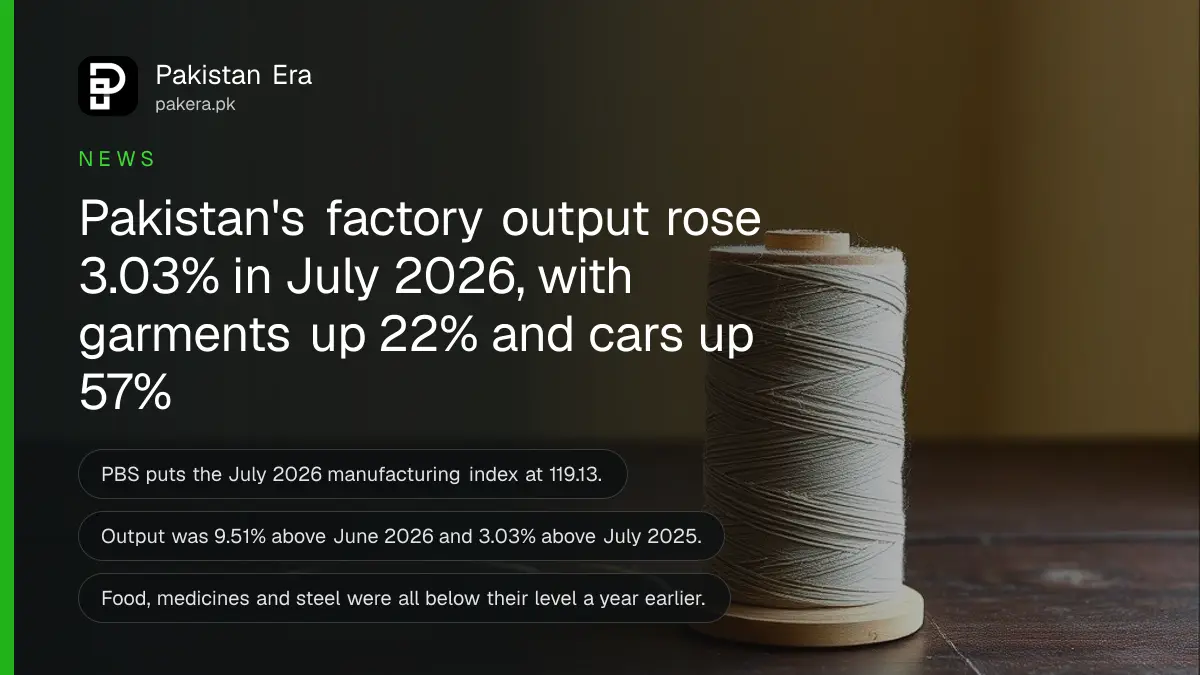
Short answer: Pakistan's large-scale manufacturing output was 3.03 per cent higher in July 2026 than in July 2025, and 9.51 per cent higher than in June 2026, the Pakistan Bureau of Statistics (PBS) says. Garments and cars did most of the lifting. Food, medicines and steel were all below last July.
Large-scale manufacturing, or LSM, counts what big factories make: tonnes of cement, pairs of shoes, numbers of cars. It is the monthly health check of industry. It is not the whole economy, and it leaves out small workshops and services.
We opened the PBS release and its Table 1 on 12 October 2026. PBS posted the July figures on 16 September 2026. The numbers are provisional, which means PBS may revise them when more data arrive. The index uses 2015-16 as 100.
Factory output was 3.03 per cent higher than in July 2025
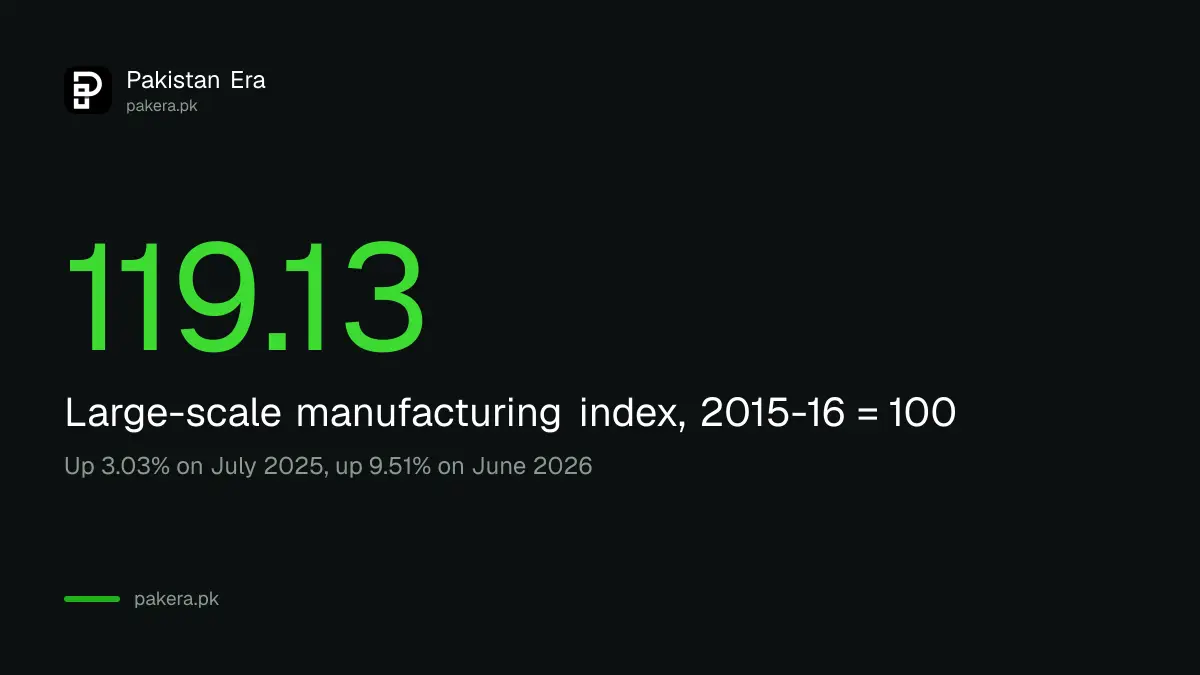
PBS puts the July 2026 quantum index at 119.13. That compares with 115.62 in July 2025 and 108.78 in June 2026. So output rose 3.03 per cent on the year and 9.51 per cent on the month.
| Period | LSM index (2015-16 = 100) | Change to July 2026 |
|---|---|---|
| July 2026 (provisional) | 119.13 | Base |
| June 2026 | 108.78 | Up 9.51% |
| July 2025 | 115.62 | Up 3.03% |
Against June, the biggest mover was garments, up 43.78 per cent. Cars and jeeps together fell 7.5 per cent, and motorcycles fell 7.87 per cent. So the monthly gain was narrow, and most of it came from clothing. Cement rose 10.87 per cent on the month.
The monthly jump is large, but one month on the previous month says little. Industry moves with seasons, holidays and the end of the fiscal year. The comparison with the same month last year is the cleaner test.
Garments and cars drove the gain
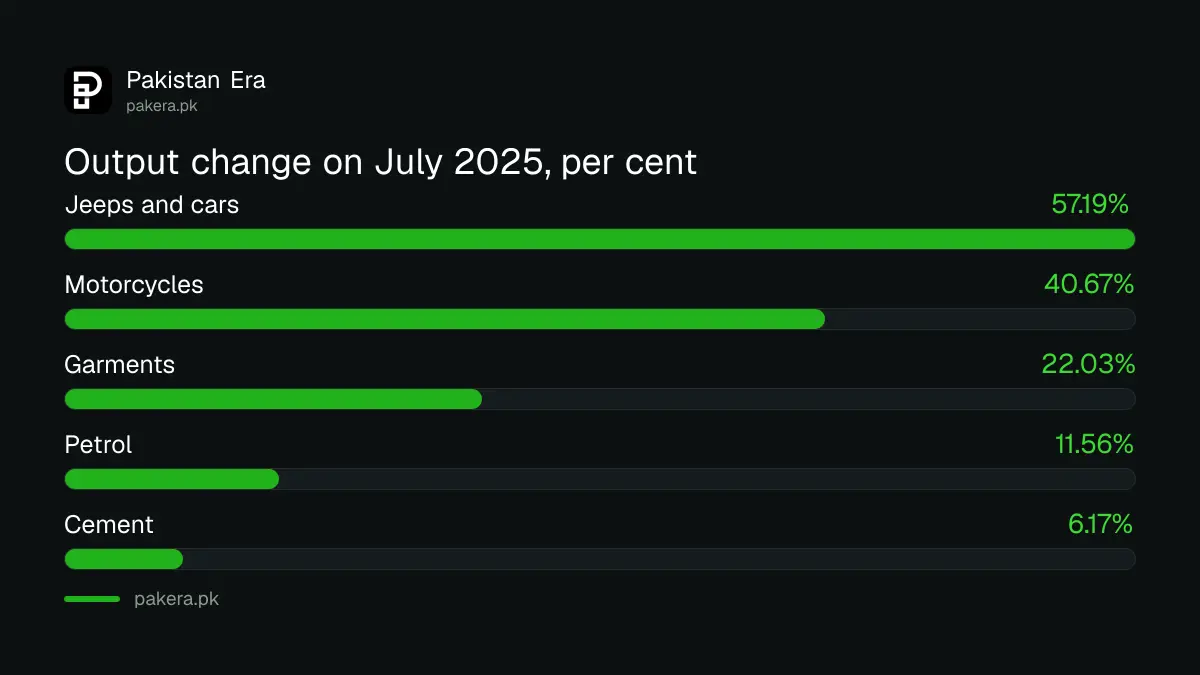
Factories made 8.7 million dozen garments in July, up 22.03 per cent on a year earlier. Jeeps and cars rose 57.19 per cent to 23,433 units. Motorcycles rose 40.67 per cent to 210,727. Cement, cigarettes and refrigerators also gained.
| Product | July 2026 | Change on July 2025 |
|---|---|---|
| Garments | 8,736 thousand dozen | Up 22.03% |
| Jeeps and cars | 23,433 units | Up 57.19% |
| Motorcycles | 210,727 units | Up 40.67% |
| Cement | 3,530 thousand tonnes | Up 6.17% |
| Motor spirit (petrol) | 344,497 thousand litres | Up 11.56% |
We worked out how much each group added to the headline, using the weights in the PBS table. Garments added about 4.5 index points and vehicles about 2.2. The net rise was only 3.5 points. So without garments the index would have been lower than a year ago. That sum is ours, not PBS's. Garments carry a weight of 6.08 in the PBS table and vehicles 3.10, out of a total of 78.37, so a big move in either one shows up in the headline.
The car figure fits what we saw in car loans, which hit a record in August. It does not tell you prices, which we track in the makers' own lists.
Food, medicines and steel were below last July
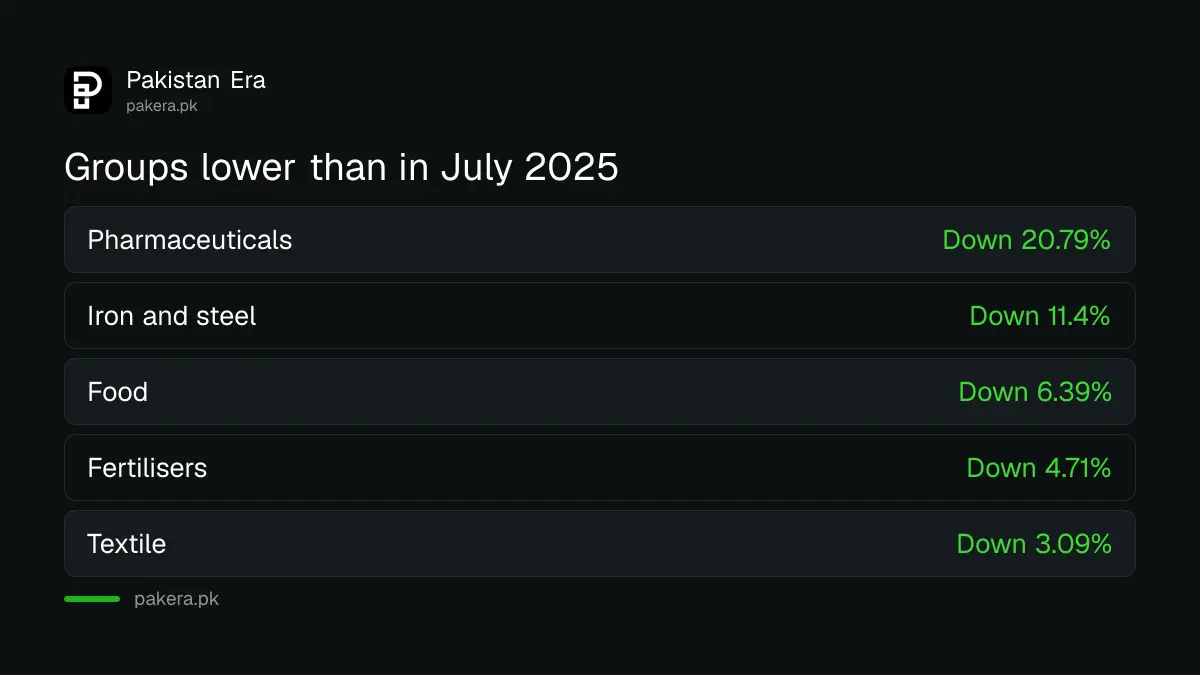
Food manufacturing was 6.39 per cent lower than in July 2025, pharmaceuticals 20.79 per cent lower, and iron and steel 11.4 per cent lower. Textiles, as a group, were 3.09 per cent lower even though garments rose.
| Group | Index, July 2026 | Change on July 2025 |
|---|---|---|
| Food | 104.67 | Down 6.39% |
| Pharmaceuticals | 83.16 | Down 20.79% |
| Iron and steel | 96.45 | Down 11.4% |
| Textile | 82.44 | Down 3.09% |
| Fertilisers | 114.29 | Down 4.71% |
Inside the groups, cooking oil was 19.22 per cent lower and vegetable ghee 11.81 per cent lower. Liquid medicine syrups fell 25.25 per cent and capsules 61.91 per cent, although tablets were up 0.47 per cent. Steel billets fell 32.2 per cent. Yarn rose 2.73 per cent and cloth was flat.
Sugar shows a zero for July, against 33,961 tonnes in June. That is the off-season for crushing, our reading, not a PBS comment.
What this does and does not tell you
LSM covers factory output in physical units, so it is not a sales or profit figure. It also covers only part of industry. The wider picture is in the Finance Division's monthly economic update, which quotes the same 3.03 per cent.
The index rose, but the mix matters. A large part of the rise came from two sectors. When one sector carries the headline, a slowdown there would show quickly. PBS has not yet posted August, so July is the latest figure we could read.
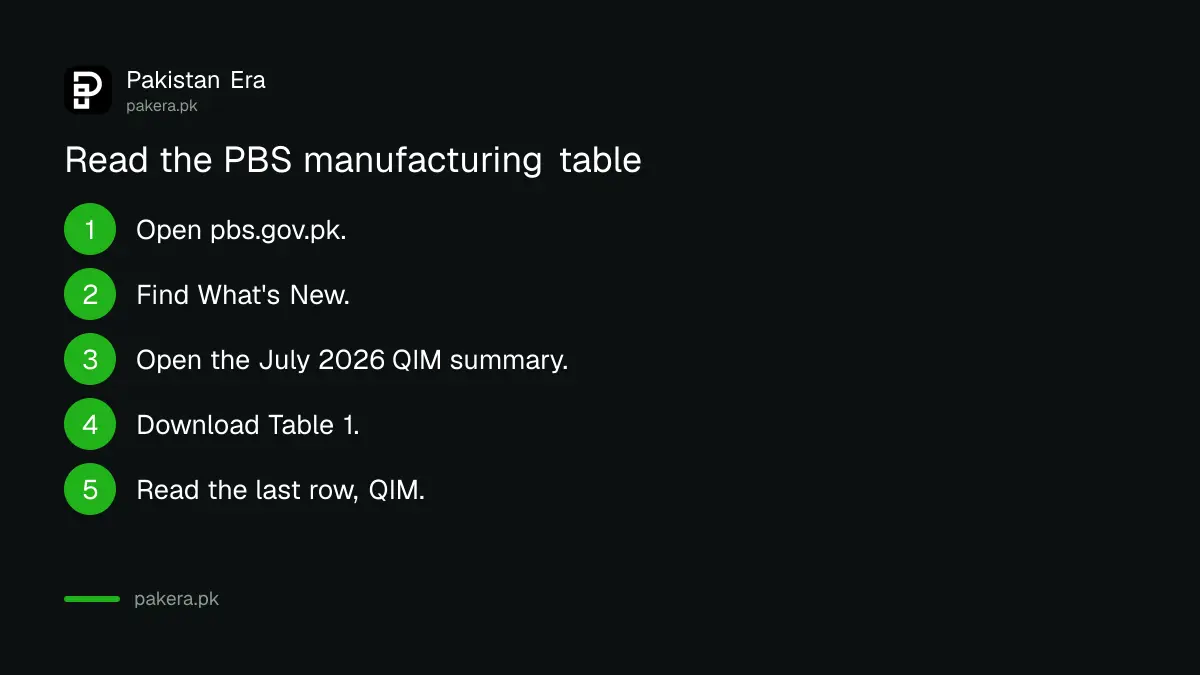
- Open pbs.gov.pk and find What's New on the home page.
- Open the summary of provisional QIM numbers for July 2026.
- Download Table 1, the XLSX file, from the list.
- Read the last row, QIM, for the total and the two changes.
- Read the group rows above it to see which sectors moved.
Common questions
What is large-scale manufacturing in Pakistan?
It is a monthly index from PBS that tracks the output of big factories in physical units such as tonnes, litres and units. The base year is 2015-16.
How much did LSM grow in July 2026?
PBS says output rose 3.03 per cent on July 2025 and 9.51 per cent on June 2026. The provisional index was 119.13.
Which sectors grew most in July 2026?
Garments rose 22.03 per cent, jeeps and cars 57.19 per cent and motorcycles 40.67 per cent, all compared with July 2025.
Is LSM the same as GDP growth?
No. LSM is one input to national accounts and covers only large factories. GDP also counts farming, services and small industry.
Are the July numbers final?
No. PBS calls them provisional and bases them on the latest data from source agencies, so they can be revised.
How we verified this
What we checked, where we read it, and what we could not confirm.
We read the PBS release for July 2026 and its Table 1 on 12 October 2026. The index values, growth rates and product units are PBS figures. The contribution of garments and vehicles, and the sugar season remark, are our own arithmetic and reading.
About the author

Global Affairs & Political Economy Writer
Muhammad Hatim is a book lover who started writing because he enjoys it. At Pakistan Era he writes about international relations, geopolitics and the global economy, with a particular interest in South Asia and the forces behind current events.