Pakistan Paid Rs 6.95 Trillion in Interest in 2025-26, 35% of All Revenue
Pakistan paid Rs 6,947.6 billion in interest in 2025-26, 35% of revenue and more than defence, pensions, subsidies and civil running costs. See the full table.
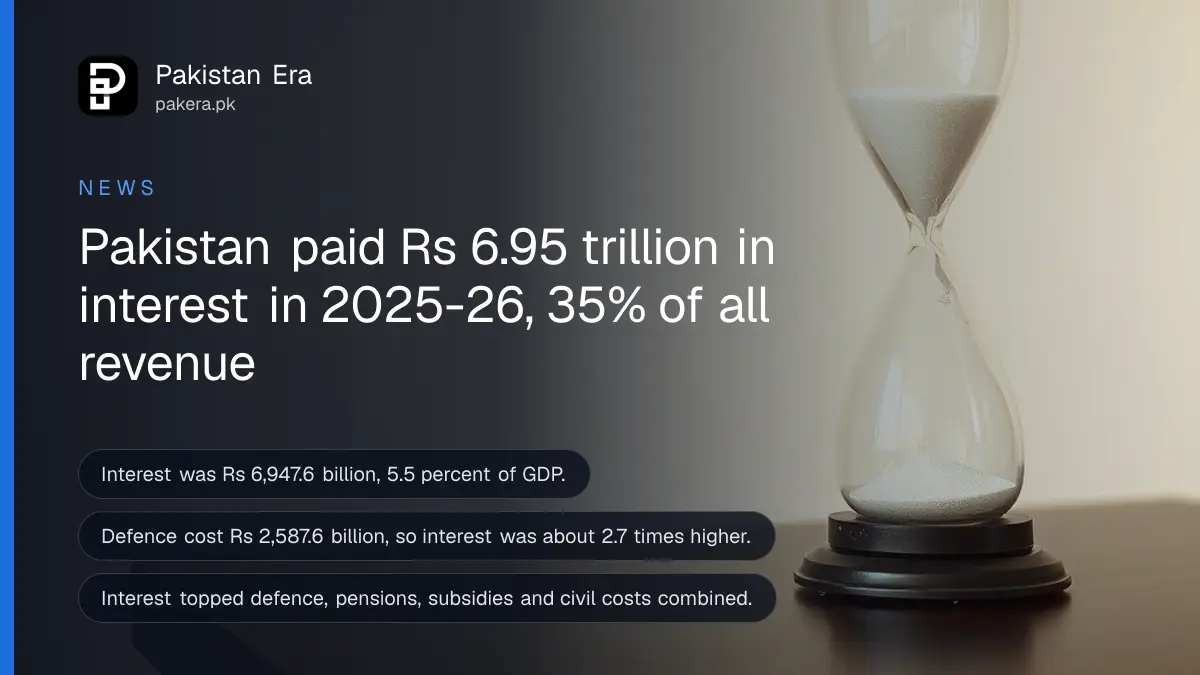
Pakistan spent Rs 6,947.6 billion, about Rs 6.95 trillion, on interest in 2025-26. That is 35 percent of all revenue collected by the federal and provincial governments. It is more than defence, pensions, running the civil government and subsidies put together.
The numbers come from the Finance Division's consolidated fiscal table for July 2025 to June 2026. Consolidated means federal and provincial spending added together. The table is provisional. We read it on 13 October 2026. Interest is called "mark-up" in Pakistani budget papers.
Interest was the largest single spending line
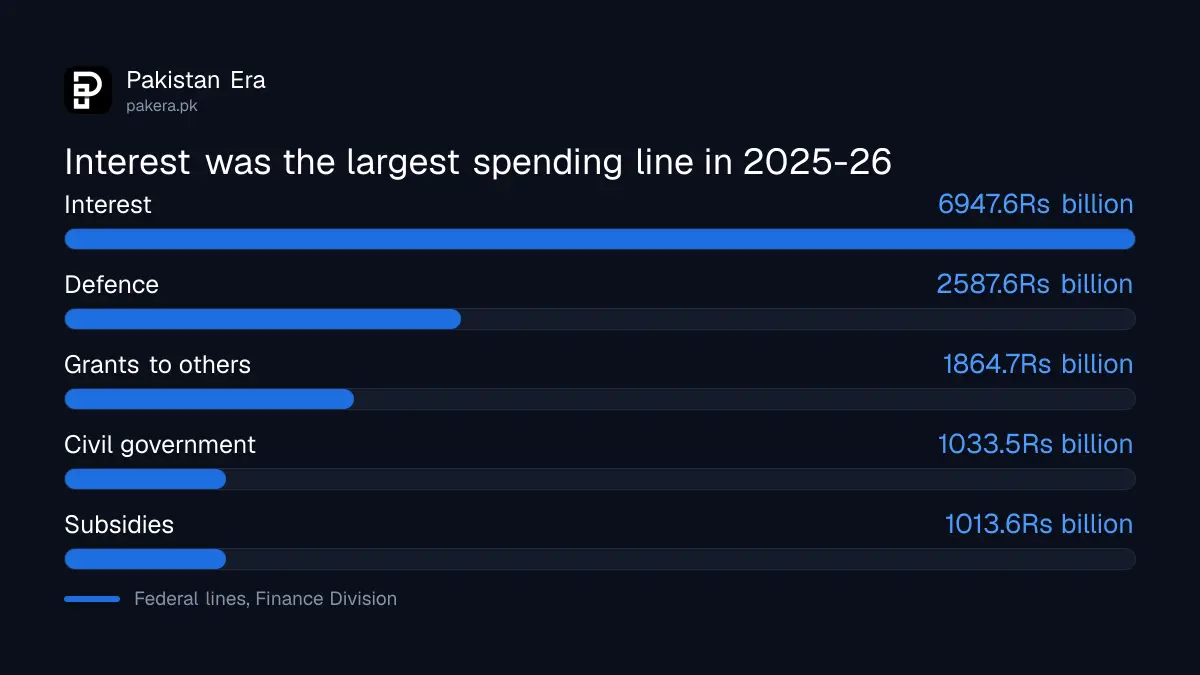
Mark-up payments were Rs 6,947.6 billion, or 5.5 percent of GDP. Domestic debt cost Rs 6,030.4 billion of that. Foreign debt cost Rs 917.2 billion. Nothing else in the table comes close.
| Spending line, 2025-26 | Rs billion | Share of GDP |
|---|---|---|
| Mark-up (interest) payments | 6,947.6 | 5.5% |
| Defence affairs and services | 2,587.6 | 2.0% |
| Grants to others | 1,864.7 | 1.5% |
| Running of civil government | 1,033.5 | 0.8% |
| Subsidies | 1,013.6 | 0.8% |
| Pensions | 1,001.6 | 0.8% |
These are federal lines. The provinces spent a further Rs 6,237.6 billion on their own current costs, and Rs 2,700.9 billion on development.
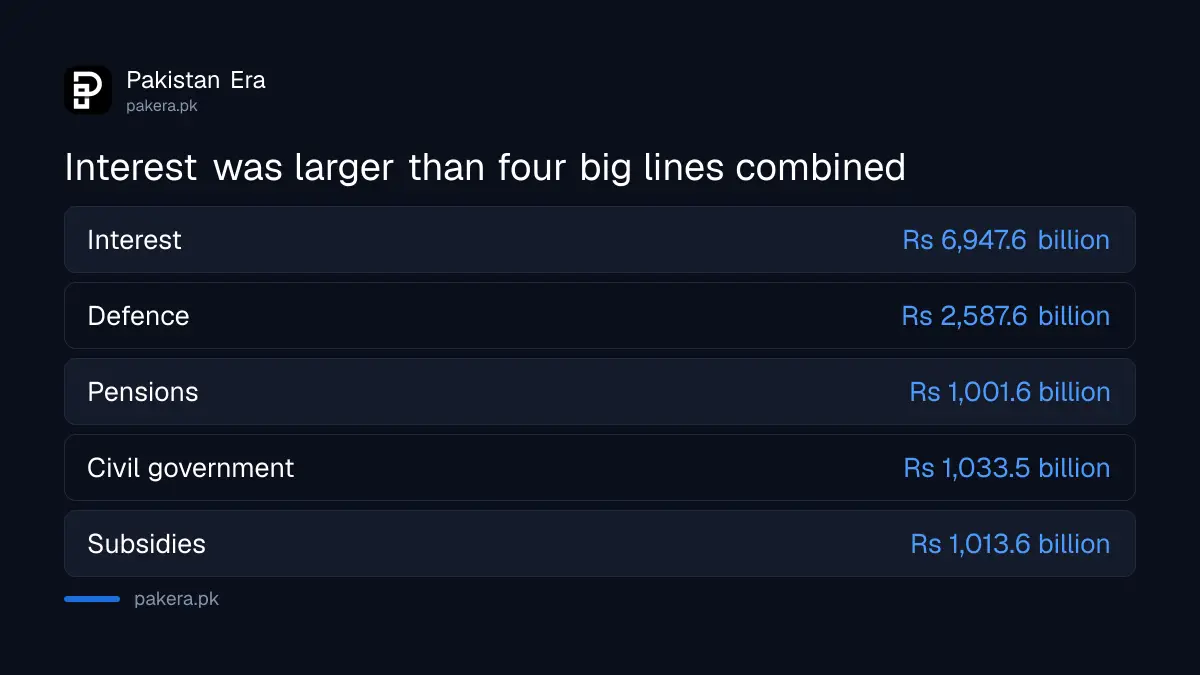
Interest cost more than four big lines combined
Defence, pensions, civil government running costs and subsidies add up to Rs 5,636.3 billion. Interest is Rs 1,311.3 billion above that total. The sum is our own arithmetic on the printed rows.
Defence cost Rs 2,587.6 billion, so interest was about 2.7 times defence. Pensions at Rs 1,001.6 billion were close to one seventh of the interest bill.
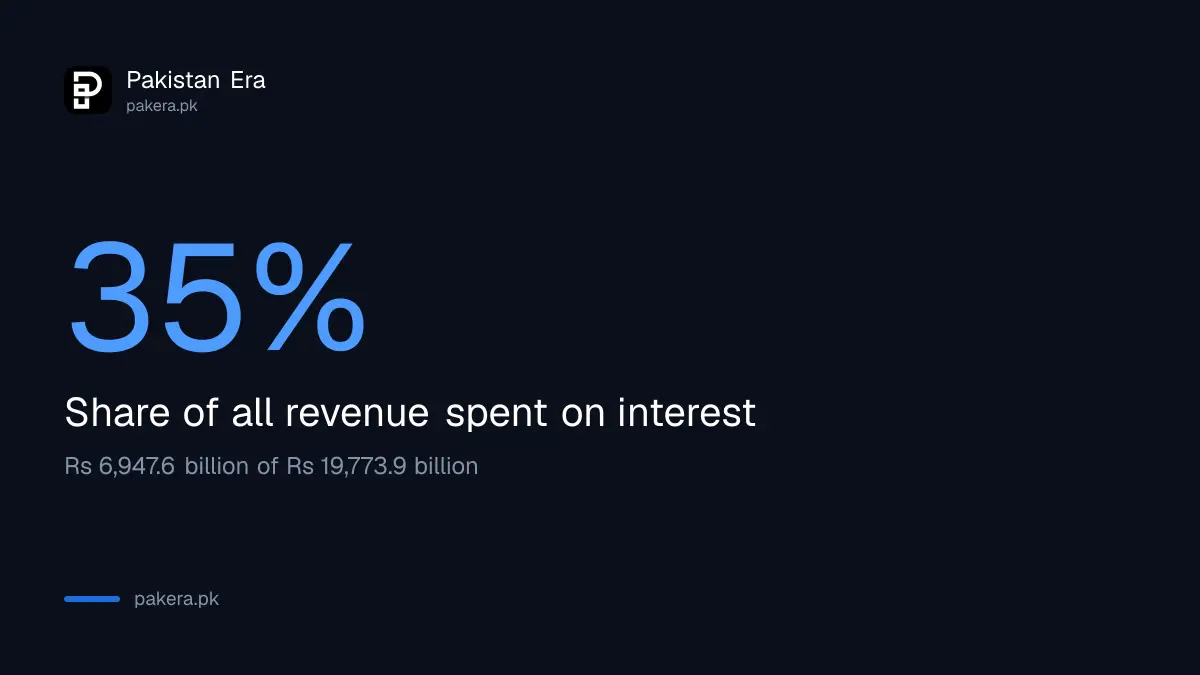
Interest took 35 percent of revenue and 53 percent of federal tax
Total revenue, federal and provincial, was Rs 19,773.9 billion. Interest of Rs 6,947.6 billion is 35.1 percent of that. Against federal tax revenue alone, Rs 13,010.4 billion, it is 53.4 percent.
We calculated both shares ourselves. The second is the one that matters to taxpayers, because provinces do not pay the federal debt. The wider picture of the debt stock is in the FY26 public debt review.
The State Bank's policy rate affects what the state pays on new borrowing, and what you pay on a loan, as we explained in what the policy rate does to your loan EMI.
Interest payments came in lumps through the year
The table gives running totals for each period. Subtracting one total from the next shows how much was paid in each quarter. The pattern is uneven, with the second and fourth quarters the heaviest.
| Quarter | Interest paid, Rs billion |
|---|---|
| July to September 2025 | 1,377.8 |
| October to December 2025 | 2,185.8 |
| January to March 2026 | 1,384.2 |
| April to June 2026 | 1,999.8 |
| Full year | 6,947.6 |
The quarterly figures are our own subtraction of the printed cumulative totals. The table does not explain the pattern, and we do not guess at the cause. Domestic debt took 86.8 percent of the full-year interest.
Subsidies came in below budget and development above
Subsidies were Rs 1,013.6 billion. The 2025-26 budget had provided Rs 1,186.0 billion, and the May revised estimate was Rs 1,157.0 billion. Spending finished Rs 172.4 billion under the original plan.
Development spending (PSDP) was Rs 3,428.4 billion in the consolidated table. Of that, the provinces spent Rs 2,700.9 billion and the federal government Rs 727.4 billion. The table lists a negative net lending to state companies of Rs 174.1 billion, which means repayments exceeded new loans.
- Interest: Rs 6,947.6 billion.
- Development spending: Rs 3,428.4 billion.
- Defence: Rs 2,587.6 billion.
- Grants to others: Rs 1,864.7 billion.
- Civil government, subsidies and pensions: about Rs 1,000 billion each.
That ranking is ours, drawn from the table, and puts interest first by a wide margin.
What this means for the next budget
The 2026-27 budget plans Rs 8,054 billion for federal interest, against a revised Rs 6,937 billion for 2025-26. The state cannot cut interest quickly because it is a contract with lenders, not a choice. That leaves the other lines to carry any saving.
For a household, a high interest bill is one reason the state asks for more tax and keeps development spending tight. It does not mean your own taxes pay interest line by line.
Interest cost about Rs 19 billion every day of the year
Interest of Rs 6,947.6 billion works out to about Rs 19.0 billion a day over 365 days. That is our own division of the printed total, not a figure in the table.
Domestic debt is the part owed to local banks and bond buyers. It made up Rs 6,030.4 billion, or 86.8 percent, of the interest. Foreign debt, owed to other countries and international lenders, cost Rs 917.2 billion. A change in local borrowing costs therefore moves the total far more than a change in foreign loan terms.
The table is provisional, which means the Finance Division may revise it when final accounts arrive.
Common questions
How much did Pakistan spend on interest in 2025-26?
Rs 6,947.6 billion, about Rs 6.95 trillion, in the Finance Division's provisional consolidated table.
What does mark-up mean?
Mark-up is the word Pakistani accounts use for interest. It is the cost of borrowing from banks, bond buyers and foreign lenders.
How much of revenue went on interest?
About 35 percent of total federal and provincial revenue. Against federal tax revenue alone it was about 53 percent.
How much did defence cost?
Rs 2,587.6 billion, 2.0 percent of GDP, in the same table.
Is domestic or foreign debt more costly?
Domestic. It cost Rs 6,030.4 billion in interest against Rs 917.2 billion for foreign debt.
Are these final figures?
No. The table is marked provisional and may be revised.
How we verified this
What we checked, where we read it, and what we could not confirm.
Last checked on 13 October 2026, Pakistan time. We read the July to June 2025-26 table on the Finance Division's Pakistan Fiscal Operations page and the 2026-27 figure in the Budget in Brief. The file carries a modified date of 13 August 2026. Shares and sums marked as ours are our own arithmetic.
About the author

Global Affairs & Political Economy Writer
Muhammad Hatim is a book lover who started writing because he enjoys it. At Pakistan Era he writes about international relations, geopolitics and the global economy, with a particular interest in South Asia and the forces behind current events.