What the SBP Policy Rate Actually Does to Your Loan EMI in Pakistan
The State Bank held its rate at 11.5 per cent again in September. Here is how that number turns into your car or home loan instalment, with worked numbers.
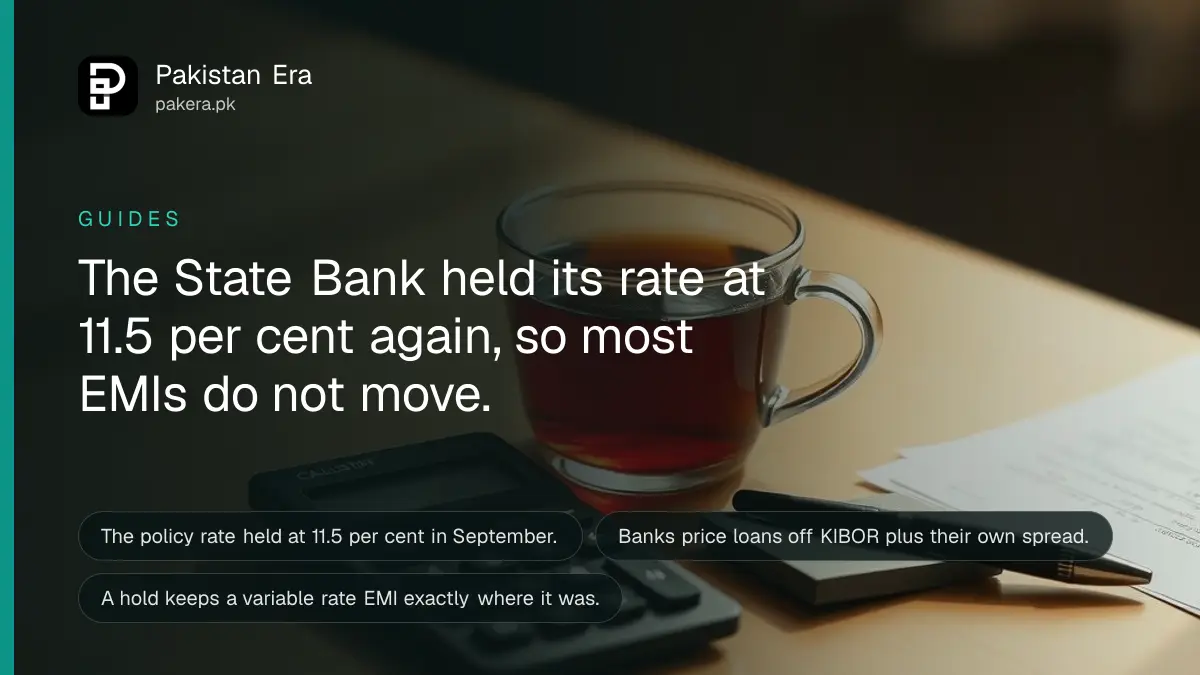
The State Bank of Pakistan held its policy rate at 11.5 per cent again at its Monetary Policy Committee meeting on 14 September 2026, the third straight hold since a rate hike in April. For most borrowers with a variable rate loan, that means your EMI, the equal monthly instalment on a car or home loan, has not moved either.
Update, 11 October 2026: SBP data shows broad money fell 4.82 per cent from July to September 2026.
What confuses people is the gap between the headline number and the figure that actually lands in their bank statement. The policy rate is not your loan's interest rate. It is the thing your loan's interest rate is built on top of.
We checked the rate decision history and the mechanics banks use to price a loan, current as of 4 October 2026.
The policy rate held at 11.5 per cent in September
The Monetary Policy Committee held the rate unchanged on 14 September 2026, after also holding it on 27 July 2026. Both holds followed a 100 basis point increase on 27 April 2026, which took the rate to 11.5 per cent. The next scheduled decision is 26 October 2026.
| Decision date | What happened |
|---|---|
| 27 April 2026 | Raised 100 basis points, to 11.5 per cent |
| 27 July 2026 | Held at 11.5 per cent |
| 14 September 2026 | Held at 11.5 per cent |
Three decisions, one direction of travel: steady. That steadiness is exactly why your EMI has not moved either, if your loan is on a variable rate.
Why the policy rate is not your loan's interest rate
The policy rate is the rate the State Bank charges commercial banks for short term lending. It is a ceiling on the system, not a retail price. Nobody walks into a branch and borrows at 11.5 per cent.
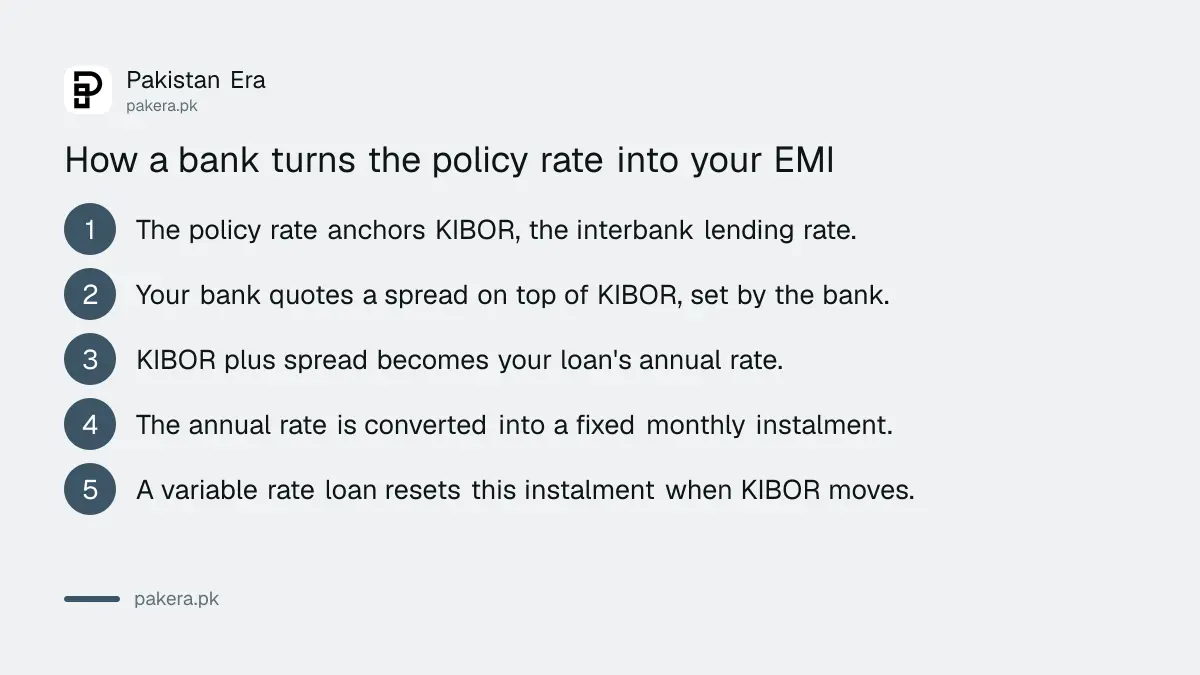
What actually prices your loan is KIBOR, the Karachi Interbank Offered Rate, the rate banks charge each other. KIBOR tracks the policy rate closely, because it is anchored by it, but it is not identical to it. Your bank then adds its own spread on top of KIBOR, and that combined figure becomes your loan's annual rate.
So the chain runs: policy rate shapes KIBOR, KIBOR plus the bank's spread becomes your loan rate, and your loan rate converts into a fixed monthly instalment through a standard amortisation formula. Four steps, and the policy rate is only the first one.
A worked example: what an EMI actually looks like
Say a bank prices a car loan at an illustrative annual rate of 17 per cent, a figure we are using purely to show the arithmetic, not a rate any specific bank is currently advertising. For an exact, current rate card, our guide to what a car loan actually costs carries figures we sourced directly from lenders.
- Borrow Rs 2,000,000 over 5 years, at an illustrative 17 per cent annual rate.
- Convert the annual rate to a monthly rate: 17 divided by 12, about 1.42 per cent a month.
- Apply the standard EMI formula banks use for equal monthly instalments.
- The result is roughly Rs 49,700 a month, repeated for 60 months.
- Total repayment over the term comes to roughly Rs 2.98 million, against Rs 2 million borrowed.
Move the rate up or down by even one percentage point and that monthly figure shifts by a few hundred rupees. That is the entire point of this article: small moves in the underlying rate turn into real, felt changes in what leaves your account every month.
A worked example for a home loan
Home loans run longer, so the same logic compounds further. Borrow Rs 8,000,000 over 20 years at an illustrative 16 per cent, again purely for the arithmetic, and the EMI works out to roughly Rs 111,300 a month.
Over 20 years, that is close to Rs 26.7 million repaid against Rs 8 million borrowed, almost all of it interest in the early years of the loan. Our guide to how banks decide your home loan covers the eligibility side of this same decision, which matters as much as the rate itself.
A hold does not mean your EMI falls
This is the mix-up we see most often. People hear "held" three times and expect their instalment to shrink three times. A hold means the rate stayed where it was, not that it came down.
A variable rate loan's EMI only drops when the policy rate itself is cut, which pulls KIBOR down with it at the next reset date written into your loan contract. A fixed rate loan does not move during a hold or a cut or a hike, because its rate was locked at the start.
What actually changes your EMI
Four things move an EMI, and a hold is not one of them. A cut or a hike in the policy rate, if your loan is variable. A change in your bank's own spread, which is set at the bank's discretion and is worth negotiating before you sign. A change in the loan term, since stretching 5 years to 7 lowers the monthly figure but raises the total interest paid. And extra principal payments, which shrink the balance the interest is calculated on, regardless of what the State Bank does next.
Of those four, the spread is the one borrowers argue over least and should argue over most. It is not set by the central bank, and two people with identical loans at the same bank can end up with different spreads depending on how hard they pushed.
Common questions
What is the SBP policy rate right now?
11.5 per cent, held at the Monetary Policy Committee meeting of 14 September 2026, the same level set after a hike on 27 April 2026.
Does a policy rate hold mean my EMI goes down?
No. A hold keeps your instalment roughly where it already was. Your EMI only falls when the policy rate itself is cut.
What is KIBOR and why does my loan use it instead of the policy rate?
KIBOR is the rate banks charge each other, anchored by the policy rate but not identical to it. Banks price loans off KIBOR plus their own added spread.
Can I negotiate my loan's interest rate?
You can negotiate the spread your bank adds on top of KIBOR. That part is the bank's own decision, not the central bank's.
When is the next policy rate decision?
26 October 2026, according to the State Bank's own published calendar for the current financial year.
How we verified this
What we checked, where we read it, and what we could not confirm.
Last checked 4 October 2026. We tried to fetch sbp.org.pk's own monetary policy and press release pages directly and were blocked with an HTTP 403 response on each attempt, so the current rate and decision dates in this article are corroborated through the State Bank's own published MPC calendar for the current financial year and multiple independent news reports of the 14 September 2026 decision, cross checked against the corridor rates sbp.org.pk itself returned in a search result snippet, 11.50 per cent policy rate, 12.50 per cent reverse repo ceiling, 10.50 per cent floor, matching what our earlier coverage read directly from the live site in August. The worked EMI examples use an explicitly illustrative interest rate for the arithmetic and are not a claim about any specific bank's current rate card. Nothing here is financial advice.
Work it out yourself
Check what the current rate means for a car loan at every bank.
Car Loan Calculator →Check the same for a home loan.
Home Loan Calculator →About the author

Tax, Bills and Technology Writer
Ali Akhtar is a young and curious voice here at Pakistan Era. He is currently pursuing his A-Levels and has a growing interest in Pakistan’s changing industrial landscape and educational trends. Ali likes to write in a way that helps him explain and explore the world around him. His writing reflects the perspective of the new generation navigating the evolving trends of Pakistan where technology, youth innovation, and shifting opportunities are reshaping the country’s future.