Check Livestock in Pakistan: 55.86 Million Cattle and 95.83 Million Goats in the 2024 Census
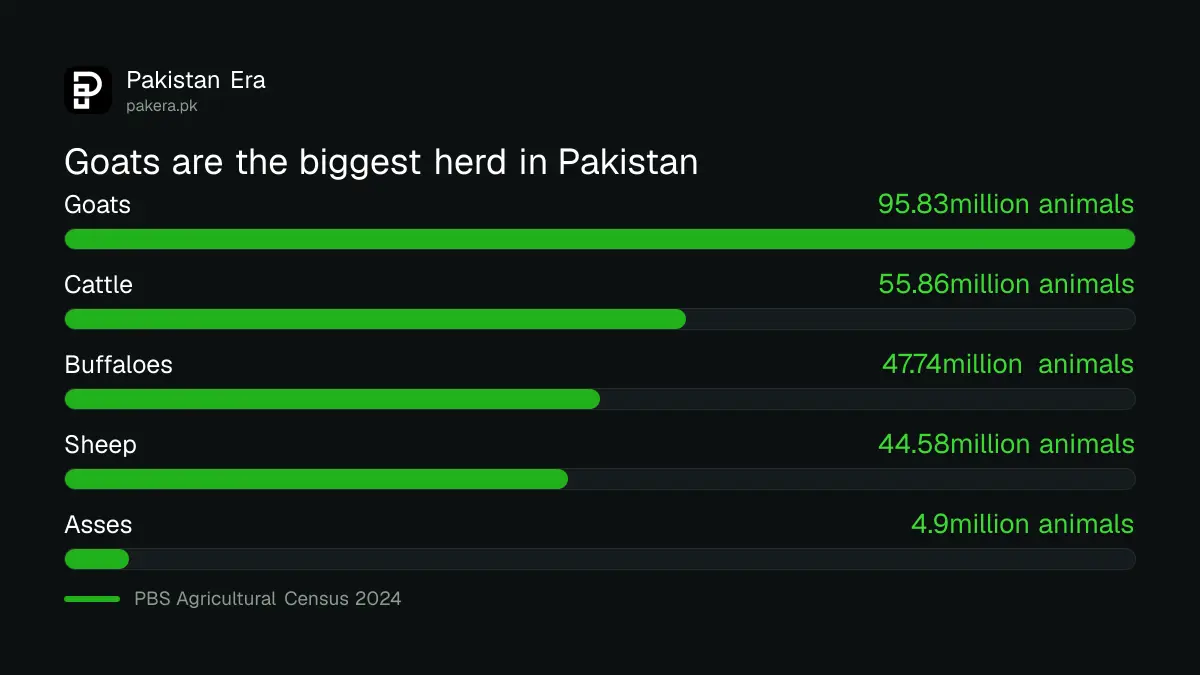
The 2024 Agricultural Census counted 55.86 million cattle, 47.74 million buffaloes, 44.58 million sheep and 95.83 million goats. See each province's share.
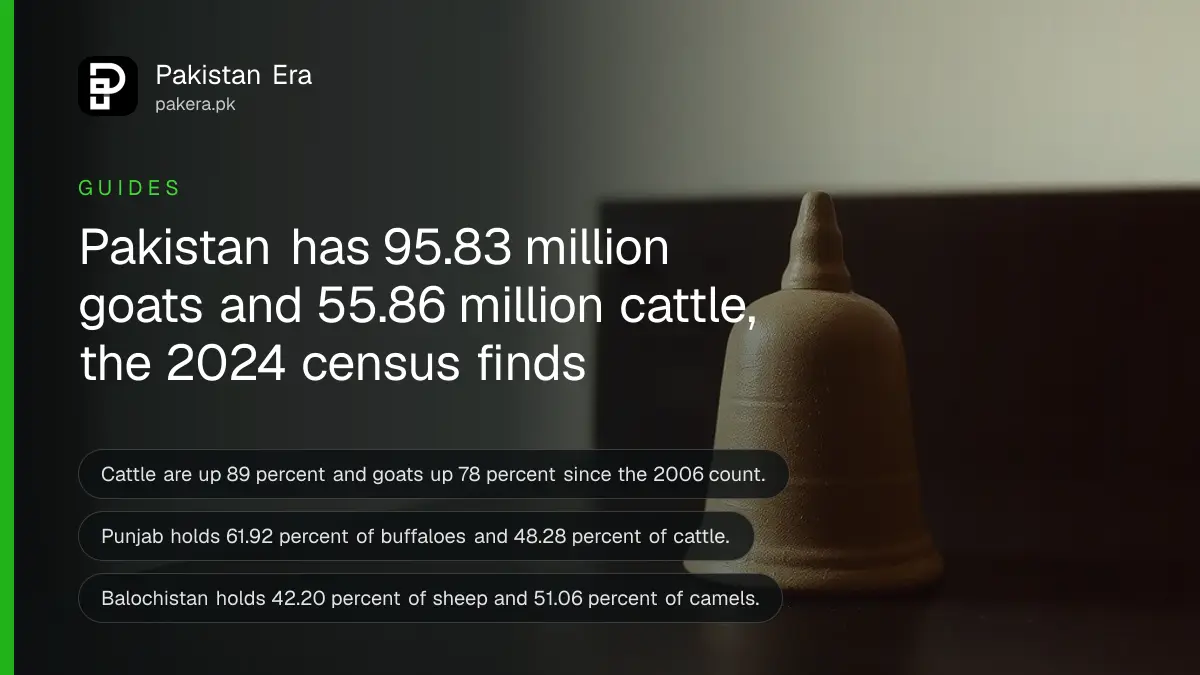
Short answer: Pakistan's Agricultural Census 2024 counted 55.86 million cattle, 47.74 million buffaloes, 44.58 million sheep and 95.83 million goats. Goats are the biggest herd. Cattle are up 89 percent and goats 78 percent since the last livestock census in 2006.
If you keep two buffaloes in a village courtyard, you are part of the largest count of animals the Pakistan Bureau of Statistics (PBS) has ever made. Its census team visited homes with tablets and asked each household what it owned. The results are now public.
We opened the PBS National Report of the 7th Agricultural Census 2024 (June 2026) on 14 October 2026 and read its livestock findings, Tables 9 to 14 in the main findings and Tables 1.0 and 7.1 in the annex. Sums and shares we worked out ourselves are marked "our sum".
Pakistan has 244 million cattle, buffaloes, sheep and goats
Adding the four main herds gives 244.01 million animals (our sum). Goats lead with 95.83 million, then cattle at 55.86 million, buffaloes at 47.74 million and sheep at 44.58 million. Goats alone are 39 percent of that total (our sum).
| Animal | Census 2024 | Livestock Census 2006 | Change |
|---|---|---|---|
| Goats | 95,827,177 | 53,786,988 | +78% |
| Cattle | 55,862,560 | 29,558,812 | +89% |
| Buffaloes | 47,738,368 | 27,334,985 | +75% |
| Sheep | 44,584,926 | 26,487,741 | +68% |
| Camels | 1,511,340 | 920,868 | +64% |
| Asses (donkeys) | 4,899,392 | 4,268,472 | +15% |
The 2006 column comes from the earlier Livestock Census that PBS prints beside the new count. The census is the first since then, so the gap spans 18 years.
Cattle grew 89 percent and male buffaloes grew five times
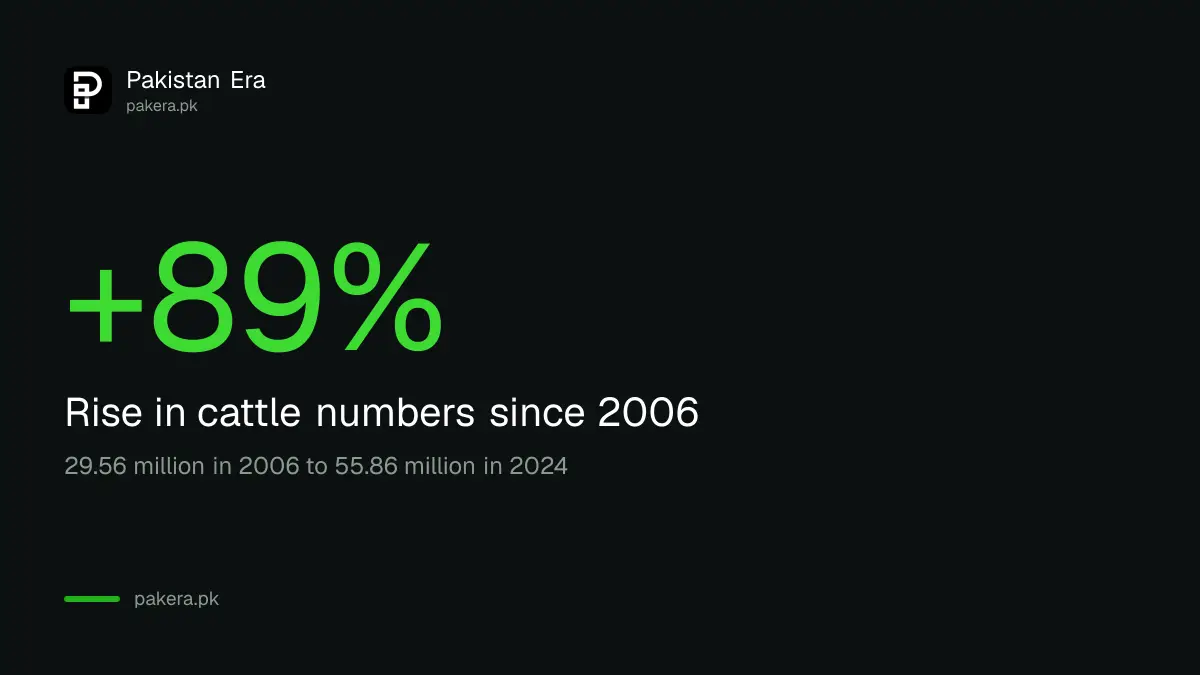
Cattle rose from 29.56 million in 2006 to 55.86 million in 2024, up 89 percent. Cows aged three years and above grew 112 percent, to 32.13 million. Male buffaloes aged three and above grew 412 percent, from 609,956 to 3,122,164.
PBS does not explain the male buffalo jump. It only prints the counts. Different survey methods across 18 years can also move the numbers, so treat the exact percentages as a guide and not as proof of a farming trend.
Bullocks, the male cattle used for ploughing and carting, grew 77 percent to 7.36 million. That is a slower rise than cows. The same census counted 986,998 tractors, so the two numbers can be read side by side.
Animals in milk have almost doubled since 2006
PBS counted 20.93 million cattle and 21.56 million buffaloes in milk on the day of the count. Together that is 42.49 million milk animals (our sum). In-milk cattle rose 140 percent since 2006, and in-milk buffaloes rose 111 percent.
The census counts animals in milk on one day, not milk produced. It does not tell you how many litres a day the herd gives. For milk and meat output, read the national accounts, which use different methods.
A small herd owner still earns more from careful feeding and health care than from adding animals. Punjab runs a free treatment line and a livestock loan card. See free animal treatment in Punjab and how to apply for the Punjab Livestock Card.
Punjab leads in cattle and buffaloes, Balochistan in sheep and camels
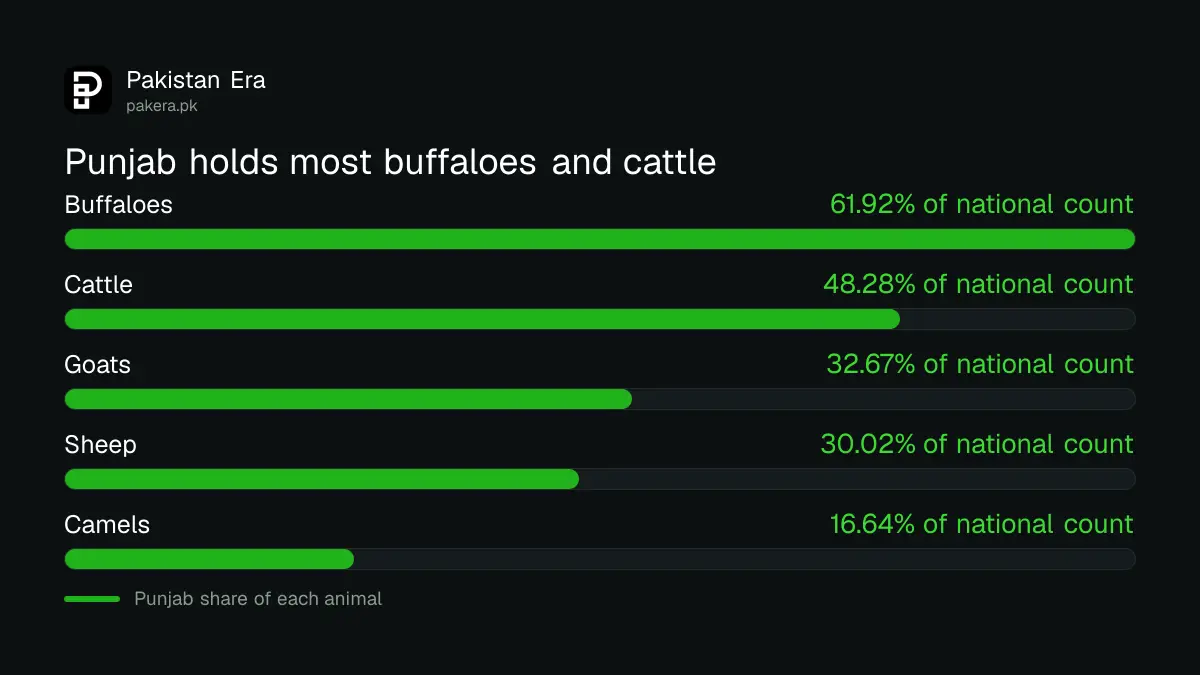
Punjab holds 48.28 percent of Pakistan's cattle, 61.92 percent of its buffaloes and 32.67 percent of its goats. Balochistan holds 42.20 percent of sheep and 51.06 percent of camels. Sindh is second for buffaloes at 28.19 percent.
| Province | Cattle | Buffaloes | Sheep | Goats | Camels |
|---|---|---|---|---|---|
| Punjab | 48.28% | 61.92% | 30.02% | 32.67% | 16.64% |
| Sindh | 20.06% | 28.19% | 10.64% | 19.84% | 24.16% |
| Khyber Pakhtunkhwa | 24.18% | 8.24% | 17.13% | 23.47% | 8.11% |
| Balochistan | 7.29% | 1.39% | 42.20% | 23.88% | 51.06% |
Each column shows a province's share of the national count of that animal. Islamabad holds under 0.3 percent of each. The pattern fits the land: canals and fodder in Punjab and Sindh, open rangeland in Balochistan.
Donkeys, camels and horses still do work in Pakistan
PBS counted 4.90 million asses, 1.51 million camels, 553,256 horses and 296,135 mules. Camels are up 64 percent since 2006, horses 61 percent and mules 90 percent. Asses grew only 15 percent. Punjab holds 49.05 percent of the asses.
These animals pull carts, carry loads in the mountains and move goods where trucks cannot go. They have no insurance, little veterinary cover and are rarely in any scheme. A loan against them is not usually possible.
For meat, the picture is separate. The government has drafted duty-free import of animals for fattening, which is explained in the FBR draft on live animals for fattening and meat export.
Check your own herd against the census
You can place your own herd against the national numbers in a few minutes. The census does not give owner level data, so this is a self check, not an official ranking. You need your animal count and your province.
- Count your animals by type: cattle, buffaloes, sheep, goats.
- Note which of them are in milk, and which are young stock under three years (cattle) or one year (sheep and goats).
- Compare your province's share in the table above with your own herd's mix.
- Call your district livestock office to ask about vaccination days and free treatment for the animals you own.
- Keep a written count each year, since support schemes often ask for it.
In Khyber Pakhtunkhwa, mobile clinics visit farms. Read how the KP mobile veterinary clinics work before you travel to a town for care.
Common questions
How many animals are there in Pakistan?
The census counted 55.86 million cattle, 47.74 million buffaloes, 44.58 million sheep and 95.83 million goats. That is 244.01 million in the four main herds (our sum).
Which animal is most common in Pakistan?
Goats, at 95.83 million. That is close to the 103.60 million cattle and buffaloes put together (our sum).
Which province has the most buffaloes?
Punjab, with 61.92 percent of the national count. Sindh is second at 28.19 percent.
How many donkeys does Pakistan have?
PBS counted 4,899,392 asses. The text in the report rounds this to 4.90 million in one place and 4.80 million in another, so we use the table figure.
Is the livestock census the same as milk production?
No. It counts animals on the day of the visit. It does not measure how much milk or meat they produce.
When was the last livestock count before this one?
The 4th Livestock Census was in 2006. PBS compares the 2024 census with it.
How we verified this
What we checked, where we read it, and what we could not confirm.
Last checked on 14 October 2026, Pakistan time. We read the PBS "Agricultural Census 2024, National Report" (PDF dated June 2026), linked from the PBS Agricultural Census page. Tables 9 to 14 hold the 2006 and 2024 counts, and Table 9 holds the provincial shares. PBS says figures may not add because of rounding. The census does not give milk or meat output, and it does not say why numbers changed. We did not compare with other surveys.
About the author

Global Affairs & Political Economy Writer
Muhammad Hatim is a book lover who started writing because he enjoys it. At Pakistan Era he writes about international relations, geopolitics and the global economy, with a particular interest in South Asia and the forces behind current events.