Request a Video Link Hearing in the Supreme Court of Pakistan: Form, 2 Day Rule and Limits
Skip the trip to Islamabad: how to request a Supreme Court of Pakistan video link hearing from Karachi, Lahore, Peshawar or Quetta, the form and the 2 day rule.
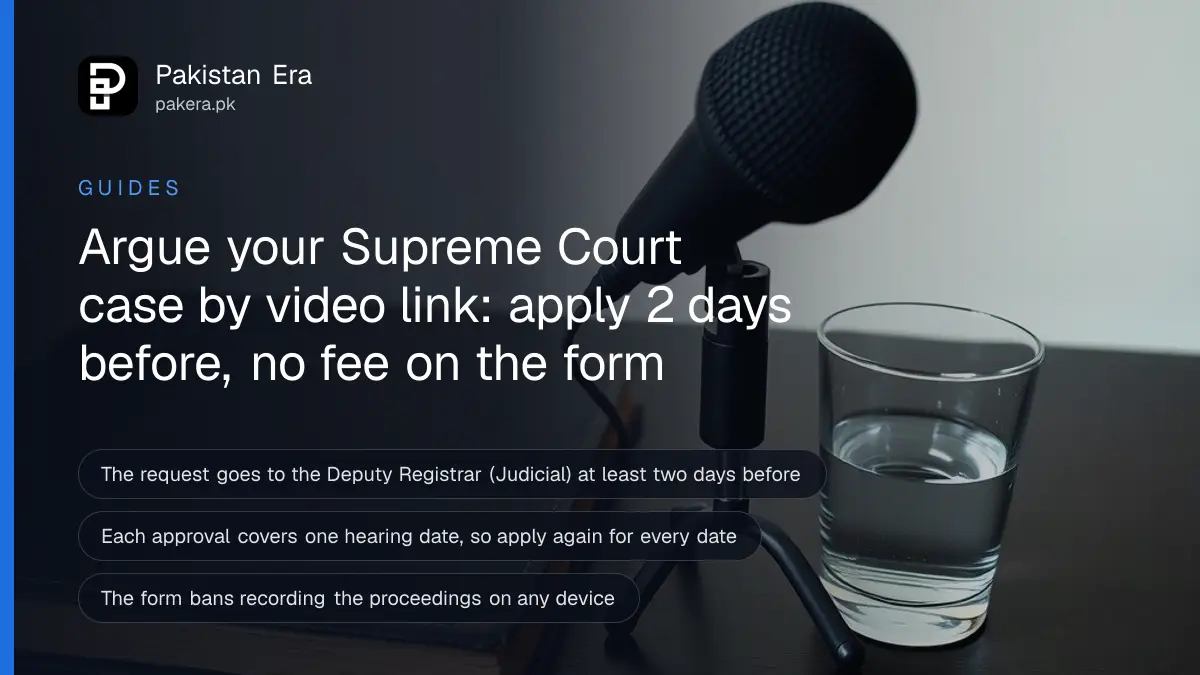
You can ask to argue your Supreme Court of Pakistan case by video link from Karachi, Lahore, Peshawar or Quetta instead of travelling to Islamabad. Fill in the Court's Video Link Request Form and send it to the Deputy Registrar (Judicial) at least two days before the hearing, with a genuine reason. There is no fee on the form.
The facility is a privilege, not a right. Slots go first come, first served, and each request covers only one hearing date. We read the Court's Standard Operating Procedure (SOP) and the request form, both on the Supreme Court's website, on 10 October 2026.
Who can ask for a Supreme Court video link hearing
An advocate, or a petitioner arguing their own case, can request a video link once the Court has issued the cause list with the case on it. The request must give a "sufficient, valid, genuine and justifiable" reason, such as age, illness or a long journey.
The Supreme Court sits at its principal seat in Islamabad and at four branch registries, in Karachi, Lahore, Peshawar and Quetta. A video link joins your registry to the courtroom where the bench sits. You still go to a court building, just the one nearer to you.
The Court has been using this more. On 28 September 2026 it held hearings that joined Islamabad with Peshawar, Mingora, Quetta, Karachi and Lahore on one day, using fully digital case files, according to its press release No. 157. And since 9 October 2026, its new Smart Judicial Assistant also answers questions about video link arrangements.
How to request a video link hearing in five steps
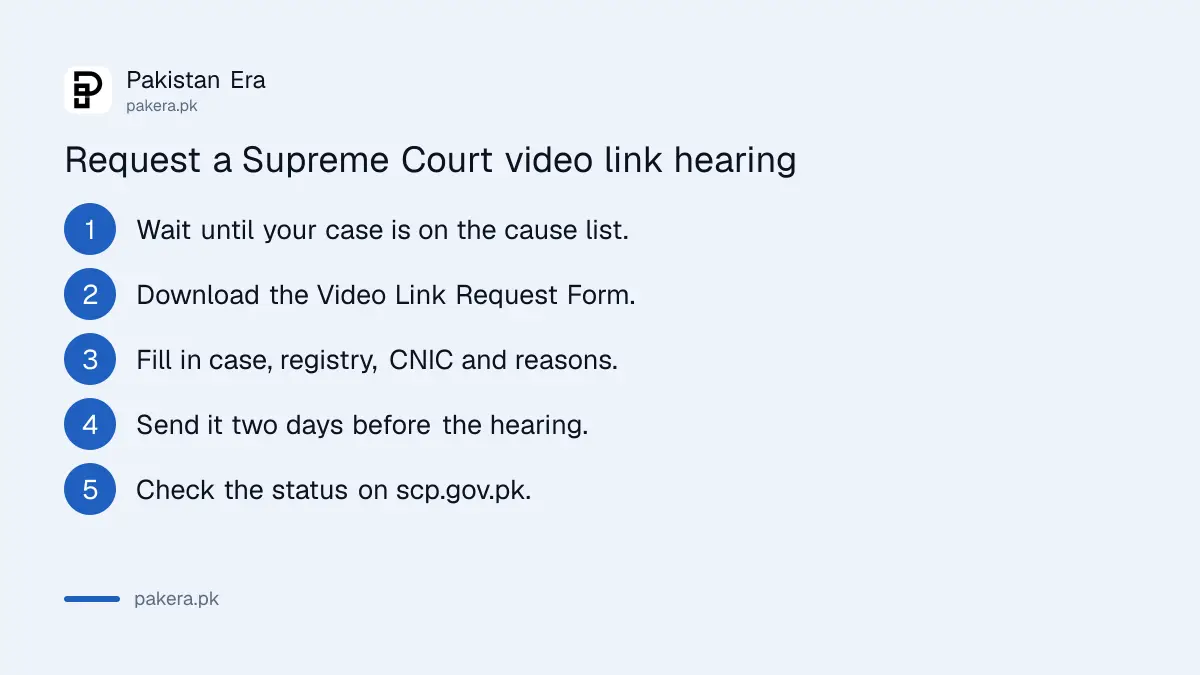
Wait for the cause list, fill in the Video Link Request Form, sign the undertaking, and send it to the Deputy Registrar (Judicial) at least two days before the hearing. Then check whether it was approved, and apply again for every later date.
- Check the cause list. A request can only be made after your case appears on an issued cause list. You can check a court case status online by case number to see when it is fixed.
- Download the Video Link Request Form. It is on the Supreme Court's Video Link Case Hearing page, next to the SOP.
- Fill in every field. The form asks for the request date, the registry you will appear from and the one hearing the case, the case number and title, the bench and hearing date, the advocate's or petitioner's name and CNIC, the AOR's SCP ID, up to three reasons, an address and a mobile number.
- Sign the undertaking and send it. Address it to the Deputy Registrar (Judicial). Make sure it reaches the office at least two days before the hearing date.
- Check the status. The Court's Public Facilitation portal on scp.gov.pk shows early hearing and video link application status.
The AOR's SCP ID is the Supreme Court's identity number for your Advocate on Record, the lawyer who files papers in the Court on your behalf. If you are arguing your own case, leave it blank and give your CNIC.
Reasons the Court accepts, and the ones it rejects
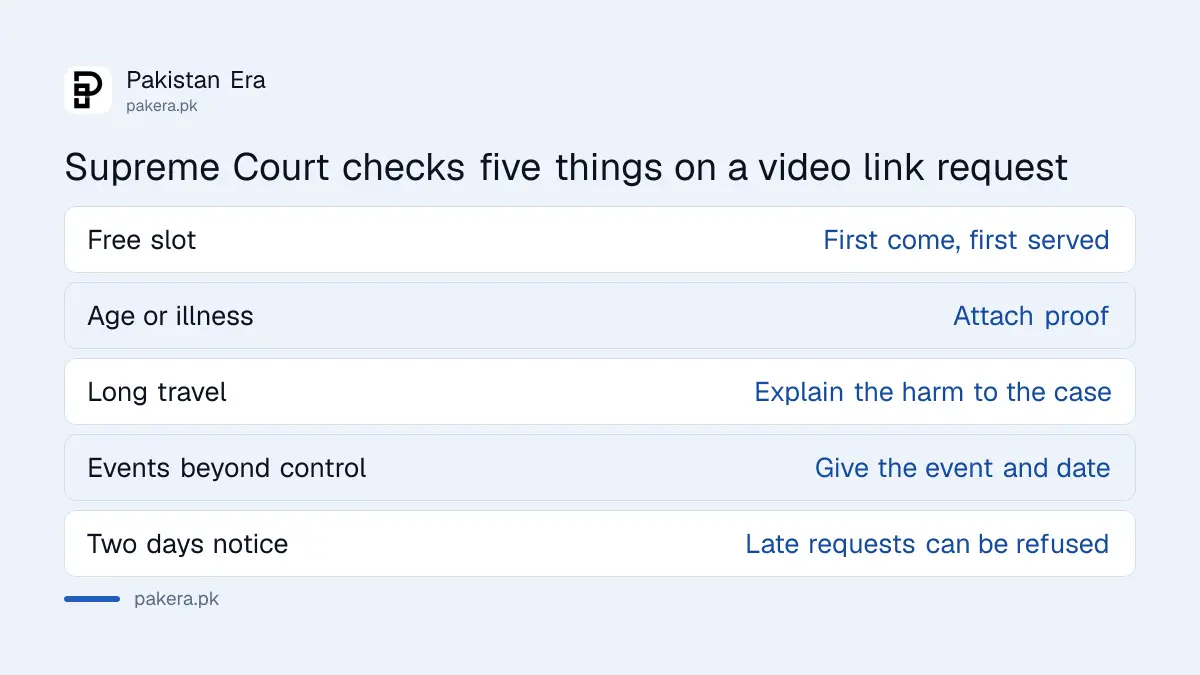
The SOP lists what officers weigh: whether a slot is free on that date, the person's age or a genuine medical reason, whether travel would take so long that the case suffers, and events beyond anyone's control. A late request, or a vague reason, can be rejected without a hearing.
| What the SOP looks at | What it means for you |
|---|---|
| Slot available, first come first served | Apply as early as the cause list allows |
| Age or a genuine medical reason | Attach a medical note or proof of age |
| Long travel to Islamabad | Explain why the trip would harm the case |
| Circumstances beyond control | State the event and its date |
| Filed two days before the hearing | A late request can be refused outright |
Our advice: write the reason as a fact, not a plea. "Counsel is 74 and has a cardiac condition, certificate attached" will do better than "it is very difficult to travel".
Limits written into the SOP
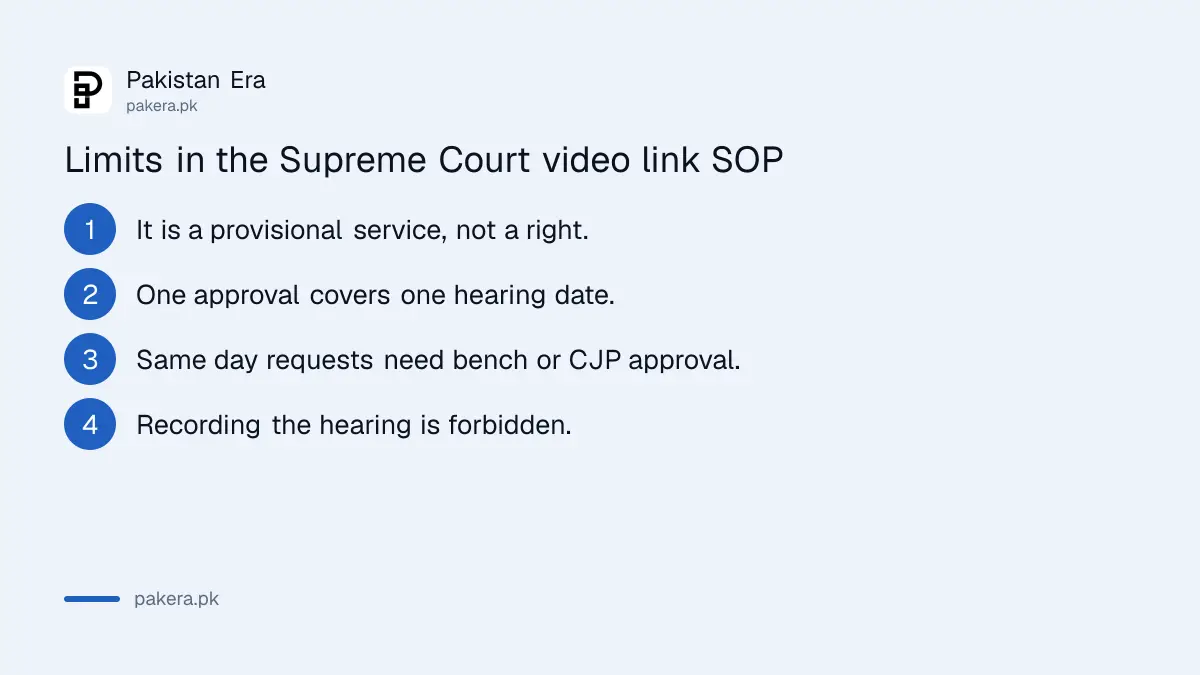
The SOP says video link is "a provisional service" that no lawyer or litigant can "claim as a matter of right". It also contains limits on benches, on Peshawar and on same day requests. Some of these may now be out of date, as the next paragraphs explain.
- Benches. The SOP says video link is available "for the time being" only for cases fixed before Bench I to IV.
- Peshawar. It says requests from the Peshawar registry are not entertained except in hardship, with preference to Karachi, Lahore and Quetta because they are farther from Islamabad.
- Same day requests. These are entertained only if the Chief Justice or the bench approves.
- One date only. Each approval covers one hearing date. You must apply afresh for every later hearing.
The SOP carries no date, and the page holding it was first posted in 2021. The 28 September 2026 hearings included a judge sitting at the Peshawar registry and counsel joining from Mingora, so the Peshawar limit is plainly not applied rigidly today. Ask the Deputy Registrar's office or your AOR which limits still apply before you rely on them.
The undertaking you sign, and what it forbids
The form ends with an undertaking that the information is true and that you will not record the proceedings on any device or make them public on any platform. Breaking it can lead to action "under the applicable laws".
That means no screen recording and no phone clips for social media, even of your own case. The Court streams some proceedings itself, but that is its decision, not yours.
If what you really need is an earlier date rather than a remote one, that is a separate application. The Court has a policy to apply for an early hearing in the Supreme Court, with its own proof rules. And if you cannot afford a lawyer to argue by video link at all, the 1818 helpline now refers people for free legal aid through a Bar Council.
Common questions
Is there a fee for a Supreme Court video link hearing?
The form and the SOP mention no fee. Your lawyer may still charge for the request and the appearance.
How early must I apply for a video link?
At least two days before the hearing, after the cause list is issued. Same day requests need approval from the Chief Justice or the bench.
Can a litigant without a lawyer use video link?
Yes. The SOP allows a petitioner in person to request it, using their own name and CNIC on the form.
Can I join a Supreme Court hearing from home?
The SOP describes links between the Court's registries, not homes. Plan to appear from the nearest branch registry unless the Court tells you otherwise.
Does one approval cover all my hearings?
No. Each request covers one hearing date. You must apply again for every later date.
Where do I check if my video link request was approved?
On the Public Facilitation portal at scp.gov.pk, or by asking the Smart Judicial Assistant at sja.scp.gov.pk.
How we verified this
What we checked, where we read it, and what we could not confirm.
Last checked 10 October 2026, about 9:30 pm PKT. The rules, criteria, limits and form fields are from the Supreme Court's Video Link Case Hearing page, its Standard Operating Procedure for Video Link Facility and its Video Link Request Form, which we read in full. The multi-city hearings are from Supreme Court press release No. 157 of 28 September 2026. Status is checked on the Court's Public Facilitation portal. The SOP is undated, so some limits may have changed.
About the author

Tax, Bills and Technology Writer
Ali Akhtar is a young and curious voice here at Pakistan Era. He is currently pursuing his A-Levels and has a growing interest in Pakistan’s changing industrial landscape and educational trends. Ali likes to write in a way that helps him explain and explore the world around him. His writing reflects the perspective of the new generation navigating the evolving trends of Pakistan where technology, youth innovation, and shifting opportunities are reshaping the country’s future.