Apply for an Early Hearing in the Supreme Court of Pakistan: Proof Needed, Result in 3 Days
How to apply for an early hearing in the Supreme Court of Pakistan: who must file it, the proof of urgency it needs, the 3 day result and cases that skip it.
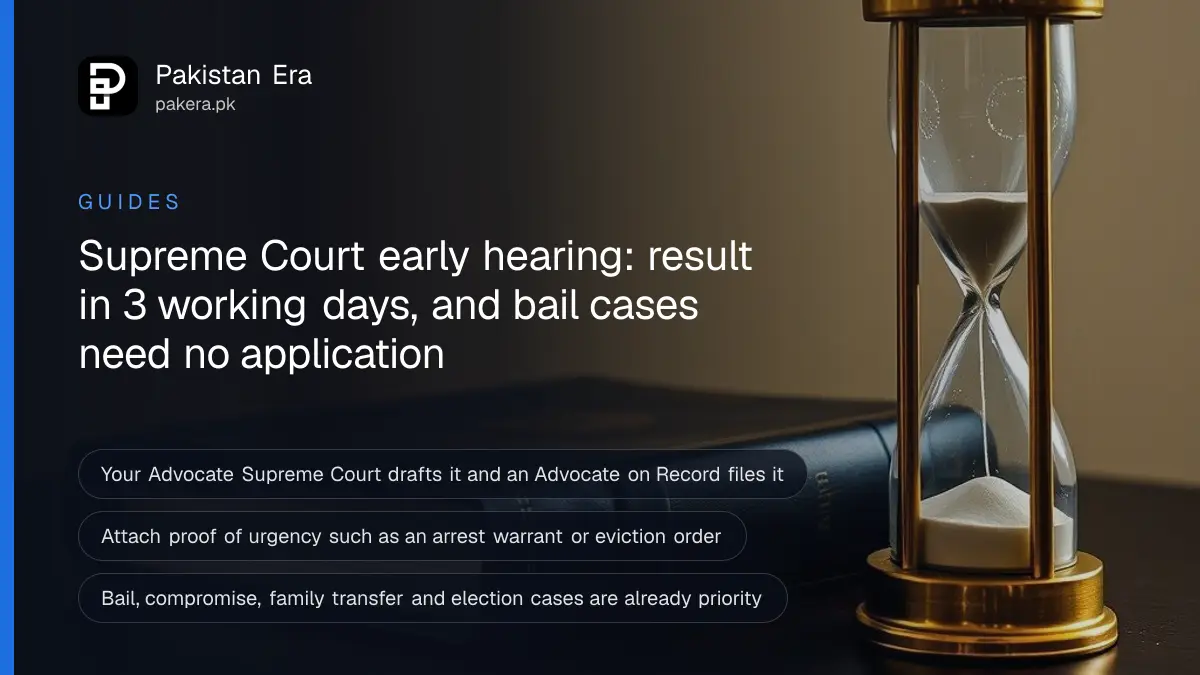
To get an early hearing in the Supreme Court of Pakistan, your Advocate Supreme Court must draft an application for out of turn fixation, file it through an Advocate on Record, and attach proof of urgency such as an arrest warrant or an eviction order. The Court posts the result on its website within three working days.
Some cases need no application at all. Bail, compromise, family transfer and election cases are already treated as priority. The rules come from the Court's Policy for Early Hearing, last amended on 16 January 2026, which we read in full in English and Urdu.
Five kinds of cases are fixed early without any application
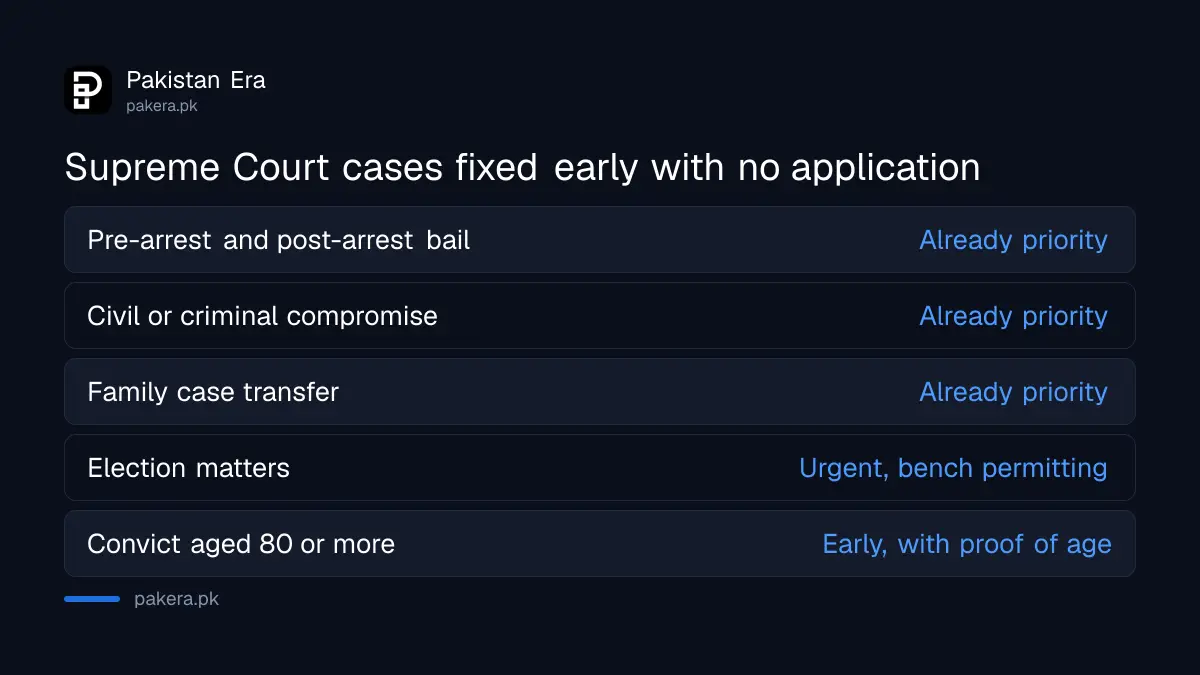
Bail petitions, compromise cases, family transfer cases and election cases are fixed on priority automatically. A criminal appeal by a convict aged 80 or over is fixed early once proof of age is given. For these, an early hearing application is not needed.
Many litigants pay for an application they do not need. Check this list first.
| Type of case | Early hearing application needed? |
|---|---|
| Bail before arrest (BBA) and post arrest bail | No, already priority |
| Compromise in a civil or criminal case | No, already priority |
| Transfer of family case proceedings or decrees | No, already priority |
| Election matters | No, fixed urgently when a bench is available |
| Criminal case of a convict aged 80 or more | No, but proof of age is required |
| Any other case | Yes, with grounds and proof of urgency |
Election matters are fixed "on urgent basis", the policy says, but still in date order and only when the right bench is available.
How to apply for an early hearing in the Supreme Court
The application must be written by your Advocate Supreme Court, filed through an Advocate on Record, and backed by documents that prove the urgency. A litigant cannot simply write a letter to the Registrar asking for a date.
Two terms first. An Advocate Supreme Court (ASC) is a lawyer enrolled to argue before the Supreme Court. An Advocate on Record (AOR) is the lawyer who files papers in the Court's office on your behalf. Sometimes one lawyer is both.
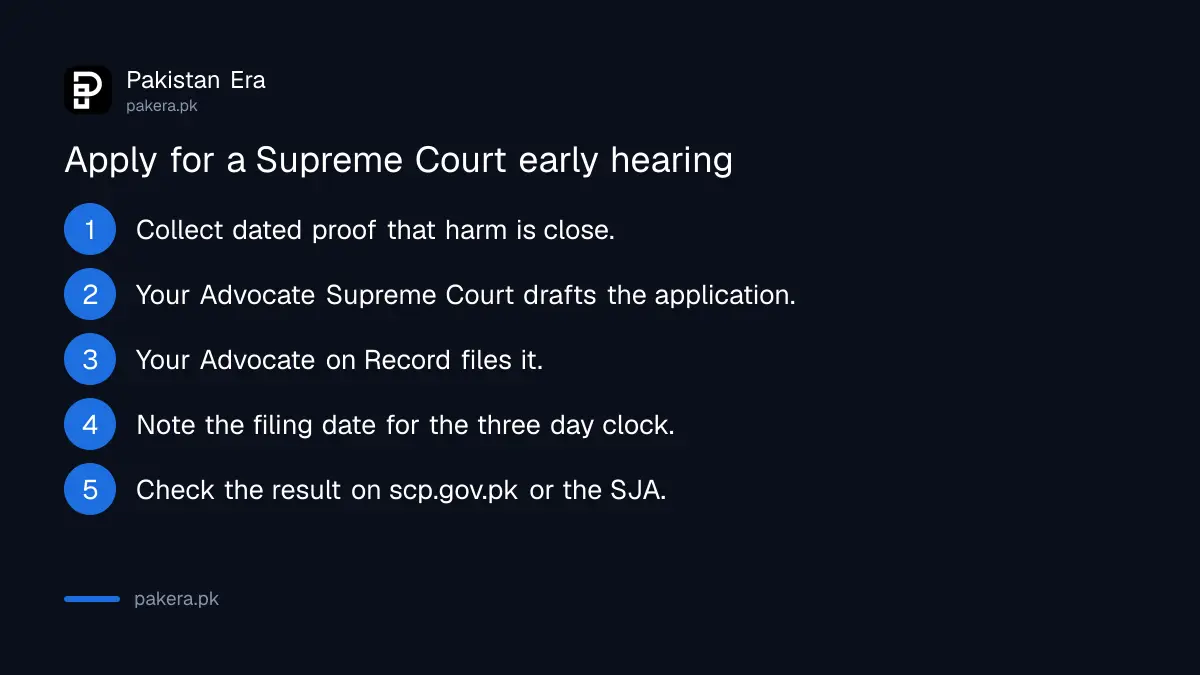
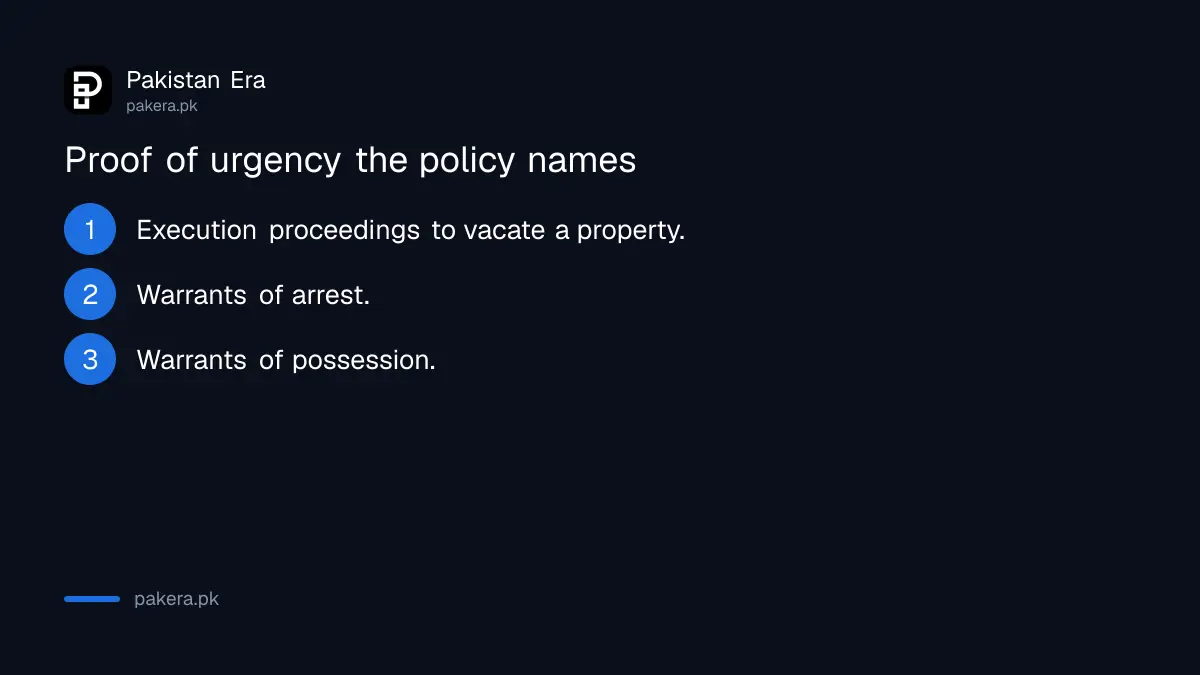
- Collect proof of urgency. The policy names examples: copies of execution proceedings to vacate a property, warrants of arrest and warrants of possession.
- Ask your ASC to draft the application. The policy says it "must be drawn by the ASC himself". It must state the grounds for urgency.
- File it through your AOR. The AOR files it at the principal seat in Islamabad or the branch registry where your case is.
- Note the filing date. The three working day clock for the result starts from filing.
- Check the result online. Open the Early Hearing Status page on scp.gov.pk, or ask the new Smart Judicial Assistant.
Grounds that count as urgent, and grounds that do not
Urgency means harm that a normal wait would make permanent. Losing your house to an eviction, an arrest warrant or a court order to take possession of property are the policy's own examples. A wish for a quicker result is not enough.
On 9 October 2026 the Chief Justice told the Supreme Court Bar Association that early hearing requests "must be supported by cogent and justifiable grounds". He also said the Registrar is competent to approve the processing of these applications. In plain words, a court officer screens them before any bench sees them.
Weak applications tend to repeat the case's merits. That is the wrong focus. The Registrar is not deciding who is right. The question is only whether waiting will cause damage that cannot be undone, so lead with the dated document that shows the threat.
The result comes in three working days, and a refusal needs fresh grounds
The Court notifies the fate of each early hearing application on its website within three working days of filing. If it is turned down, you can apply again only with fresh grounds and solid proof of urgency. Refiling the same application will not work.
The Urdu text of the policy adds that a second application can be filed only after a gap of at least 15 days, with new grounds. The English text does not state that gap. Ask your AOR which reading the office applies before you plan around it.
Some good news on the backlog. The Chief Justice said on 9 October that 192 pending early hearing applications had been fixed before the afternoon bench at 1:00 pm, and fresh cases would now be listed there. Recent applications should face a shorter queue than older ones did.
If you only want to know where your case stands, you do not need an application. You can check a court case status online by case or diary number, or ask the Supreme Court Smart Judicial Assistant, which also reports early hearing status.

What an early hearing application costs
The policy sets no separate government fee for an early hearing application, and none is listed beside it on the Court's website. The real cost is your lawyer's fee for drafting and filing it. Agree that fee in writing before the work starts.
If you cannot pay a lawyer at all, call the Supreme Court helpline 1818. Since 9 October 2026 it can refer you for free legal aid through a Bar Council, which must decide within seven days. And if a lawyer takes your money and files nothing, you can complain against the lawyer to the Bar Council.
Common questions
Can I apply for an early hearing in the Supreme Court myself?
Not under the policy. The application must be drawn by an Advocate Supreme Court and filed through an Advocate on Record.
How long does the Supreme Court take to decide an early hearing application?
The result is notified on the Court's website within three working days of filing.
Do bail cases need an early hearing application?
No. Pre-arrest and post-arrest bail petitions are already a priority area, so no application is required.
What proof should I attach for urgency?
Documents showing harm is close, such as execution proceedings to vacate property, arrest warrants or warrants of possession.
What happens if my early hearing application is rejected?
You can apply again only with fresh grounds and solid proof of urgency. The Urdu text adds a gap of at least 15 days.
Where do I check the early hearing result?
On the Early Hearing Status page of scp.gov.pk, the Public Facilitation portal, or the Smart Judicial Assistant at sja.scp.gov.pk.
How we verified this
What we checked, where we read it, and what we could not confirm.
Last checked 10 October 2026, about 8:00 pm PKT. The rules are from the Supreme Court's Policy for Early Hearing / Out of Turn Fixation, amended 16 January 2026, read in its English and Urdu text. The Registrar's role, the "cogent and justifiable grounds" test and the 192 fixed applications are from the Court's press release of 9 October 2026, carried as PID PR No. 117. Status is checked on the Court's Early Hearing Status page.
About the author

Tax, Bills and Technology Writer
Ali Akhtar is a young and curious voice here at Pakistan Era. He is currently pursuing his A-Levels and has a growing interest in Pakistan’s changing industrial landscape and educational trends. Ali likes to write in a way that helps him explain and explore the world around him. His writing reflects the perspective of the new generation navigating the evolving trends of Pakistan where technology, youth innovation, and shifting opportunities are reshaping the country’s future.