Indus Waters Treaty Still in Force: What the Court of Arbitration Ruled for Pakistan
A Hague court ruled on 31 August 2026 that the Indus Waters Treaty is fully in force despite India's abeyance. Its findings, the Ratle order and what is next.
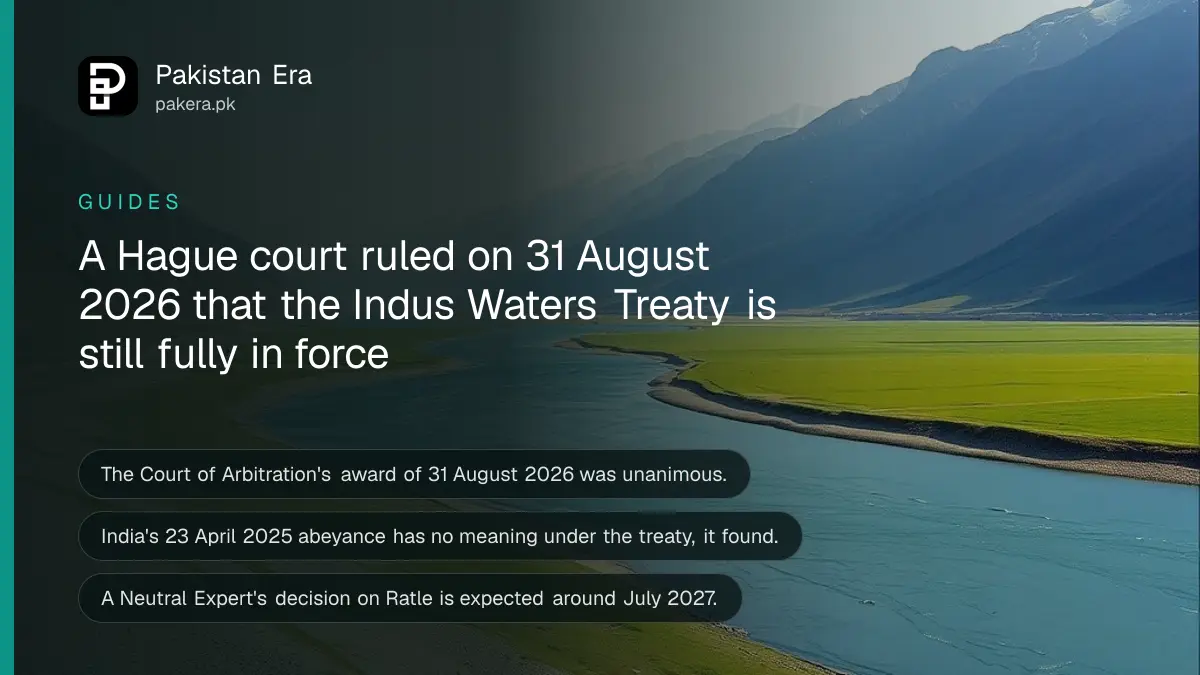
The Indus Waters Treaty is still fully in force. That is the finding of the Court of Arbitration in The Hague, in a unanimous award dated 31 August 2026. It ruled that India's April 2025 decision to hold the treaty "in abeyance" has no meaning under the treaty or international law, and that India must keep following it.
Pakistan's leaders are now using that award in every major meeting. Deputy Prime Minister and Foreign Minister Ishaq Dar raised India's abeyance decision with the UN Secretary-General on 6 October 2026. The same day he told a water symposium in Vienna that the court had affirmed the treaty remains in force.
We read the 129-page award, the court's press release and the case page of the Permanent Court of Arbitration (PCA), which runs the court's secretariat. Here is what the treaty does, what the court decided, and what it does and does not change for Pakistan's rivers.
The Indus Waters Treaty splits six rivers between Pakistan and India
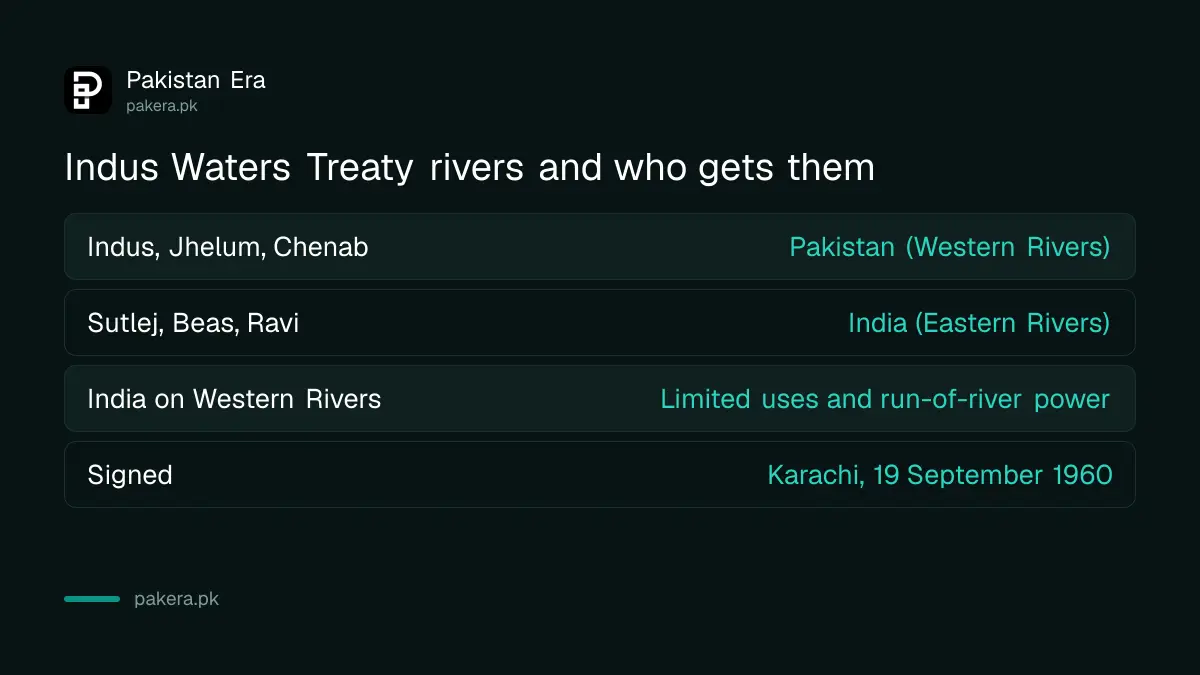
The treaty was signed in Karachi on 19 September 1960, with effect from 1 April 1960. It shares the Indus river system, which rises in the Himalaya, Hindu Kush and Karakoram mountains and drains into the Arabian Sea.
The award sets out the basic split. Pakistan gets the waters of the three Western Rivers. India gets the three Eastern Rivers. India may still use the Western Rivers in limited ways, for domestic use, some farming and hydro-electric power, under detailed design rules.
| River group | Rivers | Allocated to |
|---|---|---|
| Western Rivers | Indus, Jhelum, Chenab and their tributaries | Pakistan |
| Eastern Rivers | Sutlej, Beas, Ravi and their tributaries | India |
| India's limited use of Western Rivers | Domestic use, non-consumptive use, some agricultural use, run-of-river hydropower | Under the treaty's annexures |
Those design rules are why the treaty matters so much. They limit how much water India's dams on the Western Rivers can hold back, and India must tell Pakistan before building one. Pakistan's farms in Punjab and Sindh depend on the Indus, Jhelum and Chenab.
India put the treaty in abeyance on 23 April 2025
The award records that on 23 April 2025, after an attack in India-administered Jammu and Kashmir, India's Foreign Secretary announced the treaty "will be held in abeyance with immediate effect". India's water ministry wrote to Pakistan's Ministry of Water Resources the next day with the same decision.
The word "abeyance" is not in the treaty. The court said it has no technical meaning in international law either. So it treated India's decision as a claim that the treaty is suspended or ended, then tested whether that claim holds.
India did not take part in this phase. The court says it invited India and got no response. It held a hearing at the Peace Palace in The Hague from 26 to 28 April 2026, and it says it still took India's public statements and letters into account.
The court ruled unanimously that the treaty remains in force
The five-member court, chaired by Professor Sean D. Murphy, rejected every ground it could find for India's decision. Its decision section lists them one by one.
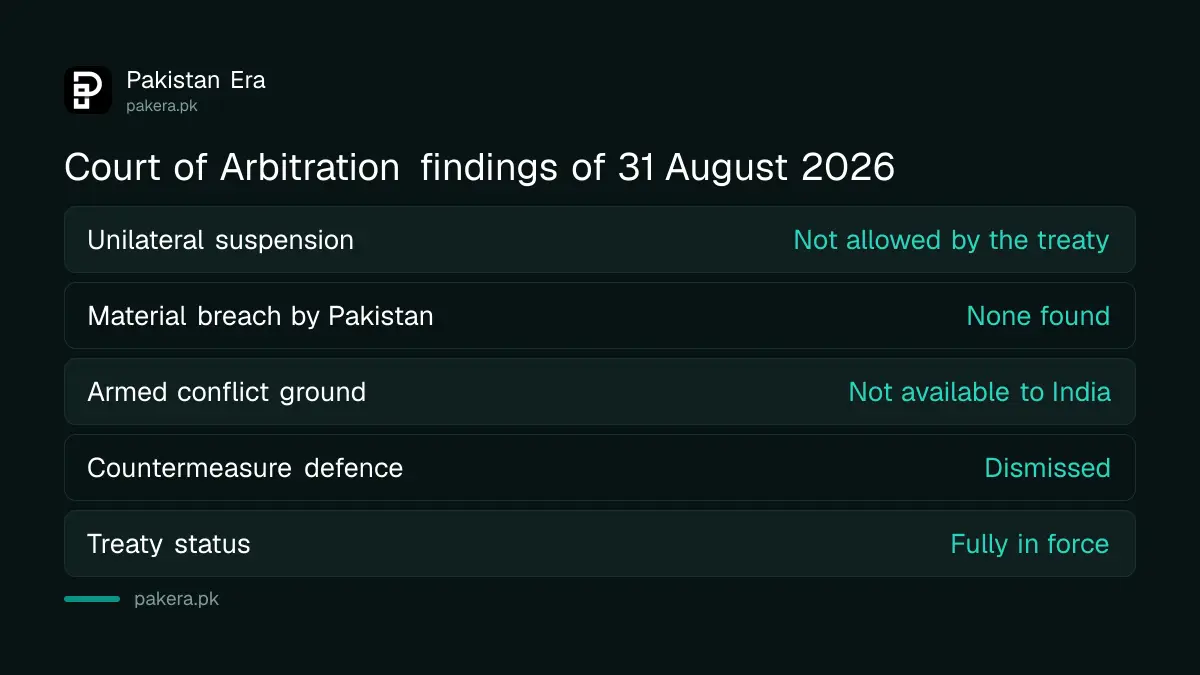
- The treaty does not allow either country to suspend, end or "hold in abeyance" it on its own.
- No later agreement between India and Pakistan has suspended it.
- India cannot suspend it simply by invoking its sovereignty.
- There is no material breach by Pakistan, including on the allegation of support for terrorism.
- There is no fundamental change of circumstances and no armed conflict that India can rely on.
- The abeyance cannot be justified as a lawful countermeasure, meaning a reprisal allowed under international law.
The court then declared that the treaty "remains fully in force and has not been terminated or its operation suspended". It said India must observe its obligations, including the rules on designing and running run-of-river hydropower plants and the treaty's dispute procedures.
The same day the court limited work on India's Ratle dam
On 31 August 2026 the court also issued an order on interim measures, meaning temporary steps while the case continues. It concerns the Ratle Hydro-Electric Plant on the Chenab.
The PCA press release says the court barred India from concreting the Ratle dam wall and power intake above certain levels until 90 days after the Neutral Expert's final decision. It also required India to report on the construction schedule. It refused two other measures Pakistan asked for.
The Neutral Expert is an engineer appointed by the World Bank to decide whether the Kishenganga and Ratle designs follow the treaty. His final decision is expected around 16 July 2027.
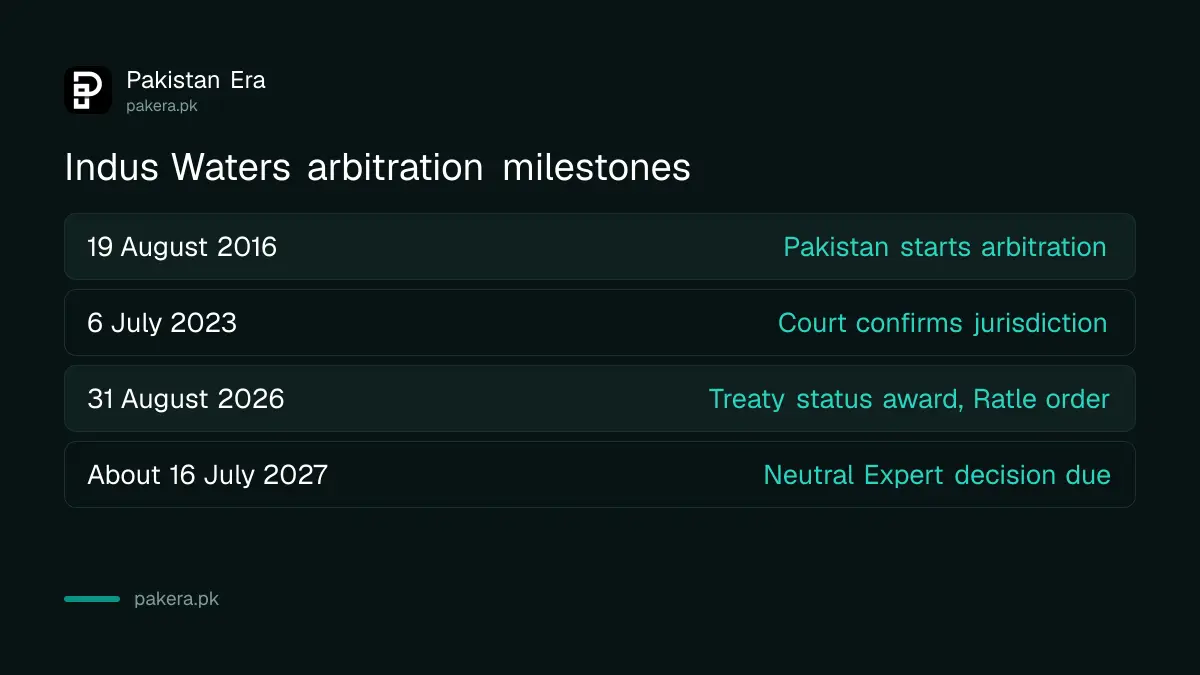
| Date | Step in the case |
|---|---|
| 19 August 2016 | Pakistan starts the arbitration |
| 6 July 2023 | Court rules it has jurisdiction |
| 8 August 2025 | Award on general interpretation of the treaty |
| 15 May 2026 | Supplemental award on maximum pondage |
| 31 August 2026 | Award on treaty status and Ratle interim order |
| About 16 July 2027 | Neutral Expert's final decision expected |
What the award changes for Pakistan, and what it does not
The award gives Pakistan a clear legal finding to use in diplomacy. That is exactly how it is being used. The Foreign Office says Dar briefed the UN Secretary-General on the abeyance decision during his visit to Pakistan, and the Prime Minister also raised water at the UN, as our summary of the UNGA speech shows.
What the award cannot do is enforce itself. There is no police force behind a Court of Arbitration. The award does not record India returning to the treaty, and we found no official sign of that. The flow of water in the Chenab and Jhelum still depends on what India does upstream.
- Changed: a unanimous international ruling that the treaty stands and India is bound by it.
- Changed: a temporary limit on raising the Ratle dam wall.
- Not changed: India's stated position, since it did not take part.
- Still open: costs, other issues, and the Neutral Expert's 2027 decision. The court says it remains seized of the case.
For farmers, the practical sources stay the same. Watch flood and flow alerts from the Pakistan Meteorological Department and provincial irrigation departments, especially in the Chenab and Jhelum catchments, rather than social media claims about India "stopping" water.
Common questions
Is the Indus Waters Treaty still valid in 2026?
Yes, according to the Court of Arbitration's unanimous award of 31 August 2026. It declared the treaty fully in force and not suspended or terminated.
Can India suspend the Indus Waters Treaty on its own?
No. The court found the treaty does not let either party suspend, end or hold it in abeyance unilaterally.
Did India take part in the case?
Not in this phase. The court says it invited India and received no response, but it considered India's public statements and letters.
Which rivers belong to Pakistan under the treaty?
The Western Rivers: the Indus, Jhelum and Chenab and their tributaries. India has limited rights to use them, including run-of-river hydropower.
Where can I read the award?
On the Permanent Court of Arbitration's case page for PCA Case No. 2023-01, the Indus Waters Western Rivers Arbitration (Pakistan v. India).
How we verified this
What we checked, where we read it, and what we could not confirm.
Last checked on 10 October 2026 at about 8:00pm PKT. We read the Award on the Status of the Indus Waters Treaty in Respect of India's Decision on Abeyance dated 31 August 2026, including its decision section, the PCA press release of the same date, and the PCA case page for the procedural history. Pakistan's diplomatic use of the award comes from the Ministry of Foreign Affairs press release of 8 October 2026 and the spokesperson's briefing of 9 October 2026. We did not find an official Indian response to the award that we could read.
About the author

Global Affairs & Political Economy Writer
Muhammad Hatim is a book lover who started writing because he enjoys it. At Pakistan Era he writes about international relations, geopolitics and the global economy, with a particular interest in South Asia and the forces behind current events.