PM Shehbaz Sharif's UN General Assembly Speech 2026: 9 Key Points
PM Shehbaz Sharif's UNGA speech on 25 September 2026 in simple English: Indus waters, the Makkah red line, Kashmir, Gaza and Afghanistan, from the UN text.
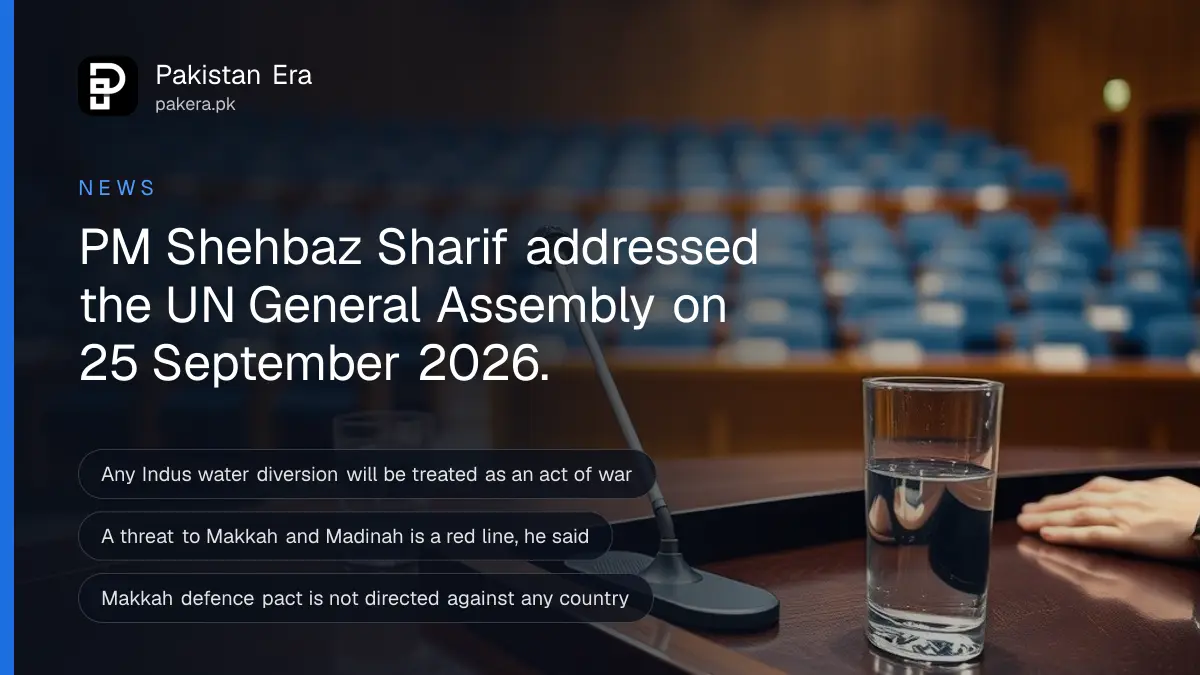
Prime Minister Shehbaz Sharif addressed the 81st session of the UN General Assembly in New York on Friday 25 September 2026. He said any attempt to stop or divert Pakistan's share of the Indus waters "will be treated as an act of war", and called any threat to Makkah and Madinah "a red line".
We read the full text of the speech on the UN's own General Debate website. Every quote below comes from that text, in the order he spoke, with no comment from us. It was his fourth address to the Assembly.
PM Shehbaz Sharif's UNGA speech 2026 in one table
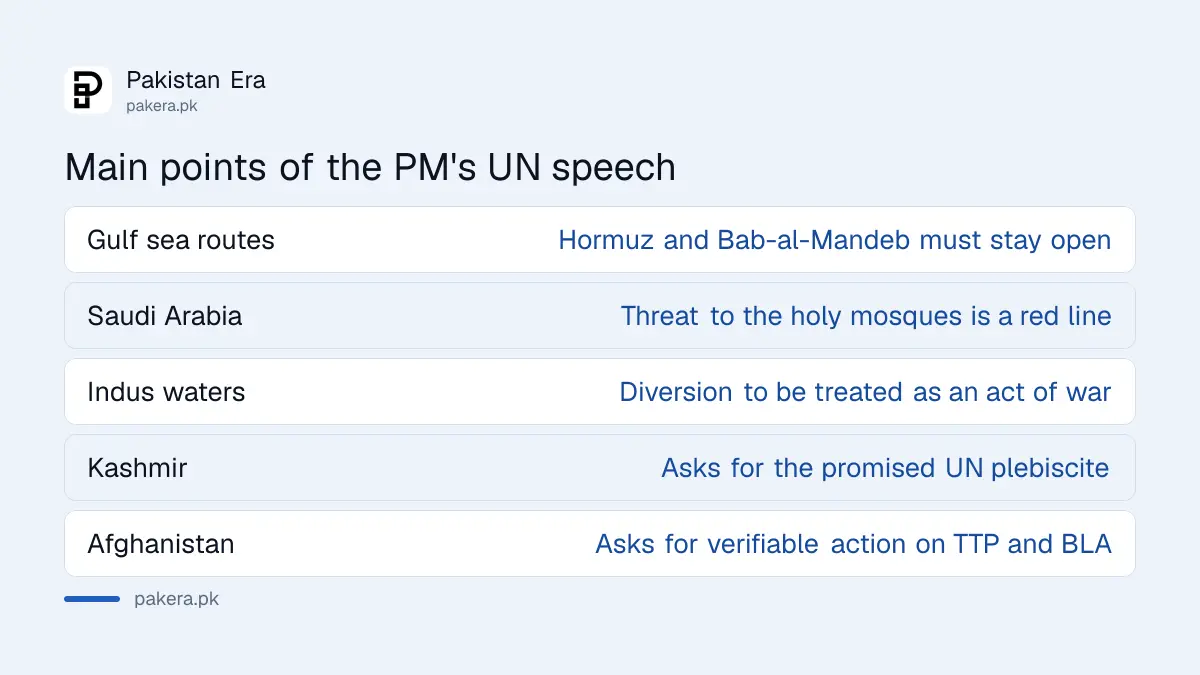
The PM Shehbaz UNGA speech 2026 ran across the Gulf crisis, Saudi Arabia, India, Kashmir, the Indus waters, Palestine, Afghanistan, Islamophobia, the economy, climate and UN reform. The table gives the main line on each subject, taken from the official text.
| Subject | Main line in the speech |
|---|---|
| Gulf and Middle East | Pakistan brought Washington and Tehran together in Islamabad. The Strait of Hormuz and Bab-al-Mandeb "must remain open". |
| Saudi Arabia | Condemned Houthi attacks. A threat to the Haramain Sharifain is "a red line that must never be crossed". |
| Makkah defence agreement | "This Alliance is not directed against any country." |
| India and Kashmir | Called for a "just and fair solution" of the Jammu and Kashmir dispute. |
| Indus waters | Diverting Pakistan's share "will be treated as an act of war". |
| Palestine | Supports a Palestinian state on the pre-1967 borders, with Al-Quds Al-Sharif as its capital. |
| Afghanistan | Afghan authorities must take "verifiable, decisive action" against groups attacking Pakistan. |
| Economy and climate | Macroeconomic stability restored. Pakistan contributes under 1 per cent of world emissions. |
| UN reform | The Security Council "must become more representative, democratic and accountable". |
The Gulf conflict, the Houthi attacks and the Makkah red line
The Prime Minister said conflict engulfed the Gulf in February 2026 and that Pakistan brought Washington and Tehran "under one roof" in Islamabad. He condemned Houthi attacks on Saudi Arabia and called any threat to Makkah and Madinah a red line.
He named the Islamabad Talks and the Islamabad Memorandum of Understanding as steps towards ending the US and Iran conflict. He thanked Field Marshal Syed Asim Munir for helping "create space for diplomacy".
He then turned to the attacks on Saudi Arabia. "The attempted drone attack on the Holy City of Makkah Al-Mukarramah has outraged Muslims across the world," he said. "Any threat to the safety and sanctity of the Haramain Sharifain is a red line that must never be crossed." Haramain Sharifain means the two holy mosques in Makkah and Madinah.
He also mentioned the Makkah Joint Defence Agreement among Saudi Arabia, Türkiye and Pakistan. "This Alliance is not directed against any country," he said. "It is a collective commitment for defence, stability and peace in the region." The agreement's joint defence bodies are still being set up.
India, Kashmir and the Indus Waters Treaty
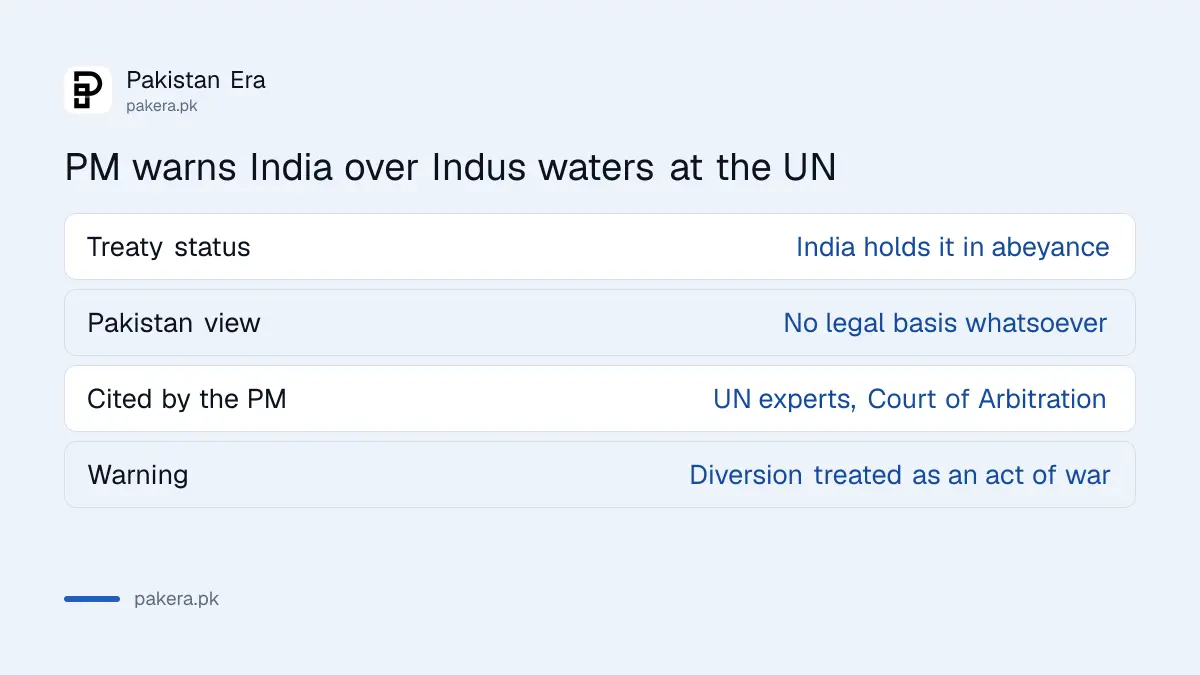
On India, the Prime Minister said Pakistan used its right of self-defence under Article 51 of the UN Charter a year ago. He asked for a solution to the Kashmir dispute and said any move to divert Pakistan's river waters would be treated as war.
He thanked US President Donald Trump for a "timely intervention" when "two nuclear-armed neighbours stood at the brink of an all-out war". On Kashmir, he said Kashmiris have waited eight decades for the UN plebiscite, a vote on their future. Pakistan will keep giving them "full diplomatic, political, and moral support", he said.
On water, he said India's decision to hold the Indus Waters Treaty "in abeyance", meaning suspended, "has no legal basis whatsoever". He said UN experts and the Court of Arbitration had rejected India's claims. He then said: "Any attempt to stop, impede, or divert Pakistan's share of the waters will be treated as an act of war."
Palestine, Afghanistan and terrorism in the speech
The Prime Minister spoke of Gaza through the story of an eight-year-old girl, Wafaa Akila, and backed an independent Palestinian state. On Afghanistan, he said armed groups use Afghan soil to attack Pakistan and asked the Afghan authorities to act.
He said Wafaa Akila was killed on what should have been her first day of school. He called for a Palestinian state "based on the pre-1967 borders, with Al-Quds Al-Sharif as its capital". He also condemned Israeli attacks on Lebanon and Syria.
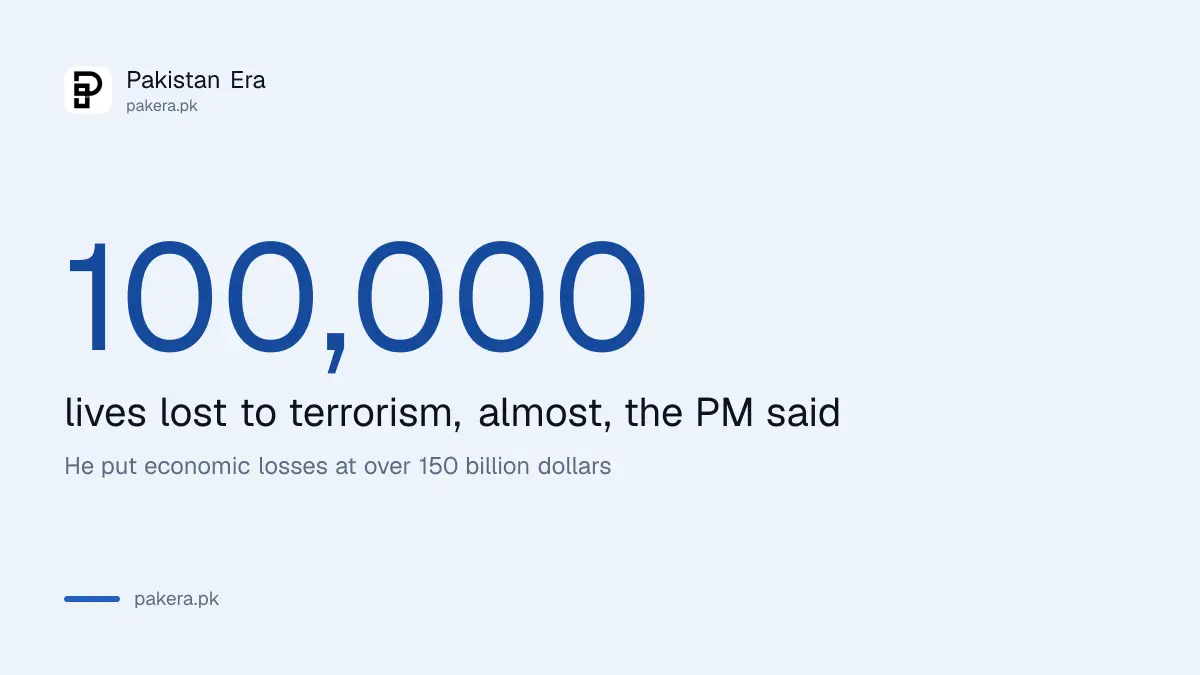
On terrorism, he gave two figures. Pakistan has lost almost 100,000 lives and suffered economic losses of over 150 billion dollars, he said. He named the TTP, which he called Fitna-al-Khawarij, and the BLA, which he called Fitna-al-Hindustan.
He said these groups work "from sanctuaries inside Afghanistan". He asked the Afghan authorities to take "verifiable, decisive action" so that Afghan soil is never used against Pakistan. On 1 October, the information ministry announced air strikes on hideouts in Afghanistan. He also said the rights of Afghan women and girls must be respected.
Economy, climate and UN reform
The Prime Minister said reforms and "stringent fiscal discipline" have restored macroeconomic stability. He asked rich countries for debt relief and climate finance, and asked for a Security Council that is "more representative, democratic and accountable". He closed on peace.
On Islamophobia, he named the demolition of a 150-year-old mosque in Saharanpur, India, earlier in September. On climate, he said Pakistan contributes less than 1 per cent of global emissions but "repeatedly bears the horrific consequences of climate change". He repeated Pakistan's motto on Council reform, "Reform for All" and "Privilege for None".
These were the requests he made of other countries, in the order he made them:
- Keep the Strait of Hormuz and Bab-al-Mandeb open to shipping.
- Hold the plebiscite promised to the people of Jammu and Kashmir.
- Create an independent Palestinian state on the pre-1967 borders.
- Give developing countries debt relief and affordable long-term finance.
- Pay the climate finance already promised, including for loss and damage.
- Reform the Security Council so it serves most member states.
He ended with three lines: "We have chosen dialogue over confrontation. We have chosen cooperation over coercion. We have chosen peace over war."
The defence pact the Prime Minister referred to is set out in the Makkah Joint Defence Agreement explained.
Common questions
When did PM Shehbaz Sharif address the UN General Assembly in 2026?
On Friday 25 September 2026, in the General Debate of the 81st session in New York.
What did Shehbaz Sharif say about the Indus Waters Treaty at the UN?
He said any attempt to stop, impede or divert Pakistan's share of the waters "will be treated as an act of war".
What was the red line in the PM's UN speech?
Any threat to the safety and sanctity of the Haramain Sharifain, the holy mosques of Makkah and Madinah.
Did the PM mention the Makkah Joint Defence Agreement?
Yes. He said the alliance with Saudi Arabia and Türkiye "is not directed against any country".
Where can I read the full text of the speech?
On the UN General Debate website, which publishes Pakistan's statement as a PDF in English.
How we verified this
What we checked, where we read it, and what we could not confirm.
Last checked on 1 October 2026. Every quote and figure here comes from Pakistan's statement on the UN General Debate page for Pakistan, which links the full English text as a nine-page PDF. The UN's summary on the same page dates the speech 25 September 2026. The PDF is the text Pakistan gave to the UN, and the spoken words may differ slightly. We have added no outside comment.
About the author
Senior Writer, Public Services and Technology
Shahid joined us in 2024 as an author. He is a senior contributor to Pakistan's leading technology websites. He writes detailed articles, mostly covering his expertise in the latest tech, mobiles, apps, gadgets, and step-by-step guides. His ideology is to help people understand the latest trends and explain complex methods through very easy-to-understand guides.