How to Apply for FBR Alternative Dispute Resolution Under Section 134A in Pakistan
FBR rule 231C sets the ADR form, your nominee and committee fees of Rs 150,000 to Rs 500,000. See who qualifies under section 134A and the 90 day clock.
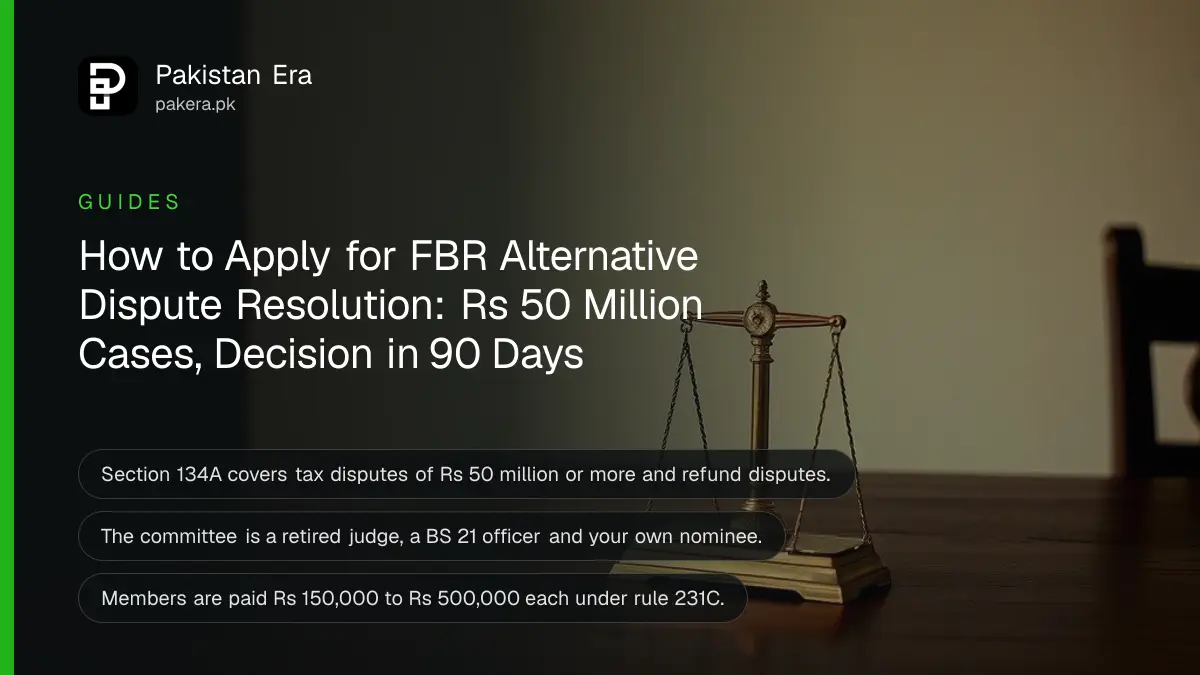
To use FBR's alternative dispute resolution, you apply in writing to the Board on the form in Part I of the Schedule to rule 231C, name your own nominee for the committee, and give three names of retired judges for the chair. The route is open for a dispute over a tax liability of Rs 50 million or more, over a refund, over waiver of default surcharge or penalty, or for other specific relief. The committee must decide within 90 days, and its members are paid Rs 150,000 to Rs 500,000 each depending on the amount in dispute.
The form and the fee scale are new. FBR substituted rule 231C of the Income Tax Rules, 2002 through S.R.O. 1827(I)/2026 on 15 October 2026, after a draft published on 2 September. We read the notification and section 134A of the Income Tax Ordinance, 2001 on 19 October 2026.
Section 134A covers disputes of Rs 50 million and three other kinds
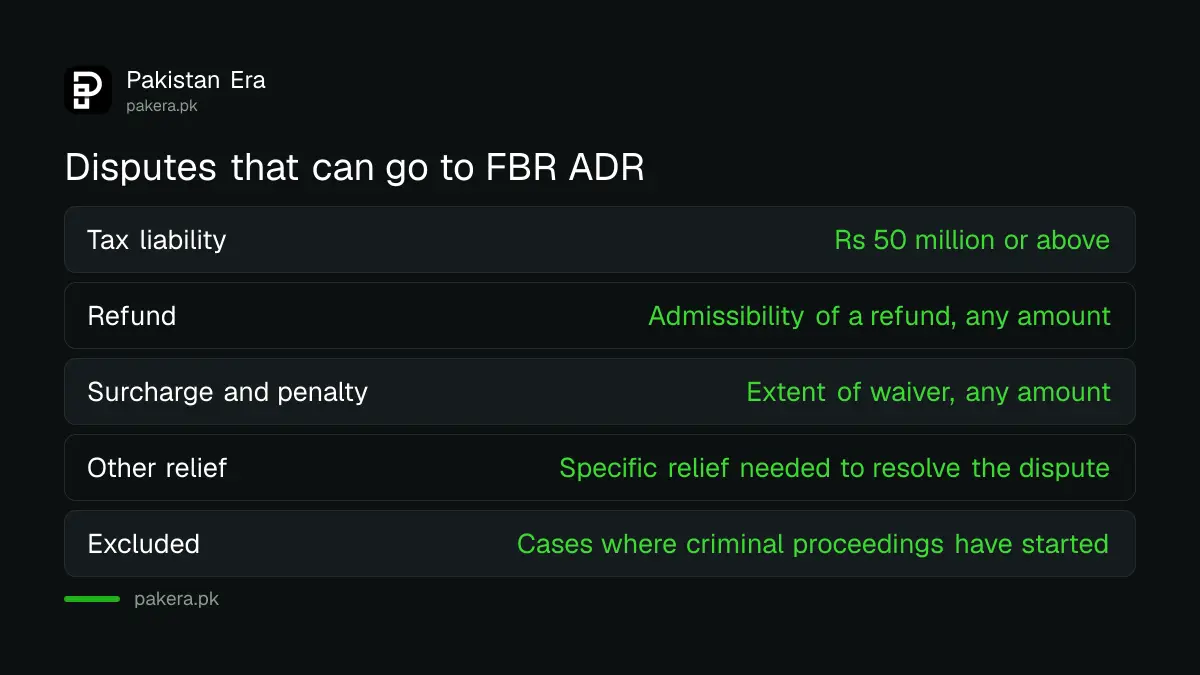
Section 134A, as substituted by the Income Tax (Amendment) Act, 2026, lets an aggrieved person apply to the Board for a committee where the dispute concerns a tax liability of Rs 50 million or above or the admissibility of a refund, the extent of waiver of default surcharge and penalty, or other specific relief needed to resolve the dispute. It is closed where criminal proceedings have started.
A state-owned enterprise has no Rs 50 million floor and must use this route. For everyone else it is a choice, and it runs alongside the ordinary appeal: the usual first step is still an appeal to the Commissioner (Appeals) within the time limit.
The application needs a proposition, an undertaking and a nominee
Sub-section (2) of section 134A requires two things with the application: an initial proposition for resolving the dispute, and an undertaking that if you accept the committee's decision it binds you and you will withdraw all pending cases within 15 days. Rule 231C adds the nominee details and the judges' names.
The annexure to the form asks for your NTN, CNIC, the tax year, the Commissioner with whom the dispute arose, a statement of facts and law, your own interpretation, the amount of tax you agree to pay, and a declaration of where the matter is pending: Commissioner (Appeals), the Appellate Tribunal, a High Court or the Supreme Court, or nowhere.
- Write the application to the Chairman, FBR, Islamabad in the Part I form, with the annexure filled in.
- Attach the initial proposition, including any tax you offer to pay, and the undertaking under sub-section (2).
- Nominate your committee member and give the nominee's CNIC copy, phone number, permanent address and email, plus the nominee's undertaking.
- Have the nominee list three retired judges for the chair, as rule 231C(3) requires.
- Attach the documents needed to decide the dispute, listed in the form.
- Once the committee is appointed, file Part II of the Schedule with the court or tribunal to withdraw the pending appeal.
The committee is a retired judge, a BS 21 officer and your nominee
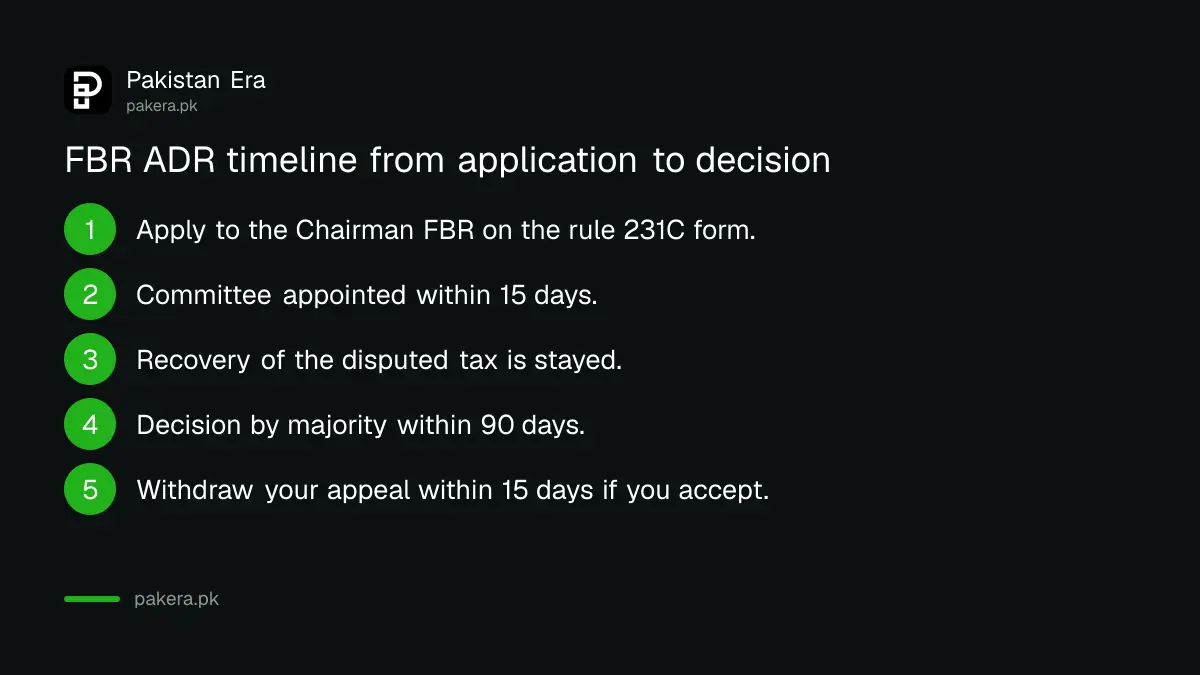
Under sub-section (3) the Chairman of the Board appoints the committee within 15 days of receiving the application. The chair is a retired judge of a High Court, the Federal Constitutional Court or the Supreme Court with tax or commercial experience, picked from the three names your nominee proposes; if the Chairman disagrees, each side proposes one name and the Law Minister chooses.
The second member is an Inland Revenue officer not below BS 21, but not the Chief Commissioner with jurisdiction over your case. The third is your nominee: a chartered accountant, a cost and management accountant, an advocate with 15 years of tax or commercial experience, a retired IRS officer of BS 21 or above, or a businessman from an FPCCI list notified by the Board. You cannot nominate your own auditor or authorised representative.
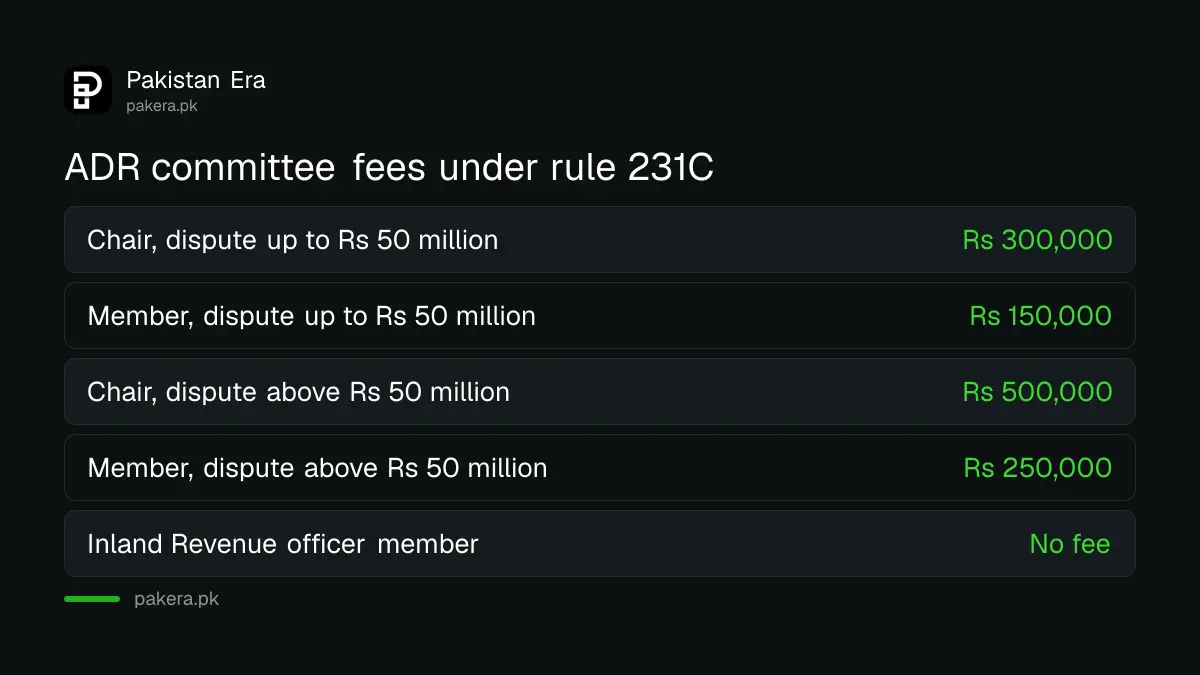
| Disputed tax liability | Chairperson | Each other member |
|---|---|---|
| Up to Rs 50 million | Rs 300,000 | Rs 150,000 |
| Above Rs 50 million | Rs 500,000 | Rs 250,000 |
Those are the one-time, lump-sum amounts in rule 231C(4). The Inland Revenue officer is excluded, and the chair and members can also claim travel and daily allowance at BPS-22 and BPS-21 rates. The rule speaks of amounts "advanced or deposited" being refunded to "the respective parties" if the committee becomes defunct through no fault of either side, so expect to be asked to deposit the fee; the rule does not say who pays which share.
Recovery stops on appointment and the decision comes within 90 days
Sub-section (7) says recovery of the disputed tax is stayed from the day the committee is constituted until its decision or dissolution. Sub-section (5) gives the committee 90 days to decide by majority; it can hold an inquiry, take expert opinion or order an audit on the way.
The decision binds the Commissioner once you, being satisfied, withdraw your pending appeal and communicate the withdrawal within 60 days of receiving the decision. The Commissioner then withdraws any departmental appeal within 30 days. You pay the tax within the time the committee sets, and all earlier orders stand modified to that extent.
The Finance Act 2026 added sub-section (10A): the committee can correct a mistake apparent from the record within 30 days of either side receiving the decision, even after it is dissolved. It also added a replacement rule: if a member drops out, the Chairman fills the seat within 15 days and the committee gets a further 60 days, with at least 90 days in total from the original appointment.
What happens if the committee fails or you walk away
If there is no decision within 90 days, the Chairman dissolves the committee and the matter goes back to the court, tribunal or tax authority where it was pending. Sub-section (6) says a decision cannot be cited as precedent in another case or in your own case for another tax year.
Accepting is your choice. The undertaking binds you only "if the applicant accepts the decision", and the Commissioner is bound only after you withdraw. This is different from the algorithmic settlement offer under section 134B, which runs on IRIS with a ten-day clock. A member who cannot serve must tell the Board within seven days and repay any advance.
Common questions
What is the minimum dispute for FBR ADR?
A tax liability of Rs 50 million or above, or a refund dispute. Disputes over waiver of default surcharge and penalty, or other specific relief, have no floor, which is why rule 231C has a fee band for disputes up to Rs 50 million.
How long does the committee take?
Ninety days from appointment under sub-section (5). If a member is replaced, it gets a further 60 days, with at least 90 days in all.
Who pays the committee members?
Rule 231C sets Rs 300,000 or Rs 500,000 for the chair and Rs 150,000 or Rs 250,000 for each member, depending on whether the disputed tax exceeds Rs 50 million. It refers to amounts advanced by "the respective parties" but does not split the share.
Do I have to withdraw my appeal first?
Not before the decision. The undertaking is to withdraw within 15 days if you accept the decision, and the Commissioner is bound only after you communicate that withdrawal within 60 days.
Is recovery stayed while the committee sits?
Yes. Sub-section (7) deems recovery stayed from the committee's constitution until its decision or dissolution.
Can the committee fix an error in its decision?
Yes, within 30 days of the decision reaching the taxpayer or the Commissioner, under sub-section (10A) added by the Finance Act 2026.
How we verified this
What we checked, where we read it, and what we could not confirm.
Last checked 19 October 2026. We read S.R.O. 1827(I)/2026 dated 15 October 2026, linked from the FBR home page, for rule 231C, the application form and the fee scale, and section 134A in FBR's consolidated Income Tax Ordinance, 2001 amended up to 30 June 2026, with FBR's Circular No. 02 of 2026-27 for the Finance Act 2026 changes. We could not verify who deposits the committee fee or whether the Law Ministry panel of retired judges has been notified, because neither appears in the rule.
About the author

Senior Writer, Public Services and Technology
Shahid joined us in 2024 as an author. He is a senior contributor to Pakistan's leading technology websites. He writes detailed articles, mostly covering his expertise in the latest tech, mobiles, apps, gadgets, and step-by-step guides. His ideology is to help people understand the latest trends and explain complex methods through very easy-to-understand guides.