Punjab Property Tax After 30 September 2026: Surcharge, Penalty and How to Pay
Missed the 30 September property tax rebate in Punjab? The 2026 law adds a 1% surcharge each quarter from 1 October. See the penalty and how to pay online now.
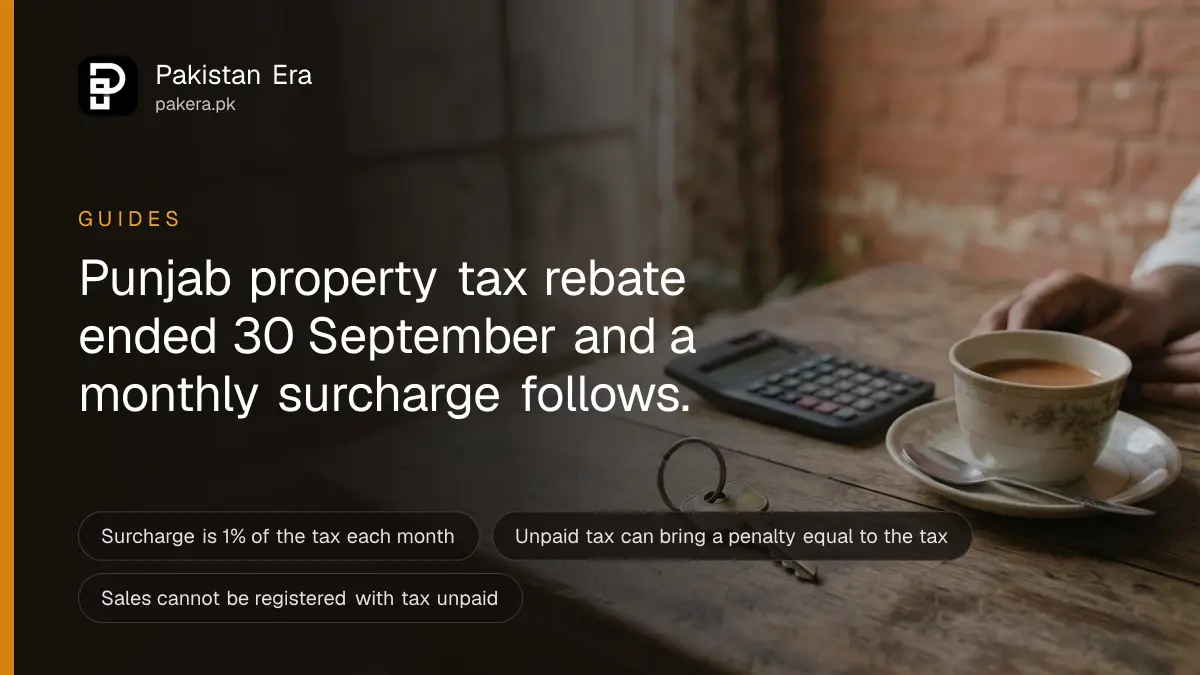
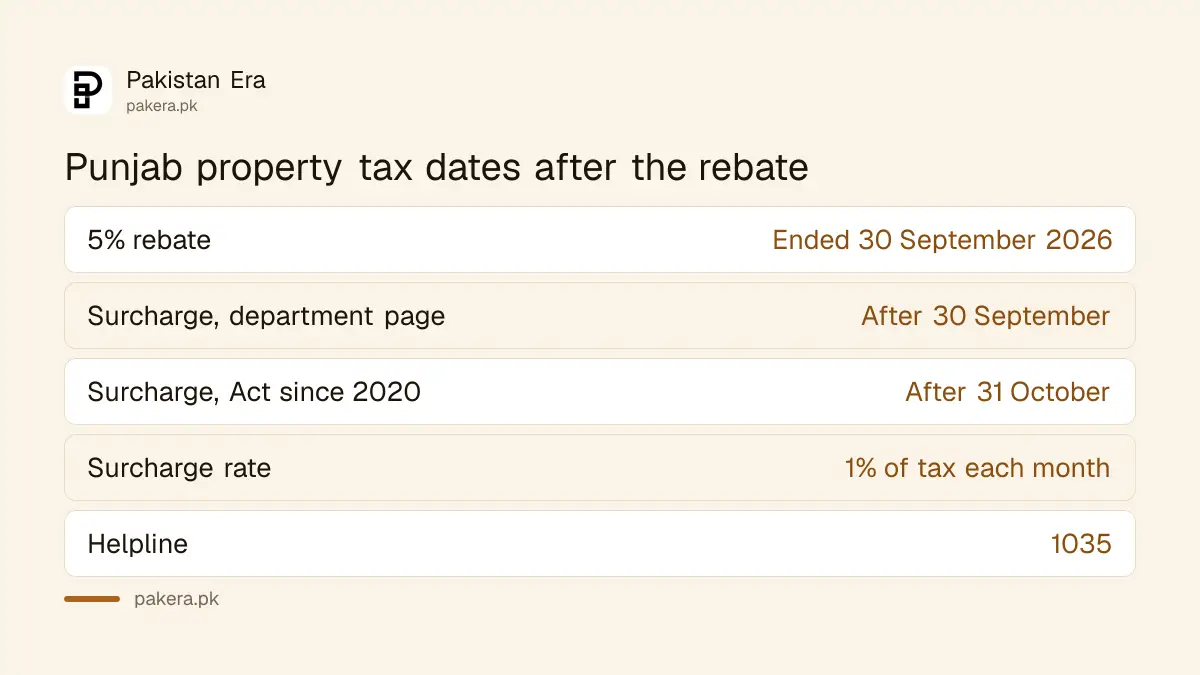
The 5% rebate on Punjab property tax ended on 30 September 2026. If you have not paid, you now pay the full annual tax, and a surcharge of 1% of the tax was added on 1 October. Under the law as amended in 2026, another 1% follows on 1 January, 1 April and 1 July if the bill is still unpaid. Pay through ePay Punjab with the bill's PSID as soon as you can.
Missing the property tax rebate costs 5% of one year's tax. That is annoying, but it is not the real risk. The real risk is a bill that sits unpaid into next year and picks up a surcharge every quarter, then a penalty notice, then trouble when you try to sell the house.
We read the Punjab Urban Immovable Property Tax Act 1958 on the Punjab Code website and the Excise, Taxation and Narcotics Control Department's property tax page. They do not agree on how often the surcharge is added, and that is explained below.
Correction, 1 October 2026: an earlier version of this page said the Act sets the surcharge after 31 October and adds it monthly. That was the 2020 wording. Section 2 of the Punjab Finance Act 2026, in force from 1 July 2026, changed section 12(3) to a 1% surcharge on 1 October, 1 January, 1 April and 1 July. We have corrected the page.
What changes for Punjab property tax after 30 September
From 1 October, you cannot get the 5% rebate for tax year 2026-27. You owe the full annual tax on your bill. A late payment surcharge of 1% of the gross tax applies from 1 October, and the law adds another 1% each quarter you stay unpaid.
The rebate rule is in the Act and on the department's page. A rebate of 5% of the annual tax is given only if the whole year's tax is paid in one lump sum on or before 30 September. On the evening of 30 September 2026, the department's homepage still said "Get 5% Rebate on Property Tax till 30 September 2026". We found no notice of an extension.
The deadline story that ran before the date is in the 30 September property tax rebate update. This page is about what happens now.
The 2026 law sets a quarterly surcharge, not a monthly one
Since 1 July 2026, the Act adds a 1% surcharge on 1 October, 1 January, 1 April and 1 July for tax unpaid by the quarter before. The department's page still says 1% every month. Sources differ, and the law is what counts.
Section 2 of the Punjab Finance Act 2026 changed section 12(3). It replaced "every month of delay" with "October, January, April and July", and "31st day of October" with "30th September, 31st December, 31st March and 30th June". Read together, the clause now says a 1% surcharge "shall stand imposed on the first day of October, January, April and July" if the tax is not paid by those four dates.
So the first surcharge for 2026-27 started on 1 October 2026. Both the law and the department agree on that date. They differ on what comes next: the law adds the next 1% on 1 January 2027, while the department's page describes 1% every month.
The same amendment says property tax "shall be paid electronically". The 5% rebate rule was not changed. The Act also still lets the government set later dates by notification.
If your bill shows a monthly surcharge, ask your district Excise and Taxation Office about section 12(3) as amended in 2026 before you pay. The department's helpline is 1035.
How the Punjab property tax surcharge grows each quarter
The surcharge is 1% of the gross payable tax, added on the first day of each quarter you remain unpaid. It is not a one-off fine. A bill left unpaid until June 2027 carries 3% more than the tax itself under the law, on top of the lost rebate.
| When you pay a Rs 20,000 bill | Surcharge under the Act as amended in 2026 | Surcharge on the department's monthly reading |
|---|---|---|
| By 30 September (5% rebate, Rs 1,000 off) | None | None |
| In October 2026 | Rs 200 (1%) | Rs 200 (1%) |
| In December 2026 | Rs 200 (1%) | Rs 600 (3%) |
| In March 2027 | Rs 400 (2%) | Rs 1,200 (6%) |
| In June 2027 | Rs 600 (3%) | Rs 1,800 (9%) |
The Rs 20,000 bill is only an example to show the maths. Your own bill decides your tax. Paying in October costs the same under either reading, which is one more reason to pay now.
A property tax penalty and recovery come after the surcharge
If you still do not pay, the department can serve a notice and then impose a penalty of up to the full amount of the unpaid tax. It can also recover the money by attaching and selling property, and by sealing commercial premises.
The department's page describes the notice steps. A PT-10 notice sets a time to pay. If you miss it, a PT-11 notice gives you a chance to explain why. Section 15 of the Act says a penalty can only be imposed if the officer is satisfied that you failed to pay wilfully. So answer a PT-11 notice in person or through a representative.
Section 16 lists the recovery powers:
- Seizure and sale of your movable property
- Sealing of non-residential property until the dues are paid
- Attachment and sale of your immovable property
- Recovery as arrears of land revenue
Two more rules catch people later. Under section 14, the department can order your tenant to pay rent straight to it until the arrears are cleared. And under section 16-A, the registering office cannot register a sale, gift or exchange of the property until the outstanding tax is paid. An old unpaid bill often surfaces on the day of a sale.
How to pay Punjab property tax online now
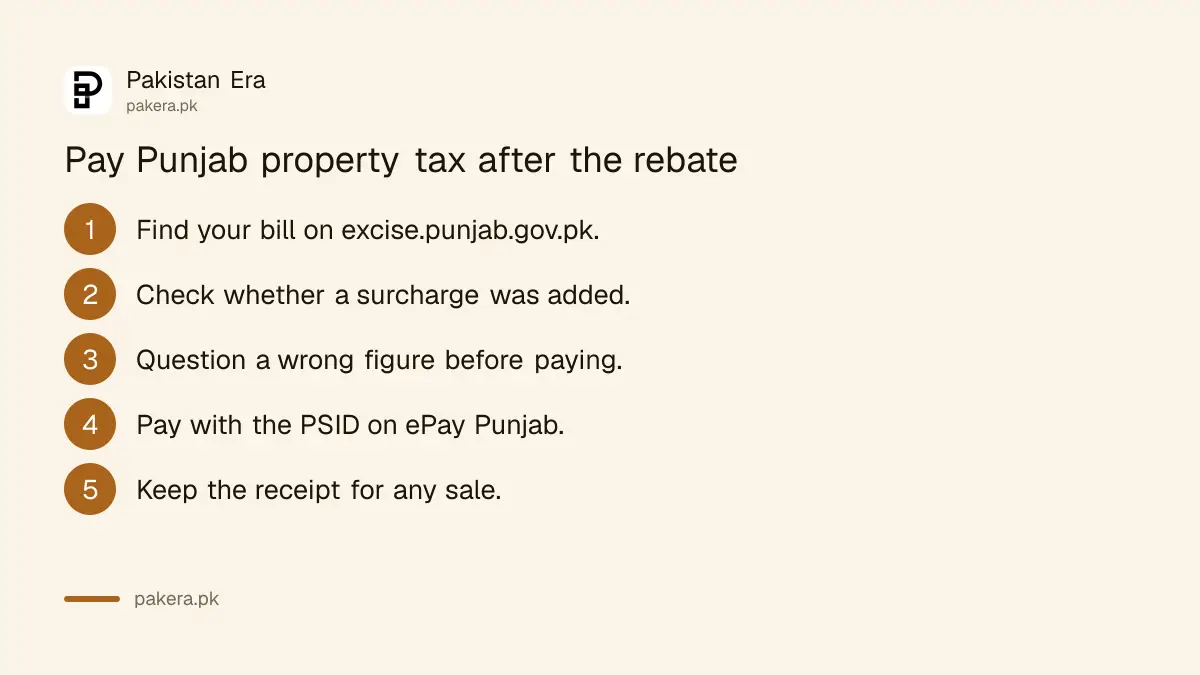
Pay through ePay Punjab at epay.punjab.gov.pk or its app, using the PSID on your property tax bill. You can find the bill on the department's website with your property details. Payment works through bank apps, internet banking and other linked channels.
- Get your bill. Open excise.punjab.gov.pk, go to property tax, and find your bill with your property number or details.
- Check the amount. Make sure the rebate is gone and see whether a surcharge has been added.
- Question a wrong figure first. Contact your district Excise and Taxation Office before paying if the tax looks wrong.
- Pay with the PSID. Use ePay Punjab or your banking app.
- Save the receipt. You will need it when you sell or transfer the property.
The full screen-by-screen method, with what to do when your CNIC search finds nothing, is in the steps to pay Punjab property tax online.
An appeal against your valuation does not pause the bill. Section 11 says tax is collected even while an appeal is pending.
Common questions
Can I still get the 5% rebate after 30 September?
No, unless the government issues a notification extending it. We found no extension on the department's website on 30 September 2026.
When does the property tax surcharge start in Punjab?
On 1 October 2026 for this year's tax. The law and the department's page agree on that first date.
How much is the late payment surcharge?
1% of the gross payable tax. Under the Act as amended in 2026, it is added on 1 October, 1 January, 1 April and 1 July. The department's page still describes it as monthly.
Can I pay in parts to avoid the surcharge?
Paying in parts does not help. The surcharge is worked out on the tax not paid in time, so any part left unpaid still picks it up.
Who is exempt from Punjab property tax?
The department lists widows, minor orphans and disabled owners whose tax is up to Rs 12,150 a year. One house up to one kanal owned and lived in by a retired government servant is also exempt.
Can I sell my house with property tax unpaid?
No. Section 16-A of the Act stops registration of a sale, gift or exchange until outstanding tax is paid.
How we verified this
What we checked, where we read it, and what we could not confirm.
Last checked on 30 September 2026 at about 18:30 PKT, and corrected on 1 October 2026. We read the department's property tax page for the rebate, the surcharge, the PT-10 and PT-11 notices and the exemptions, and its homepage for the rebate notice and the 1035 helpline. We read the Punjab Urban Immovable Property Tax Act 1958 on the Punjab Code website, sections 11, 12, 14, 15, 16 and 16-A, and section 2 of the Punjab Finance Act 2026 on Punjab's laws website, which changed the surcharge in section 12(3) to quarterly from 1 July 2026. The department's page still describes a monthly surcharge, so sources differ and we follow the law. ePay Punjab is a JavaScript app we could not read screen by screen, so its payment channels are as the department describes them. This is general information, not tax advice. Your bill and any notification that applies to you are what count.
About the author

Tax, Bills and Technology Writer
Ali Akhtar is a young and curious voice here at Pakistan Era. He is currently pursuing his A-Levels and has a growing interest in Pakistan’s changing industrial landscape and educational trends. Ali likes to write in a way that helps him explain and explore the world around him. His writing reflects the perspective of the new generation navigating the evolving trends of Pakistan where technology, youth innovation, and shifting opportunities are reshaping the country’s future.