Wheat Sowing in Punjab 2026: Best Dates, Varieties and Seed Rate
Wheat sowing in Punjab: 1 to 20 November on irrigated land, 15 October to 15 November on barani land. Approved varieties, seed rate, fertiliser and subsidy.
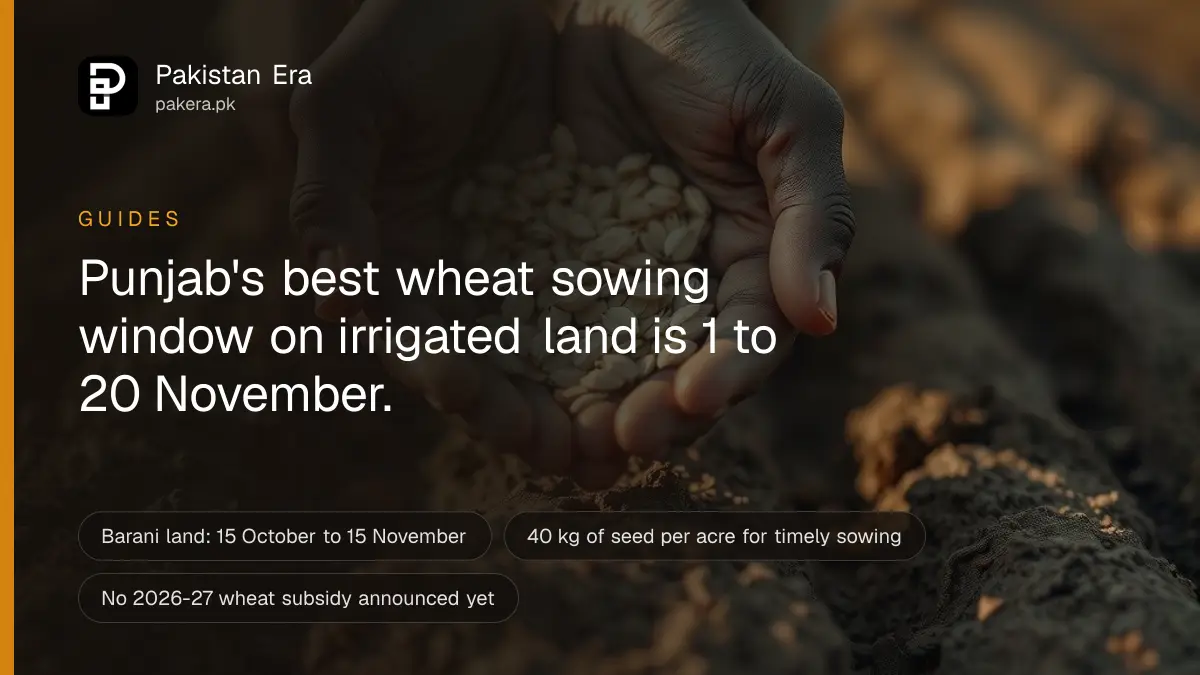
In Punjab, the best time to sow wheat on irrigated land is 1 to 20 November. Sowing can go on until 30 November, and a few varieties until 10 December. On rain-fed (barani) land, sow from 15 October to 15 November. Use 40 kg of seed per acre for timely sowing.
Those dates and rates come from the Punjab Agriculture Department's wheat production plan, which we read on agripunjab.gov.pk on 30 September 2026. The latest plan on the site is for the 2025-26 crop. The department has not yet published a plan for 2026-27, so we use the latest one and say so.
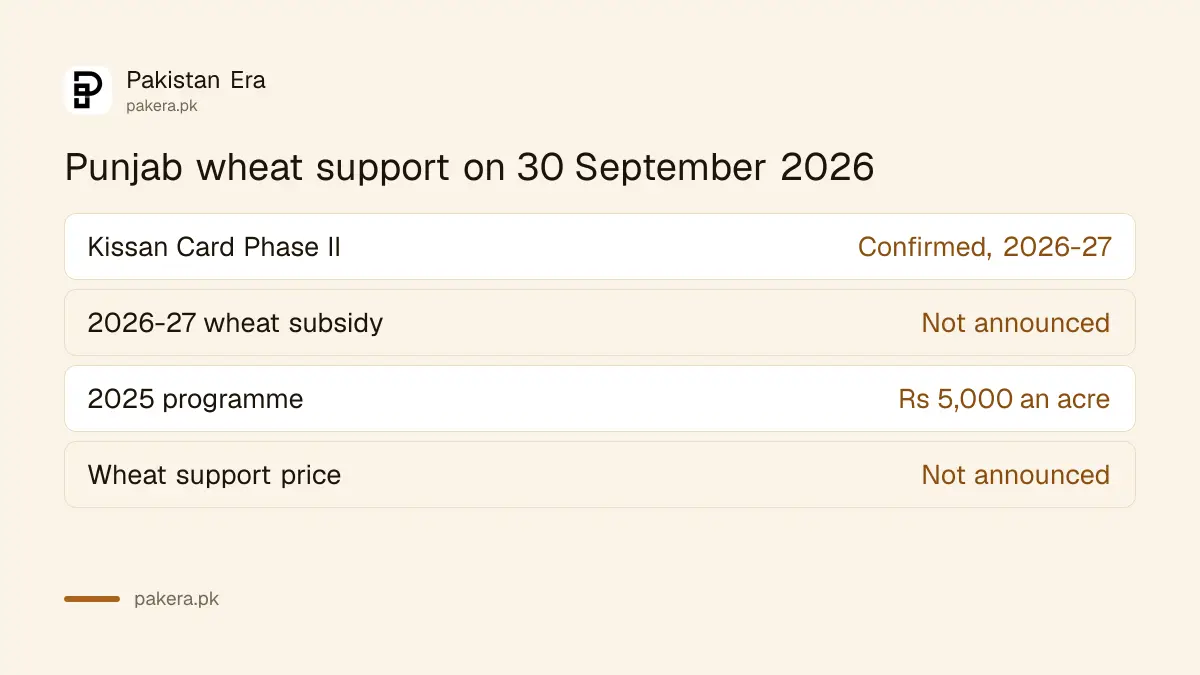
On support money, the short answer is also clear. As of 30 September 2026, the department's own pages list no wheat seed or fertiliser subsidy for the 2026-27 season. The Kissan Card runs on into 2026-27.
Wheat sowing time in Punjab for 2026
On irrigated land, sow wheat between 1 and 20 November for the best yield. The department allows sowing up to 30 November, and up to 10 December for some varieties if you must sow late. On barani land, sow from 15 October to 15 November.
Barani farmers can start earlier. The plan says sowing on rain-fed land can begin from the first week of October if the soil has enough moisture and the temperature allows it.
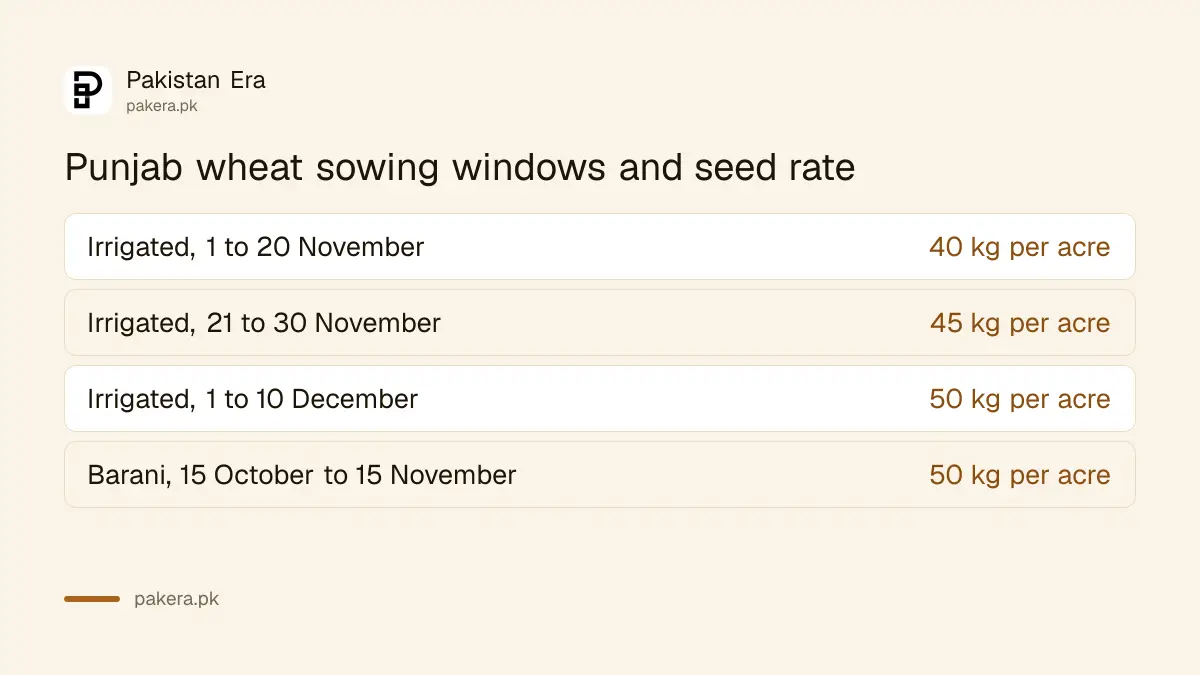
| Land type | Sowing window | Seed per acre |
|---|---|---|
| Irrigated, timely | 1 to 20 November | 40 kg |
| Irrigated, late | 21 to 30 November | 45 kg |
| Irrigated, very late | 1 to 10 December | 50 kg |
| Barani (rain-fed) | 15 October to 15 November | 50 kg |
Late sowing costs money. The plan says yield starts to fall day by day once sowing runs late. Late wheat takes longer to come up, sends out fewer shoots, and its ears stay short. If March and April turn hot, late wheat suffers most.
The seed rates assume germination above 85 per cent. If your seed germinates less well, the plan says to raise the rate to match. For late sowing, it says raising the rate up to a limit of 50 kg an acre adds shoots and helps the yield.
Approved wheat varieties and their sowing dates
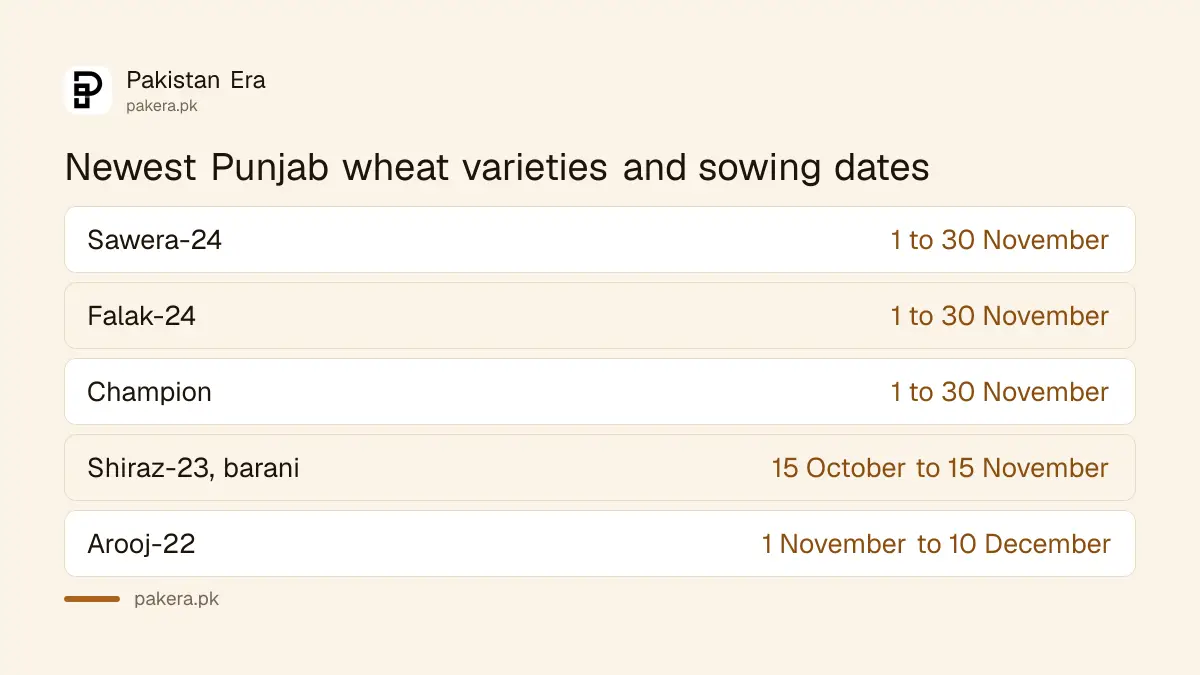
The department recommends 23 wheat varieties for irrigated land and 8 for barani land. Three are new 2025 releases: Sawera-24 and Falak-24 from the Wheat Research Institute, Faisalabad, and Champion from the Arid Zone Research Institute, Bhakkar. Each has its own sowing window.
| Variety | Land | Sow between | Yield potential, maunds per acre |
|---|---|---|---|
| Sawera-24 | Irrigated | 1 to 30 November | 76 to 78 |
| Falak-24 | Irrigated | 1 to 30 November | 74 to 76 |
| Champion | Irrigated | 1 to 30 November | 75 |
| Arooj-22 | Irrigated and barani | 1 November to 10 December | 76 |
| Dilkash-20 | Irrigated | 1 November to 10 December | 71 |
| Akbar-19 | Irrigated | 1 November to 10 December | 75 |
| Shiraz-23 | Barani | 15 October to 15 November | 63 |
A maund here is 40 kg. The yield figures are what each variety can reach in good conditions, not what a typical field gets.
The plan adds a few notes that matter when you pick seed:
- Arooj-22 and Nishan-21 are approved for both irrigated and barani land. On barani land, sow them in the barani window.
- Sadiq-21 and Nawab-21 suit southern Punjab best.
- Akbar-19, Nawab-21 and Zincol-16 carry more zinc than most.
- Faisalabad-2008, Pakistan-13 and Barani-17 are hit by rust, so the department says to sow them on less land.
- Durum-2021 is a different type of wheat, meant for pasta and noodles.
The other barani varieties are MA-21, Markaz-19, Barani-17, Fatehjang-16 and Pakistan-13.
Where to buy certified wheat seed in Punjab
Certified seed of approved varieties is sold at Punjab Seed Corporation depots and sale points, at FFC Sona centres and through dealers. The department asks farmers to check the Federal Seed Certification tag on every bag at the time of purchase.
For the 2025-26 crop, the plan put the Punjab Seed Corporation's certified seed at about 592,618 bags of 50 kg of certified seed. Dilkash-20, Akbar-19 and Arooj-22 made up most of it. The department has not published the 2026-27 figure.
Treat the seed before you sow. The plan recommends thiophanate methyl at 2 to 2.5 grams per kg of seed, or imidacloprid plus tebuconazole at 2 ml per kg. This guards against smut, Karnal bunt and other seed-borne diseases. A rotating drum mixes it best. A half-filled plastic sack, tied and shaken, also works.
Fertiliser is the other big bill. A bag of DAP averaged Rs 16,055 in July 2026, the federal food ministry's latest figure.
Fertiliser doses the department recommends for wheat
On average irrigated soil, the department recommends 1.5 bags of DAP, about 1.75 bags of urea and 1 bag of SOP or MOP per acre. Weak soil needs more, fertile soil less. Barani doses depend on rainfall. Get your soil tested at the district laboratory first.
| Soil or area | Nitrogen, phosphorus, potash (kg per acre) | One option, bags per acre |
|---|---|---|
| Irrigated, weak soil | 64, 46, 25 | 2 DAP, 2 urea, 1 SOP or MOP |
| Irrigated, average soil | 54, 34, 25 | 1.5 DAP, 1.75 urea, 1 SOP or MOP |
| Irrigated, fertile soil | 46, 30, 25 | 1.25 DAP, 1.5 urea, 1 SOP or MOP |
| Barani, under 350 mm rain | 32, 23, 12 | 1 DAP, 1 urea, half SOP or MOP |
| Barani, 350 to 600 mm rain | 40, 28, 12 | 1.25 DAP, 1.25 urea, half SOP or MOP |
| Barani, over 600 mm rain | 48, 34, 25 | 1.5 DAP, 1.5 urea, 1 SOP or MOP |
The barani doses are from the Soil Fertility Research Institute, Lahore. The plan names the low-rain areas as barani parts of Rajanpur, Layyah, Dera Ghazi Khan, Muzaffargarh, Bhakkar, Mianwali and Khushab, plus Jand and Pindi Gheb. Chakwal, Talagang and Pind Dadan Khan are medium rain. Rawalpindi, Attock, Jhelum, Sohawa, Narowal, Gujrat, Kharian and Shakargarh are high rain.
Before you sow, follow these steps:
- Pick an approved variety that suits your land and your sowing date.
- Buy certified seed and check the certification tag on the bag.
- Treat the seed with a recommended fungicide.
- Test your soil and set the fertiliser dose to the result.
- Sow with a drill inside your window, and do not burn the last crop's stubble.
Wheat subsidy and Kissan Card support for 2026-27
As of 30 September 2026, no wheat seed or fertiliser subsidy for 2026-27 appears on the department's pages. Last season's CM Punjab Wheat Support Program 2025 paid Rs 5,000 an acre to farmers with up to 12.5 acres. A 2026 version has not been announced.
What is confirmed is the Kissan Card. The department lists Kissan Card Phase II for 2026-27 to 2027-28, with interest-free loans for 1 million card holders. On 8 September, Punjab's agriculture minister said 10 lakh (1 million) farmers were already using the card. It only works at registered Kissan Card dealers, so find yours before sowing.
The department has also held a high-level meeting on its strategy for the 2026-27 wheat crop. It has posted only photos of that meeting, not a decision. There is also still no wheat support price for 2026-27. By contrast, Sindh has already approved a Rs 14.9 billion wheat subsidy for its growers.
Common questions
What is the best time to sow wheat in Punjab?
1 to 20 November on irrigated land, and 15 October to 15 November on barani land.
How much wheat seed is needed per acre?
40 kg for timely irrigated sowing, 45 kg from 21 to 30 November, and 50 kg for very late or barani sowing.
Which new wheat varieties are approved in Punjab?
Sawera-24, Falak-24 and Champion, released in 2025, plus Shiraz-23 for barani land.
Is there a wheat subsidy in Punjab for 2026?
Not yet. The department had announced none for 2026-27 by 30 September 2026. Last season paid Rs 5,000 an acre.
Can I buy seed with the Kissan Card?
The card is for farm inputs at registered dealers. Check with your dealer that certified wheat seed is on offer before you go.
How we verified this
What we checked, where we read it, and what we could not confirm.
Last checked on 30 September 2026. Sowing windows, seed rates, varieties, seed treatment, seed stock and fertiliser doses are read in the Punjab Agriculture Department's wheat production plan 2025-26, the latest listed. Kissan Card Phase II is read on the department's Chief Minister's initiatives page. The 2025 Rs 5,000 an acre programme is read on the CM Punjab Wheat Support Program 2025 portal. The minister's 10 lakh figure is from the department's press release of 8 September 2026.
About the author

Senior Writer, Public Services and Technology
Shahid joined us in 2024 as an author. He is a senior contributor to Pakistan's leading technology websites. He writes detailed articles, mostly covering his expertise in the latest tech, mobiles, apps, gadgets, and step-by-step guides. His ideology is to help people understand the latest trends and explain complex methods through very easy-to-understand guides.