PPC Sections List in Pakistan: 30 Common Offences, Punishment and Bail Status (2026)
PPC sections list for Pakistan: 30 common FIR sections from 302 to 509 with maximum jail term, bail status from the CrPC schedule and which can be compromised.
The Pakistan Penal Code (PPC) is the law behind most FIRs in Pakistan, and the section number on an FIR tells you the maximum punishment and whether bail is a right or a court decision. Below is a table of 30 sections that turn up most often in police cases, from 302 (murder) and 420 (cheating) to 489-F (bounced cheque) and 506 (threats), with the jail term and bail status for each.
We read the full PPC and the Second Schedule of the Code of Criminal Procedure (CrPC) on Pakistan Code, the Ministry of Law and Justice website, on 1 November 2026. The PPC sets the punishment. The CrPC schedule decides whether police can arrest without a warrant, whether the offence is bailable, and whether it can be settled by compromise.
The 30 PPC sections most FIRs use, with punishment and bail
Each row below gives the maximum jail term written in the PPC and the bail status from the CrPC Second Schedule. "Bailable" means release on bail is a right. "Non-bailable" means a magistrate or judge decides, and bail is still often granted for offences below ten years.
| Section | Offence | Maximum punishment | Bail |
|---|---|---|---|
| 302 | Qatl-i-amd (murder) | Death or life imprisonment; up to 25 years where qisas does not apply | Non-bailable |
| 319 | Qatl-i-khata (death by mistake) | Diyat, plus up to 5 years for a rash act | Bailable |
| 320 | Death by rash or negligent driving | Diyat plus up to 10 years | Bailable |
| 322 | Qatl-bis-sabab (death caused by an unlawful act) | Diyat | Non-bailable |
| 324 | Attempt to murder | Up to 10 years and fine | Non-bailable |
| 337-A(i) | Minor head or face injury | Daman plus up to 2 years | Bailable |
| 337-F(i) | Minor body wound (damiyah) | Daman plus up to 1 year | Bailable |
| 337-L(2) | Other hurt | Up to 2 years or daman | Bailable |
| 353 | Assault to stop a public servant | Up to 2 years | Bailable |
| 354 | Assault on a woman to outrage modesty | Up to 2 years | Bailable |
| 363 | Kidnapping | Up to 7 years and fine | Bailable |
| 365-A | Kidnapping for ransom | Death or life imprisonment | Non-bailable |
| 376 | Rape | Death, or 10 to 25 years | Non-bailable |
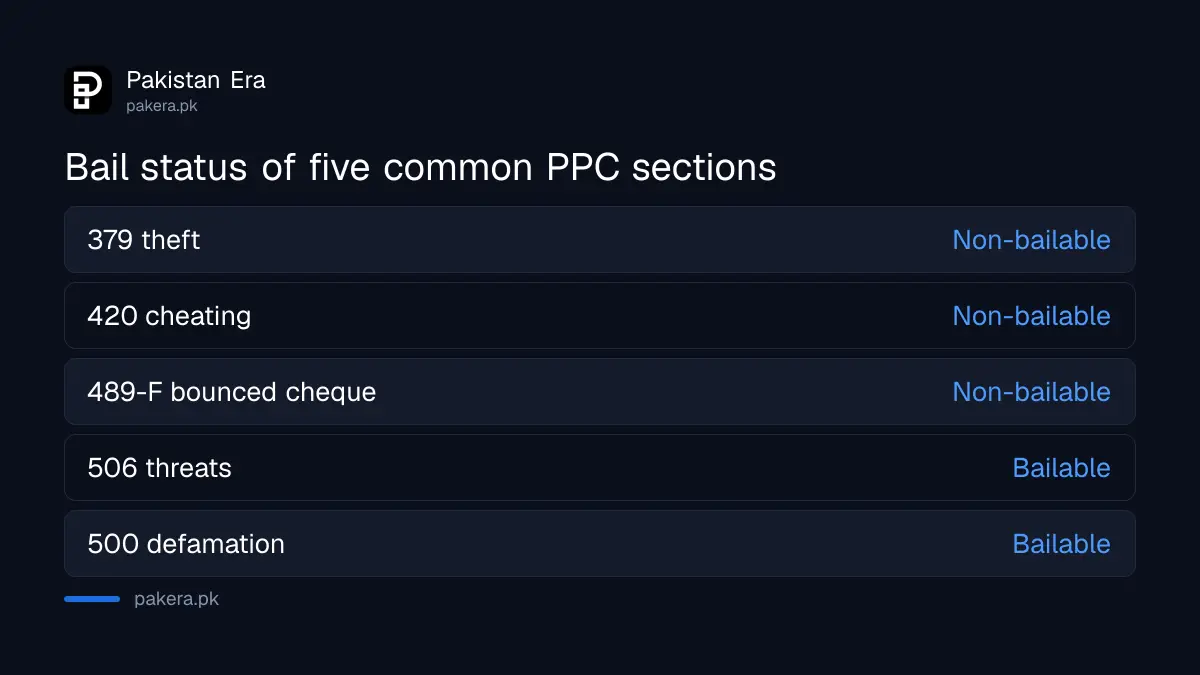
| 379 | Theft | Up to 3 years | Non-bailable |
| 380 | Theft in a house | Up to 7 years and fine | Non-bailable |
| 392 | Robbery | 3 to 10 years; up to 14 on a highway | Non-bailable |
| 395 | Dacoity | Life, or 4 to 10 years | Non-bailable |
| 406 | Criminal breach of trust | Up to 7 years | Non-bailable |
| 409 | Breach of trust by a public servant or banker | Life, or up to 10 years | Non-bailable |
| 411 | Receiving stolen property | Up to 3 years | Non-bailable |
| 419 | Cheating by pretending to be someone else | Up to 7 years | Non-bailable |
| 420 | Cheating | Up to 7 years and fine | Non-bailable |
| 448 | House trespass | Up to 1 year or Rs 3,000 fine | Bailable |
| 452 | House trespass after preparing to hurt | Up to 7 years and fine | Non-bailable |
| 471 | Using a forged document | Same as forgery | Bailable |
| 489-F | Bounced cheque issued dishonestly | Up to 3 years | Non-bailable |
| 500 | Defamation | Up to 2 years; up to 5 for the originator | Bailable |
| 504 | Insult to provoke a fight | Up to 2 years | Bailable |
| 506 | Criminal intimidation (threats) | Up to 2 years; up to 7 for a death threat | Bailable |
| 509 | Insulting a woman's modesty, sexual harassment | Up to 3 years | Bailable |
Section 34, 109 and 149 are add-ons, not separate crimes
An FIR that reads "302/34" or "420/109" charges the main offence plus a rule on shared guilt. Section 34 makes everyone acting with a common intention equally liable. Section 109 punishes an abettor like the main offender. Section 149 covers members of an unlawful assembly.
So "302/34" against three people means the police say all three shared the plan to kill. The punishment is the one written for 302. These add-on sections matter at the bail stage, because the role of each accused is what the court weighs.
Non-bailable does not mean no bail
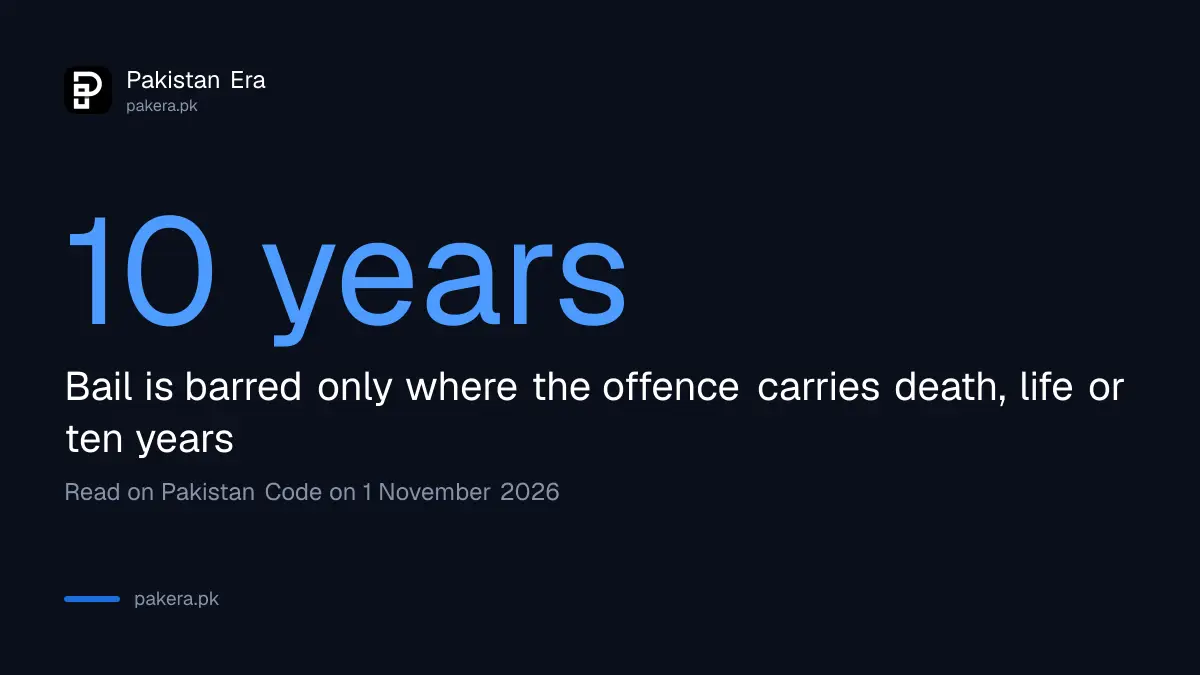
Section 497 of the CrPC lets a court release a person accused of a non-bailable offence. The bar applies only where there are reasonable grounds to believe the offence carries death, life imprisonment or ten years. Below that line, bail is the usual result, not the exception.
That is why people charged under 379, 406, 420 or 489-F often get bail within days, even though the schedule marks them non-bailable. Each of those carries seven years or less. Murder, attempted murder, robbery, dacoity, rape and kidnapping for ransom sit inside the bar.
Section 497 also sets two delay rules. A person held for more than one year (six months for a woman) on an offence not punishable with death must be released if the trial has not ended and the delay is not their fault. For death penalty offences, the limit is two years (one year for a woman). Women, children under 16 and sick people can be bailed even inside the bar. The full process, sureties and bonds are explained in how to get bail in Pakistan.
How to read the sections on your FIR copy
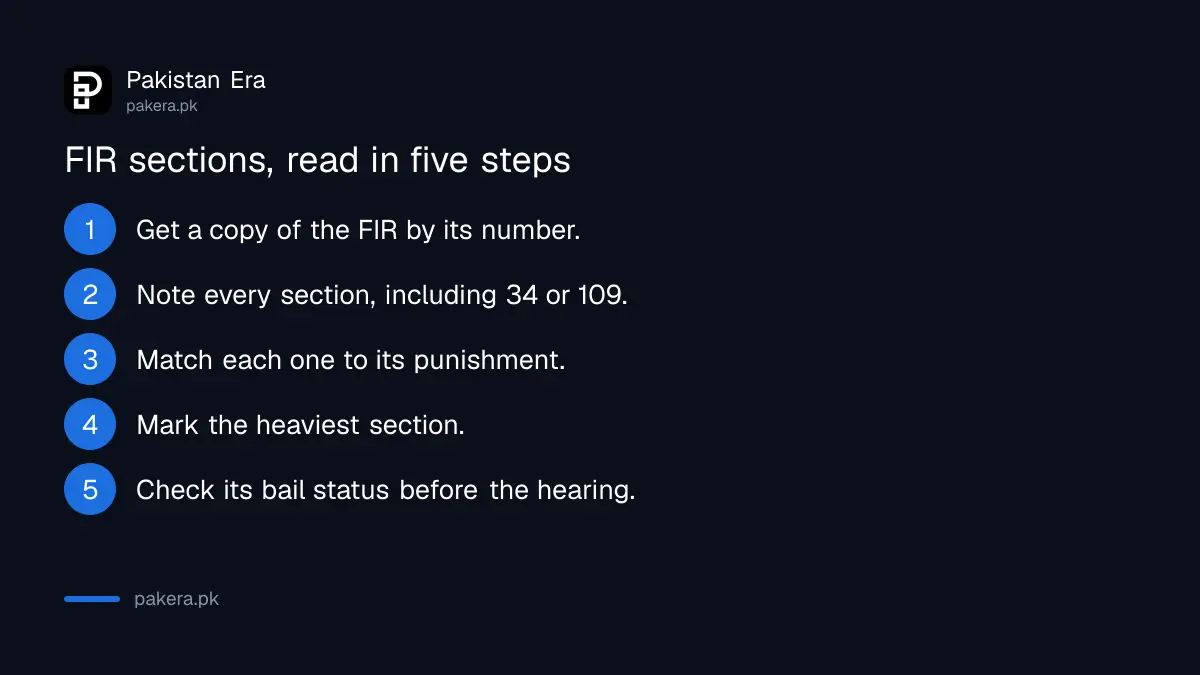
The sections are written near the top of the FIR, usually after the name of the police station. Look up each number in the table, then find the one with the highest punishment. That section decides which court hears the case and how hard bail will be.
- Get a copy of the FIR. You can order one by FIR number, as explained in how to check an FIR online.
- Note every section number, including add-ons like 34 or 109.
- Match each number to the table above and mark the heaviest one.
- Check whether the heaviest section is bailable or non-bailable.
- If it is non-bailable, check whether it carries ten years or more.
- Take the FIR to a lawyer before any bail hearing.
Police sometimes add a heavier section to make bail harder, and courts regularly drop sections at the bail or charge stage. If you think a section does not fit the facts, that is an argument for the bail hearing, not a reason to panic.
Some cases can be settled by compromise
Many PPC offences are "compoundable", which means the complainant can forgive the accused and the case ends. Theft and robbery are not. Cheating under 419 and 420 can be compounded only with the court's permission. Bounced cheques, threats and minor hurt can be settled.
The CrPC schedule marks 489-F, 500, 504, 506 (first part), 320, 337-A(i) and 448 as compoundable. Murder can also end in a compromise with the heirs under the qisas and diyat rules, subject to the court. The rules and the paperwork are set out in settling a criminal case by compromise.
Where this list comes from, and its limits
Every punishment above is from the PPC text on Pakistan Code, and every bail status is from the CrPC Second Schedule on the same site. Pakistan Code marks both laws "Under Review", so check the latest text of a federal law or ask a lawyer before a hearing.
Provinces can amend the CrPC for their own courts, and a few have. Special laws also change the picture: narcotics, arms, cybercrime and terrorism cases have their own bail rules. Cybercrime offences have a separate table in the PECA sections list. If your FIR names a law other than the PPC, this table does not cover it.
Common questions
Is 420 PPC bailable?
No. The CrPC schedule marks section 420 non-bailable. It carries up to seven years, so it is below the section 497 bar, and courts often grant bail. It can be compounded with the court's permission.
What is the punishment for 489-F?
Up to three years in jail, or a fine, or both. The offence is non-bailable but compoundable. The accused escapes liability by proving they had arranged funds and the bank was at fault.
Is 506 PPC bailable?
Yes. Criminal intimidation is bailable. The basic offence carries up to two years. A threat to kill, cause grievous hurt or burn property carries up to seven years.
What does 302/34 mean on an FIR?
It means murder (section 302) committed by more than one person with a common intention (section 34). Each person named is charged as if they did the act alone.
Is theft (379) bailable in Pakistan?
No. The CrPC schedule marks 379 non-bailable and not compoundable. It carries up to three years, so courts usually grant bail on a proper application.
How we verified this
What we checked, where we read it, and what we could not confirm.
We read the Pakistan Penal Code and the Code of Criminal Procedure, Second Schedule, as published on pakistancode.gov.pk, on 1 November 2026, including section 497 of the CrPC. We could not confirm provincial amendments to the CrPC schedule in Punjab, Sindh, Khyber Pakhtunkhwa or Balochistan, and both federal texts are marked "Under Review" by the Ministry. This page is a reference, not legal advice for a particular case.
About the author

Global Affairs & Political Economy Writer
Muhammad Hatim is a book lover who started writing because he enjoys it. At Pakistan Era he writes about international relations, geopolitics and the global economy, with a particular interest in South Asia and the forces behind current events.