How to Cancel a False FIR in Pakistan: Four Legal Routes From Police to High Court
A false FIR can be challenged under CrPC Sections 169, 22-A(6), 561-A and 265-K. See which route fits, who decides, and what a false complainant can face.
A false FIR can be challenged in four places under Pakistani law: before the investigating officer, who can find the evidence too weak under Section 169; before the Sessions Judge, who can move the investigation; in the High Court under Section 561-A; and in the trial court, where early acquittal is possible.
An FIR is only a first report. Police must write it down when a cognizable offence is reported, and Section 154 of the Code of Criminal Procedure (CrPC) does not ask them to test whether it is true. That is why a person can wake up named in a case that rests on a grudge. We read the CrPC and the Pakistan Penal Code (PPC) on the Pakistan Code website on 15 October 2026. This is general information, not legal advice, and a lawyer must file any petition.
An FIR stays on record until police, a magistrate or a court closes it
Nobody can cancel an FIR by asking the police station to forget it. It ends when police report no case and a court accepts that, when the High Court sets it aside, or when a trial ends in acquittal.
Start by getting the facts: the FIR number, the sections charged and the investigating officer's name. If you are afraid of arrest, the first step is bail, and how to get bail explains the difference between bailable and non-bailable offences. Then choose a route below.
The investigating officer can release you if the evidence is deficient
Section 169 says that if an investigation shows too little evidence or reasonable suspicion, the officer shall release an accused person in custody on a bond to appear before a Magistrate. The case does not vanish, because police still report to the Magistrate.
Section 173 requires the officer to send a report to the Magistrate through the Public Prosecutor, and the Magistrate may take cognizance under Section 190. The Code does not use the word cancellation for this report. Give the officer your evidence in writing: dated messages, receipts, location records and the names of people who can confirm where you were. Keep a stamped copy.
Check the progress with the 14 day interim report rule, which tells you when the police must report to the court if the investigation is still open.
The Sessions Judge can direct the police to move the investigation
Section 22-A(6) lets an ex-officio Justice of the Peace direct the police on a complaint about non-registration of a case, transfer of investigation to another officer, and police neglect or excess. Section 25 makes Sessions Judges Justices of the Peace.
If you think the investigating officer is acting for the complainant, this is the application to make. It does not ask the judge to decide guilt. It asks for a different officer. The same section is the route when police refuse to register a case, which what to do in Punjab when police delay your FIR and the Sindh guide to refused FIRs describe from the complainant's side.
Section 561-A lets the High Court prevent abuse of process
Section 561-A says nothing in the Code limits the High Court's inherent power to give effect to orders under the Code, prevent abuse of the process of any court, or secure the ends of justice. A petition asks it to stop a case.
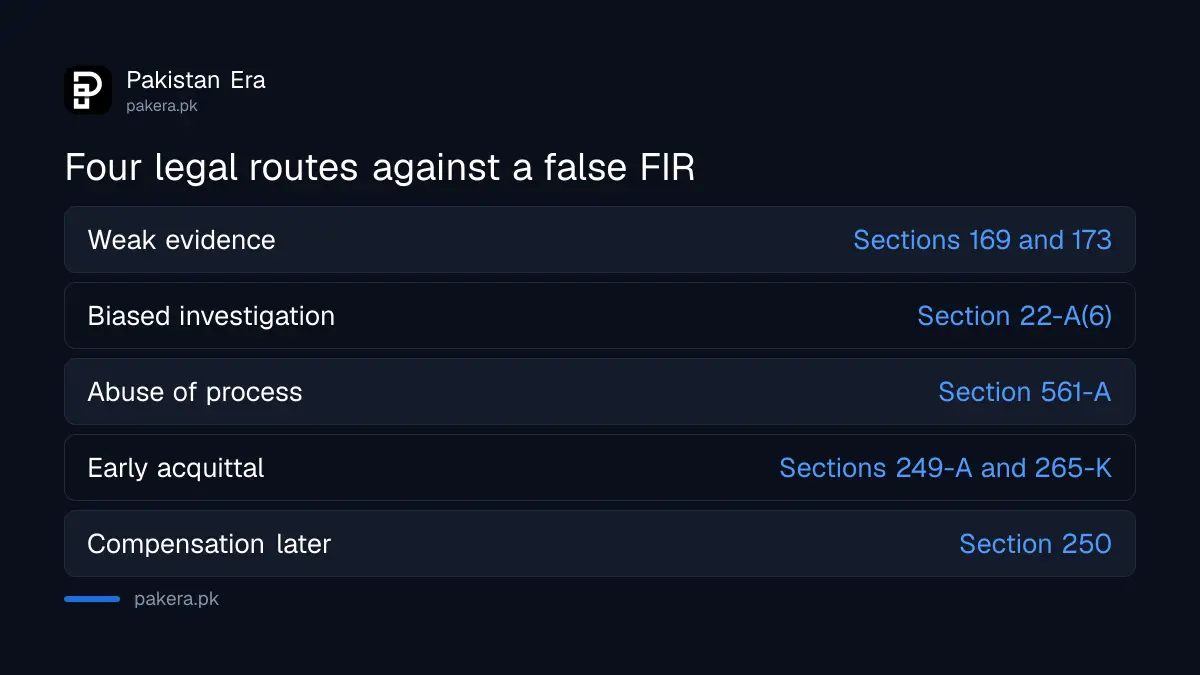
| Route | Section | Who decides | What you ask for |
|---|---|---|---|
| Weak evidence | 169 and 173 | Police, then the Magistrate | Release and a closure report |
| Biased investigation | 22-A(6) | Sessions Judge as Justice of the Peace | A different investigating officer |
| Abuse of process | 561-A | High Court | Setting aside the FIR or case |
| Early acquittal | 249-A and 265-K | Trial court | Acquittal at any stage |
The Code does not mention FIRs in Section 561-A. The High Court decides each petition on its own facts, and we cannot tell you how it will rule on yours. A lawyer files the petition with a copy of the FIR and your supporting papers, so ask for a written opinion on the chances before you pay a fee.
A trial court can acquit you at any stage if conviction is not probable
Section 265-K lets a court acquit an accused at any stage, after hearing the prosecutor and the accused and for recorded reasons, if there is no probability of conviction of any offence. Section 249-A gives a Magistrate the same power.
This route comes after the case reaches court. The full method, including what to attach, is in how to apply for early acquittal. It is cheaper than a long trial when the prosecution has no evidence, though the court may still decline.
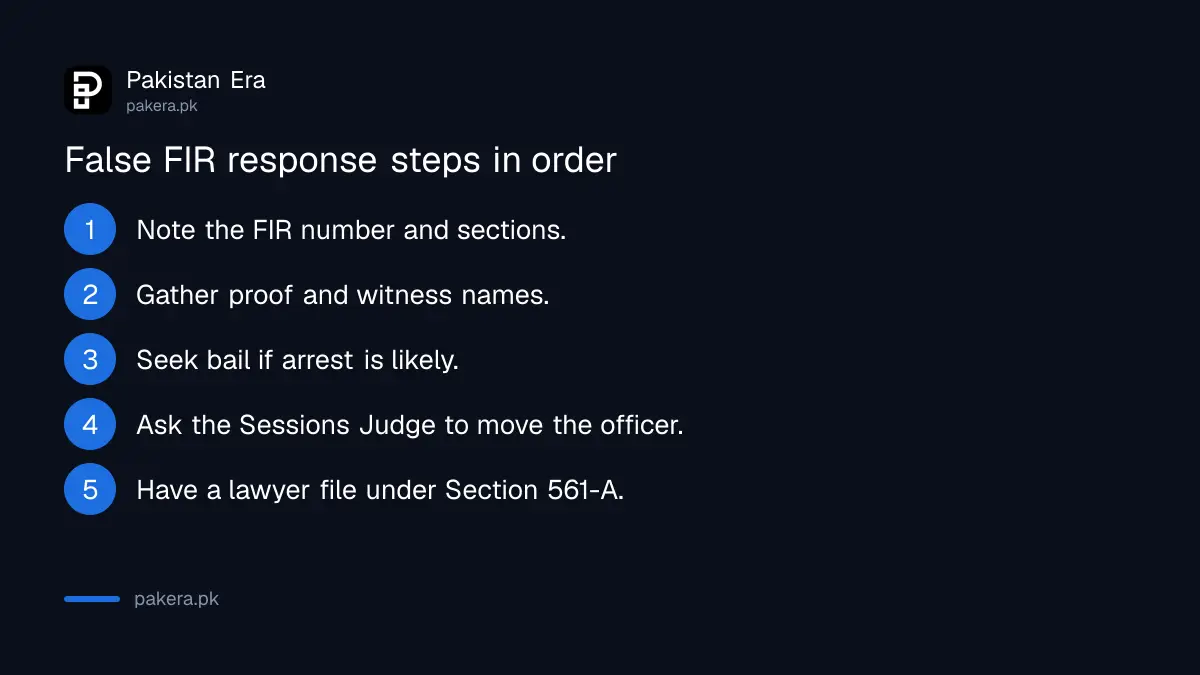
- Write down the FIR number, the sections and the officer's name from your copy of the FIR.
- Gather proof: messages, receipts, location records and names of witnesses.
- Apply for bail if arrest is likely, and give the officer your evidence in writing.
- Ask the Sessions Judge to move the investigation if the officer is biased.
- Have a lawyer file a Section 561-A petition if the case should not continue.
- Apply for early acquittal under Section 265-K if the case reaches court.
A false complainant can face compensation and a criminal charge
After an acquittal, Section 250 lets a Magistrate who finds the accusation false and frivolous or vexatious order compensation, capped at Rs 25,000 in the printed text. PPC Section 211 punishes a false charge made to injure with up to two years in jail.
| Action | Law | Limit stated in the text |
|---|---|---|
| Compensation after acquittal | CrPC Section 250 | Up to Rs 25,000 |
| False charge made to injure | PPC Section 211 | Up to 2 years, a fine, or both |
| False charge of a grave offence | PPC Section 211 | Up to 7 years and a fine |
The higher penalty applies where the false charge is of an offence punishable with death, life imprisonment or imprisonment of seven years or more. Courts decide whether a complaint was false, so do not threaten the complainant before you have an acquittal or a closure order. A lawyer can advise whether to start a separate case.
Common questions about cancelling a false FIR in Pakistan
Can police cancel an FIR on their own?
Police can close an investigation for lack of evidence under Section 169, but they still report to the Magistrate. The report does not erase the FIR.
What is Section 561-A of the CrPC?
It saves the High Court's inherent power to prevent abuse of the process of any court and to secure the ends of justice.
Can I go to the High Court without a lawyer?
A Section 561-A petition is technical, so use a lawyer. If you cannot pay, the Supreme Court legal aid helpline on 1818 links callers to bar councils.
Does a false FIR carry a punishment?
Yes. PPC Section 211 punishes a false charge made to injure a person with up to two years in jail, a fine, or both.
How much compensation can a court award?
The Section 250 text caps it at Rs 25,000, payable by the complainant after a finding of a false, frivolous or vexatious accusation.
Who can move the investigation to another officer?
A Sessions Judge acting as ex-officio Justice of the Peace can issue directions under Section 22-A(6).
How we verified this
What we checked, where we read it, and what we could not confirm.
Last checked 15 October 2026. We read the text of the Code of Criminal Procedure, 1898 and the Pakistan Penal Code on the Pakistan Code website for Sections 154, 169, 173, 190, 22-A, 25, 249-A, 250, 265-K, 561-A and PPC 211. We did not file a case. Laws change, so ask a lawyer to confirm the current text before you act.
About the author

Senior Writer, Public Services and Technology
Shahid joined us in 2024 as an author. He is a senior contributor to Pakistan's leading technology websites. He writes detailed articles, mostly covering his expertise in the latest tech, mobiles, apps, gadgets, and step-by-step guides. His ideology is to help people understand the latest trends and explain complex methods through very easy-to-understand guides.