How to Apply for Early Acquittal in a Criminal Case in Pakistan
Accused in a weak case? Sections 249-A and 265-K let a court acquit you at any stage if conviction is unlikely. See which fits your court and what to file.
If you are an accused person in a weak criminal case, your lawyer can ask the court to acquit you early under section 249-A or section 265-K of the Code of Criminal Procedure. Section 249-A is used before a magistrate. Section 265-K is used before a Sessions court. Both let a court end a case at any stage if there is no probability of conviction.
This guide explains when the route is open, what the court looks at and what to do first. It is general information, not legal advice. A lawyer must draft and argue the application.
Know which section fits your court
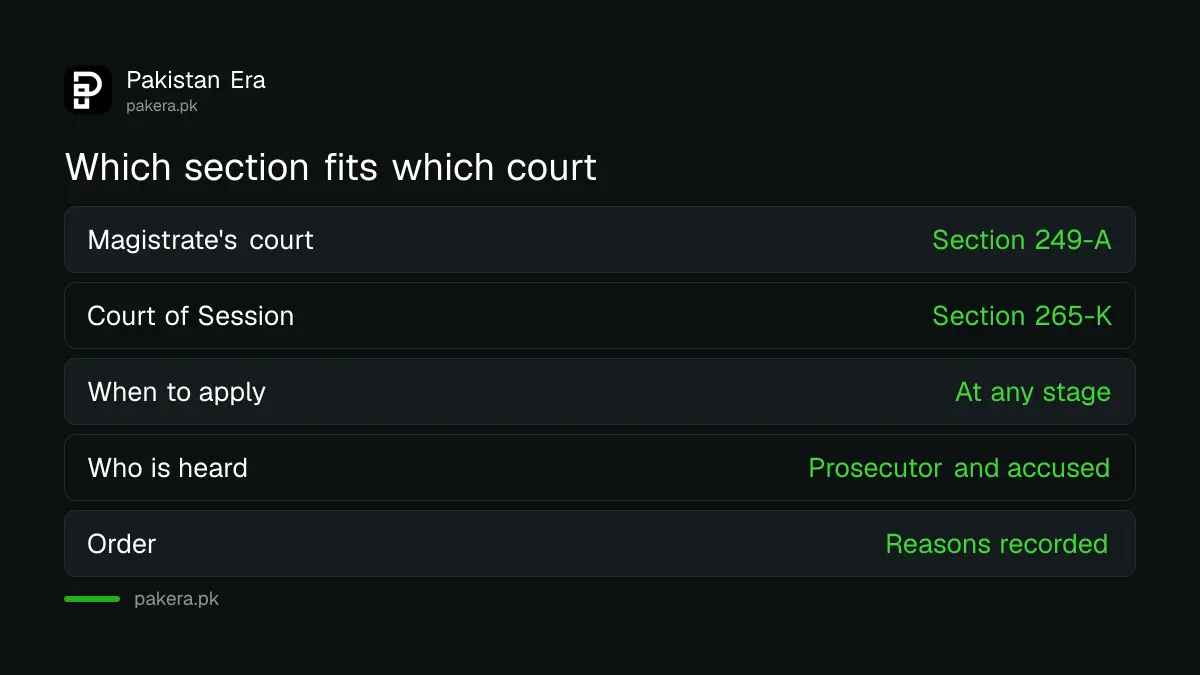
Section 249-A covers trials in a magistrate's court. Section 265-K covers trials in a Court of Session. The first asks whether the charge is groundless or whether there is no probability of conviction. The second uses the no probability test.
Both sections say the court may acquit the accused at any stage of the case, after hearing the prosecutor and the accused, and for reasons to be recorded. The words at any stage matter. The application can be made before evidence starts, or after some witnesses have been heard.
| Court | Section | Test in the Code |
|---|---|---|
| Magistrate | 249-A | Charge groundless, or no probability of conviction |
| Court of Session | 265-K | No probability of conviction |
| Both | Hearing | Prosecutor and accused are heard |
| Both | Order | Reasons must be recorded |
Check that the weak points are in the file
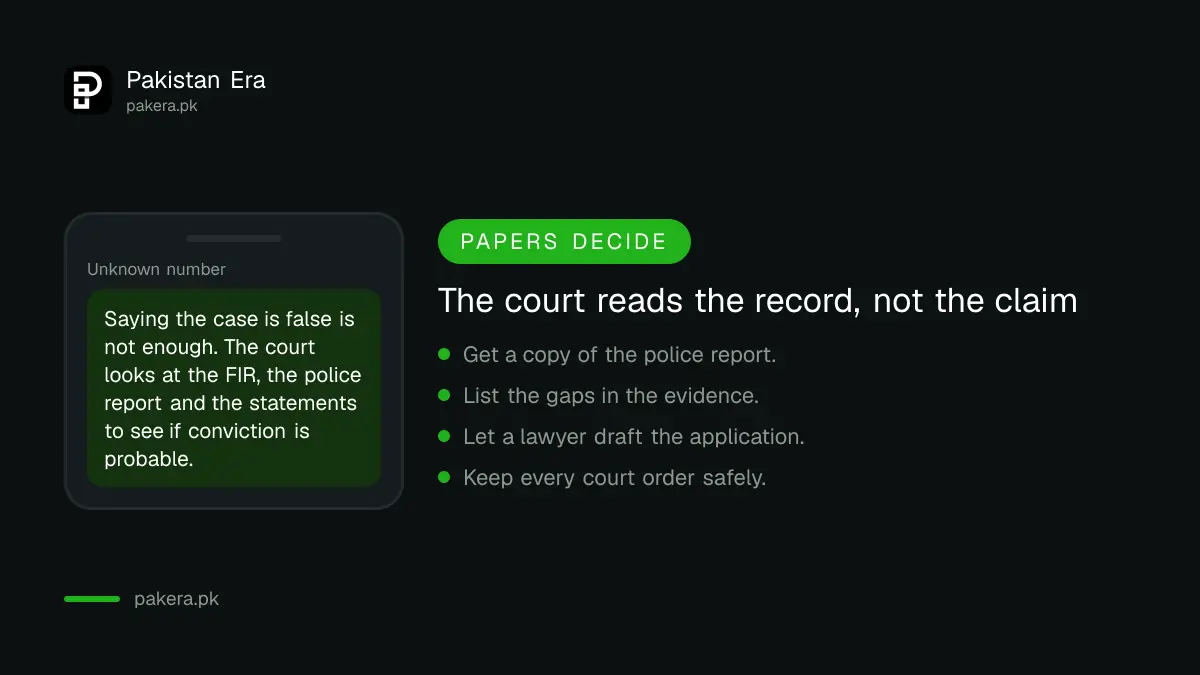
A court will not acquit because the accused says the case is false. It looks at the record. Your lawyer should read the FIR, the police report and the statements to see whether, even if everything is accepted, the evidence can support a conviction.
Common weak points include an FIR with no named role for the accused, a delay with no explanation, witnesses who contradict each other and a charge that does not match the facts. These are examples, not guarantees. Each case depends on its own papers.
Get the papers first. The guide to the police challan and interim report explains how the accused can apply for a copy of the police report. To read the FIR, see the guide to checking an FIR online.
File the application and expect a hearing
The application is filed in the court where the case is pending. It sets out the facts, the weak points and the legal ground. The court then hears the prosecutor and the accused. The state will usually oppose, so be ready to argue from the documents.
If the court agrees, it acquits and records its reasons. If it refuses, the trial continues. A refusal does not stop you from raising the same weaknesses at the end of the trial. Your lawyer can advise whether to challenge a refusal in a higher court.
If you are in custody, ask about bail alongside this application. The guide to getting bail in Pakistan explains the usual route. A lawyer's fee may be a problem, so see the guide to free legal aid in Punjab.
Know about compensation for a false accusation
Section 250 deals with false, frivolous or vexatious accusations in cases tried by a magistrate. If a magistrate acquits the accused and finds the accusation false and frivolous or vexatious, the complainant can be called to show why he should not pay compensation.
In the copy of the Code we read, the amount could not exceed Rs 25,000 for a magistrate above the third class. The same section says the order does not remove the complainant's other civil or criminal liability. Ask a lawyer whether this section has been changed and whether it fits your case.
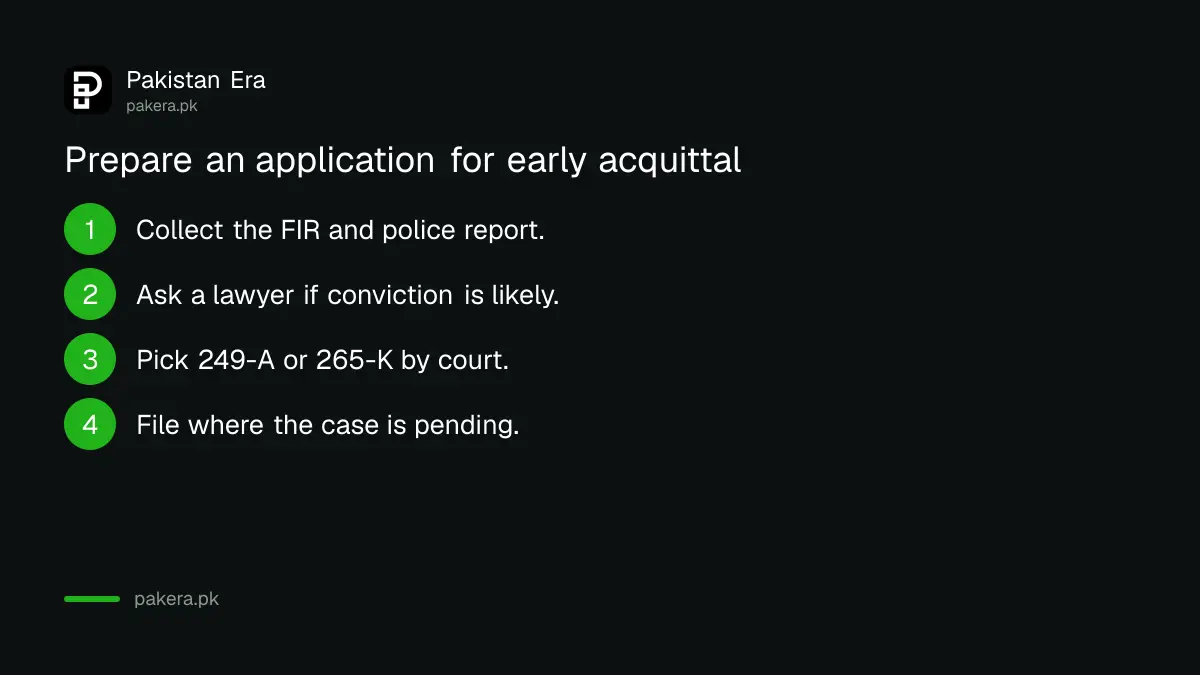
- Collect the FIR, the police report and the court orders.
- Give them to a lawyer and ask if the evidence can support a conviction.
- Choose the section: 249-A in a magistrate's court, 265-K in a Sessions court.
- File the application in the court where the case is pending.
- Attend the hearing and keep a copy of the order.
Common questions about early acquittal
Can I apply for acquittal before the trial starts?
Yes, the Code says the court may acquit at any stage. Many applications are filed early, but a court may prefer to hear evidence first. Your lawyer can say which timing suits your file.
Is acquittal the same as bail?
No. Bail lets you stay free during the trial. Acquittal ends the case in your favour. You can ask for both, and the court decides each on its own test.
What if the court rejects my application?
The trial continues and you can raise the same points at the end. Ask your lawyer whether a challenge to the refusal in a higher court is worth the cost and time.
Does this work in a serious charge such as murder?
The sections do not exclude any offence, but a court is slower to end a serious case early. Everything depends on whether the papers show a probability of conviction.
Can I claim money from the person who lodged a false case?
Section 250 allows compensation after acquittal in magistrate-tried cases if the accusation was false and frivolous or vexatious. The amount in the copy we read was small, so ask a lawyer about a civil claim as well.
How we verified this
What we checked, where we read it, and what we could not confirm.
Last checked 8 October 2026. We read sections 249-A, 250 and 265-K of the Code of Criminal Procedure 1898 on 8 October 2026 in a published copy of the Code. The Pakistan Code website did not give us the Code on that day, so we could not confirm whether the section 249-A wording or the Rs 25,000 limit in section 250 has been amended. We have not described any real case here.
About the author

Senior Writer, Public Services and Technology
Shahid joined us in 2024 as an author. He is a senior contributor to Pakistan's leading technology websites. He writes detailed articles, mostly covering his expertise in the latest tech, mobiles, apps, gadgets, and step-by-step guides. His ideology is to help people understand the latest trends and explain complex methods through very easy-to-understand guides.