Electricity Peak Hours in Pakistan: 6 pm to 10 pm Now, 5 pm to 9 pm From 1 December
Electricity peak hours in Pakistan are 6 pm to 10 pm now and 5 pm to 9 pm from 1 December. See who pays peak rates, the Rs 12.32 gap, and how to cut your bill.

Electricity peak hours in Pakistan are 6 pm to 10 pm until 30 November 2026. From 1 December they move to 5 pm to 9 pm, and stay there until the end of February. Every other hour of the day is off-peak.
Peak hours only change your bill if you have a Time of Use meter. That means homes and shops with a sanctioned load of 5 kW or more. For a home on Time of Use, a peak unit costs Rs 46.85 and an off-peak unit costs Rs 34.53, before taxes. That is Rs 12.32 more for the same unit, just because of the clock.
We read the timing table in NEPRA's terms and conditions of tariff, and the current rates in the government's February 2026 tariff notification, so you can plan your heavy loads around the right four hours.
Peak hours change four times a year
Pakistan has four seasonal peak windows, each four hours long. The window is earliest in winter, from 5 pm, because the evening demand starts sooner when the sun sets early. It is latest in summer, from 7 pm.
| Months | Peak hours | Off-peak hours |
|---|---|---|
| December to February | 5 pm to 9 pm | The other 20 hours |
| March to May | 6 pm to 10 pm | The other 20 hours |
| June to August | 7 pm to 11 pm | The other 20 hours |
| September to November | 6 pm to 10 pm | The other 20 hours |
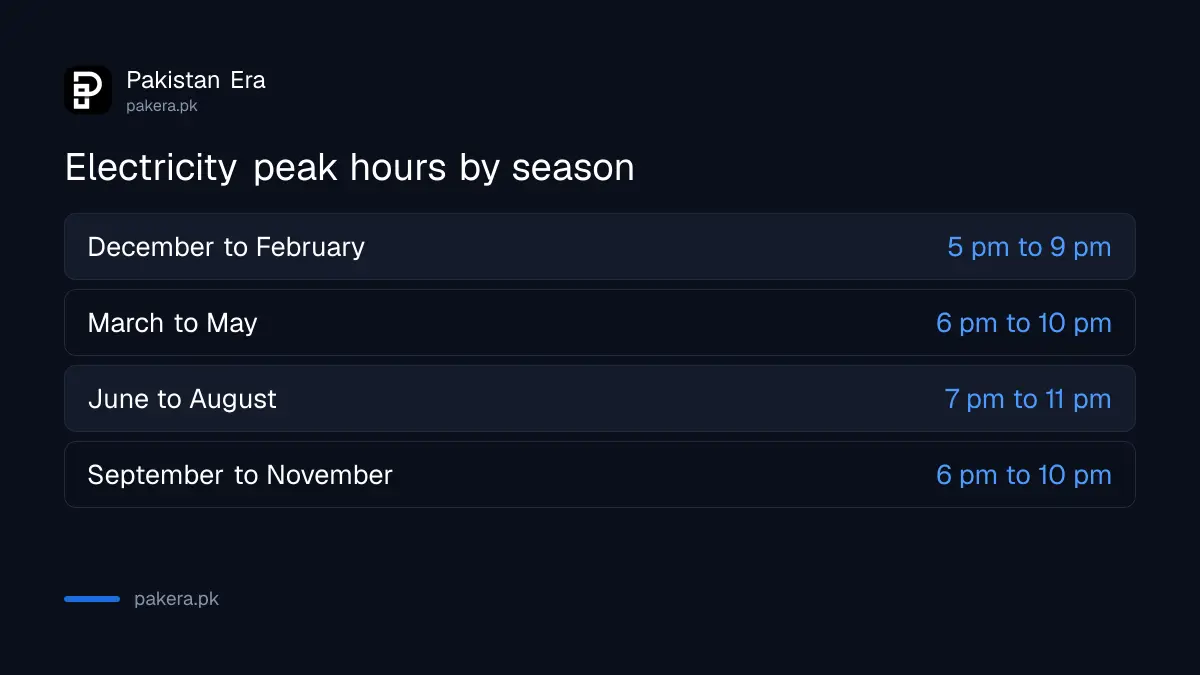
The table sits in clause 10 of the general definitions in NEPRA's terms and conditions for the state distribution companies such as LESCO, IESCO, FESCO, GEPCO and MEPCO. A footnote says the timings would be adjusted if Pakistan used daylight saving time. Pakistan does not use it at present, so the clock times stand as printed.
The next change is on 1 December 2026. If you run a pump or a washing machine at 5.30 pm today, that is off-peak. On 1 December the same half hour becomes peak.
Only Time of Use meters are billed by the hour
Peak hours affect your bill only if you are on a Time of Use (ToU) tariff. A ToU meter keeps two counts: units used in peak hours and units used in the other 20 hours. Homes and shops below 5 kW pay one rate whatever the time.
The rules are clear about who goes on ToU. Every new home connection of 5 kW or more gets a ToU meter, and existing homes of that size are to be converted by the company. Commercial connections of 5 kW and above have a ToU option, and larger industrial connections are billed on peak and off-peak rates too.
So if your sanctioned load is 3 kW, peak hours do not change your bill. If you asked the company to extend your load to 5 kW or three phase, you have almost certainly moved onto ToU billing.
A peak unit costs Rs 12.32 more for homes
For a home on ToU, the government rate is Rs 46.85 a unit in peak hours and Rs 34.53 off-peak. Shops on ToU pay Rs 43.82 peak and Rs 35.15 off-peak. These are the rates notified on 12 February 2026, before tax, fuel charge and quarterly adjustments.
| Connection | Peak rate (Rs a unit) | Off-peak rate (Rs a unit) | Gap (Rs a unit) |
|---|---|---|---|
| Home, 5 kW and above | 46.85 | 34.53 | 12.32 |
| Shop or office, 5 kW and above, ToU | 43.82 | 35.15 | 8.67 |
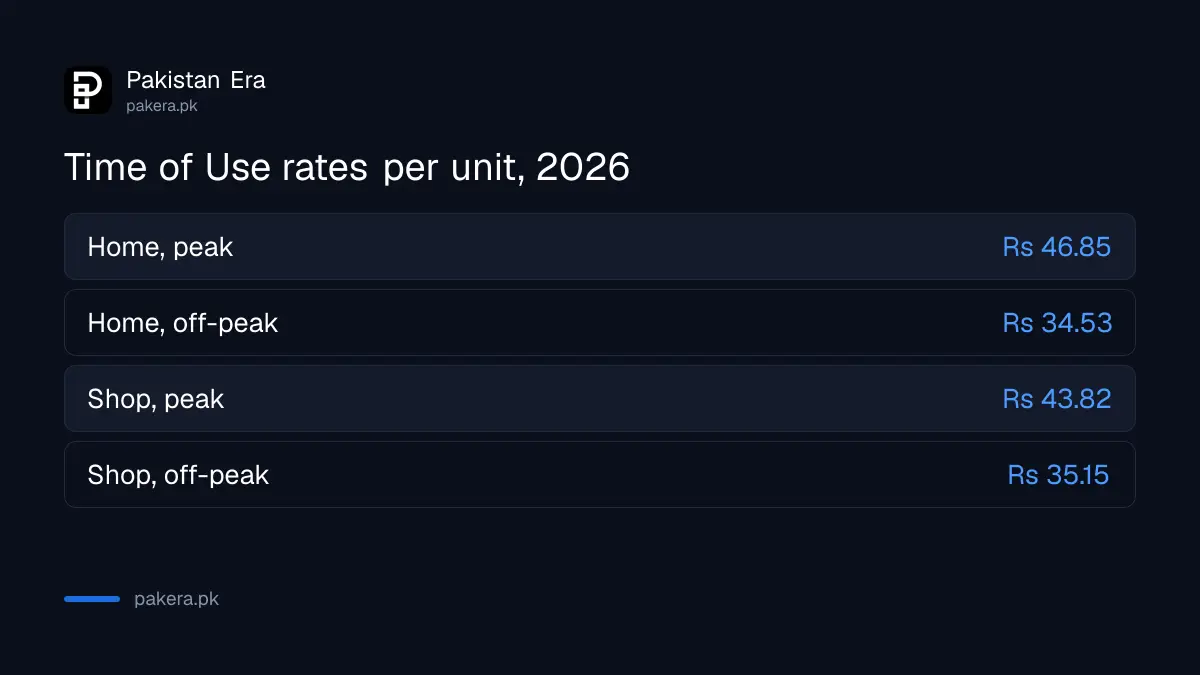
For comparison, a normal home under 5 kW pays its slab rate, from Rs 22.44 to Rs 47.20 a unit. The full list is in Pakistan's 2026 electricity slab rates, and shop rates are in the commercial unit price for 2026.
Homes on ToU also pay a fixed charge of Rs 675 per kW a month. It is worked out on half the sanctioned load or the maximum demand the meter records, whichever is higher. So a 5 kW home pays it on at least 2.5 kW, which is Rs 1,687.50 a month.
Moving 60 units out of peak saves about Rs 739
The saving is simple arithmetic. Every unit you move from peak to off-peak saves Rs 12.32 at home. Move 60 units a month and you save Rs 739.20, before tax.
Here is a worked example for a 5 kW home using 600 units a month. We assume a quarter of those units fall in peak hours, which is common when the family is home in the evening.
- 150 peak units at Rs 46.85 come to Rs 7,027.50.
- 450 off-peak units at Rs 34.53 come to Rs 15,538.50.
- The energy charge is Rs 22,566, before the fixed charge and taxes.
If the same home moves 60 of its peak units into the morning or late night, the energy charge falls to Rs 21,826.80.
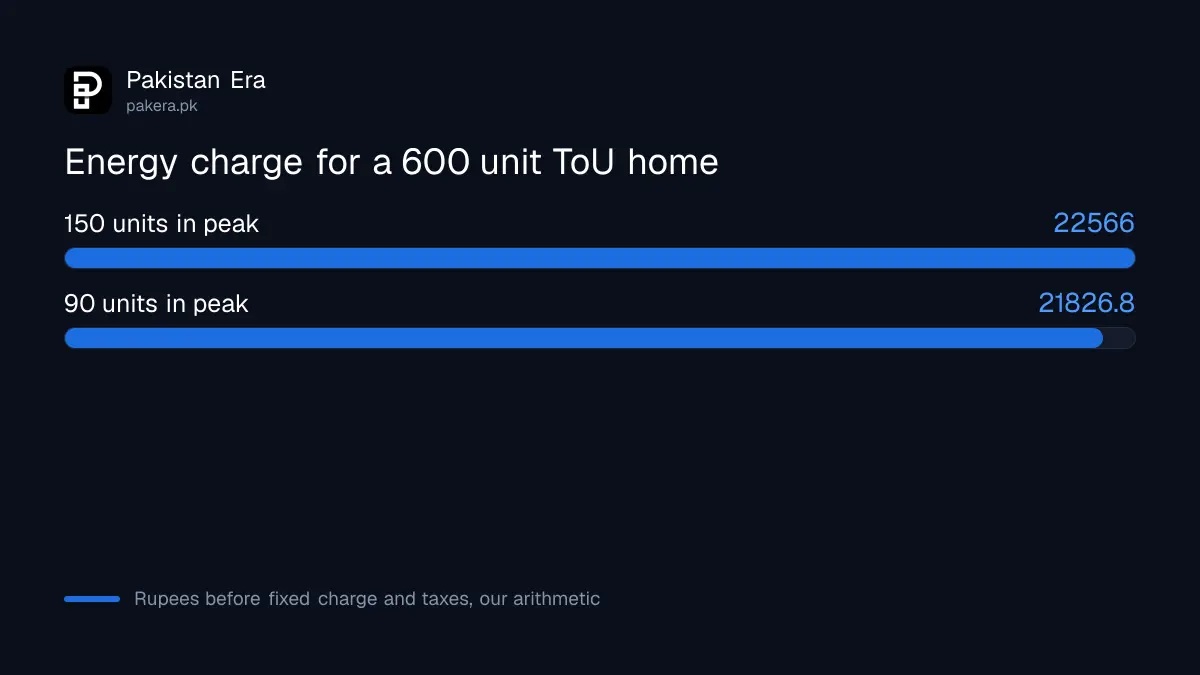
The best loads to move are the big ones you control: a water pump, a washing machine, an iron, an electric water heater and EV charging. Charging an electric car overnight off-peak is a large saving on its own, as the cost of charging an electric car at home shows.
Check your peak units in four steps
Your bill shows peak and off-peak units separately if you are on ToU.
- Find your sanctioned load on the bill. If it is 5 kW or more, you should be on ToU.
- Look for two unit lines, one for peak and one for off-peak. A single unit line on a 5 kW connection is worth asking about.
- Read the two counts on the meter on the same day the reader comes, or compare with the meter photo the company keeps.
- If the peak figure looks too high, complain to the company first, then to NEPRA if it does not fix it.
Reading the meter yourself is easier than it sounds. Checking your meter reading and the snapshot on your bill covers the photo and the 7 day window to complain. If the meter itself is faulty, ask for a test under the faulty meter replacement rules.
NEPRA has kept the old timings for now
NEPRA has been asked whether these timings still fit. Rooftop solar has changed when the grid is under most pressure, and NEPRA noted in June 2025 a mismatch between the real system peak and the peak hours used in tariffs.
It had directed the distribution companies, in a May 2025 decision, to study the Time of Use timings and the effect of rooftop solar. In its June 2025 decision for LESCO, NEPRA said any change would be considered once those studies arrive. Until then, it kept the existing peak and off-peak hours and rate design. We found no later decision that changes the timings.
That matters because any change also means reprogramming meters, as the same decision points out. If they do change, the new table will appear in a NEPRA decision first.
Common questions
What are the electricity peak hours in Pakistan right now?
From September to November, peak hours are 6 pm to 10 pm. From 1 December to the end of February they are 5 pm to 9 pm.
Do peak hours affect a normal home bill?
No, not if your sanctioned load is under 5 kW. Those homes pay one slab rate at any time of day.
How much more does a peak unit cost?
For homes on Time of Use, Rs 46.85 against Rs 34.53 off-peak, a gap of Rs 12.32 a unit before tax.
Are Saturday and Sunday off-peak all day?
The timing table in NEPRA's terms does not make an exception for weekends or holidays. The same four hours apply every day.
Do K-Electric customers have the same peak hours?
This table is from the terms for the state distribution companies. We could not confirm K-Electric's timings on an official page, so check the peak and off-peak lines on your K-Electric bill.
How we verified this
What we checked, where we read it, and what we could not confirm.
Last checked on 9 October 2026. The seasonal peak and off-peak timings, the 5 kW Time of Use rule and NEPRA's reasoning on keeping the timings are from NEPRA's LESCO decision of 23 June 2025, Annex V, terms and conditions of tariff. The peak and off-peak rates and the fixed charge rule are from the Ministry of Energy's S.R.O. 279(I)/2026 of 12 February 2026. Worked examples are our own arithmetic.
About the author

Global Affairs & Political Economy Writer
Muhammad Hatim is a book lover who started writing because he enjoys it. At Pakistan Era he writes about international relations, geopolitics and the global economy, with a particular interest in South Asia and the forces behind current events.