K-Electric Peak Hours 2026 in Karachi: 6 pm to 10 pm From 1 November, Every Season Listed
K-Electric peak hours are 6:30 pm to 10:30 pm until 31 October, then 6 pm to 10 pm to March. See how Karachi differs from LESCO and what a peak unit costs.
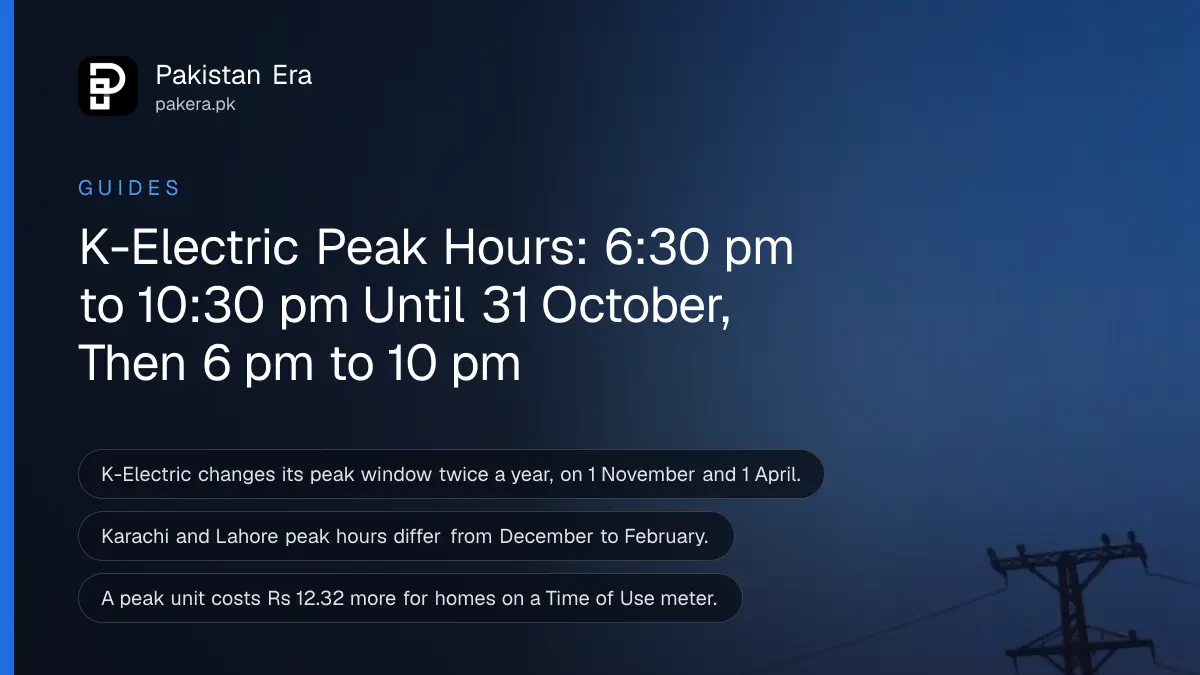
K-Electric peak hours in Karachi are 6:30 pm to 10:30 pm until 31 October 2026. From 1 November they move to 6 pm to 10 pm, and stay there until the end of March. Every other hour of the day is off-peak. That is K-Electric's own timetable, and it is not the same as the one LESCO, IESCO or MEPCO customers follow.
The difference matters only if your bill shows two unit counts, one for peak and one for off-peak. If it does, a unit used at 10:15 pm in November costs less than the same unit used at 10:15 pm in October. We read K-Electric's tariff structure page and its Know Your Bill page on 25 October 2026, and compared them with the national timetable we checked earlier this month.
K-Electric has two peak windows a year, not four
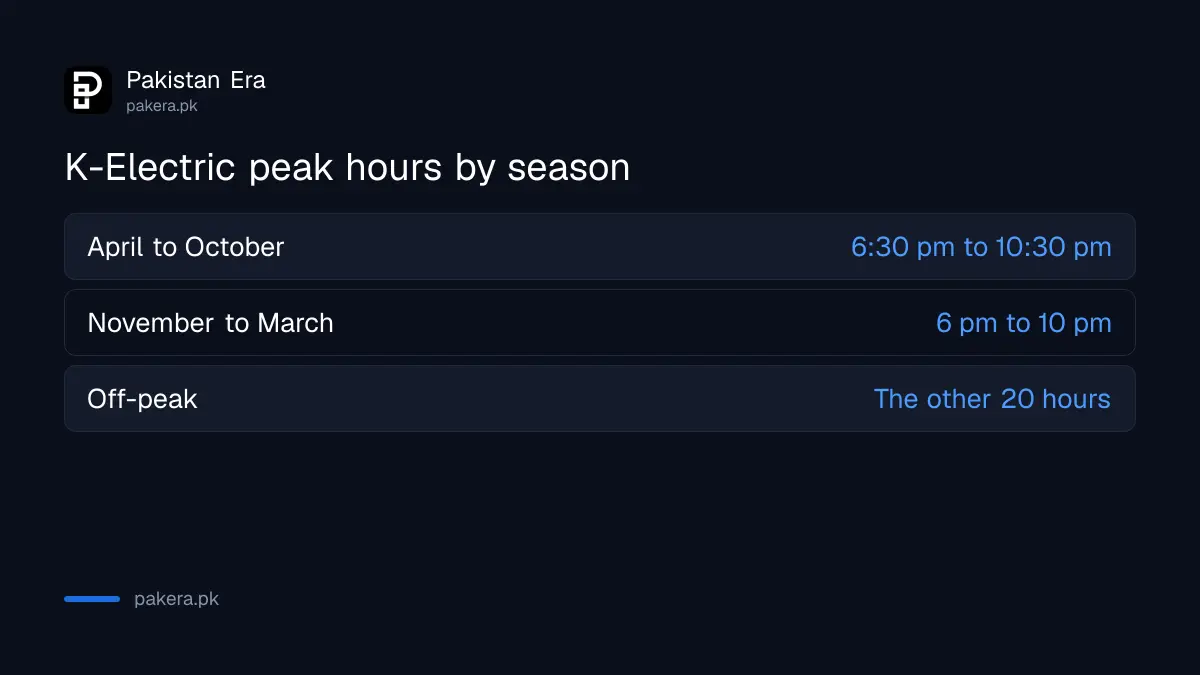
K-Electric uses one evening window from April to October, 6:30 pm to 10:30 pm, and another from November to March, 6 pm to 10 pm. Each window is four hours long. The remaining 20 hours of the day are billed at the off-peak rate.
The tariff structure page on ke.com.pk sets this out in a small Time of Use table, under the tax notes. It reads like this:
| Months | Peak hours | Off-peak hours |
|---|---|---|
| April to October | 6:30 pm to 10:30 pm | The other 20 hours |
| November to March | 6 pm to 10 pm | The other 20 hours |
So the next change is on Sunday 1 November 2026. The window starts half an hour earlier and ends half an hour earlier. The half hour from 6 pm to 6:30 pm becomes peak. The half hour from 10 pm to 10:30 pm becomes off-peak.
Karachi's peak hours differ from the rest of Pakistan
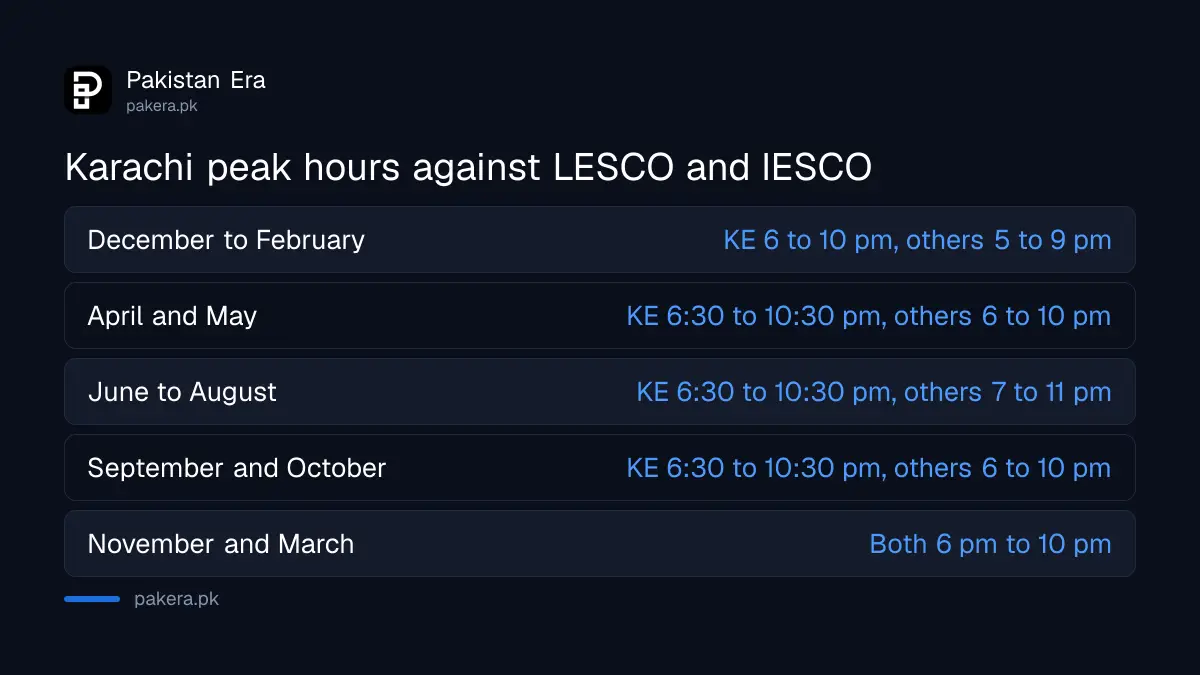
The state companies, such as LESCO, IESCO, FESCO and MEPCO, change their window four times a year, from 5 pm in winter to 7 pm in summer. K-Electric changes only twice. In five months of the year the two timetables match. In the other seven they do not.
Our earlier reading of NEPRA's terms for the state companies is in the national electricity peak hours in Pakistan. Set side by side with K-Electric's table, the months line up like this:
| Months | K-Electric (Karachi) | LESCO, IESCO, MEPCO and others | Same? |
|---|---|---|---|
| November | 6 pm to 10 pm | 6 pm to 10 pm | Yes |
| December to February | 6 pm to 10 pm | 5 pm to 9 pm | No |
| March | 6 pm to 10 pm | 6 pm to 10 pm | Yes |
| April and May | 6:30 pm to 10:30 pm | 6 pm to 10 pm | No |
| June to August | 6:30 pm to 10:30 pm | 7 pm to 11 pm | No |
| September and October | 6:30 pm to 10:30 pm | 6 pm to 10 pm | No |
This is the trap for families who read a general article or hear the time from a relative in Lahore. In December, a Lahore home is off-peak from 9 pm. A Karachi home is still in peak until 10 pm.
Only a Time of Use meter is billed by the clock
Peak hours change your bill only if you are on a Time of Use (ToU) meter. That meter keeps two counts: units used in the four peak hours and units used in the other 20. Most small homes pay one slab rate whatever the time.
When we checked NEPRA's tariff terms for the national page, homes with a sanctioned load of 5 kW or more were placed on ToU meters. Sanctioned load is the load your connection was approved for, printed on the bill in kilowatts (kW). If you raised your load or moved to three phase, as described in extending your electricity load, check whether your bill now shows two unit lines.
K-Electric's Know Your Bill page says the tariff "is universal across XWDISCOs & KE", meaning Karachi pays the same rates as the state companies. So the national ToU rates we read in the February 2026 notification apply: Rs 46.85 a unit at peak and Rs 34.53 off-peak for homes, before taxes and adjustments. The full slab list is in Pakistan's 2026 electricity slab rates.
Moving loads out of the peak saves about Rs 12 a unit
For a home on ToU, each unit moved from peak to off-peak saves Rs 12.32 before tax. Sixty units a month is a saving of Rs 739.20. The best loads to move are the big ones you control: a water motor, a washing machine, an iron and an electric heater.
Taxes widen the gap slightly. K-Electric's tariff page lists electricity duty at 1.5% of variable charges for homes, plus sales tax. It also says homes whose monthly bill is Rs 25,000 or more pay 7.5% income tax unless the account holder is on FBR's active taxpayer list. Getting on that list, and linking your CNIC to the account, is covered in updating your CNIC on K-Electric.
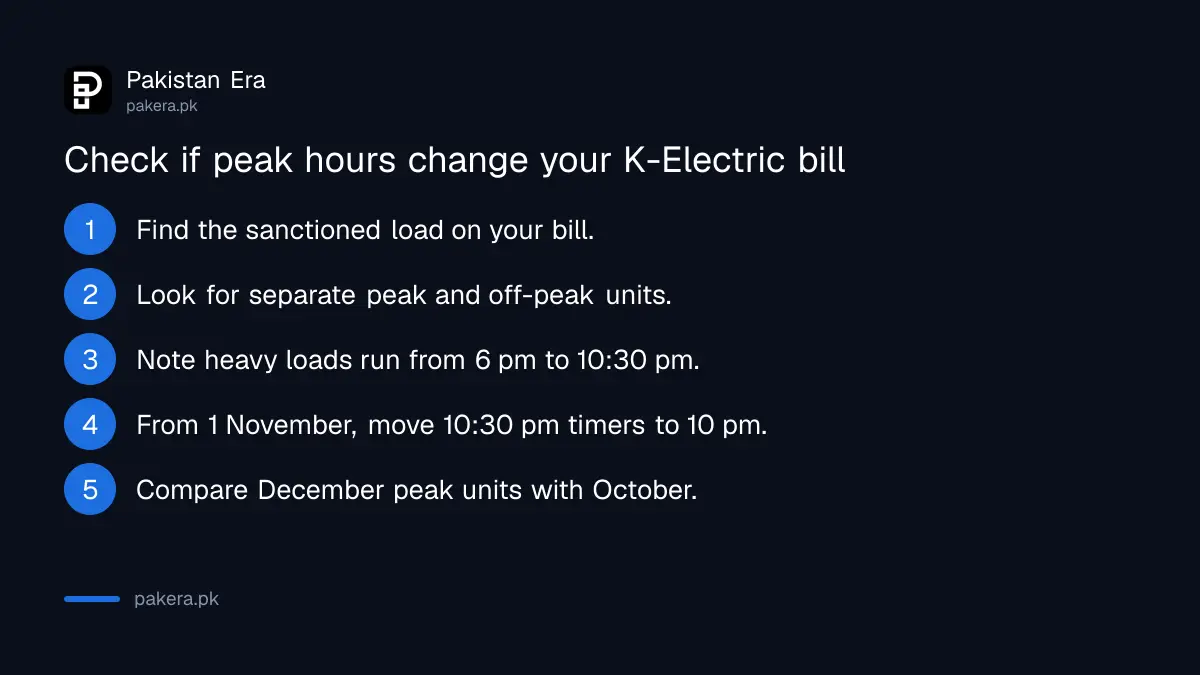
Here is how to check, in five steps, whether the 1 November change touches your bill:
- Find the sanctioned load on your latest K-Electric bill.
- Look for two unit lines, one marked peak and one off-peak.
- If you see two lines, note which heavy loads you run between 6 pm and 10:30 pm.
- From 1 November, move timers that start at 10:30 pm to 10 pm, and avoid starting big loads at 6 pm.
- Compare the peak units on your December bill with October's.
Peak hours are not load shedding hours
Peak hours are a billing window. Load shedding is a supply cut planned by area and feeder. The two often overlap in the evening, but one does not set the other, and a feeder can be on load shedding at 2 pm, well outside the peak.
For your own area's cuts, use K-Electric's load shedding schedule, which works by account number. And if your peak unit count looks too high, read the meter on the day the reader comes and compare it with the photo on the back of your bill. K-Electric's own page says a meter snapshot is printed there for that reason.
A wrong peak reading is a billing complaint. Call 118 or message 0348-0000118 on WhatsApp first. If K-Electric does not fix it, the route to NEPRA is in filing a K-Electric complaint.
Common questions
What are K-Electric peak hours in November 2026?
6 pm to 10 pm. K-Electric's tariff page lists 6 pm to 10 pm for November to March, so the window applies from 1 November 2026 to 31 March 2027.
What are K-Electric peak hours right now, in October?
6:30 pm to 10:30 pm. That window runs from April to October, so it ends on 31 October 2026.
Are Karachi peak hours the same as Lahore's?
Not always. They match in November and March only. From December to February, Lahore's peak is 5 pm to 9 pm while Karachi's is 6 pm to 10 pm.
Do peak hours affect a small home connection?
Only if the bill shows separate peak and off-peak units. A home billed on one slab rate pays the same price for a unit at any hour.
How much more does a peak unit cost?
Rs 12.32 more for a home on Time of Use, before tax: Rs 46.85 at peak against Rs 34.53 off-peak, on the national rates Karachi also pays.
Does K-Electric have peak hours on weekends?
K-Electric's table gives one daily window and names no weekend exception, so treat Saturday and Sunday evenings as peak too.
How we verified this
What we checked, where we read it, and what we could not confirm.
We read K-Electric's tariff structure page on 25 October 2026, including its Time of Use table, its electricity duty line and its income tax table. We also read K-Electric's Know Your Bill page the same day for the statement that the tariff is the same across the state companies and K-Electric, and for the meter snapshot. The national timetable and the Rs 46.85 and Rs 34.53 rates come from our reading of NEPRA's terms and the February 2026 tariff notification for an earlier article. We could not open the full consumer tariff PDF on ke.com.pk from our connection, and the tariff page gives no rule for public holidays, so we have not stated one. The Rs 739.20 saving is our arithmetic.
About the author

Senior Writer, Public Services and Technology
Shahid joined us in 2024 as an author. He is a senior contributor to Pakistan's leading technology websites. He writes detailed articles, mostly covering his expertise in the latest tech, mobiles, apps, gadgets, and step-by-step guides. His ideology is to help people understand the latest trends and explain complex methods through very easy-to-understand guides.