How to Challenge a Criminal Court Order by Revision in Pakistan
No appeal open against a criminal court order? Revision under sections 439 and 439A goes to the High Court or Sessions Judge. See the limits and steps.
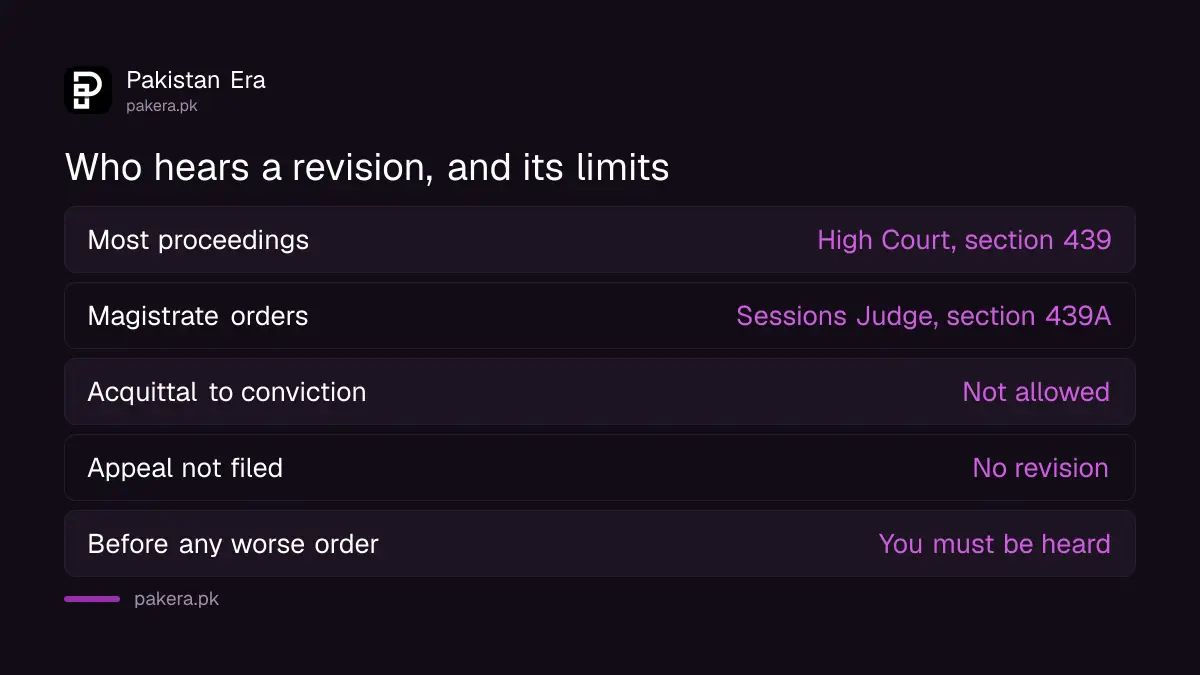
A revision petition asks a higher court to correct an order of a criminal court when no appeal is open to you, and sections 439 and 439A of the Code of Criminal Procedure say who can hear it. The High Court hears revision of most orders. A Sessions Judge hears revision of a Magistrate's orders.
Many people lose a point in a criminal case, such as refused bail papers or a wrongly framed charge, and then learn there is no appeal. A revision is often the next step. We read the revision sections of the Code of Criminal Procedure, 1898, on 21 October 2026. To choose between the routes, see the guide to appealing a criminal conviction.
The High Court can revise a lower court's proceedings under section 439
Section 439 lets the High Court use the appeal powers in sections 423, 426, 427 and 428, and the power in section 338, over any proceeding whose record it has called for or which comes to its knowledge. It can also increase a sentence.
The High Court acts "in its discretion". A revision is not a second appeal on the facts. It is a check on whether the order was legal and proper. Courts look at the record, so you need a certified copy of the order you are challenging.
| Question | Answer in the Code | Section |
|---|---|---|
| Who revises a High Court level matter? | The High Court | 439 |
| Who revises a Magistrate's order? | The Sessions Judge, with High Court powers | 439A |
| Can acquittal become conviction? | No | 439(4)(a) |
| Can I revise if I could have appealed? | No, if you did not appeal | 439(5) |
| Can the court worsen my position unheard? | No, you must be heard | 439(2) |
A Sessions Judge can revise a Magistrate's order under section 439A
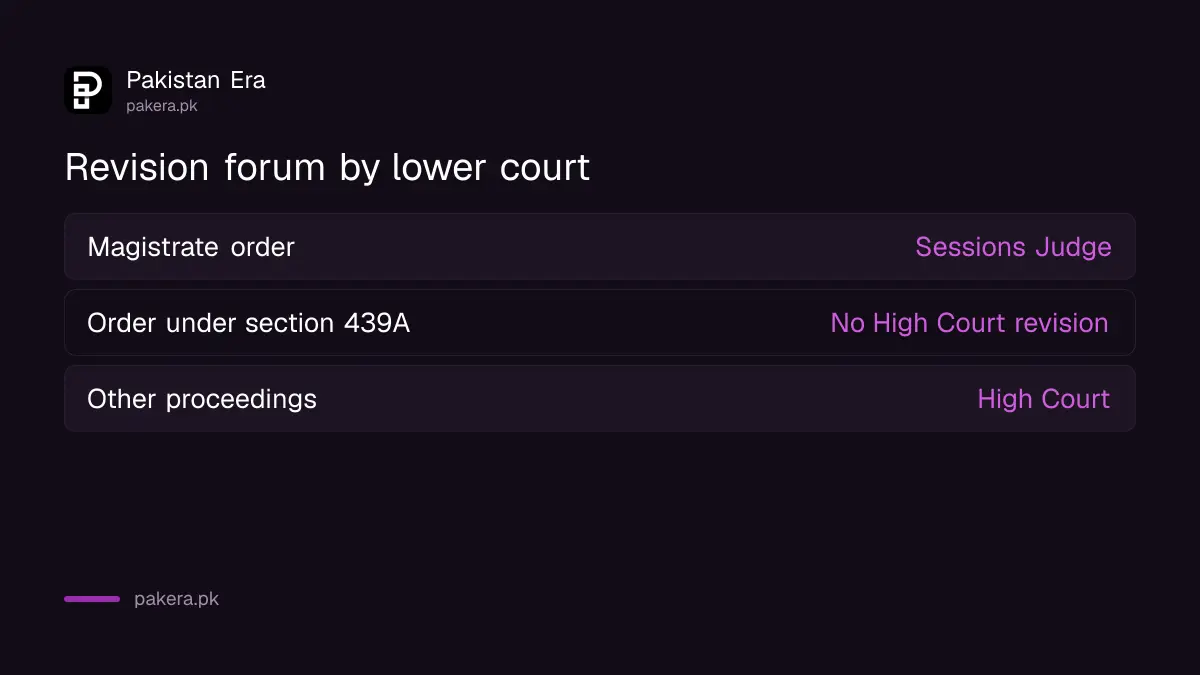
Section 439A lets a Sessions Judge call for the record of any Magistrate's proceeding, or act on information that reaches him, and use the powers of the High Court under section 439. This makes the Sessions Court the nearer forum for a Magistrate's order.
Section 439(4)(b) adds that the High Court cannot entertain a revision against an order the Sessions Judge made under section 439A. In plain terms, once the Sessions Judge decides, the revision route to the High Court on that same order is closed, though other remedies may remain.
You cannot use revision if an appeal was open and you did not file it
Section 439(5) says that where the Code gives an appeal and no appeal is brought, no revision is entertained at the instance of the party who could have appealed. Check first whether your order can be appealed at all.
Which orders can be appealed is set by the appeal sections of the Code, which we did not read in full for this page. Where the Code gives no appeal against an order, revision is the route that remains. Ask a lawyer before choosing, because a wrong route costs weeks.
The court cannot turn an acquittal into a conviction or punish you unheard
Section 439(4)(a) bars the High Court from converting a finding of acquittal into a conviction. Section 439(2) says no order may be made to the prejudice of the accused unless he has had a chance to be heard, in person or through a lawyer.
If the court proposes to raise your sentence, section 439(6) lets you argue against the conviction as well. Section 439(3) caps the sentence after a Magistrate's trial at what a Magistrate of the first class could have imposed.
- Get a certified copy of the order and the record.
- Check whether the order is appealable. If it is, appeal instead.
- Choose the forum: Sessions Judge for a Magistrate's order, High Court otherwise.
- Write the grounds: what was illegal or improper, in numbered points.
- File through a lawyer, or in person if the court allows.
- Attend every date, and tell the court if you have not been served.

The Code sets no revision deadline, so file without delay
We found no fixed number of days for a criminal revision in the Code text or in the First Schedule of the Limitation Act that we read. Section 5 of that Act lets a court admit a late revision if you show sufficient cause.
Do not rely on that favour. Delay hurts you, because the court asks why you waited. If you cannot afford a lawyer, see free legal aid in Punjab and the matching pages for other provinces.
Common questions
What is the difference between appeal and revision?
An appeal is a right the Code gives against certain orders. Revision is a discretionary check by a higher court on the legality of an order, usually where no appeal lies.
Can the High Court hear a revision of any order?
Yes, of any proceeding whose record it calls for or that comes to its knowledge, under section 439, with the limits above.
Can the State ask to increase a sentence in revision?
Section 439 allows the High Court to enhance a sentence, but only after the accused has been heard.
Does revision stop the trial?
Not automatically. A stay is a separate request to the court, and we found nothing in the Code that makes it automatic.
Is there a fee?
The Code names none. We could not check the current court fee rules, so ask the court office.
How we verified this
What we checked, where we read it, and what we could not confirm.
Last checked 21 October 2026. We read sections 439 and 439A of the Code of Criminal Procedure, 1898, and section 5 and the appeals items of the First Schedule of the Limitation Act, 1908, in the Pakistan Code PDFs, from copies saved earlier this week. The Pakistan Code portal did not open for us on the day, so later amendments are unchecked. We did not read High Court rules or case law on revision.
About the author

Global Affairs & Political Economy Writer
Muhammad Hatim is a book lover who started writing because he enjoys it. At Pakistan Era he writes about international relations, geopolitics and the global economy, with a particular interest in South Asia and the forces behind current events.