How to Appeal a Criminal Conviction in Pakistan: Which Court and How Many Days
Convicted in a Pakistani criminal case? See which court hears your appeal, the 30 and 60 day limits, how to appeal from jail and when bail is mandatory.
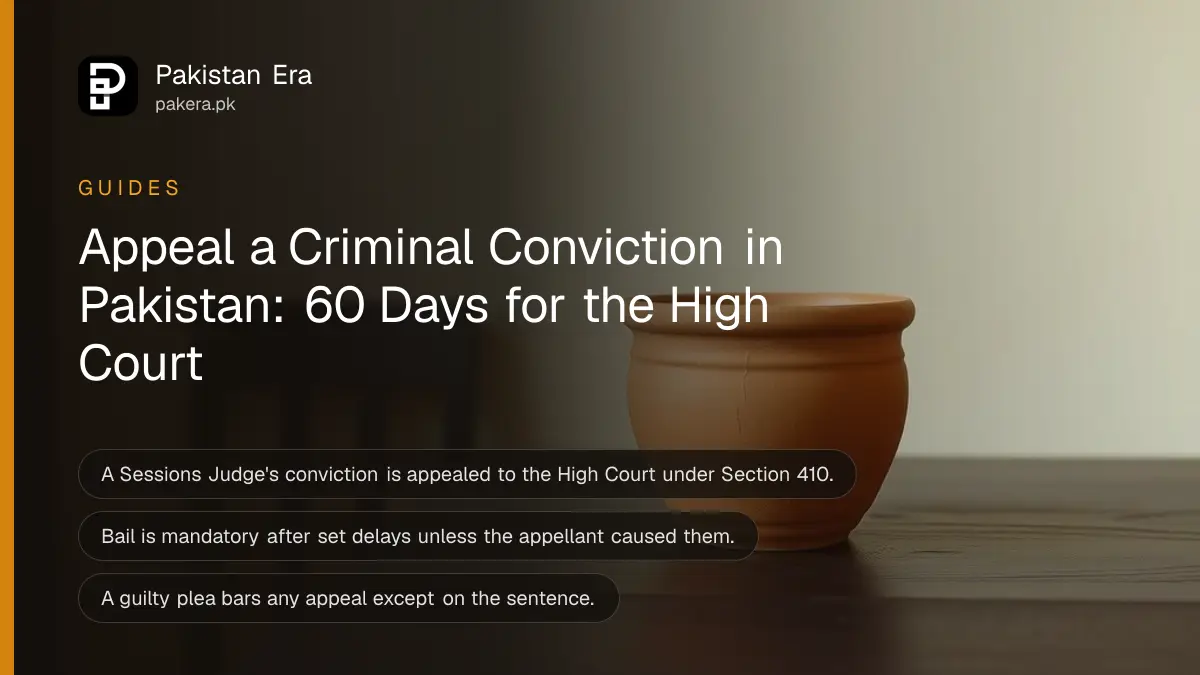
A criminal conviction in Pakistan is appealed to the Sessions Court or the High Court, depending on who convicted you. The Limitation Act sets 60 days for a High Court appeal, 30 days for a death sentence and six months for an appeal against acquittal. Bail while the appeal waits is a separate request.
The verdict is read, the family stands in the corridor, and the first question is always the same: how long do we have? The answer sits in two old laws, the Code of Criminal Procedure (CrPC) and the Limitation Act. We read both on the Pakistan Code website on 15 October 2026. This is general information, not legal advice. A deadline missed by one day can close the door, so give a lawyer the judgment copy on the day it is announced.
The court that convicted you decides where the appeal goes
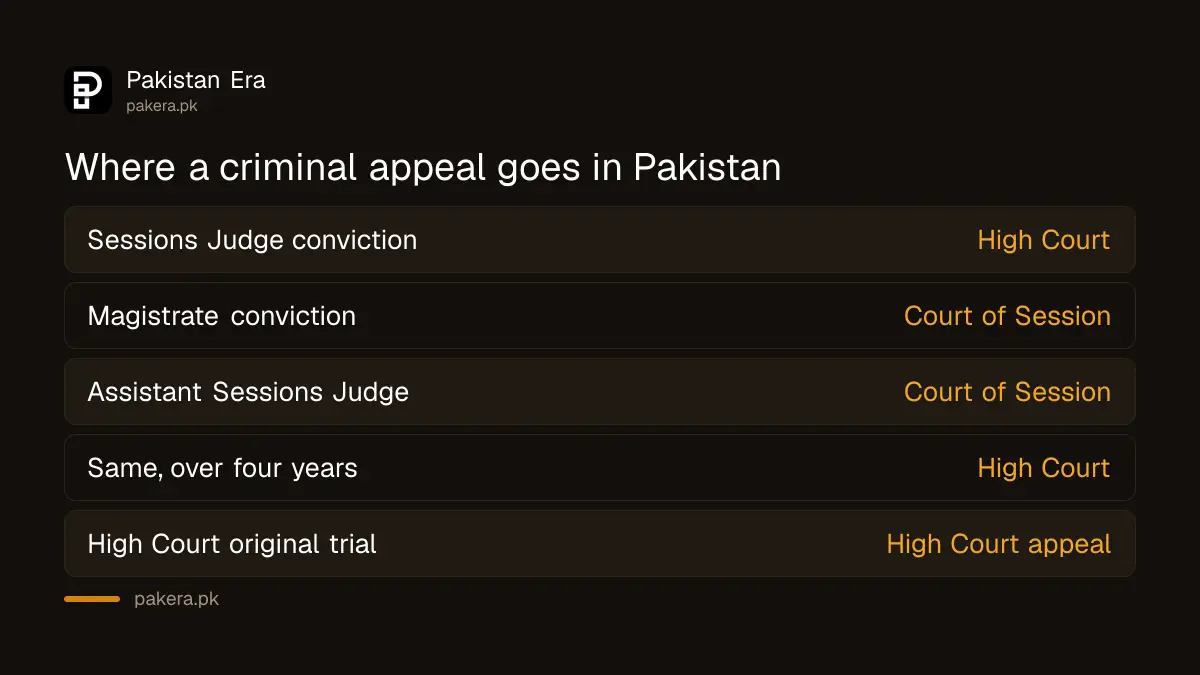
A conviction by a Sessions Judge or Additional Sessions Judge is appealed to the High Court under Section 410. A conviction by an Assistant Sessions Judge or a Judicial Magistrate is appealed to the Court of Session under Section 408, with exceptions.
| Convicted by | Appeal goes to | CrPC section |
|---|---|---|
| Sessions Judge or Additional Sessions Judge | High Court | 410 |
| Assistant Sessions Judge or Judicial Magistrate | Court of Session | 408 |
| Assistant Sessions Judge, sentence over four years | High Court | 408(b) |
| High Court in its original criminal jurisdiction | High Court (or Supreme Court where Article 185 applies) | 411A |
The sentence matters, not only the court. If the Assistant Sessions Judge passed more than four years, the appeal shifts to the High Court. For a final appeal to the top court after the High Court, see the 60 and 30 day limits for the Supreme Court.
The deadline is 60 days for the High Court and 30 days for a death sentence
The Limitation Act sets 60 days from the date of the sentence for a CrPC appeal to the High Court, under Article 155. Article 150 sets 30 days for a death sentence from a Court of Session. Article 157 gives six months against an acquittal.
One line of the schedule is unclear in the PDF we read. Article 154 covers CrPC appeals to a court other than a High Court, such as the Court of Session, and the printed period reads "Thirty years", which is plainly a misprint. We could not confirm the correct period from that file, so ask the court office for it on the day of the verdict and file as early as possible.
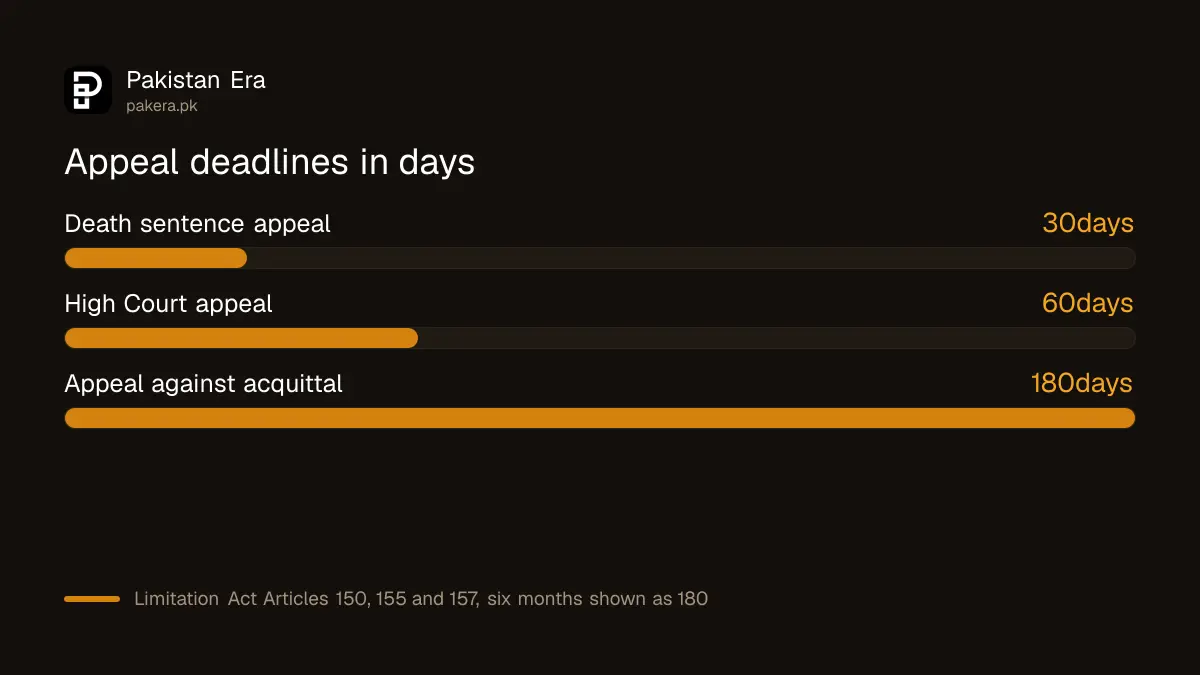
The clock starts on the date of the sentence or order, not the day you collect the file. A certified copy of the judgment is needed for the appeal, and how to get a certified copy in Punjab shows the steps and the usual wait.
A convict in jail can send the appeal through the jail officer
Section 420 of the CrPC says an appellant in jail may hand the petition of appeal and its copies to the officer in charge of the jail, who must forward them to the proper appellate court. The family does not need to carry the papers.
For a final appeal to the Supreme Court from jail, there is its own route in filing a jail petition in the Supreme Court. If you cannot pay a lawyer, free legal aid exists, and how to get a free lawyer in Punjab lists the options.
Ask for suspension of sentence and bail while the appeal waits
Under Section 426, the appellate court may, for reasons recorded in writing, suspend the sentence and release the appellant on bail or on his own bond. Section 426(1A) makes bail mandatory in some cases if the appeal is not decided within a set time.
| Sentence | Bail must be ordered if the appeal is undecided after |
|---|---|
| Up to 3 years | 6 months from conviction |
| Over 3 years, up to 7 years | 1 year from conviction |
| Life, or over 7 years | 2 years from conviction |
The rule does not apply if the delay was caused by the appellant or someone acting for him. It also does not apply to a previously convicted offender for an offence punishable with death or life imprisonment, a person the court finds a hardened, desperate or dangerous criminal, or one accused of terrorism punishable with death or life. Apply for suspension when you file, not after months of waiting.
Revision is not a free second try and can raise the sentence
Section 439 lets the High Court use its revision powers, and it may enhance the sentence. No order can go against the accused without a hearing. Where an appeal lies and none is brought, Section 439(5) bars a revision by that party.
So the choice is not between an appeal and a revision. If an appeal is available, file the appeal. Revision is for orders and cases where the Code gives no appeal, and a lawyer should explain the risk to the sentence first.
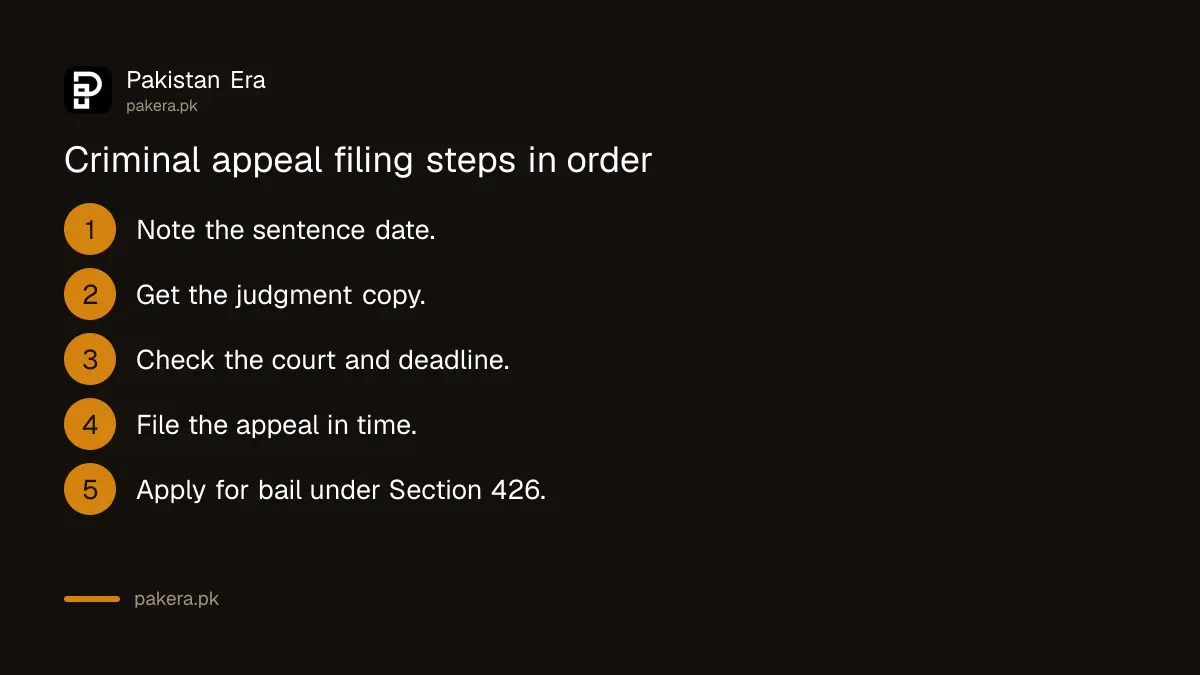
- Get the date of the sentence and a copy of the judgment on the day of the verdict.
- Find the section for your trial court in the table and note the 30, 60 day or six month limit.
- Ask a lawyer to prepare the petition of appeal with the judgment attached.
- File the appeal in time, or hand it to the jail officer if you are in custody.
- Apply for suspension of sentence and bail under Section 426.
- Track the case through the court's cause list.
Once the case is listed, how to check a court case status online shows how to follow it.
Some convictions cannot be appealed at all
Section 412 allows no appeal after a plea of guilty, except on the extent or legality of the sentence. Section 413 bars appeals in petty cases, such as a Court of Session sentence of up to one month.
Section 413 also lists a sentence of fine not exceeding fifty rupees. Check your sentence against these limits before you plan an appeal. A guilty plea is the common trap: it should never be entered without legal advice, because it closes most of the appeal.
Common questions about appealing a criminal conviction
How many days do I have to appeal a conviction in the High Court?
The Limitation Act sets 60 days from the date of the sentence or order, and 30 days for a death sentence from a Court of Session.
Where do I appeal a Magistrate's conviction?
Section 408 sends it to the Court of Session. We could not confirm the exact period for that appeal from the PDF, so ask the court office.
Can I get bail while the appeal is pending?
Yes. Section 426 lets the appellate court suspend the sentence and release you, and Section 426(1A) makes bail mandatory after set delays.
Can I appeal if I pleaded guilty?
Only on the extent or legality of the sentence. Section 412 bars any other appeal after a plea of guilty.
Can the state appeal an acquittal?
Yes. The CrPC has a section for appeals in case of acquittal, and the Limitation Act gives six months under Article 157.
Can a High Court revision increase my sentence?
Yes. Section 439 allows the High Court to enhance a sentence, after giving the accused a chance to be heard.
How we verified this
What we checked, where we read it, and what we could not confirm.
Last checked 15 October 2026. We read the Code of Criminal Procedure, 1898 and the Limitation Act, 1908 on the Pakistan Code website for Sections 408, 410, 411A, 412, 413, 420, 426 and 439 and Articles 150, 154, 155 and 157. We did not file an appeal. Ask a lawyer to confirm current periods before you rely on them.
About the author

Senior Writer, Public Services and Technology
Shahid joined us in 2024 as an author. He is a senior contributor to Pakistan's leading technology websites. He writes detailed articles, mostly covering his expertise in the latest tech, mobiles, apps, gadgets, and step-by-step guides. His ideology is to help people understand the latest trends and explain complex methods through very easy-to-understand guides.