CSS Optional Subjects List in Pakistan: All 45 Subjects in 7 Groups, 600 Marks
CSS optional subjects list from FPSC: 45 subjects in 7 groups, adding up to 600 marks. See each group's limit, valid example sets and how to narrow your choice.
CSS optional subjects are split into 7 groups, and your choices must add up to 600 marks. Group I lets you take one 200-mark subject, Group II lets you take up to 200 marks, and Groups III to VII each let you take one 100-mark subject. FPSC's syllabus lists 45 optional subjects.
Half of the written exam rides on this choice. The compulsory papers carry the other 600 of the 1,200 marks, and everybody sits those. Your optional subjects are the one part of the written exam you control, so choose them from the facts and not from academy advice alone.
We read the scheme in the Federal Public Service Commission's syllabus, "Revised Syllabi for CSS Competitive Examination, CE-2016 and onwards", on fpsc.gov.pk. We also checked FPSC's own past paper files for each subject.
Groups I and II hold the 200-mark and science subjects
Group I has five subjects worth 200 marks each, and you may pick only one. Group II mixes two 200-mark sciences with four 100-mark subjects, and you may pick subjects worth 200 marks only. A 200-mark subject means two separate papers of 100 marks each.
| Group | Rule in the scheme | Subjects (marks) |
|---|---|---|
| Group I | One subject of 200 marks only | Accountancy and Auditing (200), Economics (200), Computer Science (200), Political Science (200), International Relations (200) |
| Group II | Subject or subjects of 200 marks only | Physics (200), Chemistry (200), Applied Mathematics (100), Pure Mathematics (100), Statistics (100), Geology (100) |
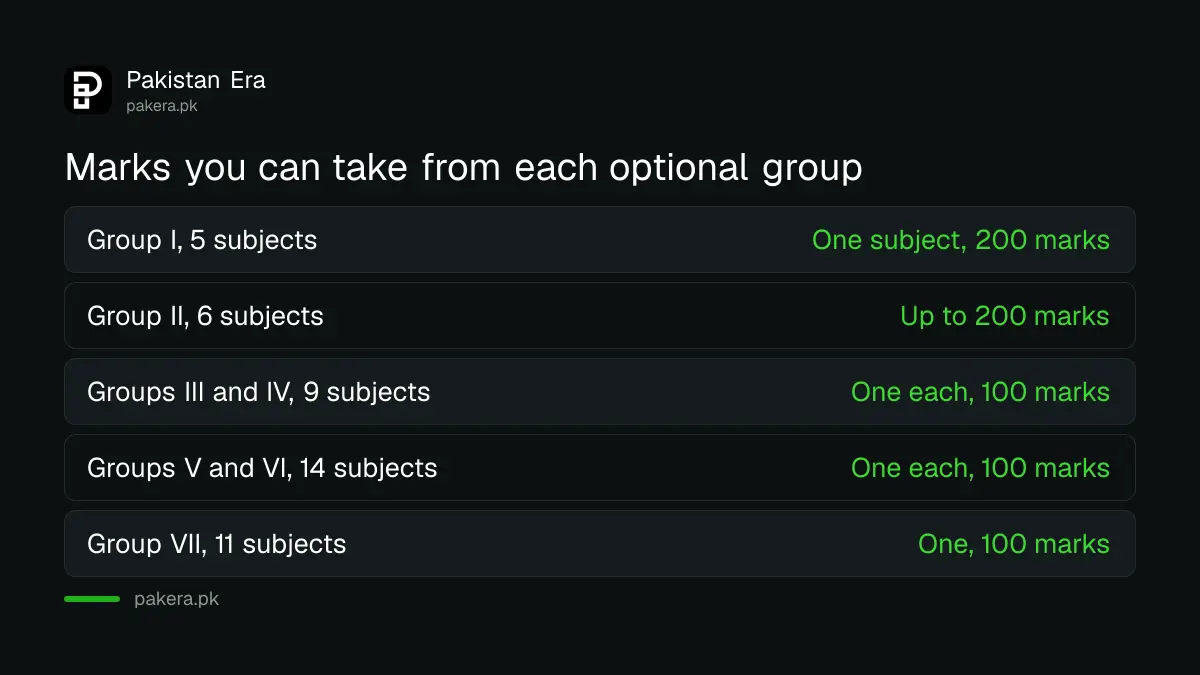
In Group II, you can take one 200-mark science, or two of the 100-mark subjects. Applied Mathematics plus Statistics makes 200 marks, for example.
Groups III to VII allow one 100-mark subject each
Groups III to VII hold 34 subjects, all worth 100 marks, and each group allows just one. This is where most choice lies. Two subjects from the same group cannot be taken together, so History of Pakistan and India rules out Islamic History and Culture.
| Group | Subjects, 100 marks each |
|---|---|
| Group III | Business Administration, Public Administration, Governance and Public Policies, Town Planning and Urban Management |
| Group IV | History of Pakistan and India, Islamic History and Culture, British History, European History, History of USA |
| Group V | Gender Studies, Environmental Sciences, Agriculture and Forestry, Botany, Zoology, English Literature, Urdu Literature |
| Group VI | Law, Constitutional Law, International Law, Muslim Law and Jurisprudence, Mercantile Law, Criminology, Philosophy |
| Group VII | Journalism and Mass Communication, Psychology, Geography, Sociology, Anthropology, Punjabi, Sindhi, Pashto, Balochi, Persian, Arabic |
Language papers have their own rule. The scheme says Urdu, the regional languages, Persian and Arabic should be answered in that language, though translation questions follow the paper's directions. All other optional papers must be answered in English.
Your subjects must add up to exactly 600 marks
The optional part totals 600 marks, and the group limits decide how you reach it. Add the marks of your choices before you fill in any form. Here are four sets that fit the limits as printed, with no claim that any one of them is the best.
| Example set | Marks |
|---|---|
| International Relations (I), Public Administration (III), History of Pakistan and India (IV), Gender Studies (V), Criminology (VI) | 200 + 100 + 100 + 100 + 100 = 600 |
| Economics (I), Statistics and Applied Mathematics (II), Governance and Public Policies (III), English Literature (V) | 200 + 200 + 100 + 100 = 600 |
| Computer Science (I), Physics (II), Business Administration (III), Psychology (VII) | 200 + 200 + 100 + 100 = 600 |
| Political Science (I), Islamic History and Culture (IV), Urdu Literature (V), Constitutional Law (VI), Sociology (VII) | 200 + 100 + 100 + 100 + 100 = 600 |
The scheme in the syllabus sets the group limits and the total. The written exam advertisement and the CSS rules can add detail, so read the advertisement before you lock in your set. FPSC has tentatively set it for 8 November 2026.
Four checks can narrow 45 subjects to a short list
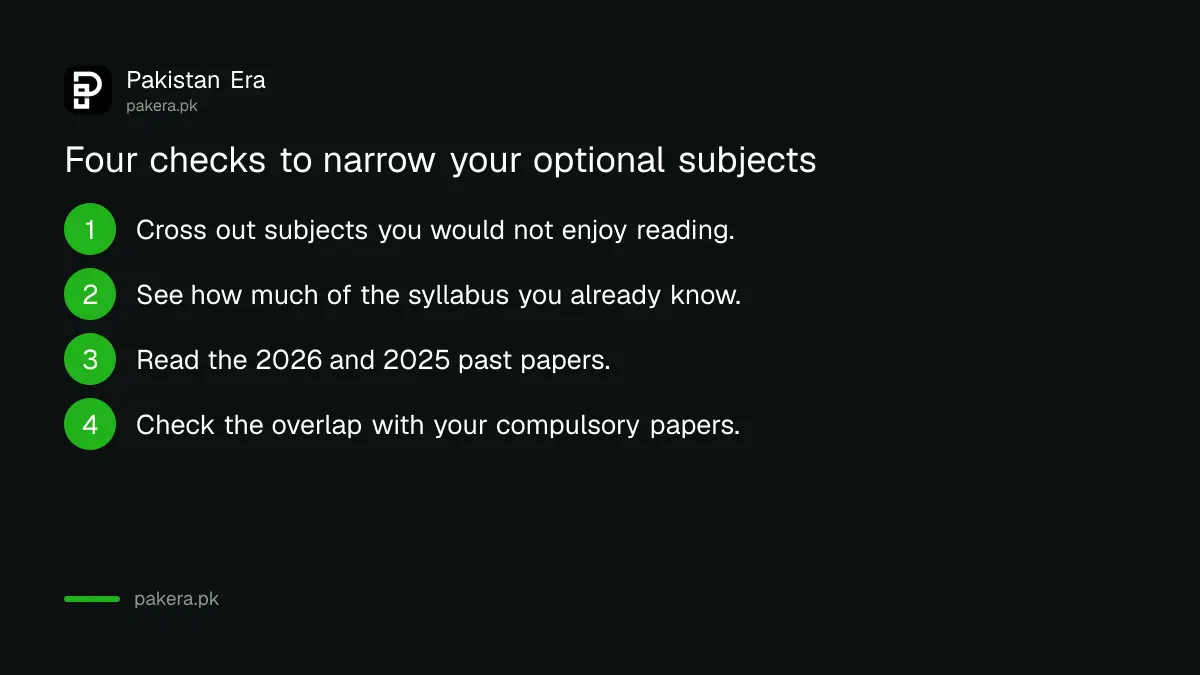
We cannot tell you which subject scores best, because we did not read any FPSC mark data by subject for this page. These four checks use material that FPSC itself publishes, and they cost nothing. They should bring your list down to a small number in one evening.
- Cross out any subject you would not enjoy reading for 11 weeks.
- Open the subject's section in the syllabus, and see how much of it you already know from your degree.
- Read the 2026 and 2025 papers for it in the official CSS past papers. Can you see yourself answering them?
- Check the overlap with your compulsory papers. Political Science, International Relations and Current Affairs share ground, as do History of Pakistan and India and Pakistan Affairs.
Be careful with any subject that has thin material. FPSC's own past paper list skips some subjects in some years, such as Town Planning and Pure Mathematics in 2026. That does not mean the subject is closed. It does mean you will have fewer real papers to practise on.
The syllabus also lists suggested readings under most subjects, as it does for the compulsory papers in the FPSC CSS book list. Check how long the list is, and whether the books are easy to find, before you commit.
Timing makes the choice more urgent this month
Applications for the written stage are close. FPSC's advance notice of 5 July 2026 sets online applications from 10 to 25 November 2026, the hard copy deadline on 4 December and written papers from 27 January 2027. All of these dates are tentative until the advertisement appears.
Only candidates who pass the screening test can apply for the written stage. The route is set out in the CSS 2027 schedule. Later stages have their own rules, such as the final preference form for 12 groups, and those groups are occupational services and should not be confused with the seven subject groups here.
Common questions
How many optional subjects are there in CSS?
FPSC's scheme lists 45 optional subjects across 7 groups.
How many marks do optional subjects carry in CSS?
600 marks out of the 1,200 in the written exam. The other 600 come from the compulsory papers.
Can I take two subjects from the same group?
Not in Groups I and III to VII, which allow one subject. Group II allows subjects worth 200 marks, so two 100-mark subjects are fine.
Is International Relations in the same group as Political Science?
Yes. Both are in Group I, so you can take only one of them.
Can I answer a language paper in Urdu or Punjabi?
Yes. The scheme says Urdu, regional language, Persian and Arabic papers should be answered in that language, subject to translation directions.
How many papers does a 200-mark subject have?
Two papers of 100 marks each. Every paper lasts 3 hours.
How we verified this
What we checked, where we read it, and what we could not confirm.
Last checked on 7 November 2026. We read the scheme in the FPSC syllabus for CE-2016 and onwards, updated on 7 July 2015, and the FPSC past papers page. If the CSS 2027 advertisement changes a group, follow the advertisement.
About the author
Public Services and Education Journalist
Fajr Riaz is a journalist and content writer at Pakistan Era, based in Lahore. She covers the questions people meet in everyday life in Pakistan: how a public service works, what a change in the rules means, and where to find a reliable answer.