How to File a Jail Petition in the Supreme Court of Pakistan: 30 Days and a State Lawyer
A convict can send a jail petition to the Supreme Court of Pakistan within 30 days of the High Court order. See who gets a state lawyer and the other route.
A convict in jail can appeal to the Supreme Court of Pakistan by sending a jail petition through the jail authorities within 30 days of the High Court's order. A prisoner sentenced to death by a High Court gets a lawyer at state expense. No private lawyer is needed to start.
We read the Supreme Court's Frequently Asked Questions page on 11 October 2026. This guide explains the jail petition route, the free lawyer rule and the other option, in plain words, for a prisoner or a family that is trying to understand it.
A jail petition is an appeal sent from inside the jail
A jail petition is a petition for leave to appeal, the request that asks the Supreme Court to agree to hear the case. The Supreme Court Rules, 1980 allow it under Rule 3 of Order XXIII. The prisoner sends it through the jail authorities, so he does not need to travel or find a court agent.
The court's FAQ says the limit is 30 days from the date of the High Court's order or judgment. That is the same limit the court lists for criminal petitions and appeals from High Court orders. Time matters here, because a prisoner cannot ask a friend to walk papers to the registry.
The family route is a petition filed through a lawyer
The same FAQ gives a second path. A convicted person can file a criminal petition for leave to appeal through a lawyer or an Advocate-on-Record within 30 days. An Advocate-on-Record is a lawyer enrolled with the Supreme Court who can file cases for clients.
Families often choose this path because the lawyer can prepare the grounds and attend the hearing. The jail petition costs less and starts sooner. Ask the Supreme Court information desk before a relative files anything for the prisoner.
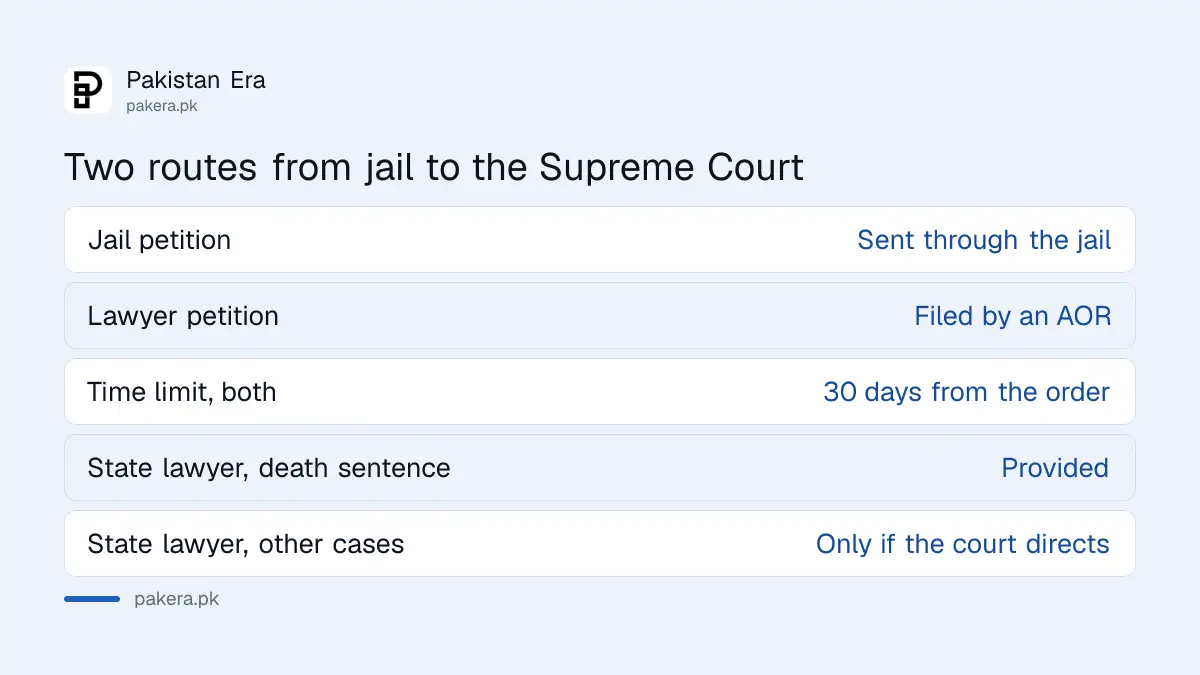
| Route | Who sends it | Time limit |
|---|---|---|
| Jail petition, Order XXIII Rule 3 | The prisoner, through the jail authorities | 30 days from the High Court order |
| Criminal petition for leave to appeal | A lawyer or Advocate-on-Record | 30 days from the High Court order |
| Criminal appeal, Article 185(2)(a), (b), (c) | As the case qualifies | 30 days from the High Court order |
A lawyer at state expense is only for two cases
The court answers a direct question: how can an accused get counsel at state expense to appear in the Supreme Court? Its FAQ says the Supreme Court Rules provide it in jail petitions of two kinds.
- A convict sentenced to death by the High Court, under Rule 6 of Order XXIII.
- An accused in a proper case, if the court directs it, under Rule 7 of Order XXII.
That is all the page lists. A prisoner serving a prison term does not get a state lawyer as of right under this answer. The court decides in a "proper case". If you are not in either group, look at other free legal help.
Other free help for a prisoner's family
The Supreme Court says it does not provide legal advice or a free lawyer facility itself. It says Free Legal Aid Committees of the Bars can help in suitable cases. The court has since linked its 1818 call centre to bar councils, and the 1818 free legal aid helpline explains how a call works.
For lower court stages, getting a free lawyer in Punjab and free legal aid from LAJA in Islamabad cover the provincial and capital routes. A prisoner's family should also read how bail works for bailable and non-bailable offences.
What to do if you are the prisoner or the family
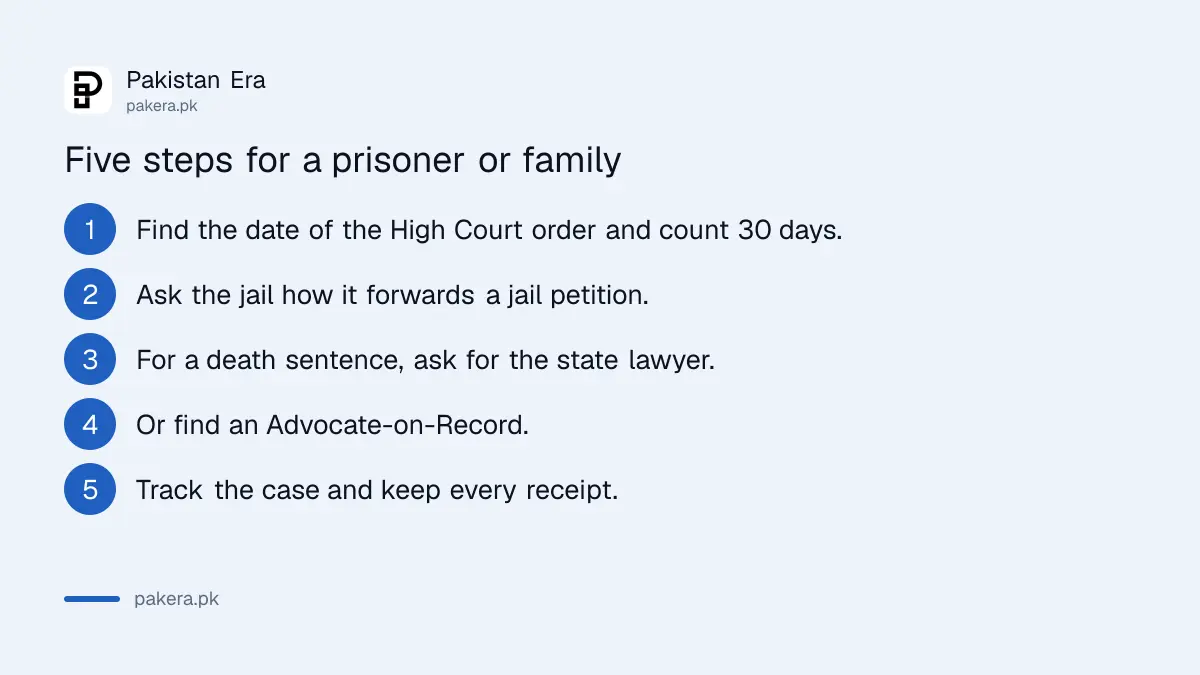
- Get the date of the High Court order and count 30 days from it. Write the last date on the jail file.
- Ask the jail authorities how they forward a jail petition, and ask for a written receipt.
- If the sentence is death, tell the jail and the family that the Rules give a state lawyer for a jail petition.
- If you want a private lawyer, find an Advocate-on-Record and ask for the grounds in writing.
- Ask the family to track the case through the court's online case status, and keep every receipt.
A jail petition does not cover everything
The FAQ lists a jail petition only for a convict after a High Court conviction. It does not say that a jail petition can reach a Federal Shariat Court case, a Service Tribunal case or an interim order. Other Articles and limits cover those, and the Supreme Court appeal time limits lay them out. If a prisoner is also challenging a bail refusal or a pending trial, the court's page does not describe it.
We have not read the Supreme Court Rules for Order XXIII or Order XXII. They set how the jail forwards the petition and what the petition must contain. A lawyer or the court's information desk can explain those details.
Common questions
How long does a prisoner have to file a jail petition?
The court says 30 days from the date of the High Court's order or judgment.
Does a death sentence prisoner get a free lawyer?
Yes, in jail petitions. The court's FAQ says counsel at state expense is provided to a convict sentenced to death by the High Court.
Can an ordinary prisoner get a state lawyer?
Only if the court directs it in a proper case, under Rule 7 of Order XXII. The FAQ names no other situation.
Does the prisoner need to travel to Islamabad?
No. A jail petition goes through the jail authorities. A lawyer-filed petition can be filed at the Principal Seat or a branch registry.
Can the Supreme Court give legal advice?
No. The court says it does not give legal advice, but its 1818 helpline connects callers to bar legal aid.
How we verified this
What we checked, where we read it, and what we could not confirm.
Last checked 11 October 2026. We read the Supreme Court of Pakistan's Frequently Asked Questions page, questions 11, 21, 22, 24 and 25, on supremecourt.gov.pk. We did not read Orders XXII or XXIII of the Supreme Court Rules, 1980, or speak to a jail office. Check the court's own page and a lawyer before you act.
About the author

Senior Writer, Public Services and Technology
Shahid joined us in 2024 as an author. He is a senior contributor to Pakistan's leading technology websites. He writes detailed articles, mostly covering his expertise in the latest tech, mobiles, apps, gadgets, and step-by-step guides. His ideology is to help people understand the latest trends and explain complex methods through very easy-to-understand guides.