How to Appeal to the Supreme Court of Pakistan: 60 and 30 Day Limits for Each Case
The Supreme Court of Pakistan gives 60 days for civil petitions and 30 days for criminal ones. See each Article, the Shariat limits and the first steps to take.
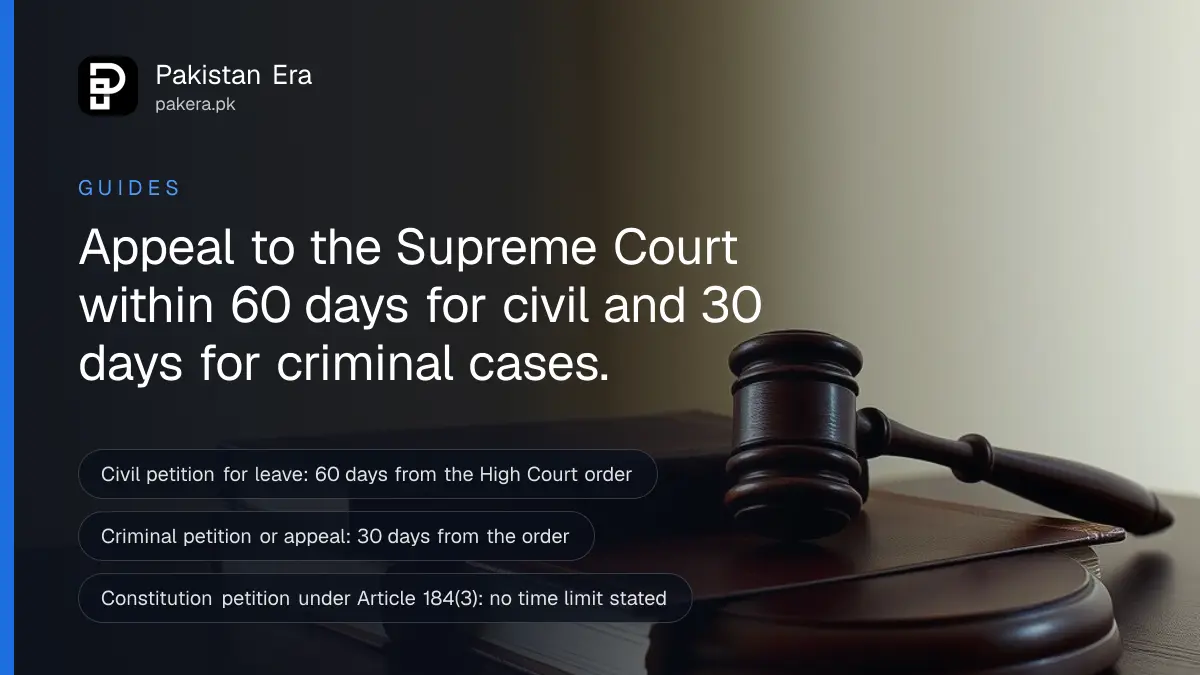
Most appeals to the Supreme Court of Pakistan must be filed within 60 days for a civil case and 30 days for a criminal case, counted from the date of the High Court order. The court counts from the date of the order. Missing that date can end the case before it starts.
Update, 11 October 2026: The Federal Constitutional Court rules of 2026 set their own appeal and review limits.
We read the Supreme Court of Pakistan's own Frequently Asked Questions page on 11 October 2026. Every time limit below comes from it. This guide is for readers who want to know which route and which deadline apply, before they speak to a lawyer.
Civil cases from a High Court have two routes
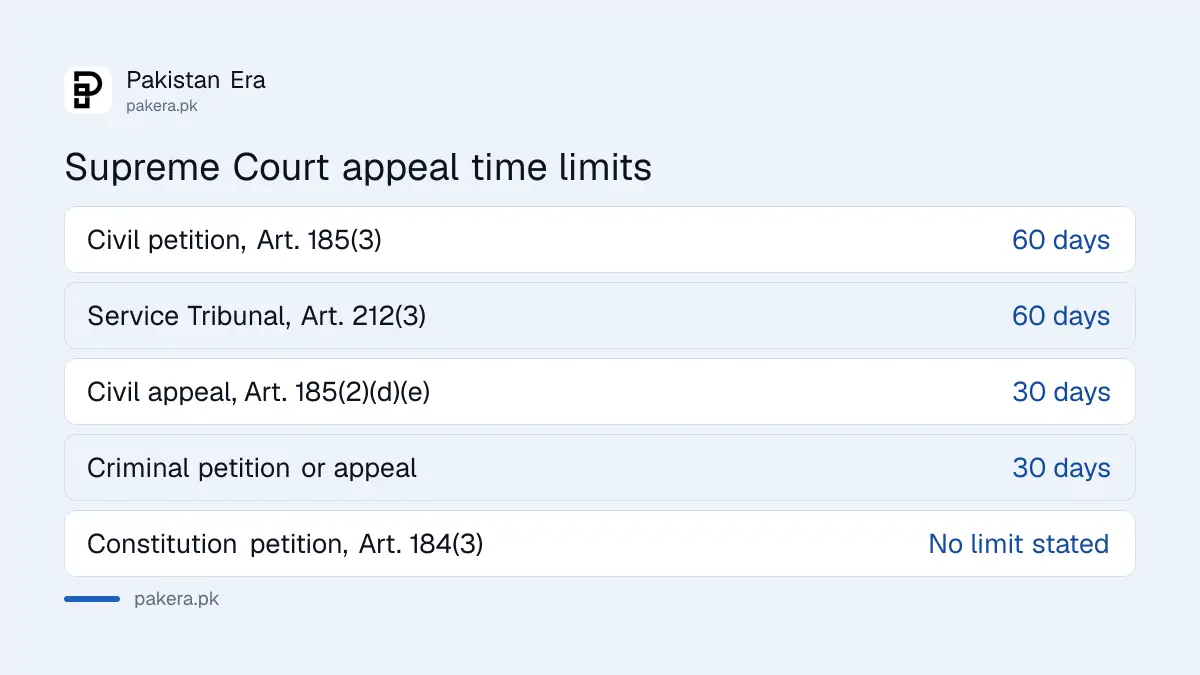
A civil case is a dispute over property, money, contracts, family matters or rights. If a High Court decided it against you, the court's FAQ gives two routes. The first is a civil petition for leave to appeal under Article 185(3) of the Constitution, within 60 days of the High Court's order or judgment.
"Leave to appeal" means the Supreme Court first decides whether to hear the case at all. The second route is a civil appeal under Article 185(2)(d) and (e), within 30 days. That route applies only in the situations those clauses describe. Ask your lawyer which one fits.
A civil appeal can also come from another law that sets its own time. In that case the time in that law applies.
Service Tribunal cases get 60 days
A government employee who loses at a Service Tribunal has a different route. The court's FAQ says a civil petition for leave to appeal under Article 212(3) must be filed within 60 days of the Tribunal's order. The Federal Service Tribunal appeal comes first, so keep both deadlines in a calendar.
| Type of case | Route | Time limit |
|---|---|---|
| Civil, High Court order | Petition for leave, Article 185(3) | 60 days |
| Civil, High Court order | Civil appeal, Article 185(2)(d) and (e) | 30 days |
| Service Tribunal order | Petition for leave, Article 212(3) | 60 days |
| Criminal, High Court order | Petition for leave, Article 185(3) | 30 days |
| Criminal, High Court order | Criminal appeal, Article 185(2)(a), (b), (c) | 30 days |
| Fundamental rights, public importance | Constitution petition, Article 184(3) | No limit stated |
Criminal cases have 30 days across the board
For a criminal case decided by a High Court, the FAQ lists a petition for leave to appeal under Article 185(3) and a criminal appeal under Article 185(2)(a), (b) and (c). Both have 30 days. A contempt appeal under section 19 of the Contempt of Court Ordinance, 2003 or section 476 of the Criminal Procedure Code also has 30 days.
A convict in jail has a simpler path. The court says he can send a jail petition through the jail authorities within the same 30 days. How a jail petition works is covered separately.
Fundamental rights cases have no stated time limit
Anyone can file a Constitution petition under Article 184(3) for a matter of public importance that touches fundamental rights. The FAQ states that no time limit is provided. That does not mean the court will hear any case on any day. It means the FAQ names no deadline.
The same is true of a contempt petition under Article 204 when someone does not obey a Supreme Court order. The FAQ again gives no time limit.
Shariat cases have their own limits
An order of the Federal Shariat Court can be taken to the Supreme Court. For a civil Shariat appeal under Article 203-F(1), the limit is 60 days. The Federation or a Province gets six months in that matter. A challenge to an interim order under Article 203-F(2B) has 60 days.
Criminal Shariat appeals and petitions, under Article 203-F(2A) and (2B), have 30 days. The Federal Shariat Court guide explains which cases go there first.
What to do in the first week after the order
Do not wait for the last day. A petition has to be drafted, signed and filed through the right channel, and fees paid. The FAQ says an Advocate-on-Record, a lawyer enrolled with the court, can file a case for you. It also says a party can file in person.
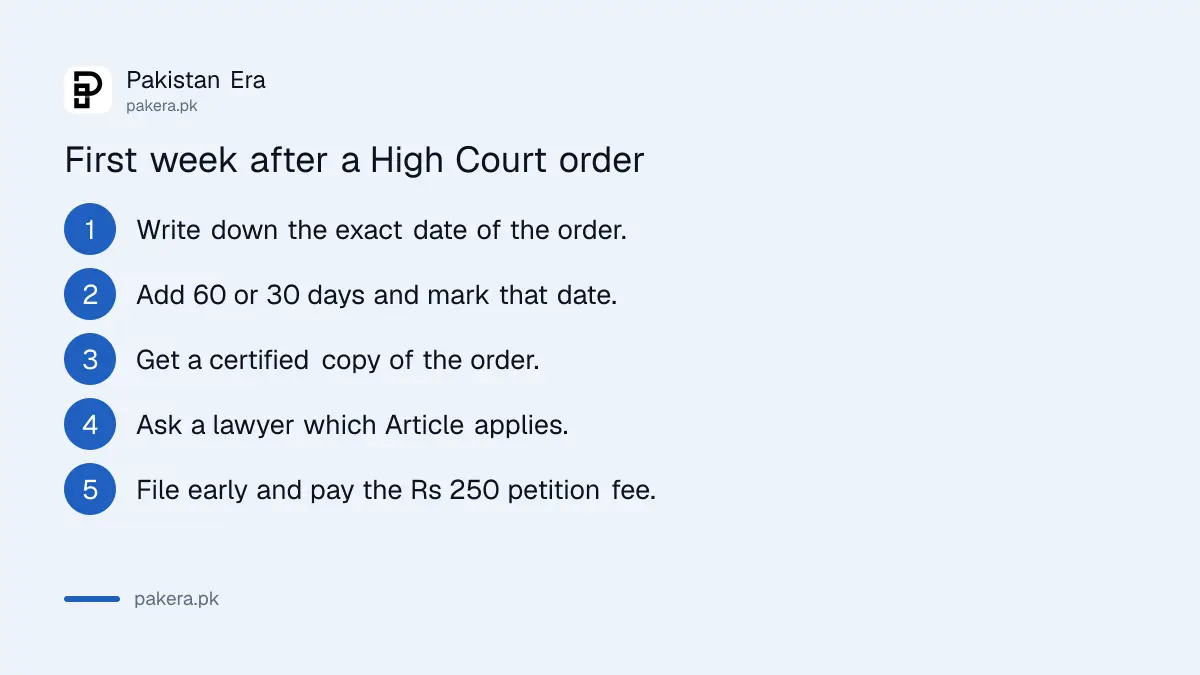
- Write down the exact date of the High Court order or judgment.
- Add 60 days for a civil case or 30 days for a criminal case, and mark that date.
- Get a certified copy of the order. Getting a certified copy in Punjab shows the steps.
- Ask a lawyer which Article applies to your case.
- File early. Pay the Rs 250 filing fee for a petition for leave to appeal, as the court lists it.
What the court's page does not say
The FAQ does not discuss delay. It does not say whether a late petition can be accepted with an excuse. We did not research the Limitation Act or any court ruling on that. If you are already late, take the papers to a lawyer today rather than guessing.
Common questions
How long do I have to appeal to the Supreme Court?
It depends on the case. The court's FAQ gives 60 days for civil petitions for leave and Service Tribunal cases, and 30 days for criminal cases.
When does the time start?
The FAQ says the time runs from the date of the order or judgment. We found no wording about the date a copy is received.
Can I file without a lawyer?
Yes. The court says petitions and appeals can be filed in person by the party under the Supreme Court Rules, 1980.
Is there a time limit for a Constitution petition under Article 184(3)?
The FAQ says no time limit is provided for it.
What does it cost to file?
The court lists Rs 250 for filing a petition for leave to appeal. Other fees depend on the Third Schedule of the Supreme Court Rules.
How we verified this
What we checked, where we read it, and what we could not confirm.
Last checked 11 October 2026. We read the Supreme Court of Pakistan's Frequently Asked Questions page, questions 8 to 13, 20 and 23, on supremecourt.gov.pk. We did not read the Supreme Court Rules themselves, the Constitution's text or any ruling on late filing. Check the court's own page and a lawyer before you rely on a date.
About the author

Senior Writer, Public Services and Technology
Shahid joined us in 2024 as an author. He is a senior contributor to Pakistan's leading technology websites. He writes detailed articles, mostly covering his expertise in the latest tech, mobiles, apps, gadgets, and step-by-step guides. His ideology is to help people understand the latest trends and explain complex methods through very easy-to-understand guides.