Federal Shariat Court of Pakistan: What It Hears, Where It Sits and How to Contact It
The Federal Shariat Court of Pakistan checks laws against Islamic injunctions and hears Hudood appeals. See four powers, bench registries and email contacts.
The Federal Shariat Court of Pakistan decides whether a law goes against the injunctions of Islam, and it hears appeals in Hudood cases. It sits in Islamabad, with bench registries in Lahore, Karachi, Quetta and Peshawar. You can reach its Human Rights Cell by email with a printed complaint form.
We opened the Federal Shariat Court's own website on 11 October 2026 and read its home page, its jurisdictions page and its Human Rights Cell page. We also read the Supreme Court's FAQ on appeals from this court. This guide tells you which cases belong here and which do not.
The court examines laws against the injunctions of Islam
The court was set up on 26 May 1980 by the President's Order No. 1 of 1980 and sits under Chapter 3-A of the Constitution. Under Article 203-D, it can decide whether a law or a provision of law is repugnant to the injunctions of Islam as laid down in the Holy Quran and the Sunnah.
The Constitution defines "law" for this purpose. It includes a custom or usage that has the force of law. It does not include the Constitution, Muslim personal law, or any law about the procedure of a court or tribunal.
The court's page says it has examined 512 federal laws and 999 provincial laws on its own motion. It says it found 55 federal laws and 212 provincial laws repugnant. Those figures are the court's, from its own page, and the page gives no date for them.
Four kinds of jurisdiction
The court's jurisdictions page lists four. Each has its own use, and only some touch ordinary people.
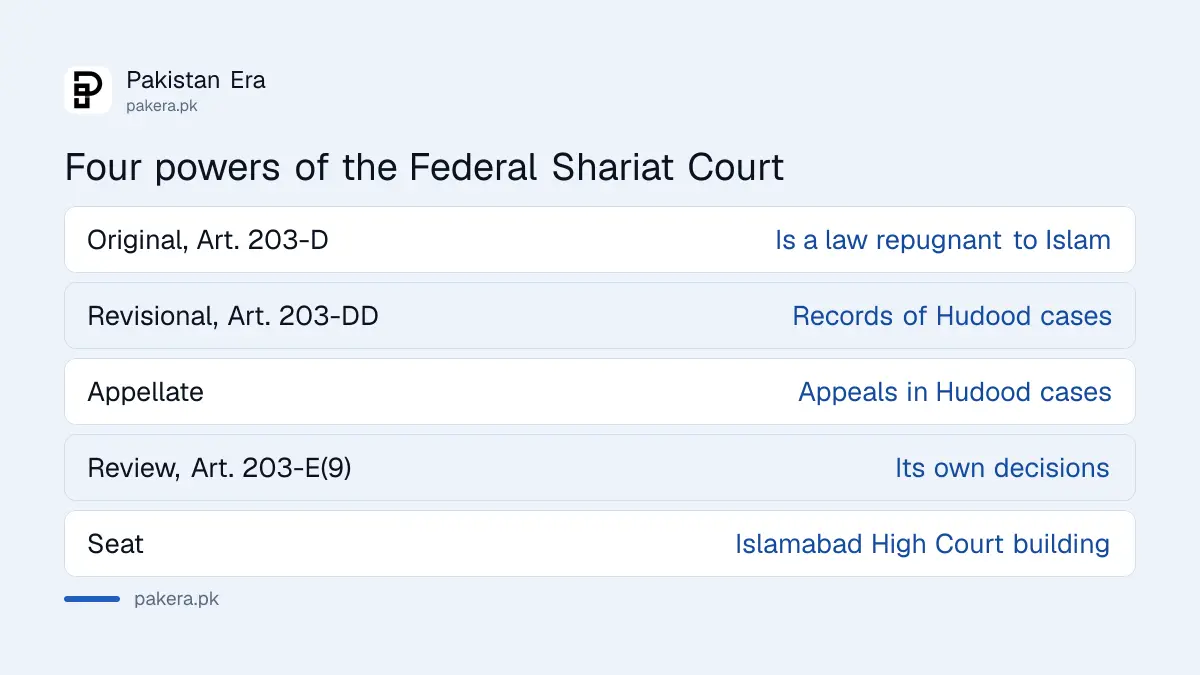
| Jurisdiction | What it covers |
|---|---|
| Original and suo moto, Article 203-D | Whether a law is repugnant to the injunctions of Islam |
| Revisional, Article 203-DD | Records of criminal cases under Hudood laws, checked for correctness and legality |
| Appellate | Appeals in Hudood cases |
| Review, Article 203-E(9) | Its own decisions and orders |
Appeals in four Hudood laws come here
The court's appellate jurisdiction covers cases under four laws from 1979. They are the Offences Against Property (Enforcement of Hudood) Ordinance, the Offence of Zina (Enforcement of Hudood) Ordinance, the Offence of Qazaf (Enforcement of Hadd) Ordinance and the Prohibition (Enforcement of Hadd) Order.
Under its revisional power, the court can call for the record of a Hudood case decided by a criminal court. It can check whether a finding, sentence or order was correct, legal and proper. When it calls for a record, it can suspend a sentence and, if the accused is in custody, direct release on bail or on his own bond while it examines the record.
That power is the court's, not a right you can claim by filing a form. If your case involves a Hudood law, a lawyer should tell you whether the route applies.
Taking a Federal Shariat Court case to the Supreme Court
The Supreme Court's FAQ gives the next step. A civil Shariat appeal under Article 203-F(1) has 60 days from the order, and six months for the Federation or a Province. A challenge to an interim order under Article 203-F(2B) has 60 days. Criminal Shariat appeals and petitions have 30 days.
Our guide on the Supreme Court appeal time limits puts those figures next to the civil and criminal ones. A lawyer can tell you which Article fits your case.
Contact the court and its Human Rights Cell
The court sits on the 3rd floor of the Islamabad High Court building on Constitution Avenue, G-5, Islamabad. It lists the phone numbers 051-9205911 and 051-9203091, and fax 051-9202724.
The Human Rights Cell takes complaints and applications on a downloadable proforma, in PDF and in Word. Pakistanis write to hrcell@federalshariatcourt.gov.pk. Overseas Pakistanis have a separate address, hrcell_overseas@federalshariatcourt.gov.pk. The page does not say what the cell can do about a case, so keep the complaint short and factual.
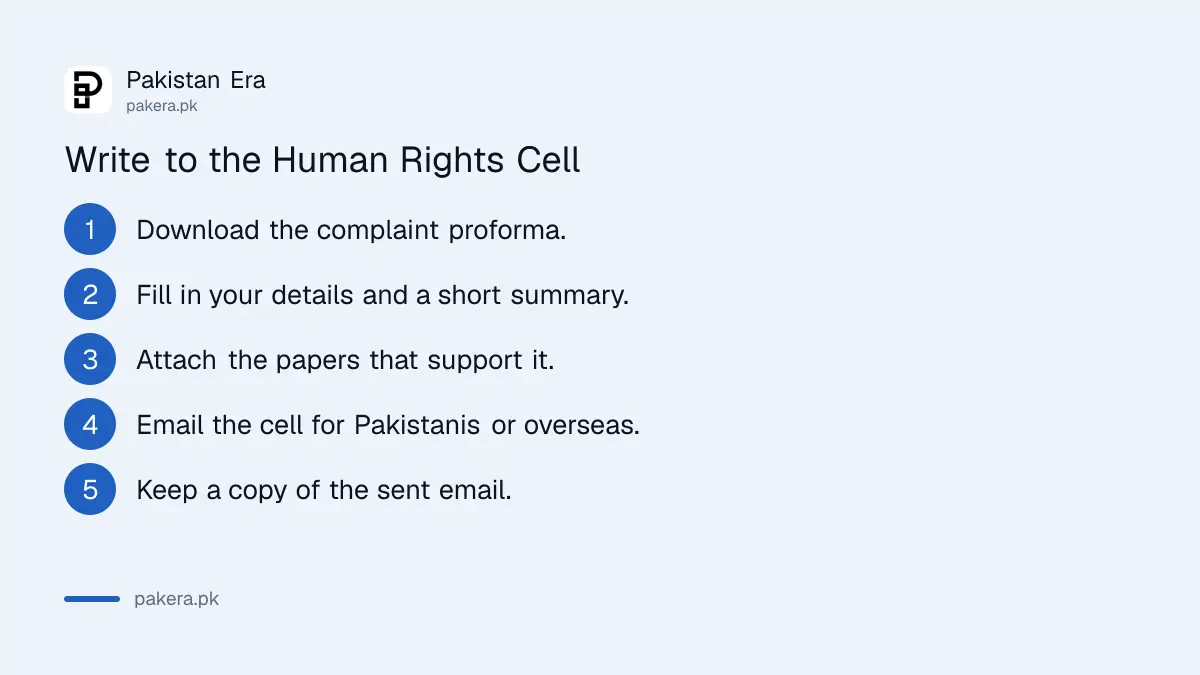
- Download the complaint or application proforma from the Human Rights Cell page.
- Fill it in with your name, contact details and a short factual summary.
- Attach the papers that support your complaint, such as an order or an FIR number.
- Email it to the cell address for Pakistanis or for overseas Pakistanis.
- Keep a copy and the sent email as proof.
Check a case on its online tools
The court's website carries an online case status search by case number or party name, a cause list, a roster of sittings and a reported judgments search. For the same steps on the Supreme Court side, checking a court case status online shows how a search works.
The court says its procedure rules are in a downloadable PDF on its site. We did not read them. They decide how a petition is drawn up, so a person who wants to file should read them or ask a lawyer.
Common questions
What does the Federal Shariat Court do?
It decides whether a law is repugnant to the injunctions of Islam and hears appeals in Hudood cases, among other powers.
Where is the Federal Shariat Court?
It is on the 3rd floor of the Islamabad High Court building, Constitution Avenue, G-5, Islamabad. It has bench registries in Lahore, Karachi, Quetta and Peshawar.
Can I complain to the court by email?
You can write to its Human Rights Cell on the proforma. The address for Pakistanis is hrcell@federalshariatcourt.gov.pk.
How long do I have to appeal a Federal Shariat Court order?
The Supreme Court says 60 days for civil Shariat appeals and 30 days for criminal ones.
Does it hear family or property cases?
Its pages do not list ordinary family or property cases. The jurisdictions page lists the four kinds above, and Muslim personal law is outside the definition of law it can examine.
How we verified this
What we checked, where we read it, and what we could not confirm.
Last checked 11 October 2026. We read the Federal Shariat Court's home page, jurisdictions page and Human Rights Cell page on federalshariatcourt.gov.pk, and the Supreme Court of Pakistan's FAQ on supremecourt.gov.pk. We did not read the court's procedure rules or its Chapter 3-A PDF. We did not email the Human Rights Cell. Check the court's own site before you write.
About the author

Senior Writer, Public Services and Technology
Shahid joined us in 2024 as an author. He is a senior contributor to Pakistan's leading technology websites. He writes detailed articles, mostly covering his expertise in the latest tech, mobiles, apps, gadgets, and step-by-step guides. His ideology is to help people understand the latest trends and explain complex methods through very easy-to-understand guides.