How to File a Federal Service Tribunal Appeal: 30 Day Limit and the 90 Day Rule
Federal employees: how to appeal to the Federal Service Tribunal. File a departmental appeal in 30 days, wait 90 days, then appeal in 30. Steps and grounds.
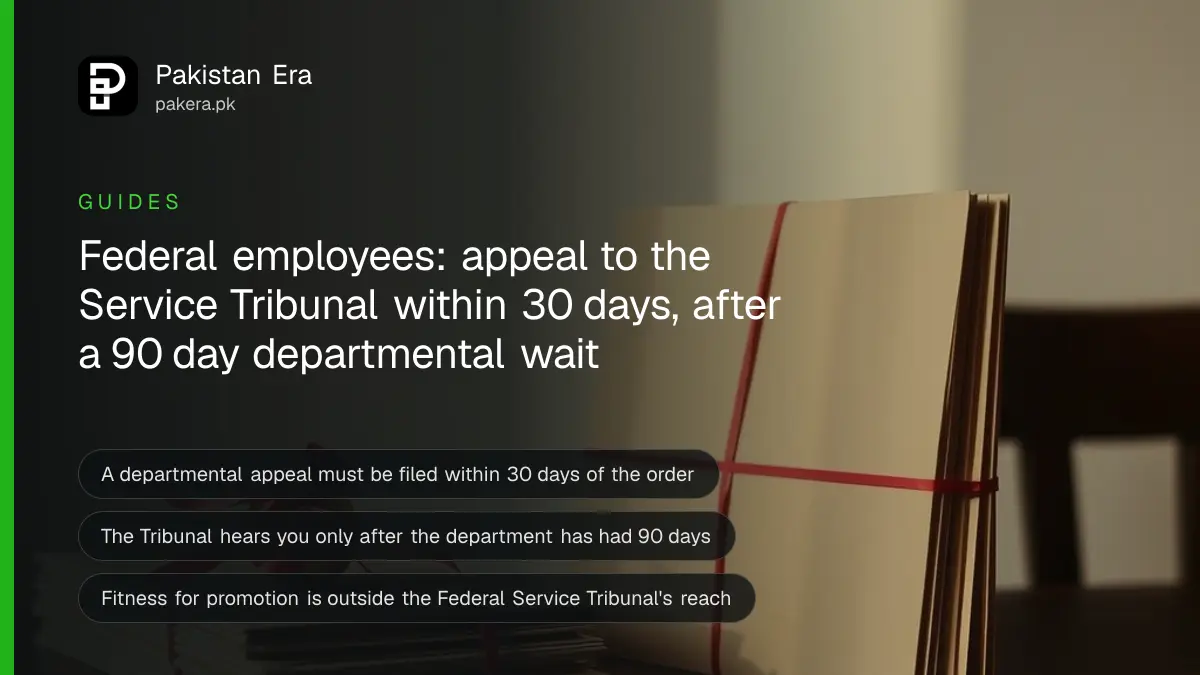
A federal civil servant who wants to challenge a service order in the Federal Service Tribunal must first file a departmental appeal within 30 days. If the department has not decided it in 90 days, or rejects it, you appeal to the Tribunal within 30 days. Those limits come from the Service Tribunals Act, 1973 and the Civil Servants Act, 1973.
The Federal Service Tribunal, often called the FST, is the court for federal government employees. It hears disputes about pay, seniority, pension, transfer and penalties such as dismissal. The Tribunal was in the news on 9 October 2026, when Federal Law Minister Azam Nazeer Tarar met its Chairman, Rana Asadullah Khan, and promised support to clear pending appeals faster.
The Federal Service Tribunal hears federal civil servants' service disputes
The Tribunal has exclusive power over the "terms and conditions of service" of federal civil servants, including disciplinary matters. That means no civil court can hear those disputes. It acts like a civil court: it can summon witnesses and order documents.
Section 3(2) of the Service Tribunals Act gives it that exclusive jurisdiction. Section 5 lets it confirm, set aside, vary or modify the order you challenge. Cases are heard by benches of at least two members.
Typical cases include:
- dismissal, removal or compulsory retirement
- reduction to a lower post or pay scale
- withheld increments, censure and other minor penalties
- pay fixation, seniority and pension disputes
- a departmental appeal that was rejected or ignored
Two things it cannot hear. Section 4(1)(b) bars appeals against decisions about your "fitness" to be appointed or promoted. And section 4(1)(c) bars orders made before 1 July 1969. So a promotion board's view that you are not yet fit is outside its reach, while a pay or seniority error usually is not.
Step one is a departmental appeal within 30 days
Before the Tribunal, you must appeal inside your own department if your rules allow it. Section 22 of the Civil Servants Act gives 30 days from the order. Where no appeal is provided, you make a representation to the authority above the one that passed the order, also within 30 days.
Skipping this step is the most common reason appeals fail. The Service Tribunals Act says no appeal lies to the Tribunal unless you have first filed the departmental appeal, review or representation and 90 days have passed since you filed it.
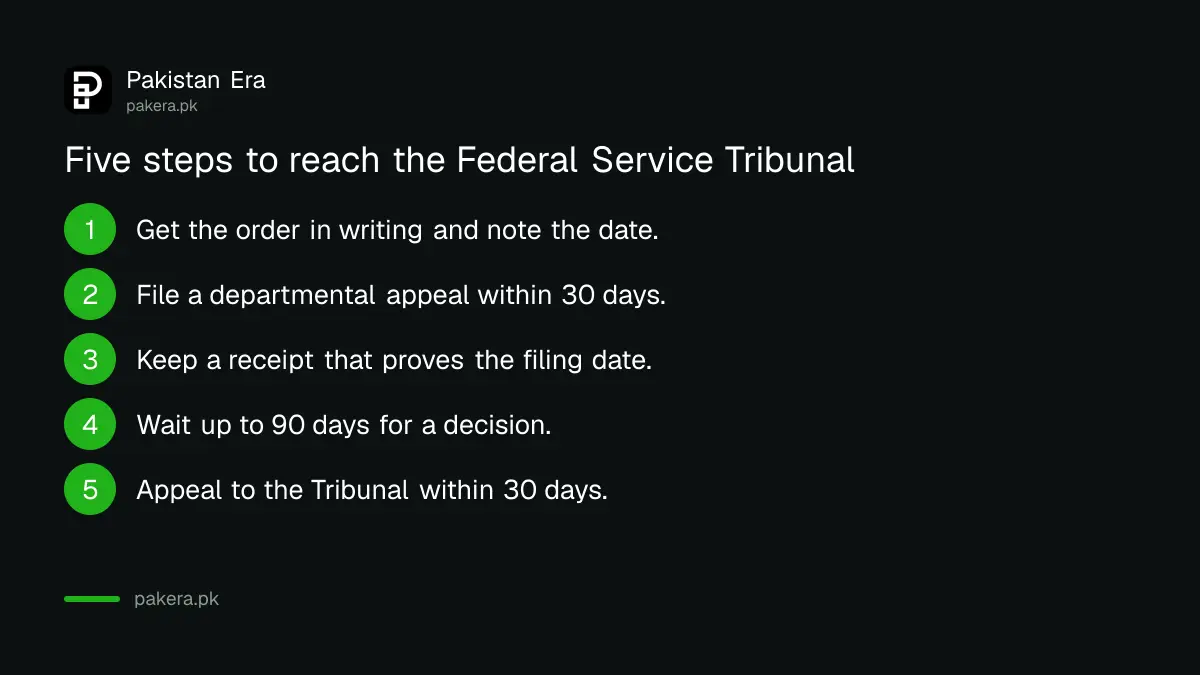
- Get the order in writing. Note the date it was communicated to you. Your 30 days run from then.
- Write the departmental appeal. Address it to the appellate authority named in your rules, or to the officer above the one who signed the order.
- Submit it and get a receipt. A diary number, a signed copy or a courier slip all prove the filing date.
- Wait for a decision, up to 90 days. If the department decides earlier and rejects it, you can move on at once.
- Appeal to the Tribunal within 30 days. Count from the rejection order. If no decision came, the Act lets you appeal once the 90 days are over. It does not spell out a separate deadline for that case, so file soon after day 90 rather than wait.
The time limits at a glance
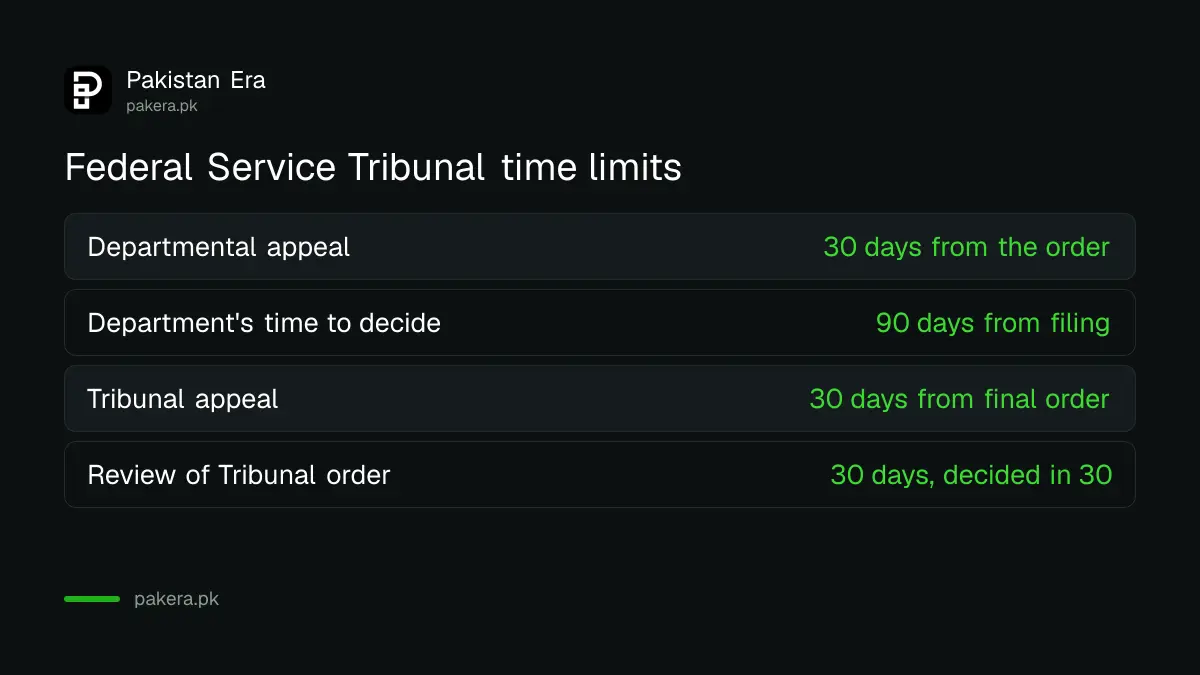
Three clocks matter: 30 days for the departmental appeal, 90 days for the department to answer, and 30 days for the Tribunal appeal. A review of the Tribunal's own order also has 30 days to file and 30 days to decide.
| Stage | Time limit | Law |
|---|---|---|
| Departmental appeal or representation | 30 days from the order | Civil Servants Act, section 22 |
| Wait before going to the Tribunal | 90 days from filing that appeal | Service Tribunals Act, section 4(1)(a) |
| Appeal to the Tribunal | 30 days from the final order being communicated | Service Tribunals Act, section 4(1) |
| Review petition to the Tribunal | 30 days from its order, decided in 30 days | Service Tribunals Act, section 4A |
Missed a deadline? Section 7 applies sections 5 and 12 of the Limitation Act, 1908. Section 5 lets the Tribunal accept a late appeal if you show "sufficient cause". Section 12 leaves out the time spent getting a certified copy of the order. Ask for condonation in a separate application and explain every day of delay. Vague reasons rarely work.
What to put in your appeal
An FST appeal is a written memorandum. It names you and the department, sets out the facts in order, lists the grounds on which the order is wrong, and states the relief you want. Attach the order, your departmental appeal and its receipt, and any reply.
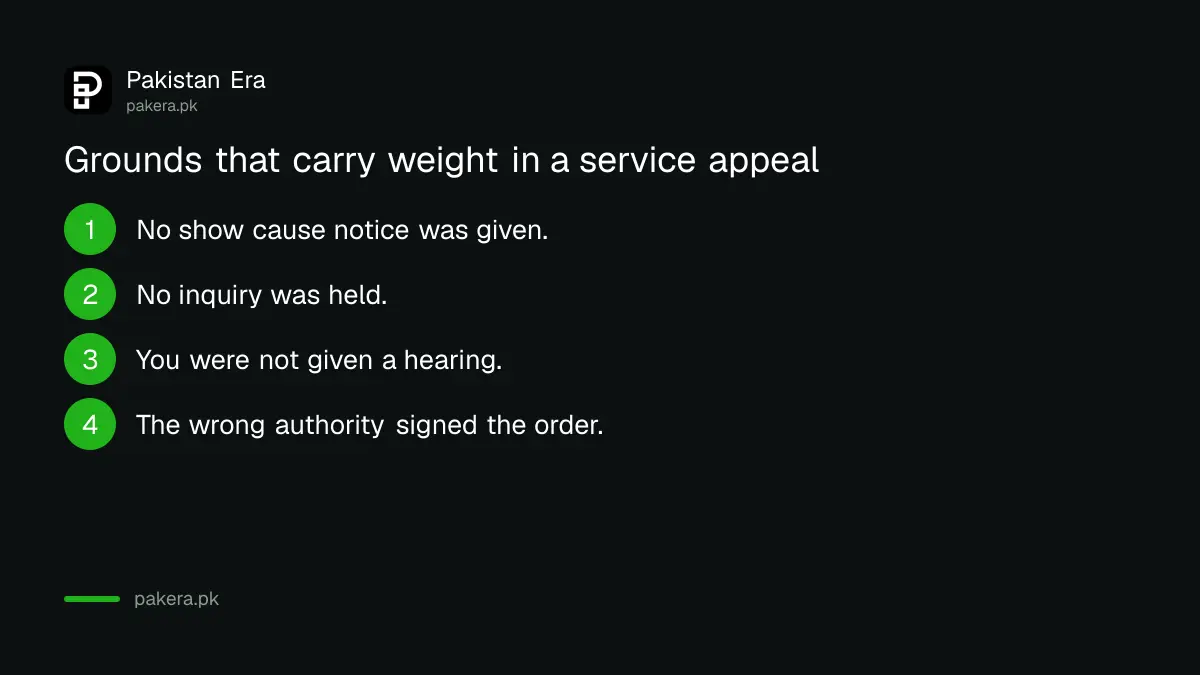
Grounds that tend to carry weight are procedural. Was a show cause notice given? Was there an inquiry? Were you given a hearing? Did the right authority sign the order? A penalty passed without a hearing is far easier to set aside than one you simply think is too harsh.
A lawyer is not legally required, but most appellants use one who practises before the Tribunal. If you cannot afford one, the Supreme Court's 1818 helpline now routes requests for free legal aid through a Bar Council. Pension disputes often start elsewhere first, so read how a government pension case is filed before you decide on the Tribunal.
What the 9 October meeting means for pending appeals
The Law Minister said speedy and affordable justice for government employees is a government priority. He promised administrative and financial support, and the meeting discussed a wider e-courts system and a stronger digital appeal management system. No new rule or deadline was announced.
So nothing changes for how you file today. The practical point is that the Tribunal's Chairman said he wants the digital appeal system to work better to speed up pending cases. We tried the Tribunal's website, fst.gov.pk, on 10 October 2026 and it returned a server error, so we could not confirm any online filing or tracking option. Ask the Tribunal's office or your lawyer about it.
If your dispute is about pay, it helps to know the numbers before you argue them. The current revised basic pay scales are the starting point for most pay fixation appeals.
Common questions
Who can appeal to the Federal Service Tribunal?
A person who is or was a federal civil servant under the Civil Servants Act, 1973, about the terms and conditions of service.
Can I go to the Federal Service Tribunal directly?
Usually no. Where your rules give a departmental appeal or representation, you must file it first and wait 90 days, unless it is decided sooner.
What is the time limit for an FST appeal?
30 days from the communication of the final departmental order. If the department never decides, you can appeal after the 90 day wait, and it is safest to file soon after it ends.
Can the Tribunal hear a promotion case?
Not on fitness for promotion. Section 4(1)(b) bars that. Other promotion issues, such as seniority errors, can be argued.
What if I file my appeal late?
Apply for condonation of delay under section 5 of the Limitation Act and explain the reason for every day.
Can I challenge the Tribunal's decision?
You can ask it to review its order within 30 days. A further appeal lies only with leave under Article 212(3) of the Constitution.
How we verified this
What we checked, where we read it, and what we could not confirm.
Last checked 10 October 2026, about 9:00 pm PKT. Time limits, bars and powers are from the Service Tribunals Act, 1973 and section 22 of the Civil Servants Act, 1973, both read on Pakistan Code. The 9 October meeting is from the Ministry of Law and Justice release carried as PID PR No. 106. The Tribunal's own website returned a server error when we checked, so filing fees and bench locations are not stated here.
About the author

Tax, Bills and Technology Writer
Ali Akhtar is a young and curious voice here at Pakistan Era. He is currently pursuing his A-Levels and has a growing interest in Pakistan’s changing industrial landscape and educational trends. Ali likes to write in a way that helps him explain and explore the world around him. His writing reflects the perspective of the new generation navigating the evolving trends of Pakistan where technology, youth innovation, and shifting opportunities are reshaping the country’s future.