Revised Basic Pay Scales 2026 for Government Employees
House Rent Allowance is frozen at its 30 June level and the 7 per cent does not count for pension. Read in the Finance Division memorandum.
Your House Rent Allowance is frozen at what it was on 30 June 2026, and the new 7 per cent allowance does not count towards your pension or gratuity. Both are in the memorandum, and neither has been widely reported.
Update, 11 October 2026: The Special Allowance for the Rs 40,700 minimum salary is explained. See the allowance.
Update, 10 October 2026: The Finance Division now pays the Rs 2,500 M.Phil Allowance on HEC equivalent degrees too. Read the update.
So the raise is smaller in practice than the headline figures suggest, and it improves your pension less than you would expect.
We downloaded and read the Finance Division's Office Memorandum, number F.1(2)IMP/2026 dated 21 July 2026, from finance.gov.pk on 2 September 2026.
What actually changed
The memorandum revises Basic Pay Scales and Allowances for civil employees of the Federal Government, paid out of civil estimates and defence estimates, with effect from 1 July 2026.
| Scale | BPS-2022 minimum | BPS-2026 minimum |
|---|---|---|
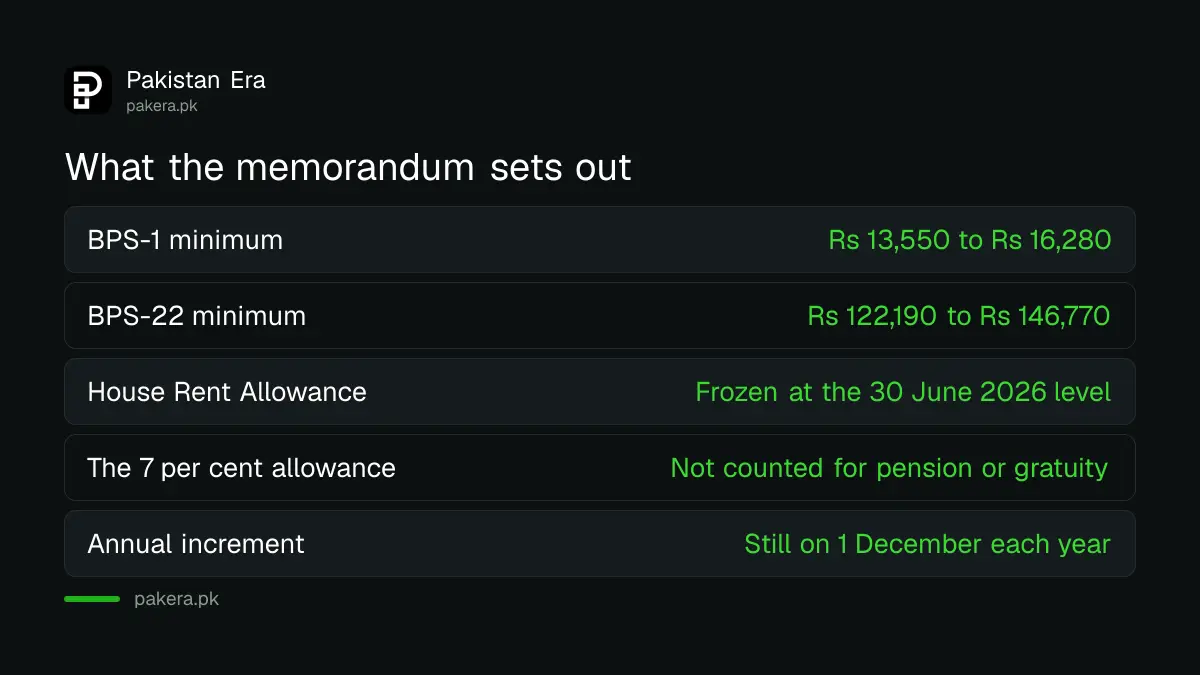
| BPS-1 | Rs 13,550 | Rs 16,280 |
| BPS-15 | Rs 23,920 | Rs 28,730 |
| BPS-17 | Rs 45,070 | Rs 54,140 |
| BPS-22 | Rs 122,190 | Rs 146,770 |
BPS-2026 was created by merging the Ad-hoc Relief Allowance of 2022 and that of 2025 into the scales, and it replaces BPS-2022 from 1 July 2026. Those two allowances, 15 per cent of running basic pay on BPS-2017 and 10 per cent on BPS-2022, cease to exist from that date.
Existing pay is fixed on a point to point basis, meaning at the stage corresponding to the one you occupied above the minimum of BPS-2022. Annual increment continues on 1 December each year.
The freeze almost nobody mentions
Paragraph 7 is the one to read twice.
All Special Pays, Special Allowances or allowances admissible as a percentage of pay, excluding those capped by a fixed maximum, including House Rent Allowance and the allowance equal to one month's basic pay, stand frozen at the level of their admissibility as on 30 June 2026.
Percentage allowances normally rise when basic pay rises. Freezing them means the merger lifts your basic pay without carrying House Rent Allowance up with it. If you were expecting your allowances to move in proportion, they will not.
The 7 per cent does not build your pension
The Ad-hoc Relief Allowance 2026 is 7 per cent of running basic pay on BPS-2026, effective 1 July 2026 and stated to run until further orders. The memorandum then sets out what it is and is not.
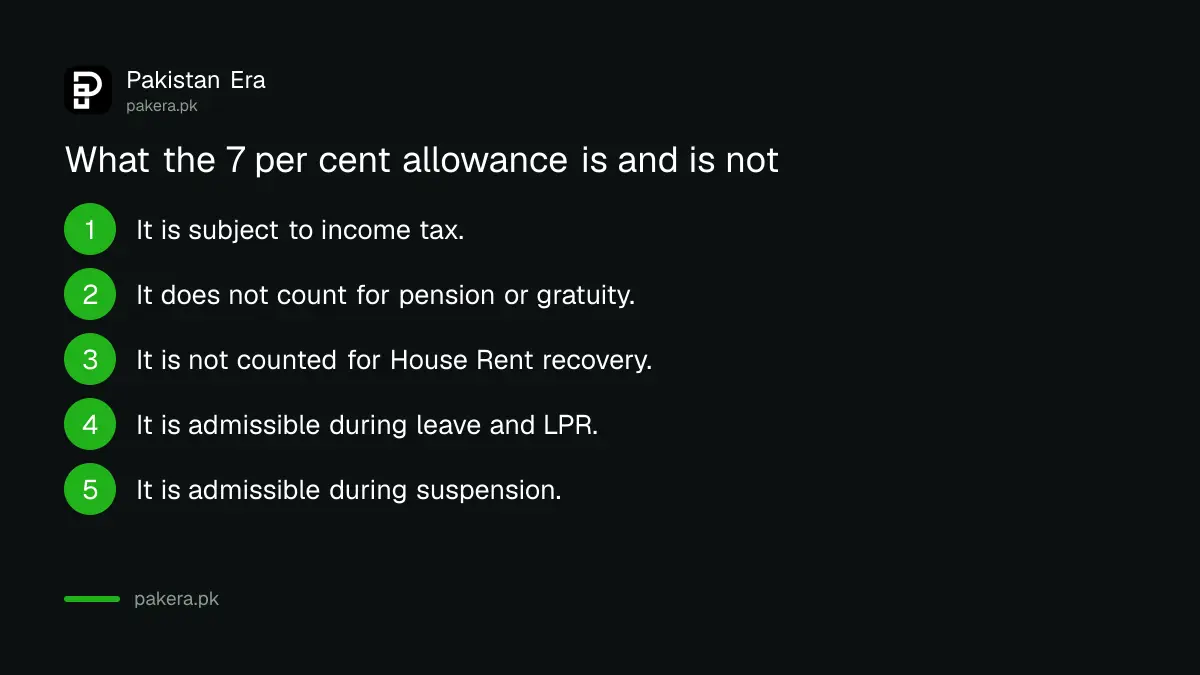
- It is subject to income tax.
- It is not treated as part of emoluments for calculating pension or gratuity.
- It is not part of emoluments for recovery of House Rent either.
- It is admissible during leave and the entire period of LPR, except extraordinary leave.
- It is admissible during suspension, but not during posting or deputation abroad.
The second point matters most to anyone near retirement. Money paid as an adhoc allowance rather than as basic pay does not raise the figure your pension is calculated from. Our guide to how a government pension case is filed covers how that calculation works.
The suspension line is worth knowing too, because it is a question people are afraid to ask their own department.
The option, and what silence meant
Paragraph 8 required your Ministry, Division, Department or Office to obtain an irrevocable option from you in writing, within 30 days from the date the memorandum was issued, and to communicate it to the Accounts Office or DDO. The choice was to continue drawing salary under BPS-2022 or move to BPS-2026.
An employee who did not exercise and communicate the option within that time is deemed to have opted for BPS-2026.
The memorandum is dated 21 July 2026, so that window has closed. If you never signed anything, the deeming provision applied to you. Ask your DDO in writing what is recorded against your name, and keep the reply.
If your figure comes out wrong
Paragraph 10 provides for an Anomaly Committee to be set up in the Finance Division, Regulations Wing, to resolve anomalies arising out of implementation.
Anomalies are expected in a revision built on a merger, particularly where point to point fixation places two colleagues on the same grade at different stages. Raise it through your department in writing with your own calculation attached, and name the Regulations Wing committee.
Personal Pay drawn beyond the maximum of a scale on 30 June 2026 continues in BPS-2026 at the revised rates, and the term basic pay includes Personal Pay granted for annual increments beyond the maximum. If your case involves Personal Pay, quote that.
Stages are not the same in every scale
The table in the memorandum lists the number of stages alongside each scale, and they differ. BPS-1 through the middle scales carry 30 stages. BPS-17 to 19 carry 20. The top scales carry 14.
That matters for anyone counting years to the maximum of their scale, because the number of increments available is not uniform. Check the stage count for your own grade rather than assuming thirty.
Provinces are separate
This memorandum is federal. Provinces notify their own scales, and Punjab was reported to have issued its own notification in July 2026.
A chart circulating as the pay scale may therefore not be yours at all. Check whether the document is a Finance Division memorandum or a provincial one before planning around it.
What it does to your tax
A rise in basic pay changes your deduction, and the adhoc allowance is expressly subject to income tax.
Our guide to how salary tax is deducted explains that the monthly deduction is made at your average rate for the year, and after adjusting tax already withheld from you elsewhere if you provide evidence. Our guide to the salary tax slabs for 2026-27 covers the rates.
Common questions
What is the BPS-1 and BPS-22 minimum now?
The memorandum's table shows BPS-1 rising from Rs 13,550 to Rs 16,280 and BPS-22 from Rs 122,190 to Rs 146,770.
Will my House Rent Allowance go up?
No. Paragraph 7 freezes percentage-based allowances including House Rent Allowance at their level as on 30 June 2026.
Does the 7 per cent allowance count for pension?
No. It is stated not to be treated as part of emoluments for calculation of pension or gratuity.
I never exercised the option. What am I on?
An employee who did not exercise and communicate the option within 30 days is deemed to have opted for BPS-2026.
Where do I take a pay anomaly?
An Anomaly Committee in the Finance Division, Regulations Wing. Go through your department in writing.
When is the annual increment?
The memorandum states that annual increment continues on 1 December each year.
How we verified this
What we checked, where we read it, and what we could not confirm.
Last checked 2 September 2026. We downloaded the Finance Division's Office Memorandum number F.1(2)IMP/2026, dated 21 July 2026 and titled Revision of Basic Pay Scales and Allowances of Civil Servants of the Federal Government 2026, from finance.gov.pk and read it. The effective date of 1 July 2026, the application to civil employees paid out of civil and defence estimates, the creation of BPS-2026 by merging Ad-hoc Relief Allowance-2022 and Ad-hoc Relief Allowance-2025, the cessation of those allowances at 15 per cent of running basic pay of BPS-2017 and 10 per cent on BPS-2022, point to point fixation, the continuation of Personal Pay at revised rates, annual increment on 1 December, the Ad-hoc Relief Allowance-2026 at 7 per cent of running basic pay until further orders together with its conditions on income tax, leave and LPR, exclusion from emoluments for pension, gratuity and House Rent recovery, posting abroad, repatriation and suspension, the paragraph 7 freezing of percentage-based Special Pays and Allowances including House Rent Allowance at their 30 June 2026 level, the paragraph 8 irrevocable option within 30 days with non-exercise deemed to be acceptance of BPS-2026, the Anomaly Committee in the Finance Division Regulations Wing, and the pay figures and stage counts quoted, are all taken from that memorandum. The Finance Division also lists a memorandum for autonomous bodies dated 27 July 2026 and a Clarification dated 4 August 2026, which we did not open. The separate Punjab notification is reported rather than read. Read the memorandum yourself on finance.gov.pk, or ask your DDO, before acting on any figure. Nothing here is financial advice.
About the author

Tax, Bills and Technology Writer
Ali Akhtar is a young and curious voice here at Pakistan Era. He is currently pursuing his A-Levels and has a growing interest in Pakistan’s changing industrial landscape and educational trends. Ali likes to write in a way that helps him explain and explore the world around him. His writing reflects the perspective of the new generation navigating the evolving trends of Pakistan where technology, youth innovation, and shifting opportunities are reshaping the country’s future.