Federal Constitutional Court of Pakistan: 60 Day Appeal and 30 Day Review Limits
Federal Constitutional Court rules 2026 set 60 days to seek leave to appeal and 30 days to seek review, plus a Rs 50,000 deposit. See every deadline and rule.
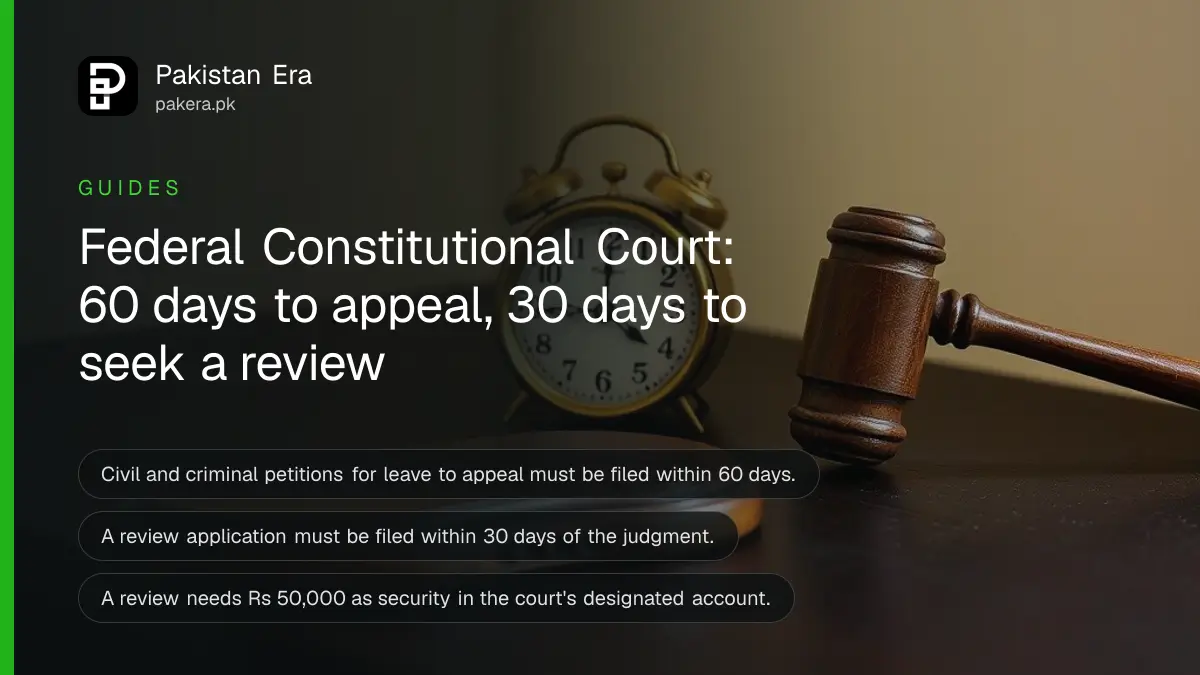
Short answer: Under the Federal Constitutional Court (Practice and Procedure) Rules, 2026, a petition for leave to appeal must be filed within 60 days, and a review application within 30 days. A review also needs a Rs 50,000 security deposit. Miss the date and you must show sufficient cause to the court.
Update, 11 October 2026: Filings need scanned copies in colour at 200 DPI with OCR.
A lawyer once told a client "we still have time" and the client heard "no hurry". Then the 60 days ran out on a Friday. Deadlines in court are not a suggestion, and the court has just published a new rulebook with the numbers in it.
We read the rules as printed in the Gazette of Pakistan, Extraordinary, dated 16 September 2026, and as posted on the Federal Constitutional Court's own website under Notifications. The Rules were notified as S.R.O. 1580(I)/2026 on 14 September 2026 and, under rule 1, came into force at once.
The Rules set a 60 day limit for most appeals
A petition for leave to appeal in a civil case must be filed within 60 days of the judgment, decree or final order, under Order XV rule 1. A criminal petition for leave to appeal has the same 60 days under Order XXV rule 2. The court may extend the time for sufficient cause.
"Leave to appeal" means you ask the court for permission to bring an appeal. The court decides first whether the case deserves a full hearing. The 60 days run from the date of the order you are challenging, not from the day you received a copy. Counting follows the Limitation Act, 1908, as Order I rule 4 says.
If the High Court refused you a certificate that your case raises a constitutional question, the 60 days run from the date of that refusal. That is a separate trigger, and it matters because the certificate route is one of the three ways a civil appeal can reach this court.
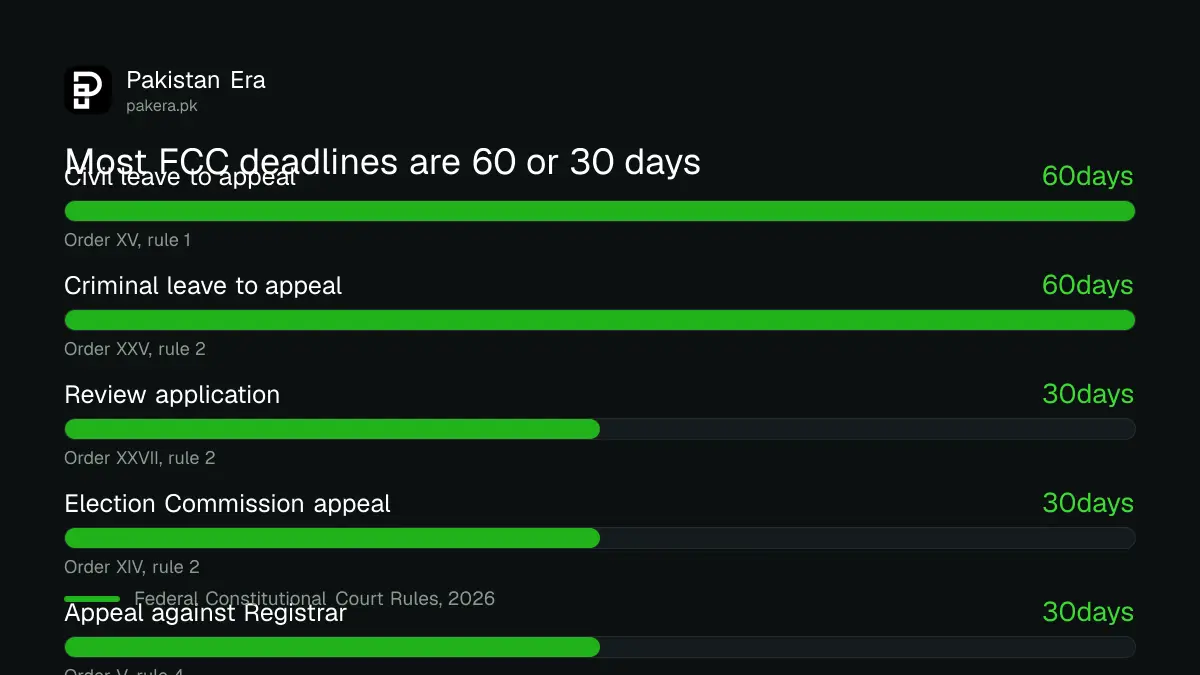
| Step | Time limit | Rule |
|---|---|---|
| Civil petition for leave to appeal | 60 days from the judgment, decree or final order | Order XV, rule 1 |
| Criminal petition for leave to appeal | 60 days from the judgment or final order | Order XXV, rule 2 |
| Civil appeal after High Court certificate | 60 days from the date of the certificate | Order XIII, rule 3 |
| Civil appeal after leave is granted | 60 days from the date leave is granted | Order XIII, rule 3 |
| Review of a judgment or order | 30 days from pronouncement | Order XXVII, rule 2 |
| Appeal from the Election Commission under Article 63A | 30 days from the decision | Order XIV, rule 2 |
| Appeal against an order of the Registrar | 30 days from the order | Order V, rule 4 |
A review must be filed in 30 days with a Rs 50,000 deposit
A review application goes to the court within 30 days of the day the judgment or order was pronounced. Order XXVII also requires Rs 50,000 as security, paid into the court's designated account, and a certificate that a review is justified. A second review is not allowed.
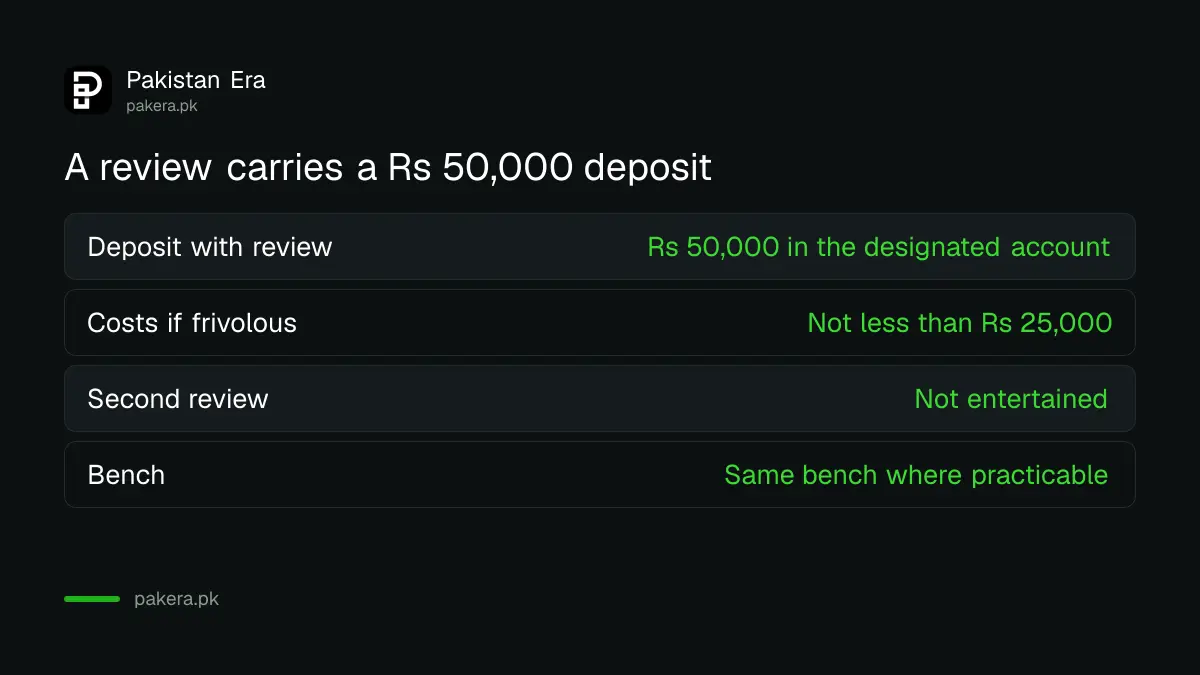
The deposit is not a fee. It can be forfeited if the application is dismissed or found frivolous or vexatious, under rule 6. A frivolous review also draws costs of not less than Rs 25,000, whether it was filed by a party or by an advocate.
- File with a certified copy of the judgment or order you want reviewed.
- If your ground is new evidence, attach certified copies and an affidavit explaining why it was not produced earlier.
- Expect the same bench to hear it, as far as practicable (rule 7).
- Do not plan on a second try. Rule 8 says a review of an order made on review is not entertained.
The Supreme Court has its own rules for the same remedy, and they differ in detail. We explained those in filing a review petition in the Supreme Court. Do not mix the two sets of numbers.
Some High Court judgments cannot be appealed at all
Order XIII rule 1 allows a civil appeal only where an Act of Parliament provides for it, where the High Court certifies a substantial question about interpreting the Constitution, or against an Article 199 order with leave. It bars appeals from Article 199 orders in rent and family matters, except guardianship.
That last bar affects ordinary families more than any other line in the Rules. A tenant or landlord who lost a writ petition about rent in the High Court cannot take it further under this Order. The same applies to most family disputes decided under Article 199. Guardianship cases are the exception.
If your dispute is about custody, read how child custody works in the family courts first, because custody cases start in the family court.
What to do in the first week after an adverse order
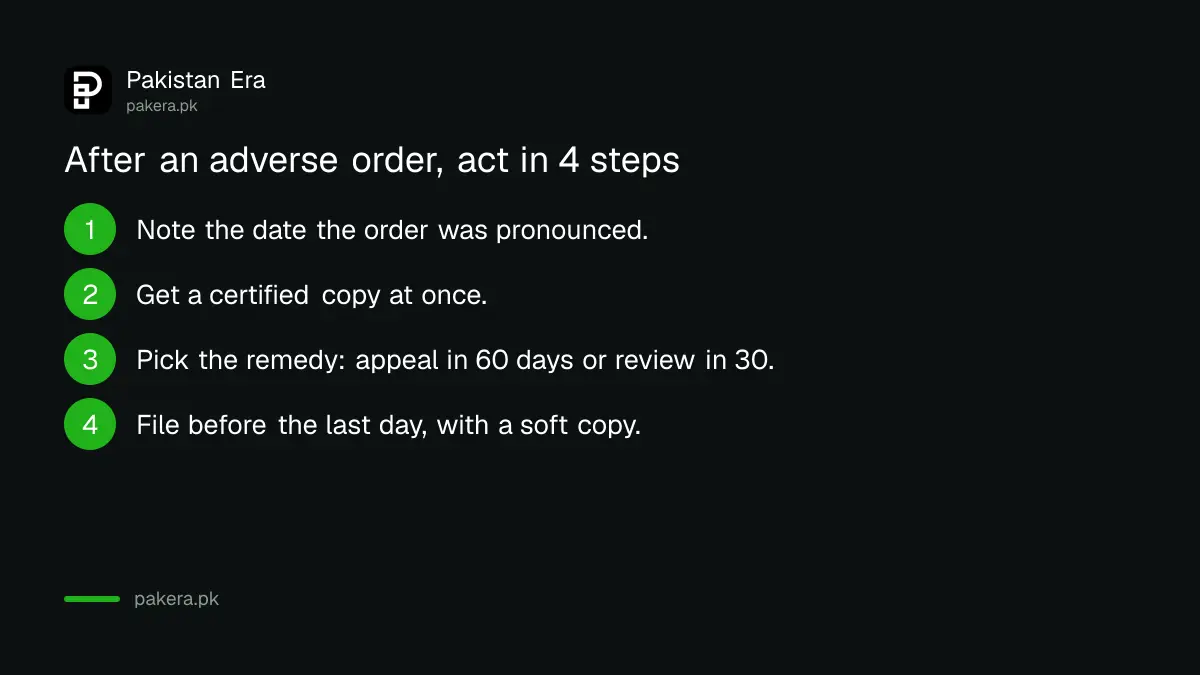
Get a certified copy of the order, write down the date it was pronounced, and count 60 days for an appeal or 30 days for a review. Then ask your Advocate-on-Record in writing which rule applies and what date they have calendared.
- Note the date the judgment or order was pronounced.
- Order a certified copy the same day. Copying takes time, so ask early.
- Decide the remedy: leave to appeal (60 days), review (30 days) or an Election Commission appeal (30 days).
- Check whether a High Court certificate is needed, and ask for it if so.
- For a review, arrange the Rs 50,000 deposit before the last week.
- Ask your lawyer to file a soft or scanned copy together with the paper-books, as the Rules require.
The Registrar can refuse a petition, and you can answer back
The Registrar may refuse to receive a petition that does not follow the Rules or is scandalous in nature. You then have 14 days to appeal to the Judge-in-Chambers, under Order XIX rule 5. A petition must also carry at least three copies and a soft or scanned copy.
If an appeal is dismissed for non-prosecution, which means nobody appeared to argue it, the appellant has 30 days to apply for restoration under Order XVII rule 5. Extra time is possible. Order XXII rule 5 lets the court enlarge or shorten time for sufficient cause, but a court is never obliged to be generous.
A party that wants to be told when a petition is filed against it can file a caveat under Order XIX rule 2. The caveator then gets notice and can ask for a copy of the petition.
Common questions
How long do I have to appeal to the Federal Constitutional Court?
Generally 60 days. Order XV rule 1 sets 60 days for civil petitions for leave to appeal and Order XXV rule 2 sets the same for criminal ones.
How long do I have to file a review?
You have 30 days from the date the judgment or order was pronounced, under Order XXVII rule 2. A deposit of Rs 50,000 is required with it.
Can I appeal a High Court rent or family order?
Not under Order XIII if the order was made under Article 199 in a rent or family case. Guardianship is the exception.
Can the deadline be extended?
Yes, for sufficient cause. Several rules say so, and Order XXII rule 5 gives a general power to enlarge time. It is the court's choice.
Do these rules apply to the Supreme Court?
No. They are the Federal Constitutional Court's Rules. The Supreme Court has separate rules, and our page on the Supreme Court appeal limits covers those.
How we verified this
What we checked, where we read it, and what we could not confirm.
Last checked on Sunday 11 October 2026. We read the Federal Constitutional Court (Practice and Procedure) Rules, 2026, as published in the Gazette of Pakistan, Extraordinary, on 16 September 2026 and listed on the court's notifications page, and the court's About Us page. This is general information, not legal advice. Confirm your own date with an Advocate-on-Record.
About the author

Public Services and Education Journalist
Fajr Riaz is a journalist and content writer at Pakistan Era, based in Lahore. She covers the questions people meet in everyday life in Pakistan: how a public service works, what a change in the rules means, and where to find a reliable answer.