How to Prepare Scanned Copies for the Federal Constitutional Court: Colour, 200 DPI, OCR
The Federal Constitutional Court's circular sets colour, 200 DPI and OCR for scanned copies from 17 August 2026. Read what it covers and how to scan correctly.
Short answer: Scan every document you file in the Federal Constitutional Court in colour, at 200 DPI, with OCR switched on. The Court's circular of 13 August 2026 sets these three specifications for Advocates-on-Record and litigants appearing in person, from 17 August 2026. A scan that misses them risks being sent back.
Picture a petition that is ready on the last day of the 60-day limit, and a scanner still set to black and white at 100 DPI. The Court has now said exactly how its electronic copies must look, so that setting becomes a filing problem rather than a small detail.
We downloaded the circular from the Notifications page of the Federal Constitutional Court's website and read it in full. We also read the Federal Constitutional Court (Practice and Procedure) Rules, 2026 for what they say about soft copies. We did not scan or file anything ourselves, so we cannot say how the Case Registration Desk treats a borderline file.
The Court has set three scan specifications for electronic copies
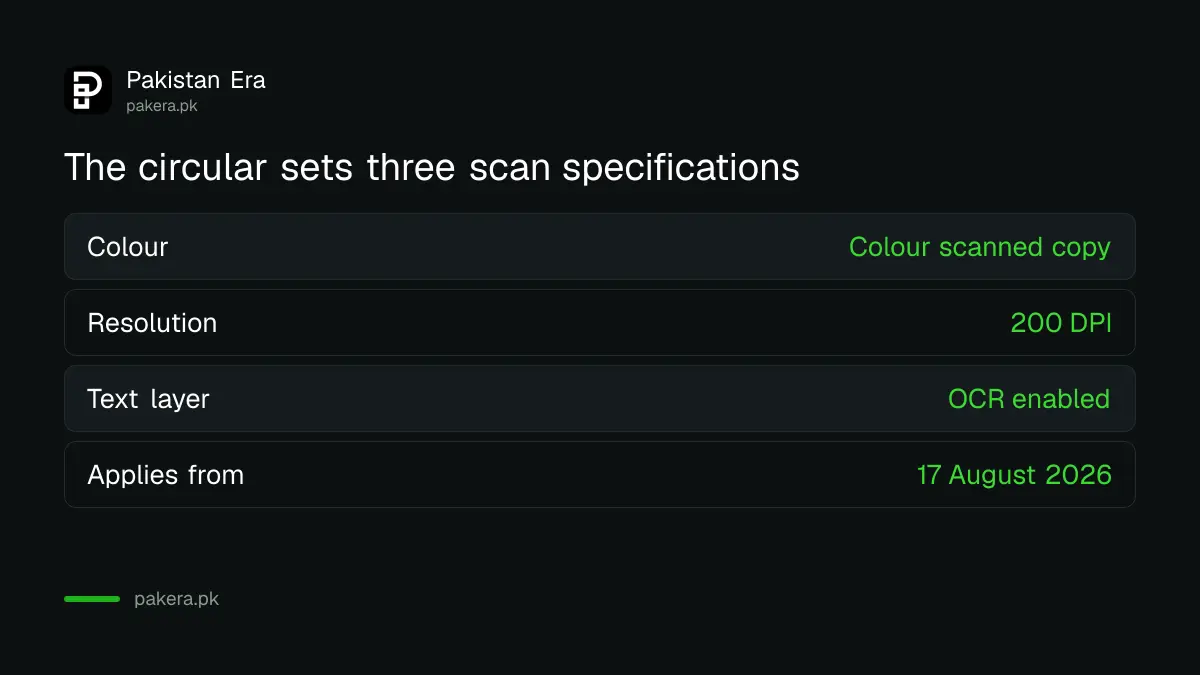
The circular lists three requirements: a colour scanned copy, a resolution of 200 DPI, and OCR enabled. It says these apply to the electronic or scanned copies that accompany cases and applications, and that they must be followed "in letter and spirit" from 17 August 2026.
The Court gives its reason in the circular itself. It is building a secure digital repository of judicial records, and the scanned papers must be indexed, kept and found again inside its electronic case management system.
| Specification | What the circular says | What it means in practice |
|---|---|---|
| Colour | Colour scanned copy | Do not use black and white or greyscale mode |
| Resolution | 200 DPI | Set the scanner to 200 dots per inch |
| Text recognition | OCR enabled | The PDF must have a searchable text layer |
The circular applies to every filing from 17 August 2026
The requirement covers all Advocates-on-Record and all litigants-in-person who institute cases or applications before the Court. The effective date printed in the circular is 17 August 2026. Anything filed from that date should follow the three specifications.
The circular is dated Islamabad, 13 August 2026. It was issued with the approval of the Registrar and signed for the Registrar by a Deputy Registrar (Administration and HR). Copies went to the branch registries at Lahore, Karachi, Quetta and Peshawar, and to the President of the Supreme Court Bar Association.
One detail needs care. The text layer of the PDF is not clean, and it renders the effective date as "L7.08.2026". We read it as 17 August 2026. Confirm it with the registry if the date decides a filing for you.
How to make a compliant scanned copy
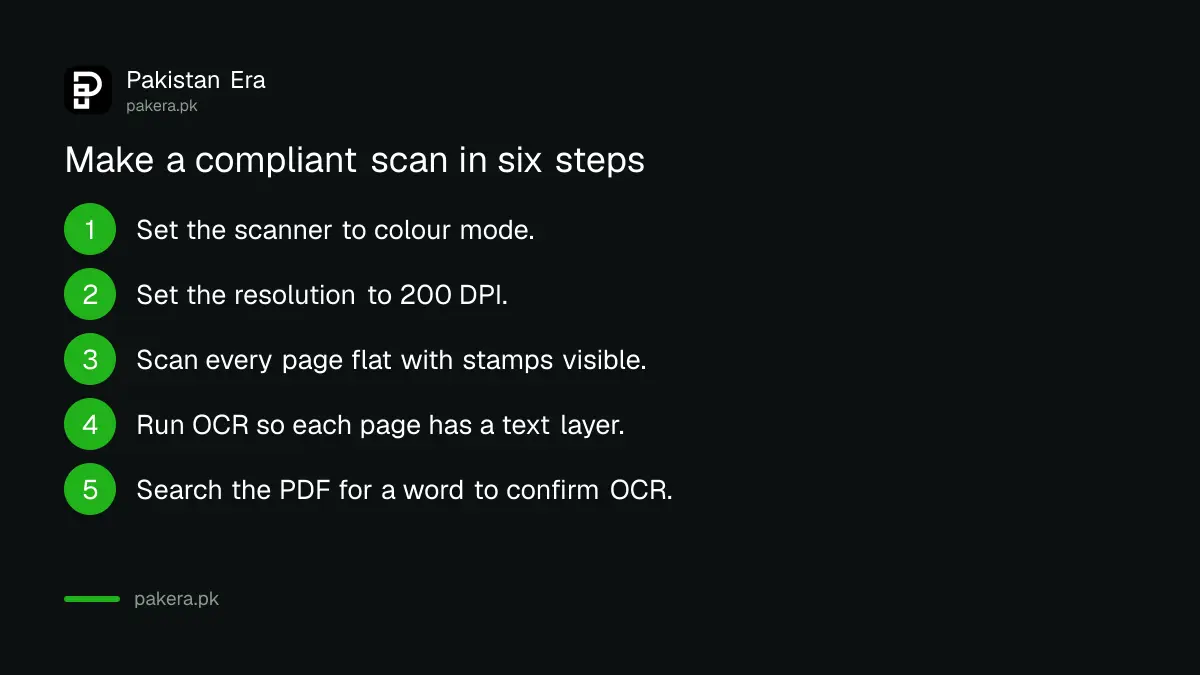
Set your scanner or scanning app to colour and 200 DPI, scan the paper-book, then run text recognition so the PDF becomes searchable. Check the result before you send it. Our steps below are practical advice built on the three specifications.
- Set the scanner to colour mode, not black and white or greyscale.
- Set the resolution to 200 DPI. A higher number is not what the circular asks for, and it only makes the file bigger.
- Scan every page flat and straight, with the stamps, signatures and annexures visible.
- Run OCR in your scanning software so each page carries a text layer.
- Open the finished PDF and try to select a line of text, or search for a word. If you cannot, OCR did not run.
- Name the file clearly and keep it with the matching hard copy set.
The Rules ask for a soft copy with several filings
The Practice and Procedure Rules, 2026 repeat the soft copy duty in several places. A civil appeal and a petition for leave to appeal need three paper-books plus a soft or scanned copy. Concise written submissions go in with a soft or scanned copy at least two days before the hearing.
| Filing | Soft or scanned copy under the Rules |
|---|---|
| Petition for leave to appeal | Three paper-books along with a soft or scanned copy |
| Appeal after leave | Three sets of paper-books along with a soft or scanned copy |
| Concise written submissions | Filed with a soft or scanned copy not later than two days before the hearing |
| Electronic filing generally | In the prescribed digital format, by a method the Court prescribes |
The Rules say electronic filing must follow the procedure, authentication and format that the Court prescribes. We found no separate public e-filing portal on the site, only the e-Services forms for adjournment, early hearing, certified copy and notice response. Until the Court prescribes more, the circular is the clearest technical standard in public view.
Read the time limits first, because a perfect scan filed late still fails. Our page on the 60 and 30 day limits under the Court's new rules sets them out. If you are filing alone, the no-fee pauper appeal route has its own papers.
What the circular does not say
The circular names no file format, no maximum file size and no page limit. It does not say how a rejected scan is returned. Those points are not in the document, so do not assume them. Ask the Registry or the Case Registration Desk before you rely on a particular PDF size.
The Court's helpline, shown on its website, is +92 51 111 322 322. Its email for notices is enotices@fccp.gov.pk. Use them for questions about the Registry. Do not send a filing to an email address unless the Registry tells you that is accepted.
Common questions
What scan quality does the Federal Constitutional Court require?
It requires a colour scanned copy at 200 DPI with OCR enabled. These three specifications are in the Court's circular dated 13 August 2026.
From what date do the specifications apply?
The circular applies them from 17 August 2026. The date in the PDF's text layer is slightly garbled, so we read it as 17 August.
Does this apply to litigants who appear without a lawyer?
Yes. The circular names Advocates-on-Record and litigants-in-person together.
Does the circular set a maximum file size?
No. It names no file size, file format or page limit. Ask the Registry if size is a problem.
What is OCR and how do I know it worked?
OCR is optical character recognition, a step that turns the picture of a page into text a computer can search. Open the PDF and try to select a line or search for a word. If that works, the text layer is there.
How we verified this
What we checked, where we read it, and what we could not confirm.
Last checked on Sunday 11 October 2026. We read the circular "Specifications of Electronic / Scanned Copies of Cases by Advocates", dated 13 August 2026, on the Notifications page of the Federal Constitutional Court, and the Practice and Procedure Rules, 2026 published in the Gazette of Pakistan, Extraordinary, of 16 September 2026. We did not test a filing.
About the author

Public Services and Education Journalist
Fajr Riaz is a journalist and content writer at Pakistan Era, based in Lahore. She covers the questions people meet in everyday life in Pakistan: how a public service works, what a change in the rules means, and where to find a reliable answer.