How to File a Pauper Appeal in the Federal Constitutional Court When You Cannot Pay Court Fee
Cannot pay court fee? Learn how a pauper appeal works at the Federal Constitutional Court: counsel certificate, property affidavit, inquiry and fee recovery.
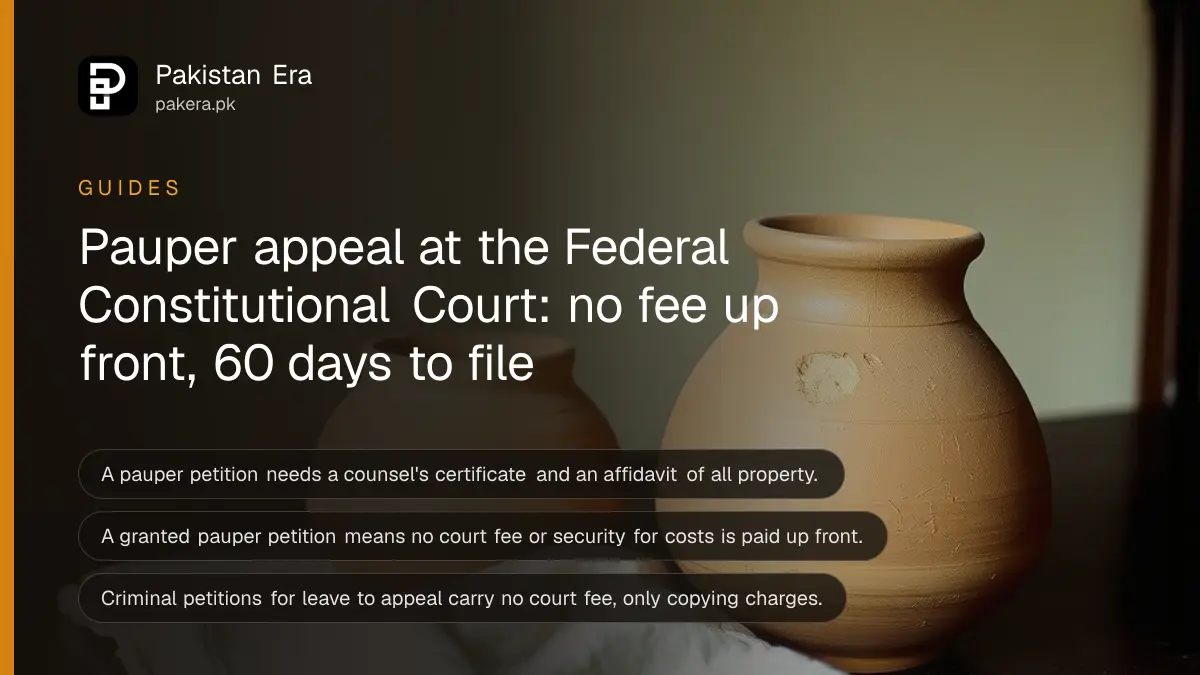
Short answer: If you cannot pay court fee, the Federal Constitutional Court's Rules let you apply to appeal as a pauper under Order XXIII. You file a petition with a counsel's certificate and an affidavit listing all your property. If the court grants it, you pay no court fee and furnish no security for costs.
The court fee on a civil appeal is paid within 30 days of leave being granted. For a family that has already lost a case and spent savings on lawyers, that bill can end the appeal on its own. The new Rules keep a door open, and it is narrower than most people assume.
We read Orders XVI, XXIII, XXIV, XXV and XXIX of the Federal Constitutional Court (Practice and Procedure) Rules, 2026, as printed in the Gazette of Pakistan of 16 September 2026. We did not file a pauper petition, and the Third Schedule fee amounts are not quoted here.
Order XXIII lets a person who cannot pay appeal as a pauper
A pauper appeal is an appeal by a person who cannot pay the court fee or give security for costs. Order XXIII applies Order XLIV of the Code of Civil Procedure with changes. The application is made as a petition to the court, not as a letter to the Registrar.
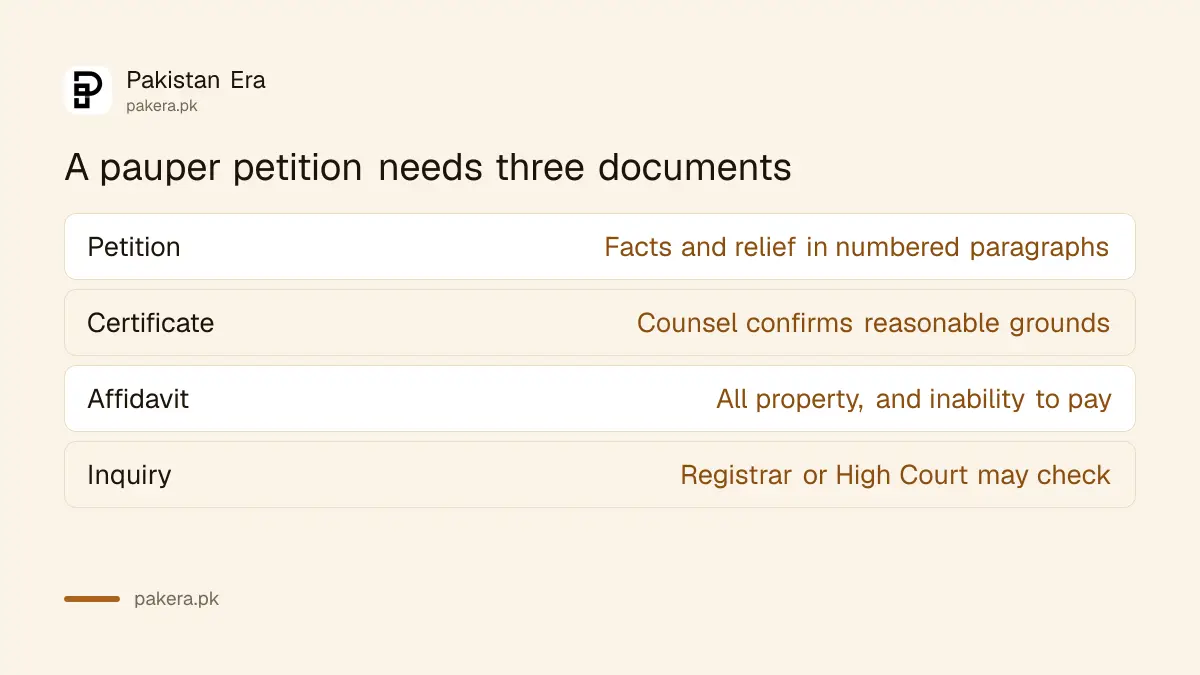
The petition must state the facts and the relief in separately numbered paragraphs. It must come with a certificate from counsel that the petitioner has reasonable grounds for the proposed appeal. So a lawyer has to look at your case first.
| Requirement | What the Rules say |
|---|---|
| Form | A petition in numbered paragraphs, facts and relief |
| Counsel's certificate | Reasonable grounds for the proposed appeal |
| Affidavit | All property and its estimated value, and that you cannot pay court fee or furnish security |
| What you may leave out | Necessary wearing apparel, and your interest in the subject matter of the appeal |
| Inquiry | By the Registrar after notice to the parties and the Attorney-General, or through the High Court |
The affidavit must list everything you own
Rule 2(3) requires an affidavit disclosing all property to which you are entitled and its estimated value, except necessary clothing and your interest in the subject of the appeal. It must also say you cannot pay court fee or give security. A false affidavit is a serious risk.
Be complete. Land, vehicles, savings certificates, jewellery and shares count. The court can inquire into whether you are really a pauper, and it can send the question to the Registrar of the High Court, who may have it investigated through a subordinate court.
That inquiry has a clock. The High Court must send its report within 30 days of receiving the reference. No inquiry is needed if you were already allowed to fight the case as a pauper in the court below.
If the court grants it, you pay no fee up front
Once permission is granted you do not pay court fee or security for the respondent's costs, under rule 4. The money is not forgiven forever. If you win, the fee is worked out and recovered from the party the court directs, and it becomes a first charge on the subject matter.
If you lose, or the court finds you were not a pauper, it may direct you to pay the fees you would have owed. The Federal Government may also apply for the fee at any time, and the Registrar sends it a memorandum of fees after the appeal is decided.
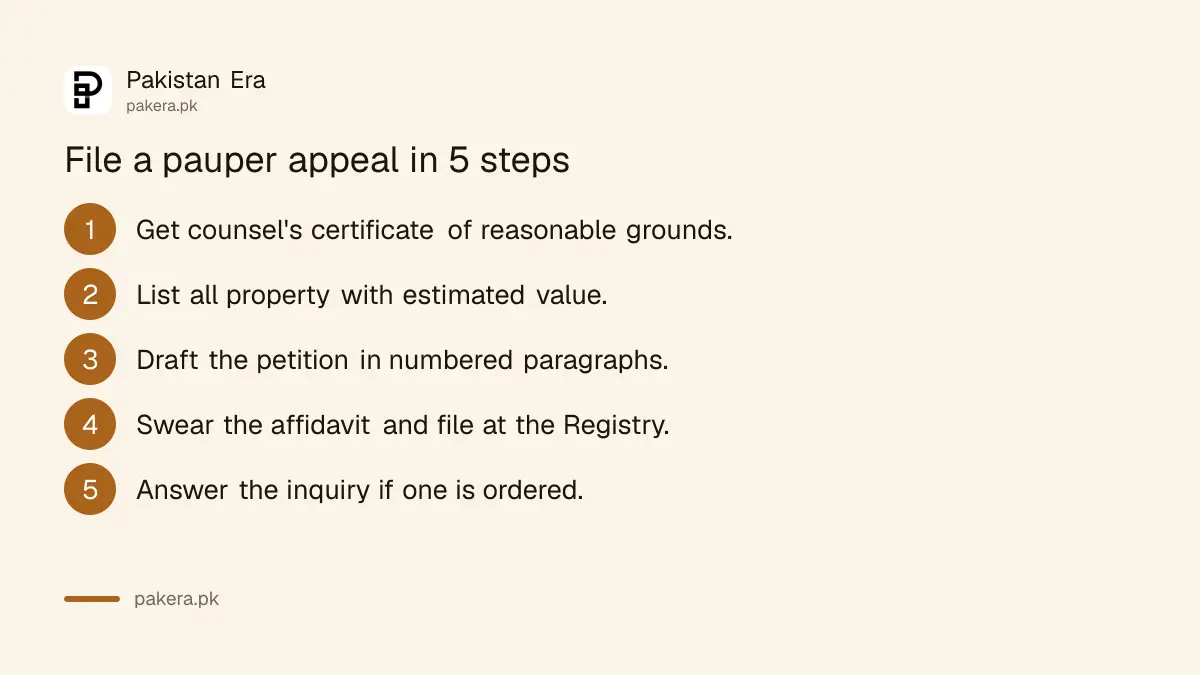
- Show the case to an Advocate-on-Record and ask for the certificate of reasonable grounds.
- List every item of property with a fair estimate of value.
- Draft the petition in numbered paragraphs, with the facts and the relief.
- Swear the affidavit.
- File the petition and affidavit at the Registry.
- Answer the Registrar's inquiry if one is ordered.
- If permission is refused, check the time left to pay the court fee.
Criminal appeals already carry no court fee
You do not need to apply as a pauper in a criminal case. Order XXV rule 1 says no court fee, process fee or search fee is payable on a criminal petition for leave to appeal. A copying fee is payable, but not on petitions filed through jail.
A prisoner may hand the petition and papers to the jail's officer-in-charge, who must send it to the Registrar. The court may also direct that an advocate be engaged for an accused or unrepresented party from a panel kept for the purpose, under Order XXIV rule 8.
For the Supreme Court's version of the jail route, see how to file a jail petition in the Supreme Court. For help finding a lawyer without cost, free legal aid in Punjab lists where to ask.
Keep the deadlines even if you are poor
Nothing in the Rules we read says a pauper application pauses the clock. A petition for leave to appeal still has 60 days, and the fee in an ordinary civil appeal falls due 30 days after leave is granted under Order XVI rule 6. Ask your lawyer to file early so the pauper question is settled in time.
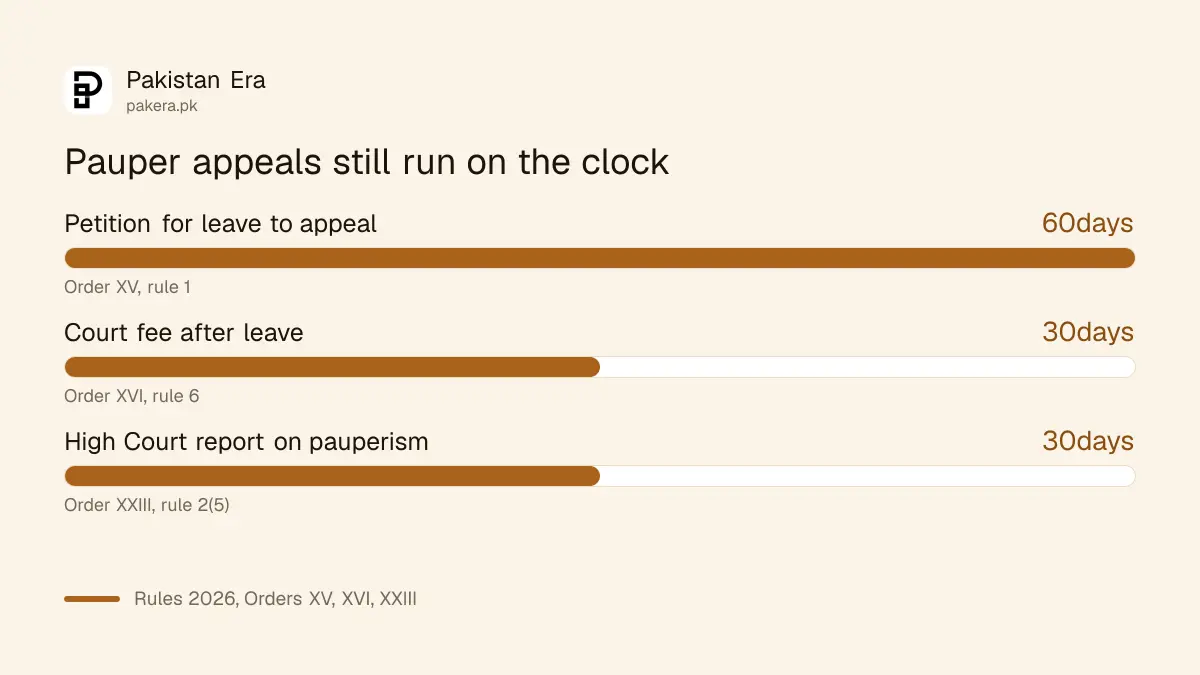
Our page on the court's appeal and review time limits sets out each date. Count from the order, not from when you received a copy.
Common questions
Who can file a pauper appeal at the Federal Constitutional Court?
A person who cannot pay court fee or give security for costs and who can prove it by affidavit, with a counsel's certificate of reasonable grounds.
Is there any fee to apply as a pauper?
Order XXIX says no court fee is payable by someone seeking leave to proceed as a pauper, except the prescribed fee on the petition for that leave. We did not read the amount.
Do I pay court fee at all if I win?
Possibly. The Rules allow the fee to be recovered from the party the court directs, as a first charge on the subject of the appeal.
Do criminal appellants need to apply as paupers?
No. Criminal petitions carry no court fee, process fee or search fee. Copying charges apply except for petitions filed through jail.
Can I get a lawyer from the court?
In an appropriate criminal case the court may direct an advocate for an accused or unrepresented party from its panel, under Order XXIV rule 8.
How we verified this
What we checked, where we read it, and what we could not confirm.
Last checked on Sunday 11 October 2026. We read Orders XVI, XXIII, XXIV, XXV and XXIX of the Federal Constitutional Court (Practice and Procedure) Rules, 2026, listed on the court's notifications page, and the court's About Us page. Fee amounts are in the Third Schedule, which we did not quote. This is general information, not legal advice.
About the author

Public Services and Education Journalist
Fajr Riaz is a journalist and content writer at Pakistan Era, based in Lahore. She covers the questions people meet in everyday life in Pakistan: how a public service works, what a change in the rules means, and where to find a reliable answer.