How to Subscribe to Right Shares in Pakistan: The 15 to 30 Day Letter of Offer, Renouncing and What a Right Is Worth
Right shares in Pakistan: the letter of offer, the 15 to 30 day deadline, renouncing in a listed company, and a worked example of what ignoring it costs.
Short answer: When a Pakistani company issues right shares, it sends every shareholder a letter of offer for new shares in proportion to what they already hold. You then have 15 to 30 days, the exact period stated in the letter, to subscribe and pay. In a listed company you can instead renounce your right in favour of someone else. If you do nothing, the offer is treated as declined.
These rules come from section 83 of the Companies Act, 2017. The Pakistan Stock Exchange (PSX) calls this the shareholder's pre-emptive right: the right to be offered new shares first, before outsiders, so your share of the company is not cut without your say.
A right issue offers new shares to existing shareholders first
A right issue is a company raising money by selling new shares to its current shareholders. Under section 83, the offer must be strictly in proportion to the shares each member already holds, class by class. A 20% right issue gives the holder of 1,000 shares an offer of 200 new shares.
The offer goes to people who are members on the date of the offer. For a listed company, that date is fixed through a book closure or entitlement date, which the company announces on PSX before the issue. Our walkthrough on finding company announcements on the PSX data portal shows where these notices appear.
Right shares are usually offered at a price below the market price. That discount is what makes the right worth something, either to use or to pass on.
The letter of offer gives you 15 to 30 days
The letter of offer must state how many shares you are offered and set a deadline of at least 15 days and at most 30 days. It must be signed by at least two directors and reach you before the acceptance period starts. A circular with the company's latest accounts and the reason for the issue comes with it.
| Rule under section 83 | What it means for you |
|---|---|
| Offer in proportion to existing holding | Everyone gets the same ratio, for example 20 new shares per 100 held |
| Acceptance period of 15 to 30 days | The letter states your exact last date |
| Not accepted in time | Treated as declined |
| Listed company: right to renounce | You can pass your right to any other person before expiry |
| Signed by at least two directors | An unsigned or one-signature letter is not a valid offer |
| Sent by registered post, courier or electronic mode | It must reach you before the acceptance period starts |
| Circular with accounts and the need for capital | Read it before paying: it says why the company wants the money |
| Unsubscribed shares | Directors may allot them as they see fit within 30 days of the close |
The circular is also filed with the registrar of companies at the same time it is sent to shareholders. Read the "necessity for issue of further capital" part. A company raising money to expand is a different story from one raising money to pay off debt it cannot service.
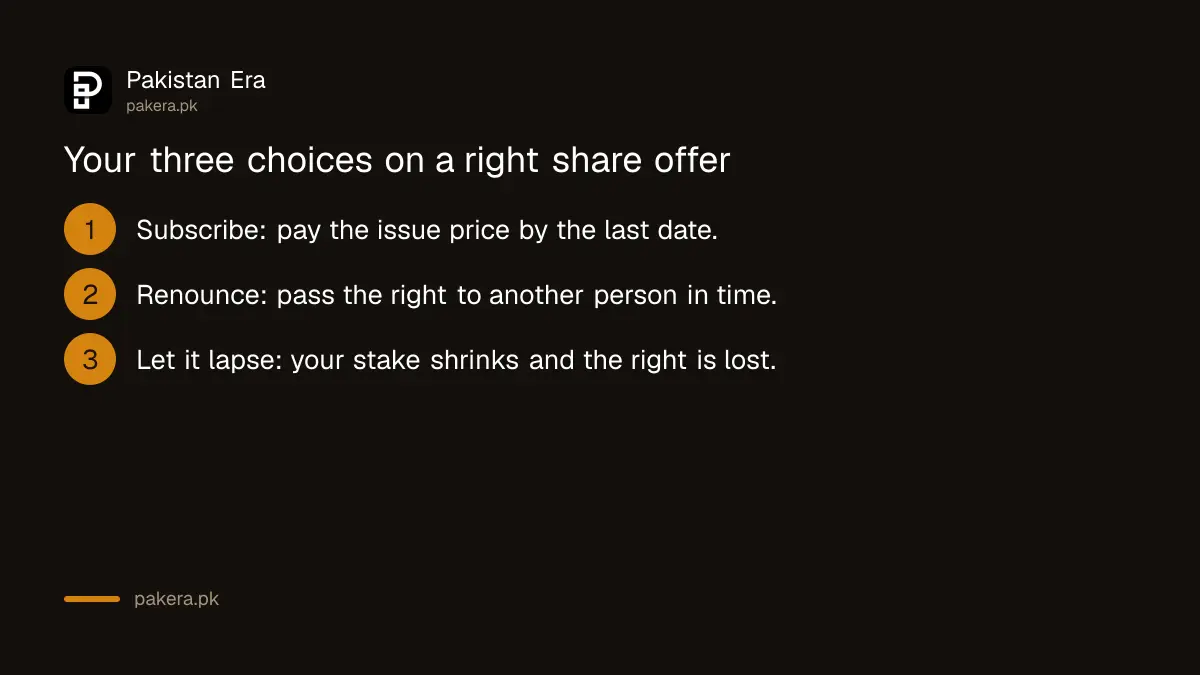
You have three choices: subscribe, renounce or let it lapse
You can pay for the shares and keep your full stake, renounce the right to another person, or let the offer lapse. Letting it lapse costs you, because the company sells the new shares to others and your percentage of the company falls.
- Read the letter of offer. Note the number of shares offered, the price per share and the last date.
- Check your CDC account or certificate details. Make sure the holding the offer is based on matches what you own on the entitlement date.
- Decide how many to take. You can take all the shares offered or, where the letter allows, only part.
- Pay before the last date. Use the payment method and bank details given in the letter, and nothing else.
- Or renounce in time. In a listed company, sign over the right to the person you choose before the offer expires.
- Keep the payment proof. The new shares are credited after the issue closes and the company allots them.
If you hold shares through a broker, ask the broker how they handle right entitlements and payments, and whether they set their own cut-off earlier than the company's last date. Never send right share money to a personal account, whoever asks for it.
How much a right is worth: a worked example
The value of a right is roughly the gap between the market price and the issue price, adjusted for the extra shares. Take a share trading at Rs 50 with a 20% right issue at Rs 30. After the issue, the price would settle near Rs 46.67, by our arithmetic.
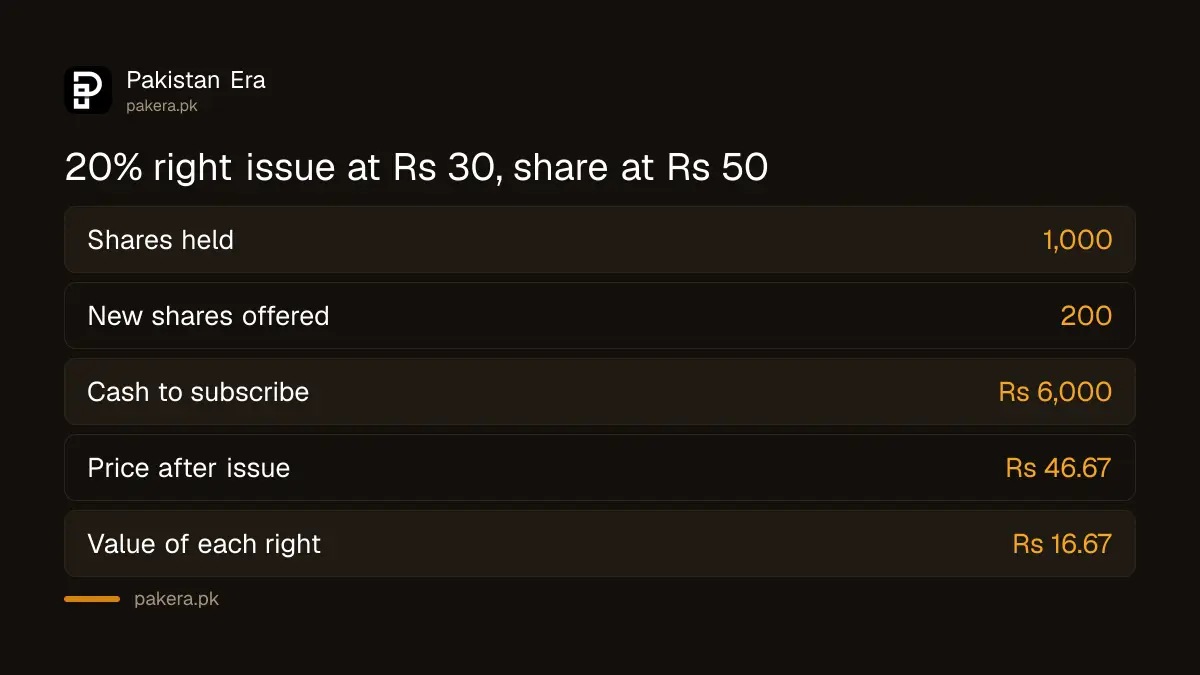
| Worked example (our arithmetic) | Amount |
|---|---|
| Shares you hold | 1,000 |
| Market price before the issue | Rs 50 |
| Right issue ratio | 20%, so 200 new shares |
| Issue price | Rs 30 a share |
| Cash you need to subscribe | Rs 6,000 |
| Expected price after the issue | (1,000 x 50 + 200 x 30) / 1,200 = Rs 46.67 |
| Value of each right, roughly | Rs 46.67 - Rs 30 = Rs 16.67 |
Now compare the three choices. If you subscribe, you hold 1,200 shares worth about Rs 56,000 after paying Rs 6,000, so you are no worse off. If you renounce for about Rs 16.67 a right, you receive about Rs 3,333 and keep 1,000 shares worth Rs 46,667, the same Rs 50,000 in total. If you let it lapse, you keep only Rs 46,667. That Rs 3,333 gap is the real cost of ignoring the letter.
Real prices move with the market, so the example is a guide, not a promise. But the logic holds: never let a right with a market value lapse without a decision.
Check the tax and the company before you pay
Before paying, read the circular, check the company's recent results, and see what the money is for. New shares bought through a right issue are treated like any other shares when you sell them later, so capital gains tax applies on sale.
The rates for filers and non-filers are in our page on capital gains tax on shares. Right shares are not the same as bonus shares, which a company gives free out of its reserves and which carry their own tax under section 236Z, as set out in tax on bonus shares.
A warning sign is a company asking shareholders for money again and again while losses grow. A right issue is a request for more of your money. Treat it with the same care as buying a new share from scratch.
Common questions
What is a right share in Pakistan?
A new share that a company offers to its existing shareholders first, in proportion to what they hold, under section 83 of the Companies Act, 2017. It is usually priced below the market.
How long do I have to accept a right offer?
The letter of offer sets a period of at least 15 days and at most 30 days. If you do not accept by the date in the letter, the offer is treated as declined.
Can I sell my right shares entitlement?
In a listed company, yes. Section 83 lets a member renounce the shares offered in favour of any other person before the expiry date in the letter.
What happens to right shares nobody takes?
The directors may allot them as they think fit within 30 days of the close of the offer. With SECP approval, that can be extended by up to 30 more days.
Do I lose money if I ignore a right issue?
Usually yes. The share price tends to fall towards a lower level after the issue, and your stake shrinks. Renouncing at least recovers the value of the right.
Are right shares free like bonus shares?
No. You pay the issue price for right shares. Bonus shares are issued free from the company's reserves.
How we verified this
What we checked and where we read it.
Last checked 17 November 2026. The offer rules, the 15 to 30 day period, renunciation, the two-director signature, the dispatch methods, the circular and the 30 day allotment of unsubscribed shares come from section 83 of the Companies Act, 2017 as amended by Act XXXVII of 2021, in the text published on Pakistan Code. The pre-emptive right is described in the PSX shareholders' rights guide. The worked example, the expected price after the issue and the value of a right are our own arithmetic on made-up prices. Payment banks, broker cut-offs and the exact last date differ for every issue and are set in each company's own letter of offer. This is general information, not investment advice.
About the author

Global Affairs & Political Economy Writer
Muhammad Hatim is a book lover who started writing because he enjoys it. At Pakistan Era he writes about international relations, geopolitics and the global economy, with a particular interest in South Asia and the forces behind current events.