EV Charging Station Electricity Connection in Pakistan: NOC in 5 Days, NEECA Registration and Rs 23.57 a Unit
Get an EV charging station electricity connection in Pakistan: NOC, NEECA registration, ENC steps, timelines, the Rs 23.57 A-2(d) tariff and NEPRA safety rules.
To get an electricity connection for an EV charging station in Pakistan, first apply to your power company for a no objection certificate (NOC), register with NEECA, then apply for the connection on the ENC portal. GEPCO's published procedure promises the NOC within 5 days, valid for 90 days. The connection is billed under tariff A-2(d) at Rs 23.57 a unit, with no fixed charge.
That rate is the draw. A shop under 5 kW pays Rs 37.44 a unit plus Rs 1,000 a month, so a charging business on the right tariff saves about Rs 14 on every unit. The catch is that the cheap rate needs its own connection, used only for charging.
Three rules govern a charging station connection
GEPCO lists three sources for its procedure: NEECA's Electric Vehicle Charging Infrastructure and Battery Swapping Regulations 2024, the New Energy Vehicles Policy 2025 to 2030, and Chapter 16 of NEPRA's Consumer Service Manual. The same manual applies to every power company.
Chapter 16 sets the core rules for a public EV charging station:
- It is treated as a commercial consumer, under the tariff NEPRA announces for it.
- Each charger installed needs a separate connection, unless the company makes an exception.
- The station may not charge drivers more than the maximum margin per unit that NEPRA notifies, and must display that margin where drivers can see it before charging.
- Meters must measure both the station's total units and each driver's units accurately.
Battery swapping stations follow the same procedure in GEPCO's document. So do existing homes or shops that want to add a charger for paid public use.
Apply in four steps, starting with an NOC
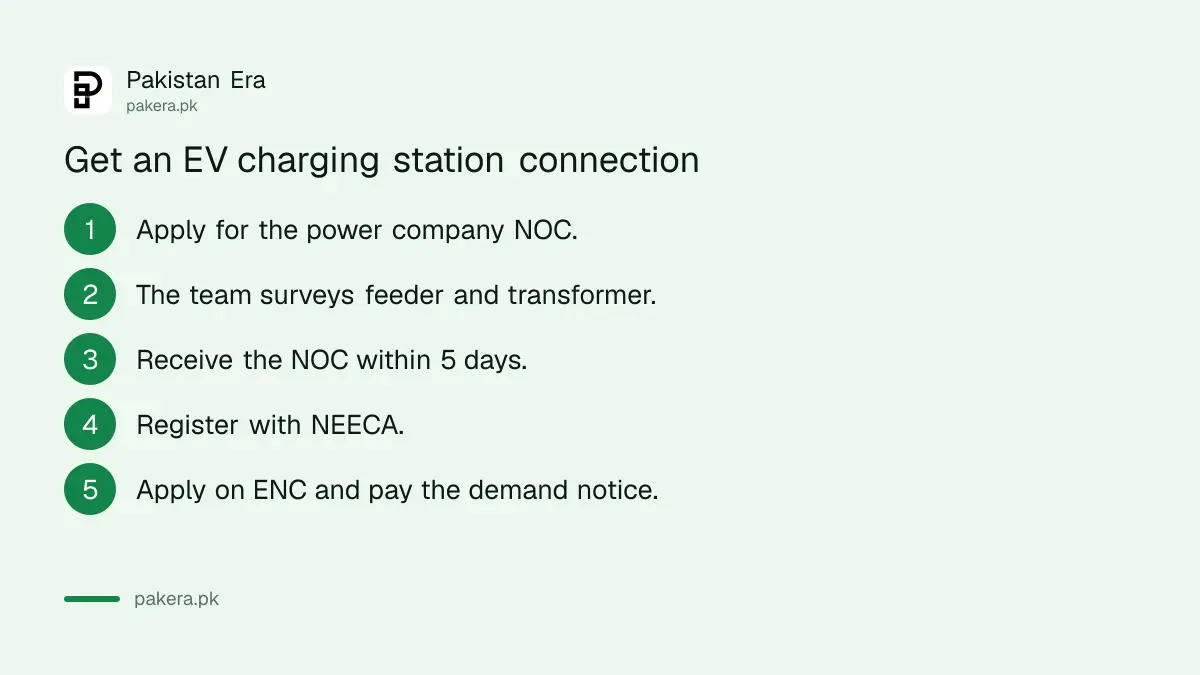
GEPCO's procedure runs in four steps: apply for an NOC, a site survey, the NOC itself, then the connection through the ENC portal once NEECA registration is done. The demand notice follows in 6 to 20 days, depending on the load.
- Apply for the NOC. GEPCO asks applicants to visit its MIRAD office for now. Bring the site address with the load you need, ownership documents for a new connection, a copy of the existing bill if the premises already has one, a CNIC copy and any other papers the load requires.
- Site survey. The company's technical team checks feeder availability, transformer capacity and other technical points.
- NOC issued. GEPCO says the NOC comes within 5 days and stays valid for 90 days. It is the approval for the connection and a requirement for NEECA registration. A tentative demand notice estimate is also prepared.
- Connection. After NEECA registration, apply online on the ENC portal and upload the NEECA registration certificate. The demand notice comes in 6 to 20 days and is valid for 30 days. After payment, the connection is installed within the time limits in Annex III of NEPRA's manual.
GEPCO says it is linking its online system with NEECA's portal, which will make the first step online too. The NEECA side, with its yearly fee and the other NOCs it asks for, is set out in how to register an EV charging station with NEECA. Afterwards, you can check new connection status on ENC.
The timeline from NOC to demand notice
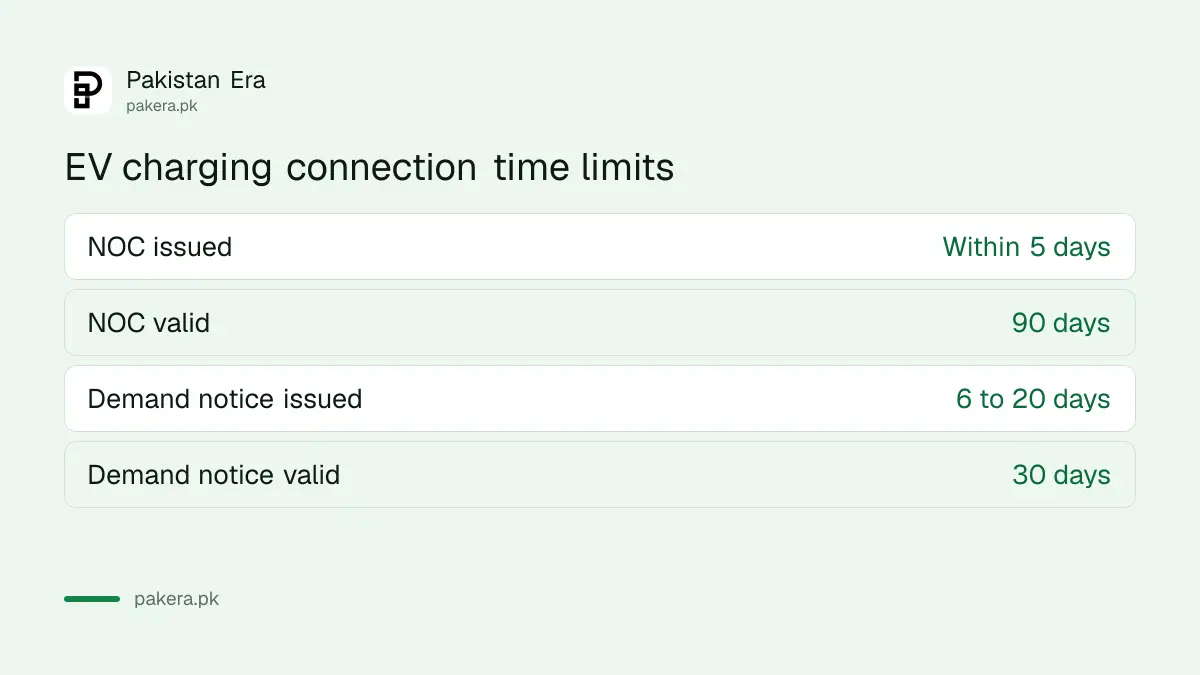
The timeline adds up quickly. Five days for the NOC, the NEECA registration, then 6 to 20 days for the demand notice and 30 days to pay it. Keep inside the 90 day NOC window, or you may have to apply again.
| Stage | Time limit in GEPCO's procedure |
|---|---|
| NOC issued | Within 5 days |
| NOC valid | 90 days |
| Demand notice issued | 6 to 20 days, by sanctioned load |
| Demand notice valid | 30 days |
| Installation after payment | As in Annex III of NEPRA's manual |
An existing home or shop needs a second connection
GEPCO says a consumer who already has a connection and wants the A-2(d) charging tariff must apply for a separate, second connection used only for EV charging. A new site files two applications: one for the charger and one for lights, offices and other use.
This keeps the cheaper rate on charging alone. Running a shop, a cafe or an office from the charger connection would be using it for a purpose other than the one it was sanctioned for. NEPRA's manual treats that as misuse, which brings a tariff change and back charges.
Homes that charge their own car do not need any of this. A home charger runs on the house connection at home rates. The A-2(d) route is for stations that serve the public.
Rs 23.57 a unit with no fixed charge
IESCO's tariff guide, which reproduces NEPRA's S.R.O. 279(I)/2026, lists the Electric Vehicle Charging Station rate at Rs 23.57 a unit with no fixed charge. That is well below the Rs 37.44 a shop pays, and below most home slabs.
| Category | Rate per unit | Fixed charge |
|---|---|---|
| EV charging station, A-2(d) | Rs 23.57 | None listed |
| Shop under 5 kW, A-2(a) | Rs 37.44 | Rs 1,000 a month |
| Shop 5 kW and above, A-2(b) | Rs 39.76 | Rs 1,250 per kW a month |
| Shop, time of use, peak | Rs 43.82 | Rs 1,250 per kW a month |
These are base rates before the monthly fuel charge and taxes. For a picture of what stations already exist, see the EV charging stations in Lahore and the fast chargers on Pakistan's motorways.
Safety rules the station must meet
NEPRA's manual makes the station owner display safe charging instructions, fixed Danger and Caution signs in Urdu, English or the local language readable from 5 feet, and provide fire detection, alarms and a fire retardant enclosure for the charger.
Chargers must also meet standards approved by NEECA and the Pakistan Standards and Quality Control Authority, plus the maker's instructions. The power company inspects the meters on the charger and can order changes if billing to drivers could go wrong.
Common questions
What is the electricity rate for an EV charging station in Pakistan?
Rs 23.57 a unit under tariff A-2(d), with no fixed charge, as listed in IESCO's tariff guide under S.R.O. 279(I)/2026. Fuel charges and taxes are added on the bill.
Do I need NEECA registration before applying?
Yes, for the connection itself. GEPCO's procedure has you get the power company's NOC first, use it to register with NEECA, then upload the NEECA certificate on the ENC portal.
How long is the NOC valid?
GEPCO says 90 days from issue. The NOC is issued within 5 days of a complete application.
Can I use my shop's meter for a public charger?
Not on the charging tariff. GEPCO says existing consumers need a separate second connection for EV charging under A-2(d).
Can a charging station charge drivers any price it likes?
No. NEPRA's manual caps the charge per unit at the maximum margin NEPRA notifies, and the station must display it before drivers charge.
Do battery swapping stations follow the same steps?
Yes. GEPCO's procedure covers both EV charging stations and battery swapping stations.
How we verified this
What we checked and where we read it.
We checked GEPCO's "Procedure for getting Electric Vehicle Charging Station (EVCS) or Battery Swapping Station (BSS) Electricity Connection", a Word document linked from its MIRAD page, on 17 November 2026. We also read Chapter 16 of NEPRA's Consumer Service Manual, revised 2025, and IESCO's tariff guide page for the A-2 rates under S.R.O. 279(I)/2026. GEPCO is the company that has published its steps in this detail; other power companies apply the same NEPRA chapter, but their office names and timings can differ. The rate saving of about Rs 14 a unit is our own arithmetic.
About the author

Senior Writer, Public Services and Technology
Shahid joined us in 2024 as an author. He is a senior contributor to Pakistan's leading technology websites. He writes detailed articles, mostly covering his expertise in the latest tech, mobiles, apps, gadgets, and step-by-step guides. His ideology is to help people understand the latest trends and explain complex methods through very easy-to-understand guides.