Capital Gains Tax on Shares in Pakistan 2026-27: Filer and Non-Filer Rates for Every Purchase Date
Capital gains tax on shares in Pakistan for 2026-27 is 15% for filers on shares bought from July 2024. See every rate by purchase date, losses and fund rules.

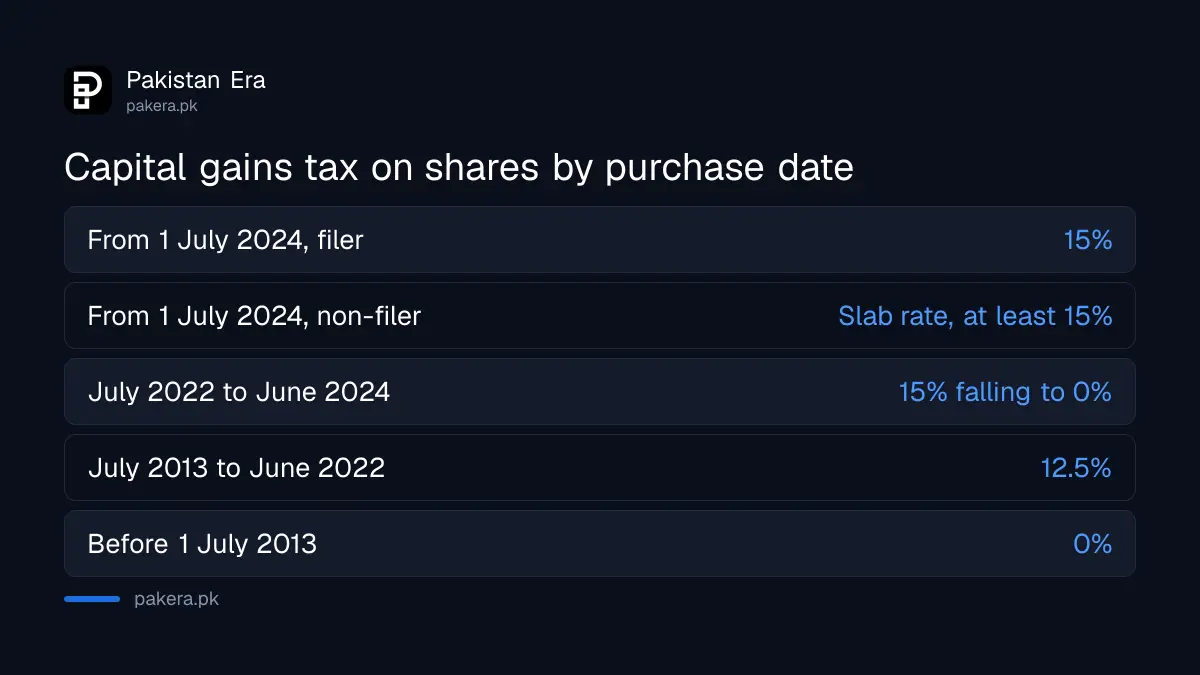
Capital gains tax on shares bought on or after 1 July 2024 is 15 per cent for a filer in Pakistan, whatever the holding period, and at least 15 per cent for a non-filer, charged at the normal income tax slab rates. Older shares keep older rules: a falling scale from 15 per cent to zero for shares bought between July 2022 and June 2024, 12.5 per cent for shares bought from July 2013 to June 2022, and nothing for shares bought before July 2013.
We read the rate table in the Income Tax Ordinance, 2001 as amended up to 30 June 2026, the version the Federal Board of Revenue publishes for tax year 2027 (the year from 1 July 2026 to 30 June 2027). Below is every rate by purchase date, worked examples, the mutual fund rates, how losses work and who collects the tax.
Filers pay 15% on shares bought from 1 July 2024
For shares bought on or after 1 July 2024, the rate is a flat 15 per cent of the gain if you appear on the Active Taxpayers' List on both the date you bought and the date you sold. Holding the shares longer no longer lowers the rate for these purchases.
The two dates matter. Being a filer on the sale date alone is not enough under the wording of Division VII of Part I of the First Schedule. If you were missing from the list when you bought, the non-filer rule below applies. You can confirm your status on the FBR website, and the latest list is explained in the active taxpayers list after the 15 October deadline.
| When you bought the shares | How long you held them | Rate |
|---|---|---|
| On or after 1 July 2024, filer on both dates | Any period | 15% |
| On or after 1 July 2024, not a filer | Any period | Slab rate, never below 15% |
| 1 July 2022 to 30 June 2024 | Up to 1 year | 15% |
| 1 July 2022 to 30 June 2024 | Over 1 year, up to 2 | 12.5% |
| 1 July 2022 to 30 June 2024 | Over 2 years, up to 3 | 10% |
| 1 July 2022 to 30 June 2024 | Over 3 years, up to 4 | 7.5% |
| 1 July 2022 to 30 June 2024 | Over 4 years, up to 5 | 5% |
| 1 July 2022 to 30 June 2024 | Over 5 years, up to 6 | 2.5% |
| 1 July 2022 to 30 June 2024 | Over 6 years | 0% |
| 1 July 2013 to 30 June 2022 | Any period | 12.5% |
| Before 1 July 2013 | Any period | 0% |
Non-filers pay their slab rate, never less than 15%
An individual or association of persons who is not on the Active Taxpayers' List on the purchase and sale dates is taxed on the gain at the ordinary income tax rates of Division I, with a floor of 15 per cent. A company in the same position pays the Division II company rate.
In plain words, a non-filer never pays less than a filer, and pays more once their income reaches a higher slab. That is a real cost on a large gain. Filing a return and getting onto the list before you buy is the cheaper path for anyone who trades regularly.
Worked examples for three different investors
The tax is the rate times the gain, and the gain is the sale price minus the purchase cost. Section 37A of the Ordinance writes this as A minus B, where A is what you received and B is what the shares cost you.
| Investor | Bought | Gain | Rate | Tax |
|---|---|---|---|---|
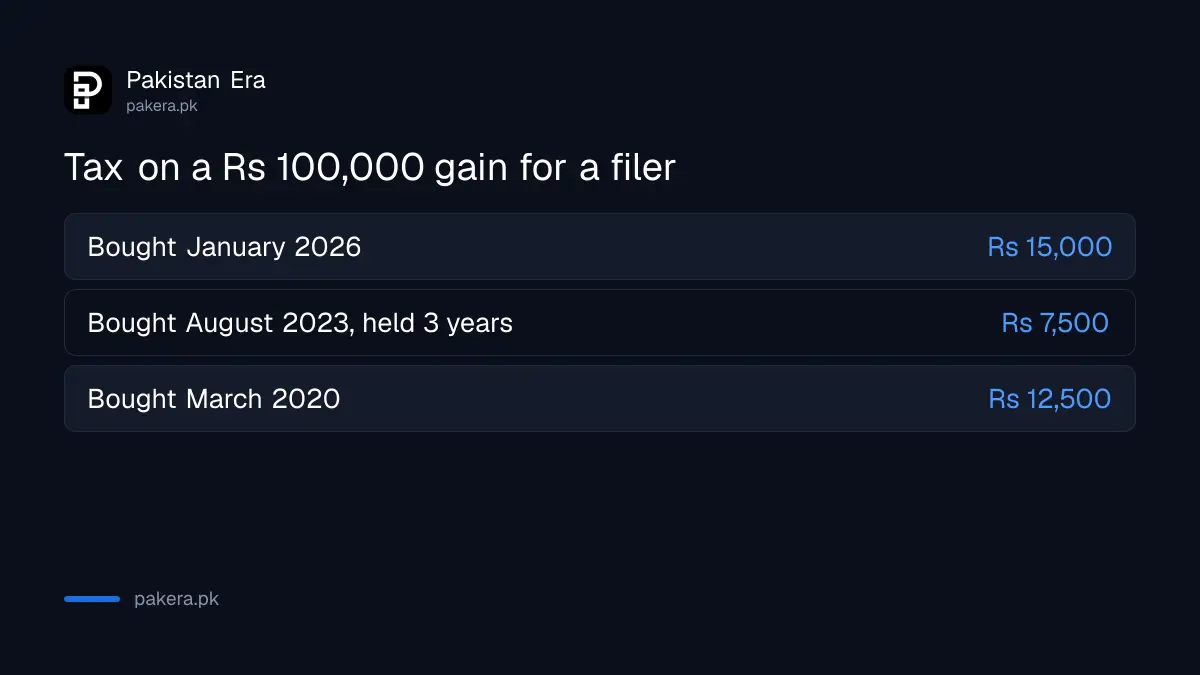
| Filer, bought January 2026, sold October 2026 | After 1 July 2024 | Rs 100,000 | 15% | Rs 15,000 |
| Filer, bought August 2023, sold October 2026 | July 2022 to June 2024, held 3 years 2 months | Rs 100,000 | 7.5% | Rs 7,500 |
| Filer, bought March 2020, sold October 2026 | July 2013 to June 2022 | Rs 100,000 | 12.5% | Rs 12,500 |
Notice the odd result in the middle row. Shares bought in the 2022 to 2024 window can now be taxed less than newer shares, because that window keeps its falling scale. If you still hold shares from that period, the date you sell can change your tax.
Mutual funds deduct 15% when you redeem units
A mutual fund, collective investment scheme or REIT scheme charges and deducts the tax when you redeem. Individuals pay 15 per cent on stock funds and 15 per cent on other funds. Companies pay 15 per cent on stock funds and 25 per cent on other funds.
Two more rules sit in the same table. A stock fund deducts 15 per cent where its dividend receipts are less than its capital gains. And no tax is deducted where the units were acquired on or before 30 June 2024 and held for more than six years. The fund itself handles this, so you see it on your redemption statement. Choosing between fund types is covered in investing in mutual funds with a CNIC.
Losses offset only gains on securities, for three years
A loss on selling securities can be set off only against gains on other securities taxed under section 37A. It cannot reduce tax on your salary, business or rent. Unused losses from tax year 2019 onwards carry forward for up to three tax years.
Section 37A treats these gains as a separate block of income, which is why the loss stays inside that block. If you sold some shares at a loss and others at a profit in the same year, the gain that is taxed is the net figure. Losses from tax year 2019 and later can be used against securities gains in the next three years, and then they lapse.
NCCPL works out and collects the tax for listed shares
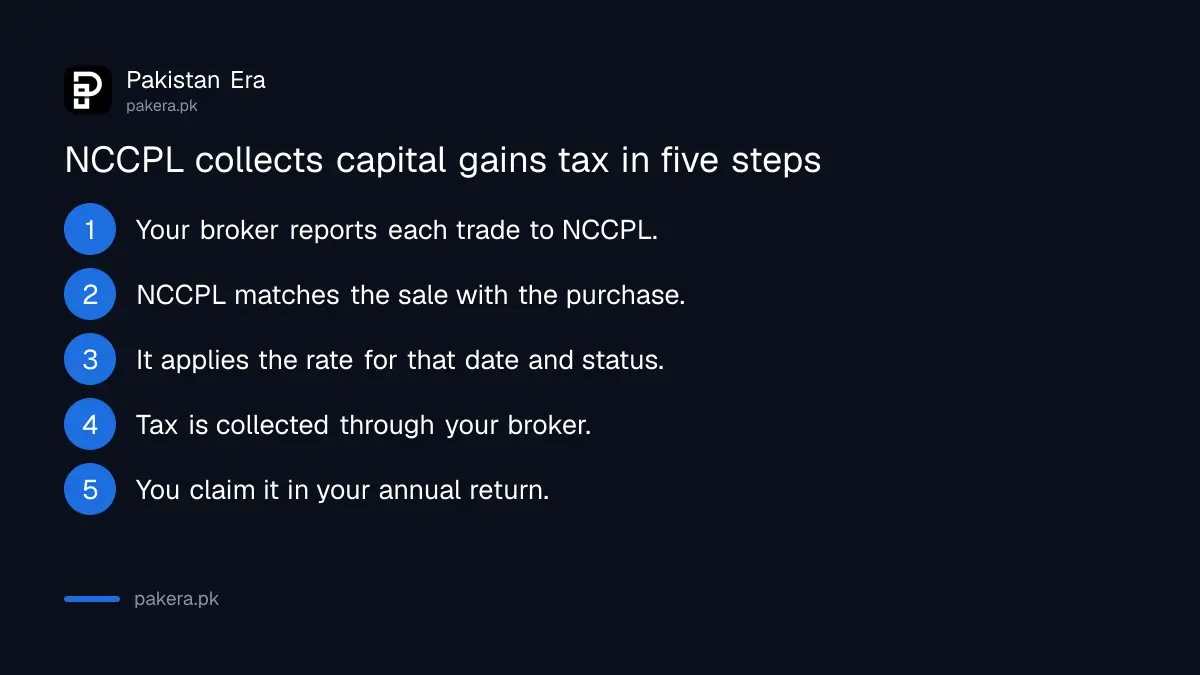
For shares listed on the Pakistan Stock Exchange, the National Clearing Company of Pakistan Limited (NCCPL) computes, collects and deposits the tax under section 100B and the Eighth Schedule. Your broker passes on the details, so most retail investors never file a separate payment.
- Your broker reports each trade, which settles through NCCPL.
- NCCPL matches each sale against your purchase cost and date.
- It applies the rate for that purchase date and your filer status.
- The tax is collected through your broker account and deposited.
- You report the gain in your annual return and claim the tax paid.
Section 37A does not apply to listed shares sold outside the exchange and not settled through NCCPL. Those sales fall under the general capital gains section 37 instead. Banks and insurance companies are also outside section 37A. For the related taxes on the same shares, see dividend tax on PSX shares and the 10 per cent tax on bonus shares. Property gains follow a different table, set out in capital gains tax on property.
Common questions
What is the capital gains tax on shares in Pakistan for 2026-27?
15 per cent for a filer on shares bought from 1 July 2024. Non-filers pay their slab rate, with a minimum of 15 per cent.
Does holding shares longer reduce the tax?
Only for shares bought between 1 July 2022 and 30 June 2024. For shares bought from 1 July 2024, the 15 per cent rate does not fall with time.
Is there tax on shares bought before 2013?
No. Shares bought before 1 July 2013 are taxed at 0 per cent on disposal.
Who deducts the capital gains tax on PSX shares?
NCCPL computes and collects it through your broker under section 100B and the Eighth Schedule.
Can I set a share loss against my salary?
No. A loss on securities can only be set against gains on securities, and carried forward for up to three tax years.
What is the tax on mutual fund redemption?
15 per cent for individuals on both stock funds and other funds. Companies pay 25 per cent on funds other than stock funds.
How we verified this
What we checked, where we read it, and what we could not confirm.
Last checked 25 October 2026. We read section 37A (definitions, the A minus B formula, loss rules), section 100B and Division VII of Part I of the First Schedule in the Income Tax Ordinance, 2001 amended up to 30 June 2026, downloaded from the Federal Board of Revenue on 25 October 2026. Part of the rate table did not extract cleanly from the PDF, so we read the surrounding pages to place each rate in its column. The worked examples are our own arithmetic. We did not read the Eighth Schedule rules in full or check how a specific broker shows the deduction. This is general information, not advice on your own tax position.
About the author

Senior Writer, Public Services and Technology
Shahid joined us in 2024 as an author. He is a senior contributor to Pakistan's leading technology websites. He writes detailed articles, mostly covering his expertise in the latest tech, mobiles, apps, gadgets, and step-by-step guides. His ideology is to help people understand the latest trends and explain complex methods through very easy-to-understand guides.