Your Leave Entitlement at Work in Pakistan
Fourteen days annual, ten casual on full pay, sixteen sick on half. Plus seven days paternity leave that almost nobody claims.
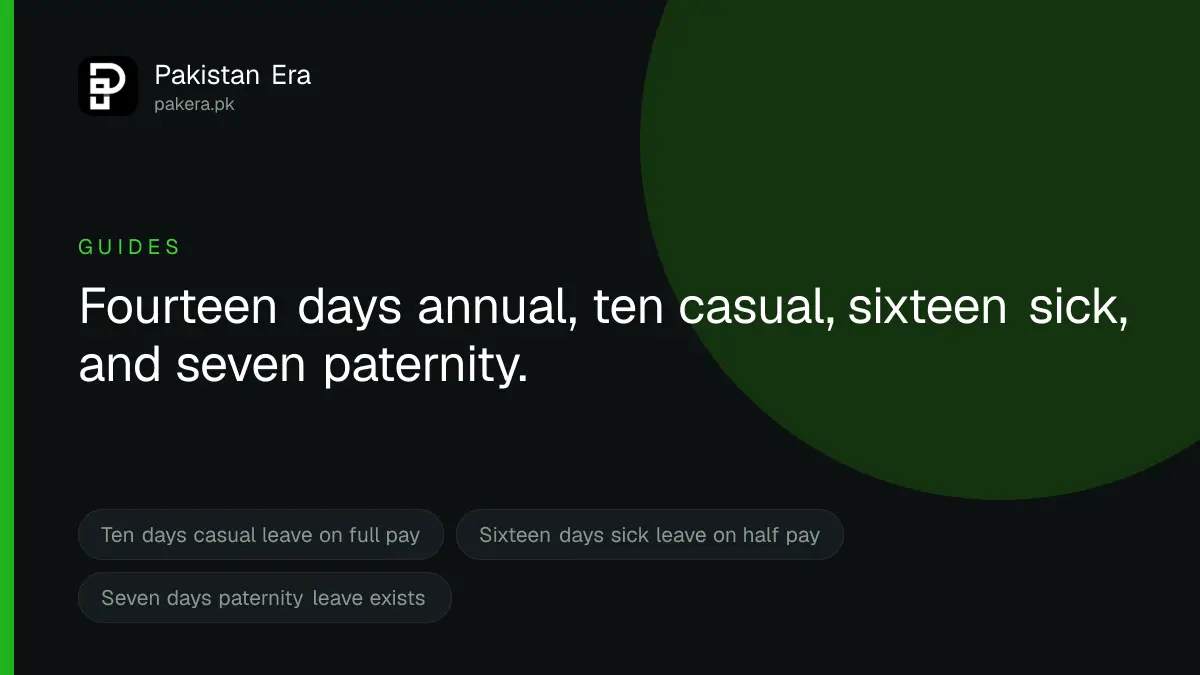
Ten days casual leave on full pay, sixteen days sick leave on half pay, and fourteen days annual holidays after a year of service. There is also seven days paternity leave, and almost nobody claims it.
These are not company policy. They are in the Factories Act, 1934, and we read them on 5 September 2026 in the text published by the Law and Parliamentary Affairs Department, Government of the Punjab.
The entitlements, in numbers
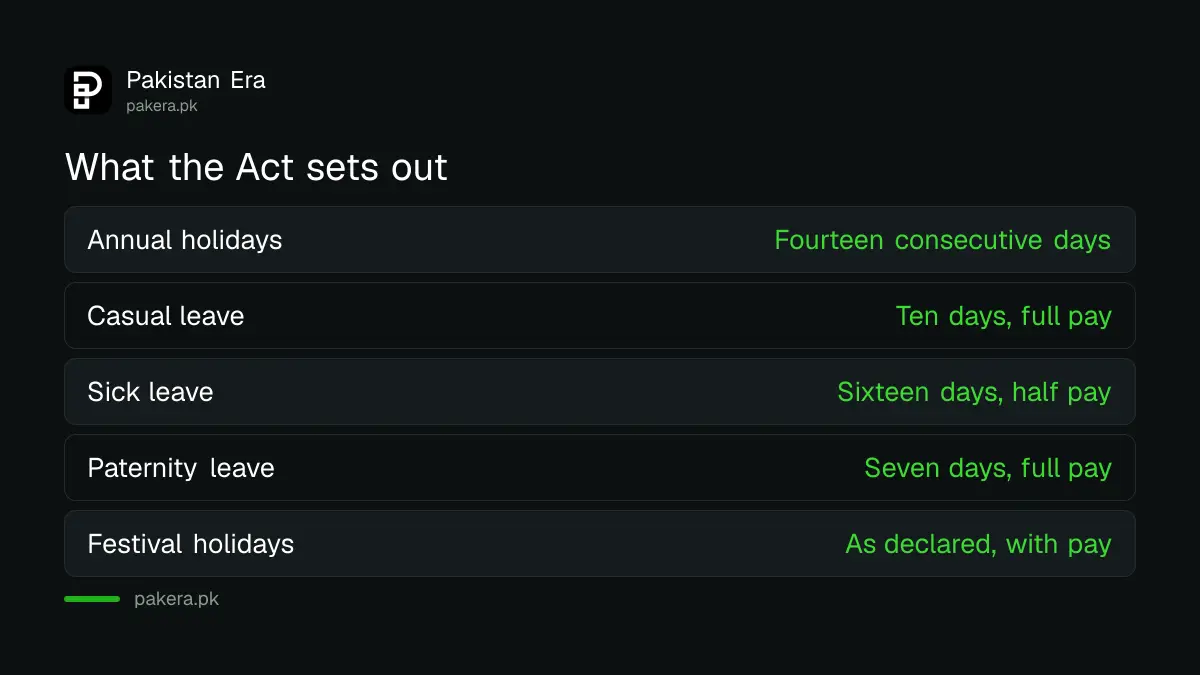
| Leave | Days | Pay |
|---|---|---|
| Annual holidays | Fourteen consecutive days | Daily average of wages |
| Casual leave | Ten days a year | Full pay |
| Sick leave | Sixteen days a year | Half average pay |
| Paternity leave | Seven days | Full pay |
| Festival holidays | As declared by Government | With pay |
Casual leave and sick leave are separate entitlements with different pay. Employers sometimes treat all absence as one pool, and the Act does not.
Annual leave, and the year you have to wait
Section 49B gives fourteen consecutive days to every worker who has completed twelve months of continuous service, during the following twelve months. So the first year builds the entitlement and the second year is when you take it.
Continuous service is defined more generously than people expect. An interruption does not break it where it was caused by sickness, accident or authorised leave not exceeding ninety days in total for all three, or by a lock-out, or by a strike that is not illegal, or by intermittent involuntary unemployment not exceeding thirty days.
So a long illness in your first year does not necessarily reset the clock, which is worth knowing before you accept being told it does.
Untaken leave carries forward, and is paid on exit
- Leave you do not take is added to the next twelve month period.
- The total carried forward cannot exceed fourteen days.
- If you are discharged before taking it, the employer pays for it.
- The same applies if you asked, were refused, and then left.
- Payment is at the rate in section 49C.
That third and fourth point are the ones that matter at the end of a job. Section 49B(3) is explicit: where a worker is discharged before being allowed the holidays, or having applied and been refused then quits, the employer shall pay the amount payable under section 49C.
Section 49C sets that rate as the daily average of wages, as defined in the Payment of Wages Act, 1936. Our guide to gratuity and provident fund rules covers the other money owed when you leave, and our guide to termination rules covers notice.
Seven days paternity leave
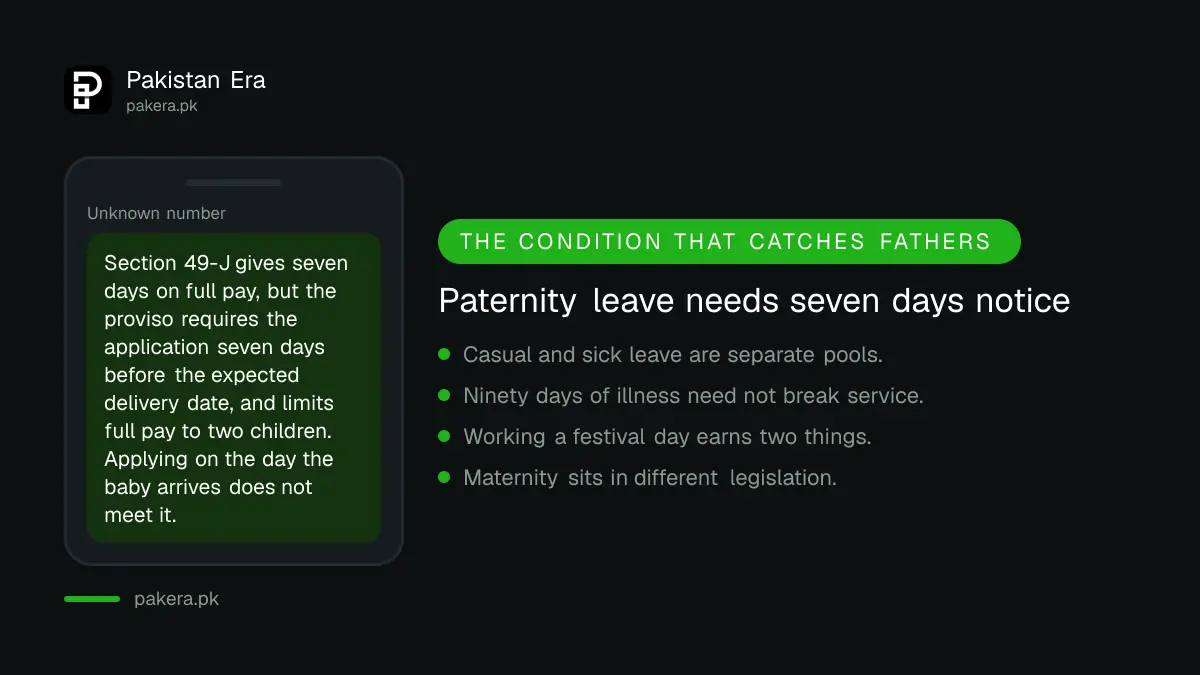
Section 49-J is recent, short, and almost unknown. Every worker shall be allowed seven days paternity leave, with full pay, commencing on or immediately before the date of delivery of his child.
Two conditions sit in the proviso. The benefit of full pay is limited to the birth of two children. And the worker shall apply for the leave seven days in advance of the expected date of delivery.
That advance notice requirement is the practical trap. A father who applies on the day the baby arrives has not met the condition the section sets, so put the application in when the due date is known rather than when the news comes.
Festival holidays, and working through one
Section 49I allows holidays with pay on all days the Government declares to be festival holidays.
A worker may be required to work on a festival holiday, but the Act then requires one additional compensatory holiday with full pay, and a substitute holiday in accordance with section 35. Read that as two things rather than one, because employers often provide only the substitute day.
Our list of public holidays covers what is declared, though the notification for each year is the authority.
The weekly holiday and the three day window
Section 35 says no adult worker shall be allowed or required to work in a factory on a Sunday unless he has had, or will have, a holiday for a whole day on one of the three days immediately before or after that Sunday, and the manager has given the required notice beforehand.
So Sunday working is permitted, but only against a substituted whole day inside a narrow window, arranged in advance. A vague promise of time off later does not satisfy it.
What this Act does not cover
Maternity leave is not in the Factories Act. It sits in separate legislation, and the position differs by province, with reporting indicating sixteen weeks in Sindh and twelve weeks elsewhere under the older ordinance.
We have not read that legislation, so we are not stating a figure as fact here. If maternity leave is your question, take the province you work in to a lawyer or your HR department and ask which statute applies to your employer.
Which workplaces this covers
The Factories Act applies to factories as defined in it, which is narrower than every workplace. Many other employees are covered instead by the Standing Orders Ordinance, which for leave points back to Chapter IV-A of this Act.
Labour is a provincial subject, so each province administers its own version with its own amendments and numbering. The text we read is the Punjab one. Our guide to what your employer must display at work covers the requirement that holidays and pay days are posted where you can read them.
Common questions
How many days casual leave am I entitled to?
Section 49H gives ten days casual leave with full pay in a year.
Is sick leave on full pay?
No. The Act gives sixteen days sick leave on half average pay in a year.
When can I take annual leave?
After completing twelve months continuous service, during the following twelve months, for fourteen consecutive days.
What happens to leave I did not take?
It carries forward, capped at fourteen days, and is paid out if you are discharged or if you were refused it and then left.
Is there paternity leave in Pakistan?
Section 49-J gives seven days with full pay, limited to two children, with an application seven days before the expected delivery date.
Does this cover maternity leave?
No. Maternity is governed by separate legislation that we have not read here.
How we verified this
What we checked, where we read it, and what we could not confirm.
Last checked 5 September 2026. We downloaded the Factories Act, 1934 from the Punjab Code portal at punjablaws.punjab.gov.pk, in the text published by the Law and Parliamentary Affairs Department, Government of the Punjab, and read it. Section 49B on fourteen consecutive days of annual holidays after twelve months continuous service, the carry forward capped at fourteen days, the payment obligation where a worker is discharged or was refused and then quits, and the explanation of continuous service covering interruptions of up to ninety days for sickness, accident or authorised leave and thirty days of intermittent involuntary unemployment; section 49C setting pay at the daily average of wages as defined in the Payment of Wages Act, 1936; section 49H giving ten days casual leave with full pay and sixteen days sick leave on half average pay; section 49I on festival holidays with pay and the compensatory plus substitute holiday where a worker is required to work; section 49-J giving seven days paternity leave with full pay, limited to two children and requiring seven days advance application; and section 35 on the weekly holiday and the three day substitution window, are all taken from that text. The Act applies to factories as defined in it, and labour is a provincial subject, so other provinces administer their own versions. Maternity leave is not in this Act and no maternity figure is stated as fact here. Nothing on this page is legal advice.
About the author

Senior Writer, Public Services and Technology
Shahid joined us in 2024 as an author. He is a senior contributor to Pakistan's leading technology websites. He writes detailed articles, mostly covering his expertise in the latest tech, mobiles, apps, gadgets, and step-by-step guides. His ideology is to help people understand the latest trends and explain complex methods through very easy-to-understand guides.