What to Do After a Dog Bite in Pakistan
Wash the wound with soap and water for at least 15 minutes, then reach a hospital the same day. What to ask for once you are there.
Wash the wound with soap and running water for at least 15 minutes. Do it now, before anything else. Then go to a hospital today, not tomorrow.
Update, 10 October 2026: Pakistan reported 5,837 suspected dog bites in week 38 of 2026. Read the update.
Those two steps decide most outcomes. The washing is free, you can start it in your own kitchen, and almost nobody does it for long enough.
This page sets out what the World Health Organization says to do, and what to ask for when you reach a hospital in Pakistan.
The first fifteen minutes
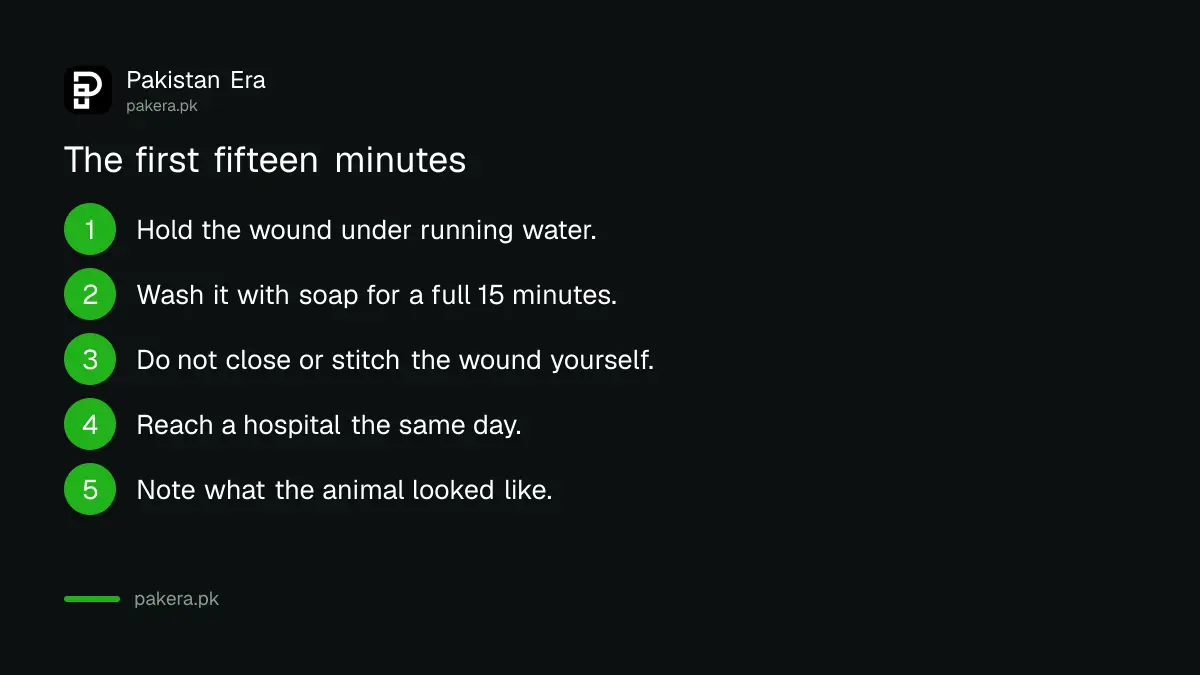
WHO calls for extensive wound washing with water and soap for at least 15 minutes, soon after the exposure.
- Hold the wound under running water and wash it with soap.
- Keep going for a full 15 minutes. Use a clock, because it feels much longer.
- Do not close the wound tightly or stitch it yourself.
- Go to a hospital the same day, even if the bite looks small.
- If you can, note what the animal looked like and where it was.
Fifteen minutes is the part people cut short. A quick rinse is not the same thing. Washing physically removes virus from the wound, and it is the only part of the treatment you can start immediately and for free.
Why the same day matters
Rabies is preventable before symptoms start and not afterwards. WHO states that once clinical symptoms appear, rabies is virtually 100 per cent fatal.
There is no treatment to fall back on later. That is the whole reason to treat a bite as urgent even when it looks minor, and why waiting to see if the wound heals is the wrong instinct.
Not every bite needs the same treatment
WHO grades exposures into three categories, and the category decides what you need.
| Category | What happened | What is needed |
|---|---|---|
| I | Touching or feeding animals, licks on unbroken skin | Washing only |
| II | Nibbling of uncovered skin, minor scratches without bleeding | Washing and immediate vaccination |
| III | Bites or scratches that break the skin, saliva on broken skin or eyes, mouth or nose, any contact with a bat | Washing, immediate vaccination and immunoglobulin |
If the skin was broken and it bled, that is category III. You need the vaccine and something extra called rabies immunoglobulin, which is put into the wound itself.
Ask about immunoglobulin by name
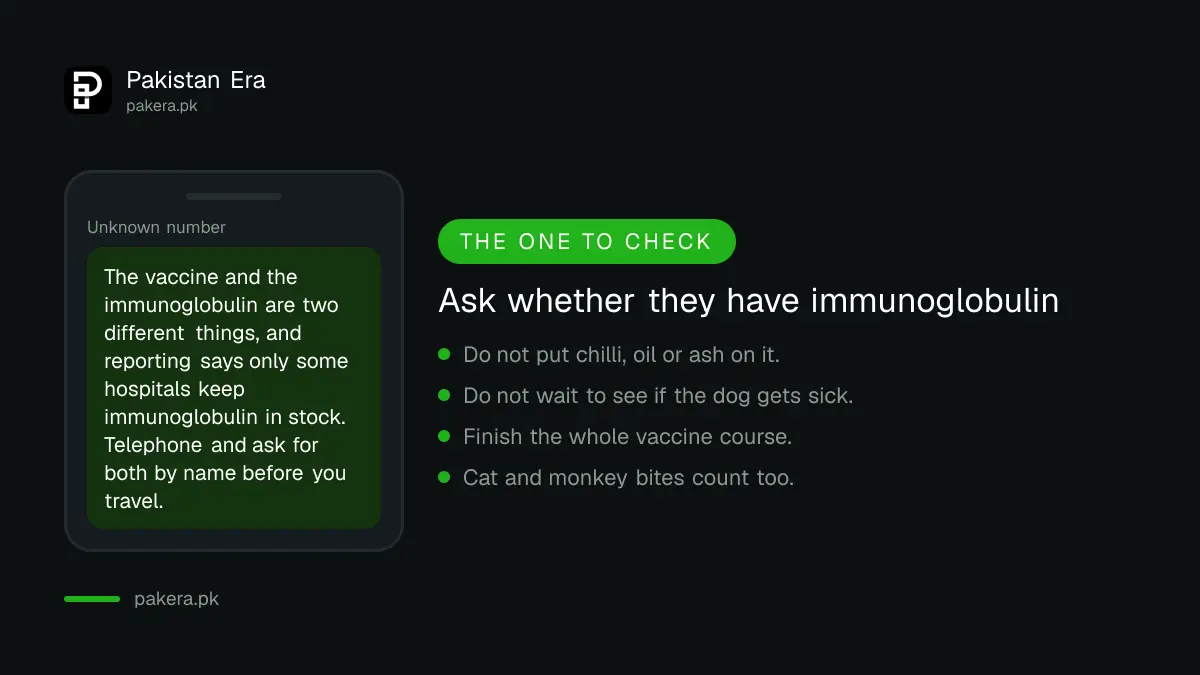
This is the practical difference between a good visit and a wasted one.
The vaccine and the immunoglobulin are two different things. Reporting in Pakistan says only some hospitals keep immunoglobulin in stock, and that supply is thin in many districts. So a hospital may have the vaccine and not the immunoglobulin.
If your bite broke the skin, ask on the phone before you travel: do you have anti rabies vaccine, and do you have rabies immunoglobulin. Asking by name saves you arriving somewhere that can only do half the job.
Reported coverage also says some government hospitals ask patients to buy the vaccine themselves because of funding shortages. Take money or a payment method with you so that is not what stops you.
Where people go in Pakistan
Large public hospitals in the big cities are the usual answer, and some handle very high volumes.
In Karachi, Indus Hospital is reported to have handled more than 15,000 dog bite cases in 2024 and provides care free of charge. Civil Hospital Karachi is reported to have treated more than 16,000 cases in a year with no deaths, which was attributed to better availability of the necessary medicines. Jinnah Postgraduate Medical Centre also treats large numbers.
Outside the major cities it is harder, and reporting describes districts with no supply at all. If your nearest facility cannot help, ask them where the nearest stocked hospital is rather than going home. Our list of emergency helpline numbers and our verified government helplines may help you find one by phone.
What not to do
Some traditional responses actively make things worse.
Do not put chilli, oil, ash, herbs or lime on the wound. Do not burn it. Do not seal it shut. None of these stop the virus and some cause infection or damage that makes proper treatment harder.
Do not wait to see whether the dog gets sick. If the animal can be observed safely by somebody else, that information is useful to a doctor, but it is never a reason to delay your own treatment.
Do not stop the vaccine course part way because you feel fine. Feeling fine is expected. Finish the schedule the hospital gives you.
Cats, bats and other animals
Rabies is not only a dog problem. Cat bites and scratches count, and WHO singles out bats: any direct contact with a bat is treated as category III, even without an obvious wound.
Monkey bites, common around some shrines and tourist spots, should be treated the same way as a dog bite. Go and get assessed rather than deciding yourself that it was minor.
Common questions about dog bites
How long do I have to get the vaccine?
Go the same day. There is no safe waiting period, and the treatment only works before symptoms appear.
The bite is tiny and did not bleed. Does it count?
A minor scratch without bleeding is category II, which still needs washing and immediate vaccination.
What is rabies immunoglobulin?
It is given alongside the vaccine for category III wounds and goes into the wound itself. Ask for it by name, as not every hospital stocks it.
The dog belongs to a neighbour and looks healthy. Do I still go?
Yes. Get assessed. A doctor can decide what the animal's status means for your treatment.
Is the vaccine free in Pakistan?
It varies. Some hospitals provide it free and others are reported to ask patients to buy it. Take money with you in case.
My child was bitten. Anything different?
Same steps, and go quickly. Children are bitten on the face and hands more often, which are higher risk sites, so do not delay.
How we verified this
What we checked, where we read it, and what we could not confirm.
Last checked 1 September 2026. The treatment protocol on this page is taken from the World Health Organization's rabies fact sheet, which we read on that date: extensive wound washing with water and soap for at least 15 minutes soon after exposure, the three exposure categories and what each requires, the use of rabies immunoglobulin or monoclonal antibodies for category III including any direct contact with bats, and the statement that once clinical symptoms appear rabies is virtually 100 per cent fatal. The Pakistan specific parts are reported rather than read on a government page: the limited availability of rabies immunoglobulin in many districts, the accounts of some government hospitals asking patients to buy vaccine themselves, and the case volumes attributed to Indus Hospital, Civil Hospital Karachi and Jinnah Postgraduate Medical Centre. Availability changes, so telephone before you travel. This page is general information and is not medical advice. If you have been bitten, go to a hospital.
About the author

Public Services and Education Journalist
Fajr Riaz is a journalist and content writer at Pakistan Era, based in Lahore. She covers the questions people meet in everyday life in Pakistan: how a public service works, what a change in the rules means, and where to find a reliable answer.