PTA Finalises In-Flight Internet Rules for Pakistani Aircraft, Transit Flights Need a NOC
PTA has finalised a licensing framework for satellite in-flight internet on Pakistani aircraft. Transit flights need a PTA NOC. No airline or start date is set.
یہ صفحہ اردو میں پڑھیں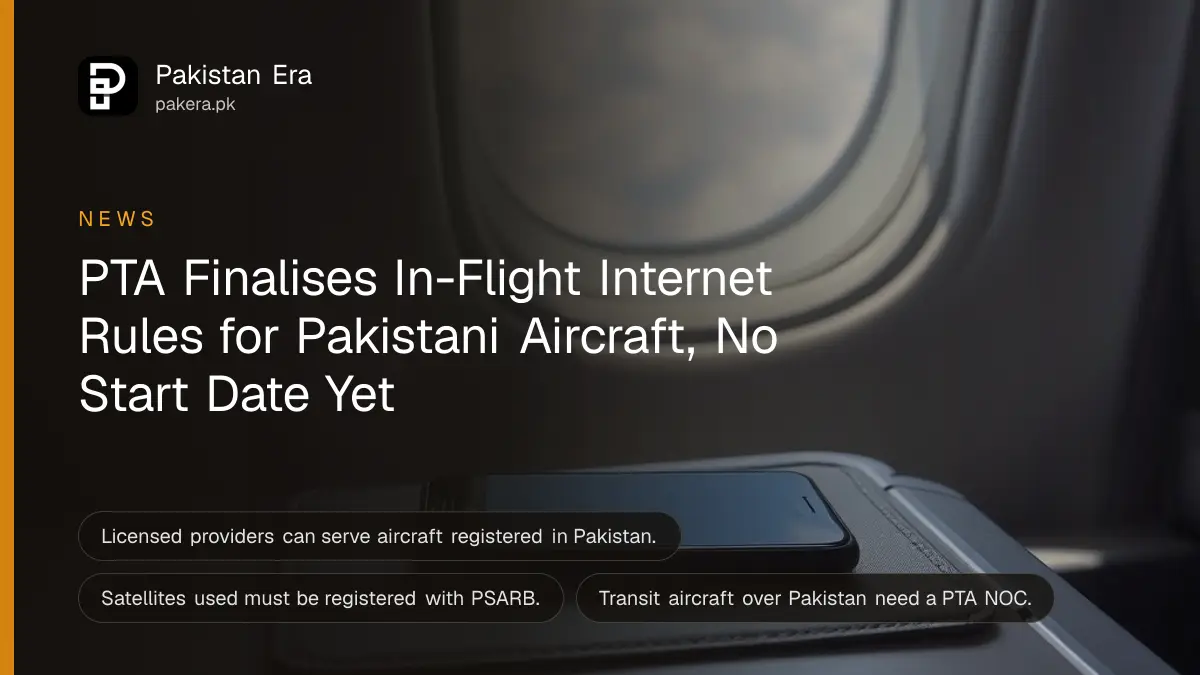
Short answer: The Pakistan Telecommunication Authority (PTA) said on 17 November 2026 that it has finalised a licensing framework for satellite-based In-Flight Telecommunication Services (ITS). It opens the way for internet and mobile services on Pakistani-registered aircraft. Foreign aircraft crossing Pakistani airspace will need a PTA No Objection Certificate (NOC).
No start date has been announced and no airline has been named. So you cannot buy Wi-Fi on a Pakistani flight today because of this decision. What has changed is that a legal route now exists for a company to get a licence and for an airline to offer the service.
PTA has finalised the in-flight internet licensing framework
PTA's framework sets the rules under which a licensed company can provide internet and calls on aircraft through satellites. It applies to aircraft registered in Pakistan. Transit flights over Pakistan need a separate PTA NOC. PTA announced it on 17 November 2026.
PTA calls the service In-Flight Telecommunication Services, or ITS. In simple words, it means internet, and possibly calls and messages, while the aircraft is in the air. On the ground, your phone uses mobile towers. At 35,000 feet there are no towers, so the signal has to come from a satellite.
PTA said the service will let passengers use digital services, entertainment, personal messages and work tools during a flight. It described the step as part of its plan to extend telecom services beyond networks on the ground.
The rules differ for Pakistani aircraft and transit flights
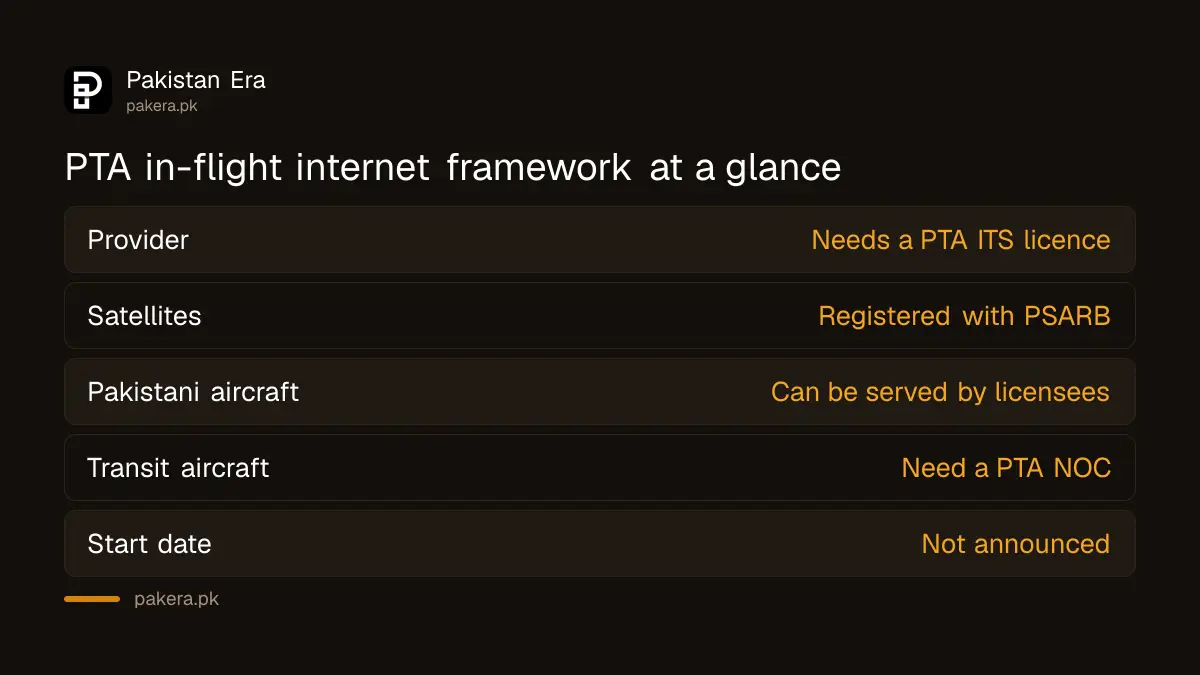
A licensed ITS provider can serve Pakistani-registered aircraft, using satellites that are registered with the Pakistan Space Activities Regulatory Board (PSARB). An aircraft that only crosses Pakistani airspace needs a PTA No Objection Certificate, subject to compliance requirements.
| Who | What the framework requires |
|---|---|
| Company providing the service | A PTA licence for In-Flight Telecommunication Services |
| Satellites used | Must be registered with the Pakistan Space Activities Regulatory Board |
| Aircraft registered in Pakistan | Can be served by a licensed ITS provider |
| Foreign aircraft crossing Pakistani airspace | Need a No Objection Certificate from PTA |
| Start date for passengers | Not announced |
| Price for passengers | Not announced, set by the airline and provider |
PSARB is the national body that registers and regulates space activities, including satellites that serve Pakistan. The same kind of satellite approval sits behind the wider debate on satellite internet for homes, covered under the Starlink licence in Pakistan.
What this means for passengers on Pakistani flights
For now, nothing changes on board. A Pakistani airline must first sign up with a licensed provider and fit its aircraft with the equipment. Only then can passengers connect. Until that happens, keep following the crew's instructions on phone use.
Fitting an aircraft for internet takes work. The plane needs an antenna on its body that talks to the satellite, and a small network inside the cabin. That is why the licence is only the first step. The airline decides which aircraft get it, which routes carry it and what it charges.
Passengers on foreign airlines may notice a change sooner. Many large international carriers already sell onboard Wi-Fi. Whether it stays on depends on the rules of each country the aircraft crosses. A PTA NOC gives those transit flights a clear route to offer the connection while they are over Pakistan.
If you fly often to the Gulf or Europe, your roaming bundle still matters at the airport on both ends. Compare Jazz roaming packages before you travel.
How in-flight Wi-Fi usually works once an airline offers it
On airlines that already offer it, you join the aircraft's Wi-Fi network, open a sign-in page, pick a plan and pay. Speeds are lower than at home because the link goes through a satellite. Text messages usually work well, while video can be slow.
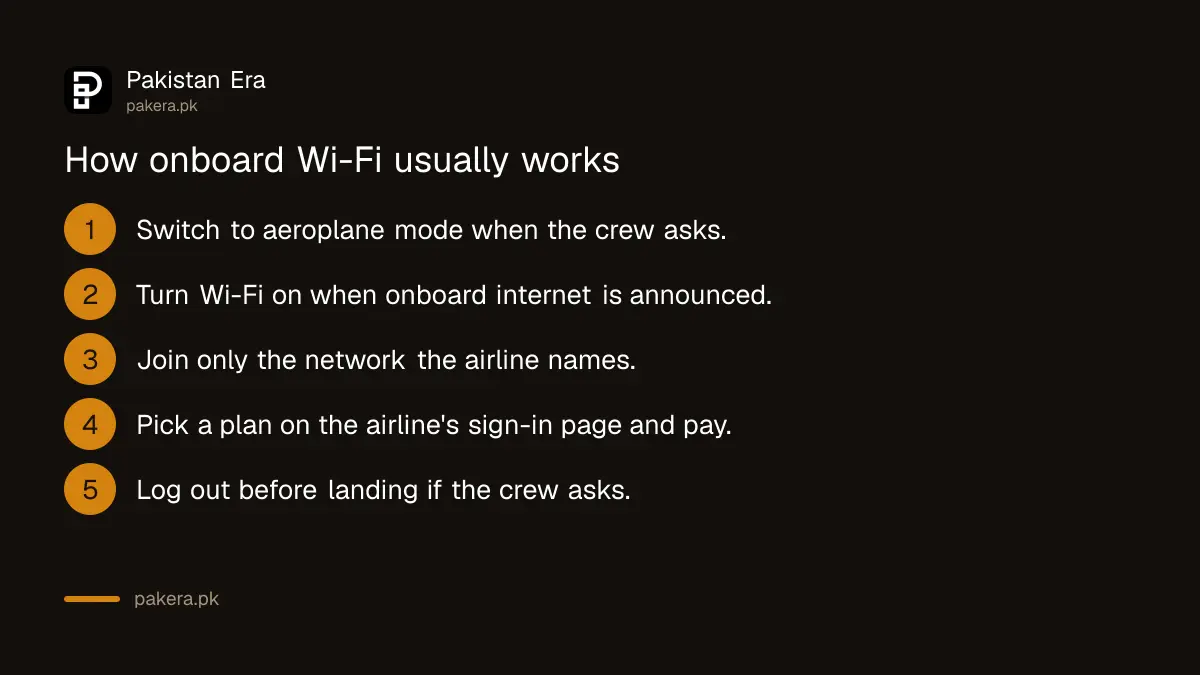
When Pakistani airlines start the service, the steps are likely to look like this, based on how onboard Wi-Fi works elsewhere:
- Switch your phone to aeroplane mode when the crew asks.
- Turn Wi-Fi back on once the crew says onboard internet is available.
- Join the network named by the airline, and only that one.
- Open your browser to reach the airline's sign-in page.
- Choose a plan, such as messaging only or full browsing, and pay.
- Log out and turn Wi-Fi off before landing if the crew asks.
Remember that your normal mobile bundle does not apply on a plane. Onboard internet is sold by the airline or its provider, not by Jazz, Zong, Ufone or Telenor, unless a future deal says otherwise.
Stay safe on onboard Wi-Fi networks
Onboard Wi-Fi is a shared public network. Join only the network the crew names, and pay only on the airline's own sign-in page. Do not enter bank or wallet PINs on a page that a link in a message sent you to.
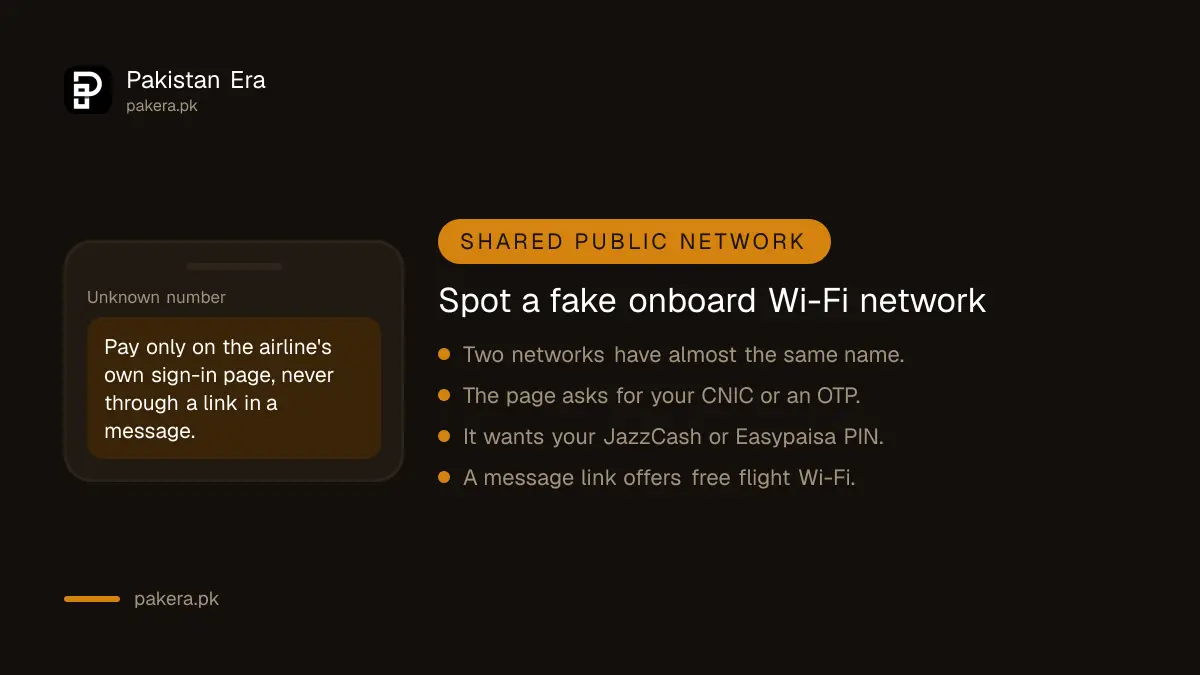
- Two networks with almost the same name can mean one is fake.
- A sign-in page that asks for your CNIC, OTP or JazzCash or Easypaisa PIN is a warning sign.
- Use your banking app, not a web link, if you must check your account in the air.
- Turn off file sharing and AirDrop style features while connected.
On the ground, the same rule applies to Wi-Fi in homes and offices: buy internet only from a licensed provider. The official way to check if your internet provider is PTA licensed uses two official lists.
What happens next
The next steps are licence applications from service providers, satellite registration with PSARB, and deals between providers and airlines. Passengers will know the service is live when an airline announces it on its own website, with prices and routes.
PTA has not given a deadline for any of these steps. Watch for three things: PTA publishing the framework text and fees, the first ITS licence being issued, and a Pakistani airline announcing onboard internet. We will update this page when any of them happens.
In the meantime, the usual flight rules still apply, from phone use to what you carry. The 100 ml liquids rule on flights from Pakistan covers what you can hand-carry.
Common questions
Can I use Wi-Fi on PIA or other Pakistani flights now?
Not because of this decision. PTA has finalised the licensing rules, but no airline has announced a start date. An airline first needs a licensed provider and equipment on its aircraft.
What is In-Flight Telecommunication Services (ITS)?
It is PTA's name for internet and other telecom services provided on aircraft through satellites, so passengers can stay connected during a flight.
Do foreign airlines flying over Pakistan need permission?
Yes. PTA said transit aircraft crossing Pakistani airspace will need a No Objection Certificate from PTA, subject to its compliance requirements.
Will my Jazz, Zong, Ufone or Telenor bundle work on the plane?
No mobile bundle works in the air today. Onboard internet is normally sold by the airline or its provider. Prices for Pakistani flights have not been announced.
What is PSARB and why does it matter here?
The Pakistan Space Activities Regulatory Board registers satellites that serve Pakistan. Under the framework, ITS providers may use satellites only if they are registered with PSARB.
Where can I complain about a telecom service?
PTA's helpline is 0800-55055. For a problem with paid onboard Wi-Fi, contact the airline first, since it sells the service.
How we verified this
What we checked and where we read it.
We checked PTA's press release "PTA Advances Digital Connectivity with Finalization of Licensing Framework for Satellite-Based In-Flight Telecommunication Services", dated 17 November 2026, on the PTA press releases page, on 18 November 2026. The release names the PSARB registration rule for satellites and the NOC rule for transit aircraft. It gives no fee, start date or airline. The PTA helpline number is from the footer of pta.gov.pk.
About the author

Technology Journalist & Multimedia Producer
Ahmad Ali is a technology journalist and multimedia producer at Pakistan Era, joining the team in October 2026. He covers consumer technology and digital life for Pakistani readers, combining research with hands-on product testing.