Starlink Pakistan Licence: The 18 Month Clock
PTA has recommended licences for Starlink, OneWeb and Amazon Kuiper. Licensed operators get 18 months to launch, so what does that mean.
Pakistanis have been promised Starlink for three years. What changed this month is that somebody finally started a clock.
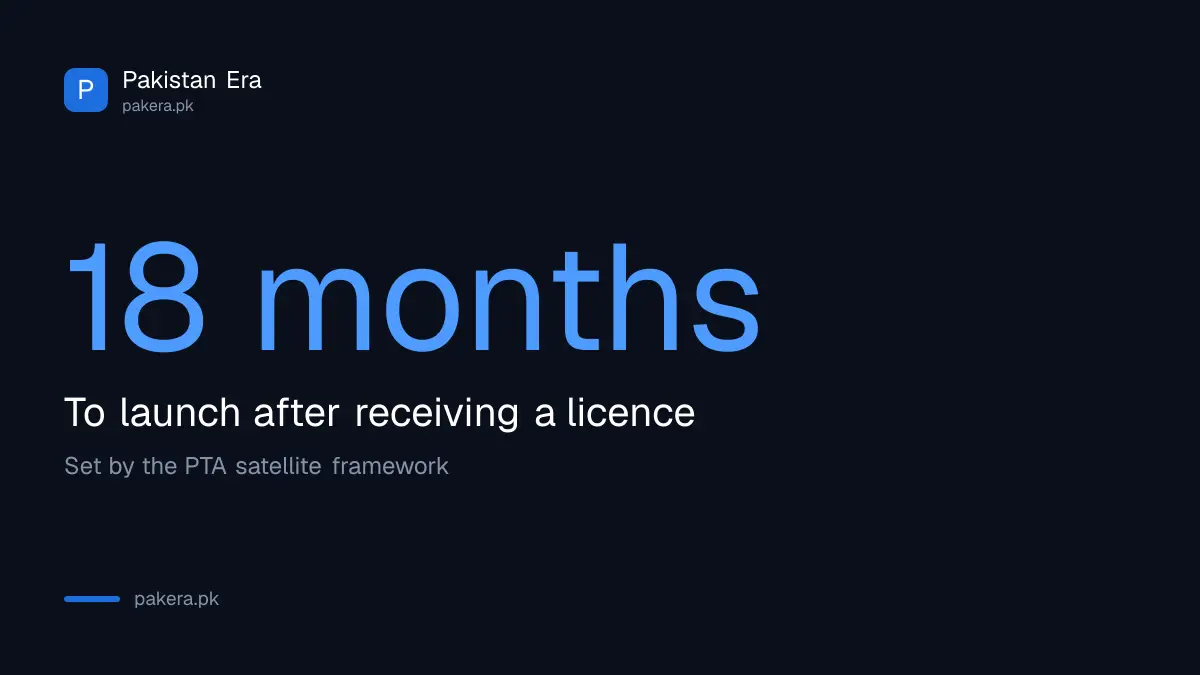
The Pakistan Telecommunication Authority has recommended licences for Starlink, OneWeb and Amazon's Project Kuiper, and sent those recommendations to the Ministry of Information Technology and Telecommunication. Under the satellite framework, an operator that receives a licence has 18 months to launch commercial service. That is the first hard deadline attached to any of this.
No licence has been granted yet. That distinction matters more than the headlines suggest.
What has PTA actually approved?
Nothing final. PTA has completed its technical and regulatory work and recommended that three satellite operators be licensed. The decision now sits with the ministry, not the regulator.
PTA Chairman Major General (R) Hafeez Ur Rehman has been publicly pushing for it, arguing satellite broadband is essential where laying conventional infrastructure is difficult and expensive. That is a regulator lobbying for approval rather than announcing one.
When could Starlink actually work in Pakistan?
Best case, before the end of 2026. The 18 month window is a maximum, not a target, and an operator with hardware already in orbit could move faster than that once paperwork clears.
Worst case is that the ministry sits on the recommendation. Pakistan has form here: approval was put on hold once already after earlier progress, so treat any date you see as conditional on a decision nobody has made yet.
| Stage | Status |
|---|---|
| PTA technical and regulatory work | Complete |
| Recommendation to the ministry | Submitted, July 2026 |
| Licence granted | Not yet |
| Deadline once licensed | 18 months to launch |
Who is this actually for?
Not you, if you live in Lahore with a fibre connection. Satellite broadband costs more per gigabyte than any fixed line and always will, because the economics are different.
It is for the places conventional rollout keeps skipping. Northern valleys, Balochistan, stretches of motorway with no coverage, and the districts where a single provider has never faced competition. PTA has been explicit that underserved areas are the point.
Worth noting those same districts are getting attention from a second direction. PTA has issued 47 district level internet licences this year, reaching places like South Waziristan, and separately ordered operators to accelerate the 5G build. Satellite is the third route to the same problem, and it is the one that needs no ground infrastructure at all.
Some practical realities worth holding on to:
- Hardware is a real upfront cost, and Pakistani pricing has not been announced by anyone.
- Rural and remote areas are expected to be the first deployment priority, not cities.
- Three operators competing is more interesting than one arriving, because that is what moves prices.
- None of this changes anything for you until a licence is actually issued.
Why has this taken so long?
Satellite internet is a security question in Pakistan before it is a technical one. A terminal that connects directly to a constellation bypasses every piece of national infrastructure, which means it also bypasses the monitoring and lawful interception built into conventional networks.
That is the real reason approval keeps stalling rather than any doubt about the technology working. The framework PTA has built is an attempt to answer that objection: licence the operator, set conditions, keep a regulatory handle on it. Whether the ministry finds those conditions sufficient is precisely what is being decided now.
The commercial objection is quieter but real too. Existing operators have spent years and enormous capital laying fibre and building towers, and a satellite entrant that skips all of it is not a welcome competitor. None of them will say that publicly.
How does satellite compare with what you have?
Differently enough that comparing them on speed alone misses the point. Satellite wins on reach and loses on cost and latency, and neither of those changes with better hardware.
| Fibre or cable | Mobile data | Satellite | |
|---|---|---|---|
| Where it works | Cities and towns | Near a tower | Almost anywhere with sky |
| Cost per GB | Lowest | Middle | Highest |
| Upfront hardware | Minimal | None | Significant |
| Best suited to | Home and office | Everyday mobile use | Places with no alternative |
Which is why the interesting question is not whether Starlink beats your fibre. It is whether it reaches the eighty percent of Pakistan's landmass where laying fibre has never made commercial sense.
What should you do now?
Nothing, and be sceptical of anyone telling you otherwise. There is no order page, no confirmed Pakistani pricing and no launch date, so any site collecting a deposit or a pre-registration for Starlink Pakistan is not doing so on the company's behalf.
If you want to follow this properly rather than react to headlines, watch these in order:
- Whether the ministry acts on PTA's recommendation at all, which is the only step that matters right now.
- Which of the three operators gets licensed first, since Starlink, OneWeb and Kuiper have very different ambitions here.
- The date a licence is actually issued, because the 18 month clock starts there and not from the recommendation.
- Whether pricing is announced in dollars or rupees, which tells you who the service is really aimed at.
- Which districts appear in the first rollout, since that reveals whether underserved areas were a genuine priority.
If you have been following this from the earlier stage, our guide on the Starlink temporary NOC, ordering and expected pricing covers the background. For the fixed line alternative that is genuinely expanding right now, the 47 new district internet licences are a more immediate development for most people.
Frequently asked questions
Is Starlink approved in Pakistan?
Not yet. PTA has recommended licences for Starlink, OneWeb and Amazon Kuiper, but the ministry has not granted them. A recommendation is not an approval.
When will Starlink launch in Pakistan?
No date exists. Once a licence is granted the operator has 18 months to launch, which makes late 2026 possible in the best case and later if the decision is delayed.
How much will Starlink cost in Pakistan?
Nobody has announced Pakistani pricing, including SpaceX. Any figure circulating is an estimate based on other markets.
Which satellite operators has PTA recommended?
Three: Starlink from SpaceX, OneWeb, and Project Kuiper from Amazon. Competition between them matters more for pricing than any single arrival.
Can I pre-order Starlink in Pakistan?
No. There is no official order channel for Pakistan. Treat any site taking a deposit as a scam.
Will satellite internet replace my fibre connection?
No. Satellite costs more per gigabyte and is aimed at places fixed lines do not reach, not at competing with urban broadband.
About the author

Public Services and Education Journalist
Fajr Riaz is a journalist and content writer at Pakistan Era, based in Lahore. She covers the questions people meet in everyday life in Pakistan: how a public service works, what a change in the rules means, and where to find a reliable answer.