47 New Internet Licences: Where Broadband Is Arriving
PTA issued 47 district internet licences in 2026, from 1 in February to 20 in June. Which districts got them and why it matters.
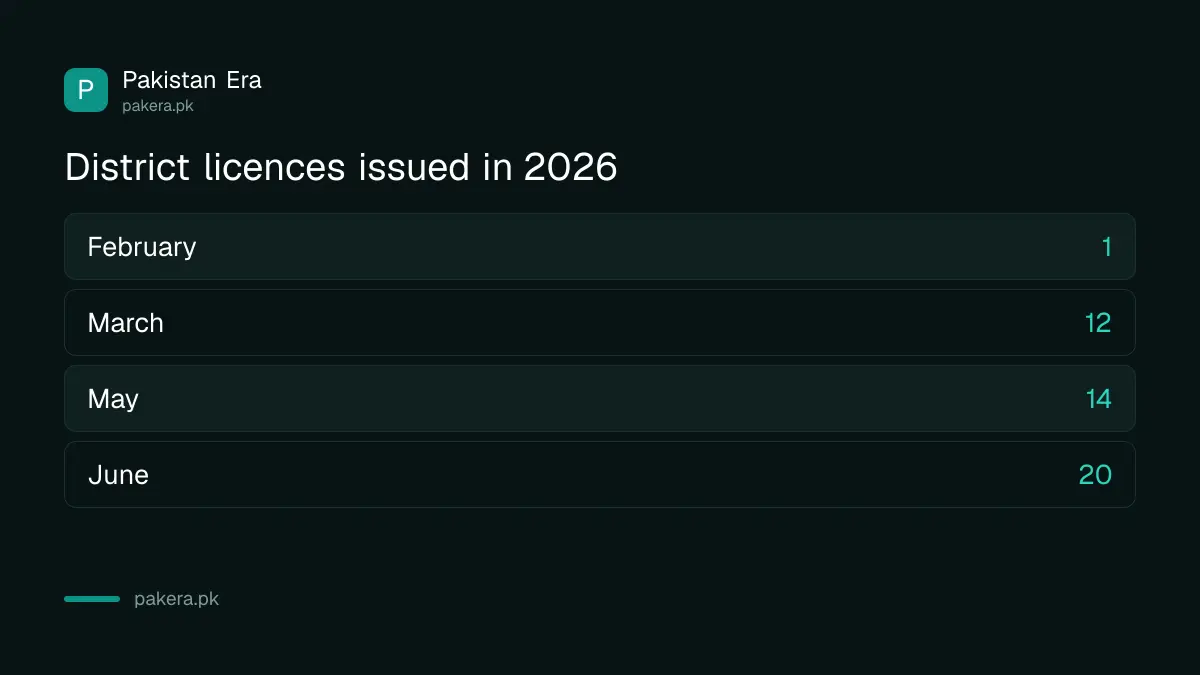
In February, Pakistan's telecom regulator issued exactly one district internet licence. In June it issued twenty.
That curve is the story. The Pakistan Telecommunication Authority has now granted 47 district-level Class Licences during 2026, and a broadband licence Pakistan operators once needed at national scale is now something a local company can get for a single district. One licence to twenty a month inside five months is not gradual progress, it is a policy switch being flipped.
What that means on the ground is competition arriving in places that have only ever had one provider.
How many broadband licences has PTA issued?
47 district-level Class Licences across 2026. The monthly pattern shows the acceleration clearly: one in February, twelve in March, fourteen in May, then twenty in June.
| Month | Licences issued |
|---|---|
| February | 1 |
| March | 12 |
| May | 14 |
| June | 20 |
| Total | 47 |
Those figures add up to 47 exactly, which is worth saying because plenty of Pakistani telecom numbers do not reconcile with their own totals. These do.
Which districts got the licences?
Lahore leads with seven, followed by Sargodha. Faisalabad and Islamabad took four each. The list also reaches South Waziristan and Lower Chitral, which is the part that matters.
Lahore getting seven is unsurprising and not very interesting. A licence in South Waziristan is a different thing entirely, because those are districts where the business case for a national operator never closed and where a local provider with a district licence might actually make the numbers work.
Sargodha coming second, ahead of Faisalabad and Islamabad, is the detail I did not expect. It suggests demand in mid-sized cities is stronger than the national rollout maps assume.
What is a district Class Licence?
A licence to sell internet service within one district rather than nationally. PTA began granting them in January 2026, and they lower the barrier enormously for a small operator who could never fund a national licence.
Consider what that changes:
- A local company can compete legally in its own city without national scale.
- Districts with one provider can get a second, which is the only reliable way prices move.
- Small operators can serve areas the big four consider commercially marginal.
- Complaints get an alternative. Right now, in many districts, leaving your provider means having no internet.
Why did PTA change the licensing model?
Because the old one priced out everyone except the incumbents. A national licence assumes national ambition, national capital and a national rollout plan, and that is a description of four companies rather than a market.
What that produced is exactly what Pakistani broadband looks like today: strong competition in Lahore and Karachi, and a single provider with no reason to improve in most other districts. If you have ever been told a fault would be fixed next week for three weeks running, that is what a monopoly feels like from the customer side.
District licensing attacks that directly. It does not require a new operator to be big, only to be competent within one district, which is a threshold a local company with local knowledge can actually clear.
The steps for an operator that wants one:
- Apply to PTA for a Class Licence covering the specific district.
- Meet the regulatory and technical conditions attached to that licence category.
- Build or lease the infrastructure to serve the district, which is the expensive part.
- Interconnect with upstream providers for backhaul capacity.
- Start selling, in a district where the incumbent has probably never had to compete.
Will this make internet cheaper?
Not immediately, and anyone promising otherwise is guessing. A licence is permission to build, not a working network, and infrastructure takes time and capital that a district-sized operator may struggle to raise.
Where it should show up first is service quality rather than price. A monopoly provider that suddenly has a competitor tends to answer the phone faster long before it discounts anything.
The honest read is that 47 licences in one year is a genuine structural change whose effects arrive in 2027, not this quarter. Worth watching rather than waiting for.
What else is changing in Pakistani internet?
Two things at once, in different directions. PTA has ordered mobile operators to accelerate their 5G build, and separately recommended licences for satellite operators including Starlink.
So fixed broadband, mobile and satellite are all being pushed simultaneously. For most readers the district licences matter most, because they affect the connection at home rather than a technology that has not launched. Our pieces on the 5G rollout directive and the Starlink licence recommendation cover the other two.
Frequently asked questions
How many internet licences did PTA issue in 2026?
47 district-level Class Licences: one in February, twelve in March, fourteen in May and twenty in June.
Which district got the most licences?
Lahore with seven, then Sargodha. Faisalabad and Islamabad received four each.
What is a district Class Licence?
Permission to provide internet service in a single district rather than nationally. PTA started granting them in January 2026 to lower the barrier for smaller operators.
Will my internet get cheaper because of this?
Not soon. A licence allows a company to build a network, which takes time and money. Expect service competition before price competition.
Can I get a district internet licence?
Applications go through PTA. The district-level route is designed to be reachable for smaller operators, but it still requires meeting regulatory and technical conditions.
Does this affect rural areas?
Yes, and that is the intent. Licences reached South Waziristan and Lower Chitral, districts a national operator would rarely prioritise.
Work out your own figure
Comparing a home broadband plan against mobile data? Work out your real monthly usage first.
Data Usage Calculator →About the author

Senior Writer, Public Services and Technology
Shahid joined us in 2024 as an author. He is a senior contributor to Pakistan's leading technology websites. He writes detailed articles, mostly covering his expertise in the latest tech, mobiles, apps, gadgets, and step-by-step guides. His ideology is to help people understand the latest trends and explain complex methods through very easy-to-understand guides.