How to Start an Online Store in Pakistan: Daraz or Your Own Website
Start an online store in Pakistan: Daraz or your own Shopify or WooCommerce site, SBP-approved payment gateways, 2% COD tax, FBR registration and return rules.
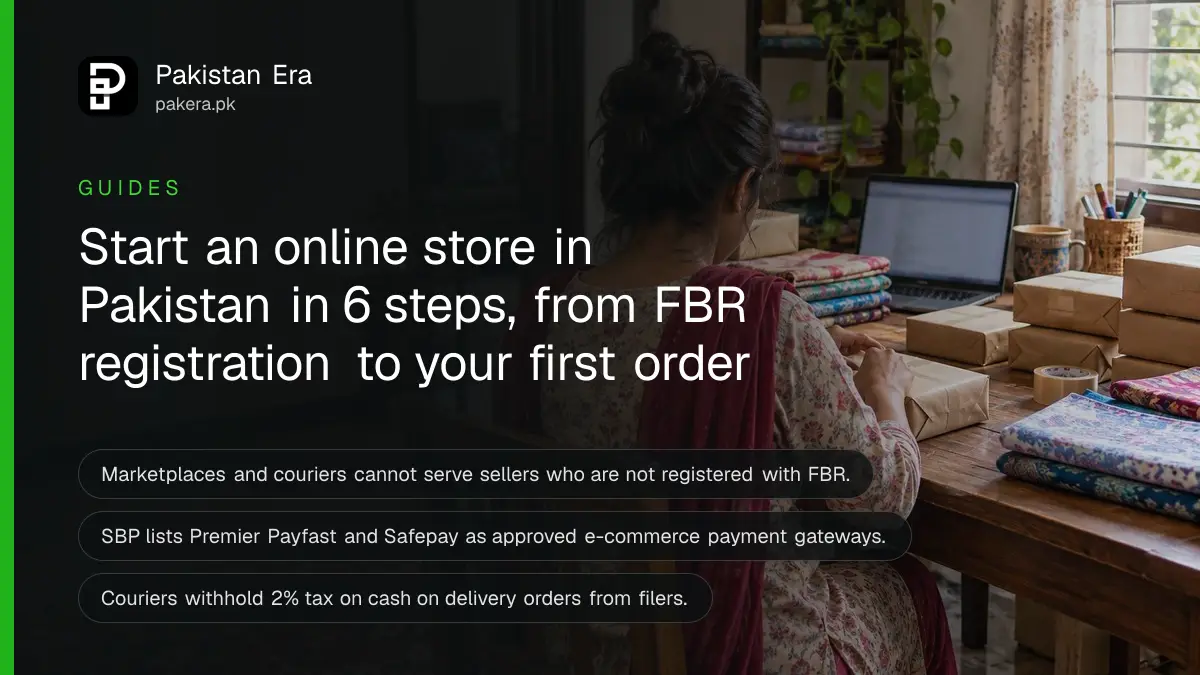
To start an online store in Pakistan, register your business with FBR on the IRIS portal first, then choose a route: sell on Daraz to test demand, or build your own site on Shopify or WooCommerce. Take card payments through an SBP-approved gateway such as PayFast or Safepay, ship cash on delivery by courier, and show your return policy before checkout.
Most Pakistani online stores start the same way: a Facebook page, a WhatsApp number and a cousin who drops parcels at the courier office. That works for twenty orders. At two hundred, the cash goes missing, returns pile up, and the courier asks for your NTN. The order below avoids those problems from day one.
We read FBR's withholding tax rate card and the State Bank of Pakistan's lists of licensed payment companies on 7 October 2026. The rules below come from official sources only.
Daraz or your own website: pick by what you need to learn
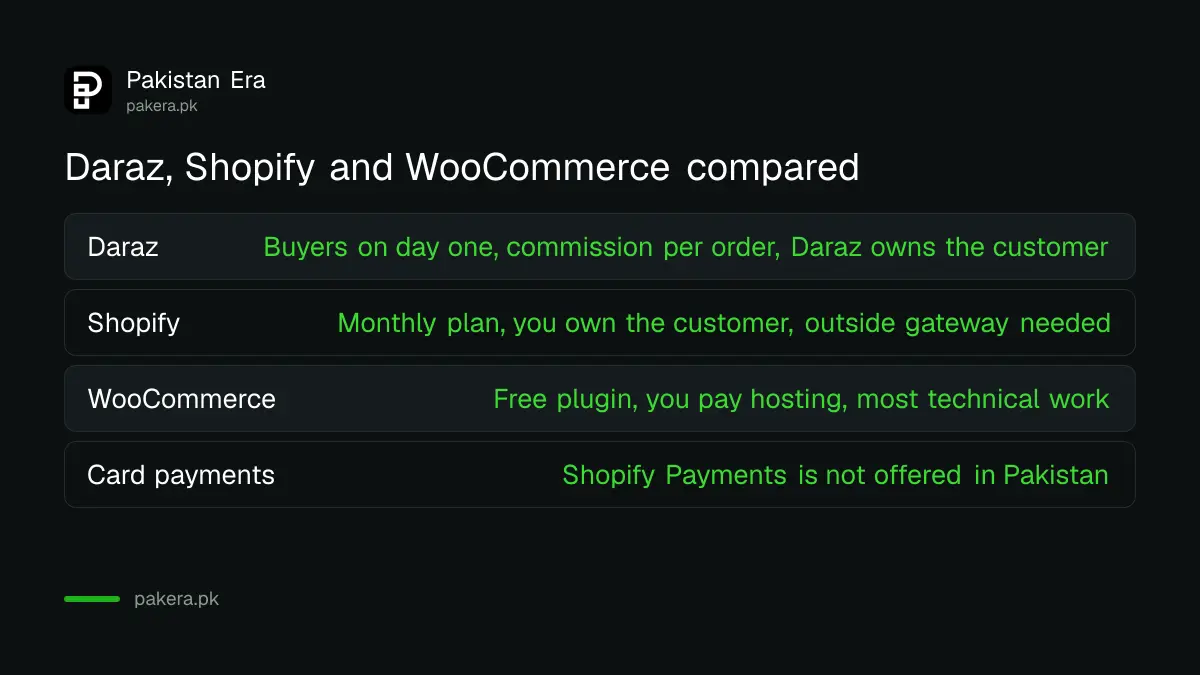
A marketplace like Daraz gives you buyers on day one but takes a cut of every order and owns the customer. Your own website keeps the customer and the margin, but you must bring every visitor yourself. You can start on Daraz and add a website once products sell.
| Point | Daraz marketplace | Shopify | WooCommerce |
|---|---|---|---|
| Buyers on day one | Yes, Daraz's own traffic | No, you bring them | No, you bring them |
| Who owns the customer | Daraz | You | You |
| Software cost | Commission and fees per order | Monthly plan | Free plugin, you pay for hosting |
| Card payments | Handled by Daraz | Third-party gateway, Shopify Payments not offered here | Gateway plugin |
| Technical work | Least | Low | Most |
Before listing anything on Daraz, work out what a seller actually keeps from each Daraz order after commission, payment and shipping fees. Price for that number, not the sticker price.
For your own site, Shopify's list of countries supported by Shopify Payments does not include Pakistan, so a Pakistani Shopify store connects an outside gateway or uses cash on delivery. WooCommerce describes its core platform as free and open source; the cost is hosting, a domain and any paid extensions, and what a website costs in Pakistan depends mostly on who builds it.
Register with FBR before your first sale
An online store needs an FBR registration before couriers and marketplaces will work with it. A sole proprietor adds the business to their own tax profile on IRIS, and the NTN is the CNIC number. Register for sales tax too if you sell taxable goods.
Since 1 July 2025, FBR's e-commerce rules bar marketplaces and couriers from serving sellers who are not registered. Registering a sole proprietorship on IRIS is free. The wider e-commerce tax registration for online sellers covers sales tax and the monthly statements couriers file about you.
You do not need SECP unless you want a company. A private limited company is a separate legal person, which helps with partners and investors but adds annual filings. If you go that way, registering a private limited company with SECP is done online through eZfile.
Take card payments through an SBP-approved gateway
The State Bank's list of payment service providers, updated 2 September 2026, shows Premier Payfast and Safepay in commercial operations with e-commerce payment gateways. JazzCash and Easypaisa offer merchant payment options of their own. Check the SBP list before you sign with anyone else.
A gateway is the service that takes a customer's card or wallet payment on your checkout and settles it into your bank account. The SBP list also shows companies only at pilot or in-principle stage, and some whose approval was withdrawn. A gateway that is on no list at all is a risk to your money. JazzCash's merchant page also offers Raast QR, which lets customers pay from any bank app with the money credited in real time.
Gateways quote their fees when you apply, and they will ask for your CNIC, NTN and a business bank account. Ask three questions before signing: the fee per transaction, how many days until settlement, and who pays when a customer disputes a charge.
Cash on delivery carries a higher tax than online payment
Tax is withheld from online sales before the money reaches you. FBR's rate card for tax year 2027 sets it at 1% for online payments and 2% for cash on delivery, for sellers on the Active Taxpayers List. Non-filers pay double: 2% and 4%.
| How the customer pays | Who withholds | Filer | Non-filer |
|---|---|---|---|
| Card, wallet or bank transfer | Bank or payment gateway | 1% | 2% |
| Cash on delivery | Courier | 2% | 4% |
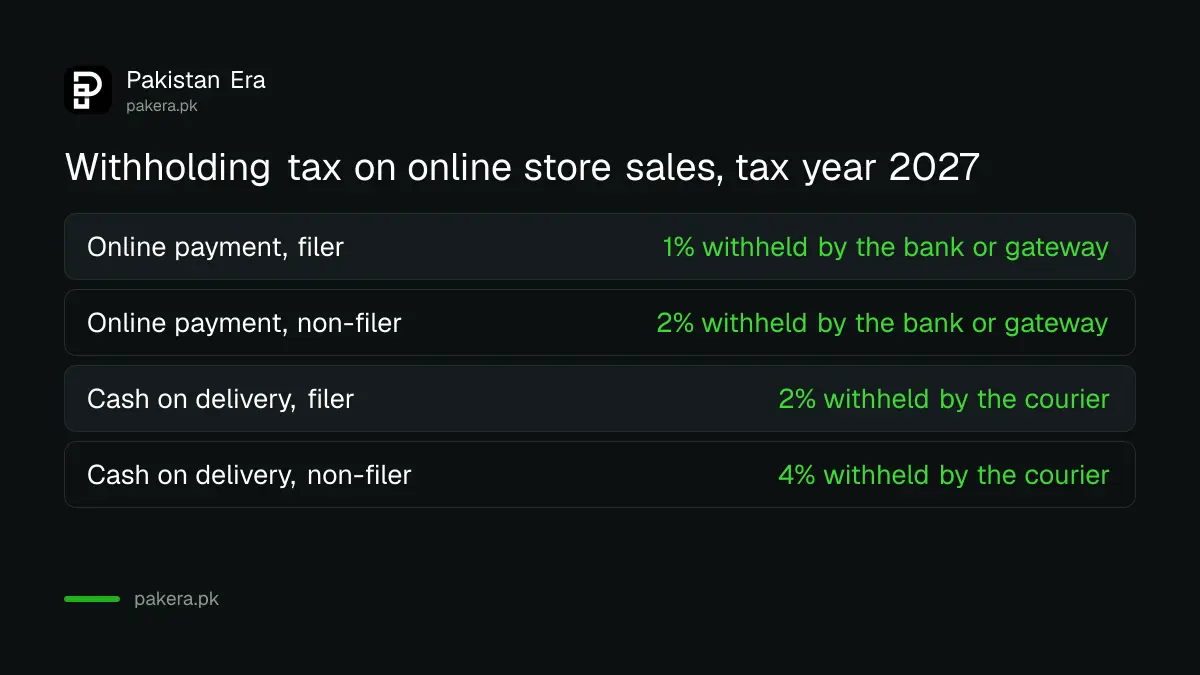
This is section 153(2A) of the Income Tax Ordinance. On a Rs 3,000 cash on delivery order, a filer loses Rs 60 to tax and a non-filer Rs 120, before courier charges. So nudging buyers toward online payment saves money. Being a filer saves more.
Buyers still lean on cash on delivery, and some check whether an online store is a scam before they pay a rupee in advance. Expect refused parcels, and price the return trip into your courier costs.
Show your return policy before the customer pays
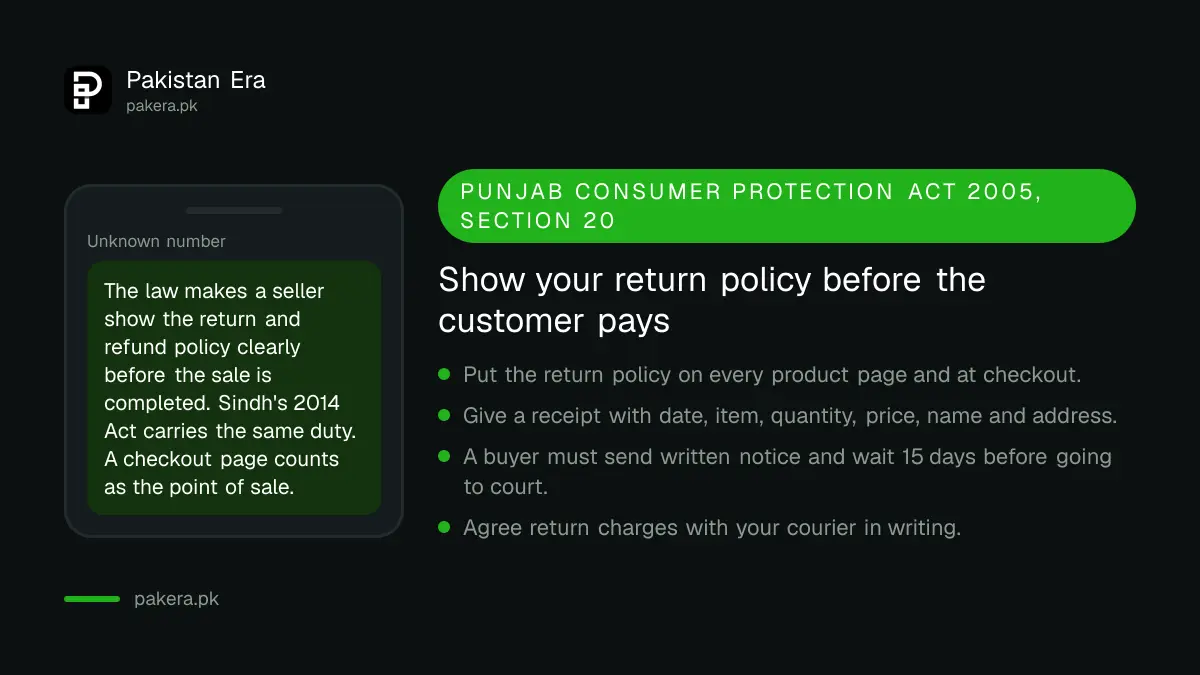
Section 20 of the Punjab Consumer Protection Act 2005 says a seller must show the return and refund policy clearly before the sale is completed. Sindh's 2014 Act has the same duty. Put the policy on every product page and at checkout.
Section 19 of the Punjab Act also requires a receipt with the date, description, quantity, price, and the seller's name and address. An order confirmation email can carry all of that. The buyer's side of these rules, including the 15-day notice before a Consumer Court claim, is set out in return and refund rights for online shoppers.
Launch in this order
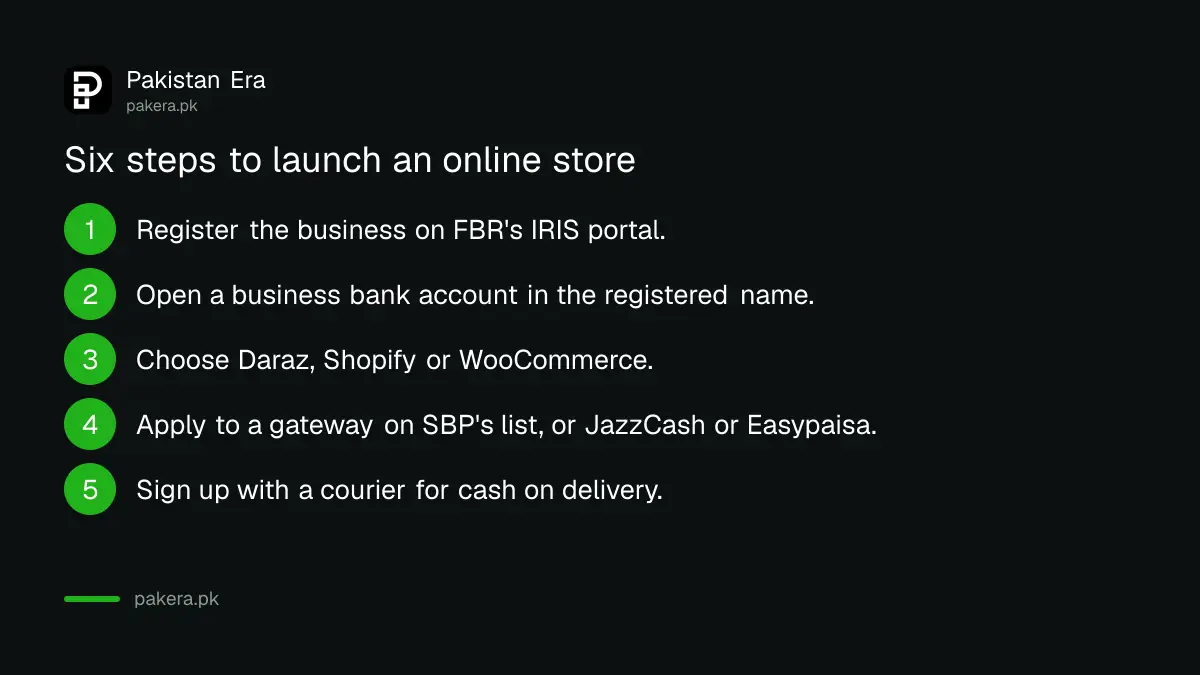
Do the legal and payment setup before you spend a rupee on ads. Each step depends on the one before it, and a courier or gateway will ask for the earlier documents.
- Register the business on FBR's IRIS portal and confirm you appear on the Active Taxpayers List.
- Open a business bank account in the name you registered.
- Choose your route: a Daraz seller account, a Shopify store, or WooCommerce on your own hosting.
- Apply to a gateway on SBP's list, or to JazzCash or Easypaisa for merchant payments.
- Sign up with a courier for cash on delivery and agree the return charges in writing.
- Publish your return policy, delivery times and contact details on the site.
If you also run a shop or pickup point customers can visit, putting your shop on Google Maps is free. Google does not list online-only stores there, so this only helps if a real address is open to customers.
Common questions
Do I need an NTN to sell online in Pakistan?
Yes. FBR's e-commerce rules bar marketplaces and couriers from serving sellers who are not registered, so you need an NTN before they will work with you.
Can I use Shopify Payments in Pakistan?
No. Pakistan is not on Shopify's list of Shopify Payments countries, so use a third-party gateway or cash on delivery.
How much tax is deducted on cash on delivery orders?
The courier withholds 2% for filers and 4% for non-filers under section 153(2A), for tax year 2027.
Do I need to register a company with SECP to start an online store?
No. A sole proprietorship registered on FBR's IRIS portal is enough. SECP is only for a private limited or other company.
Which payment gateways are licensed in Pakistan?
SBP's list of 2 September 2026 shows Premier Payfast and Safepay in commercial operations with e-commerce gateways, alongside 1LINK and others.
How we verified this
What we checked, where we read it, and what we could not confirm.
Last checked 7 October 2026. We read FBR's Withholding Income Tax Rate Card updated to 30 June 2026 under the Finance Act 2026; the State Bank of Pakistan's lists of authorised PSOs and PSPs and of licensed EMIs, both updated 2 September 2026; the Punjab Consumer Protection Act 2005, as read at source for our consumer rights coverage on 5 October 2026; Shopify's list of Shopify Payments countries; WooCommerce's listing on WordPress.org; and JazzCash's merchant payments page. Gateway, courier and Shopify plan fees are not stated because none of them publish a fixed rate we could read. This is general information, not tax or legal advice.
About the author

Founder and Editor
Umer Kureshi founded Pakistan Era in July 2024 and runs it as administrator, SEO lead and writer, overseeing website operations, search growth, content strategy and coverage of technology and current affairs.