Your Return and Refund Rights When Shopping Online in Pakistan
Punjab and Sindh law makes an online seller state its return policy before you pay. What that covers, what it does not, and how to escalate a refusal.
If an online seller in Pakistan will not say what its return and refund policy is before you pay, that is already against the law. Punjab and Sindh consumer protection law makes disclosure a condition of the sale, not a courtesy. Most buyers never ask, and most sellers never say, so the first fight after a bad order is usually about a rule nobody mentioned.
Update, 11 October 2026: Daraz publishes its own return and refund rules with a 14 day window.
We read the Punjab Consumer Protection Act 2005 at source on 5 October 2026, section by section, to answer what a buyer can actually demand, and what the law is simply silent on.
The law makes a seller state its return policy before the sale
Section 20 of the Punjab Act is one sentence: the return and refund policy has to be shown to the buyer clearly, before the transaction completes, at the point of purchase. Sindh's 2014 Act carries the same duty under its own section 20.
Written for a shop counter, the rule still applies online. A checkout page is a point of purchase. If a seller has no stated policy at all, that omission is itself the violation you can point to.
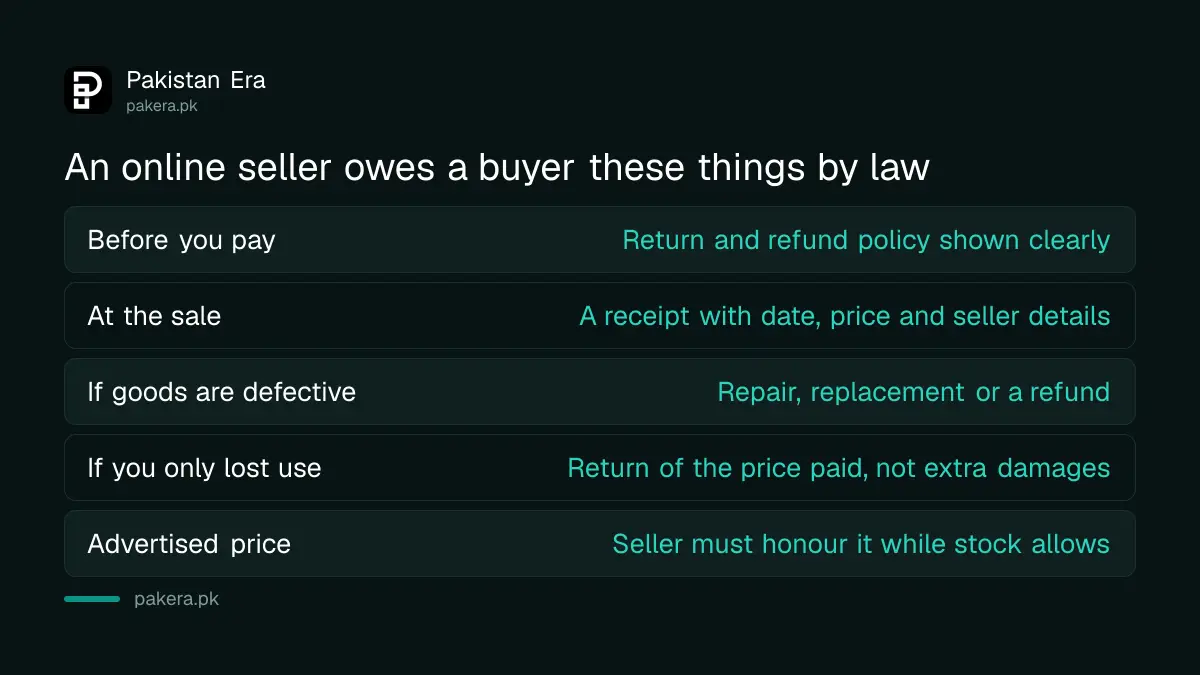
Section 19 adds a second duty most online sellers skip: a proper receipt showing the date of sale, a description of what you bought, the quantity and price, and the seller's name and address. A WhatsApp order confirmation with none of that is not a receipt.
Defective goods get repair, replacement or your money back
A product is defective, says the law, when it fails in construction, in design, through a missing warning, or because it does not match what the seller promised. Any one of those is enough; you do not have to prove all four.
If the only thing you lost is the use of the product, section 10 limits what you can claim to the price paid, plus costs. You are not owed punitive damages for a late parcel that otherwise works.
- Construction or composition different from the seller's own specification
- A design with a safer, practical alternative the seller skipped
- No adequate warning about a real risk in the product
- A product that does not conform to an express promise the seller made
You have to write to the seller before a court will hear you
Section 28 makes the first step mandatory. Send a written notice describing the defect and what you want, before you file anything. The seller or manufacturer then has fifteen days to reply.
No Consumer Court will touch a claim without proof that notice went out and was not properly answered. Keep the order number, the message, and the date you sent it.
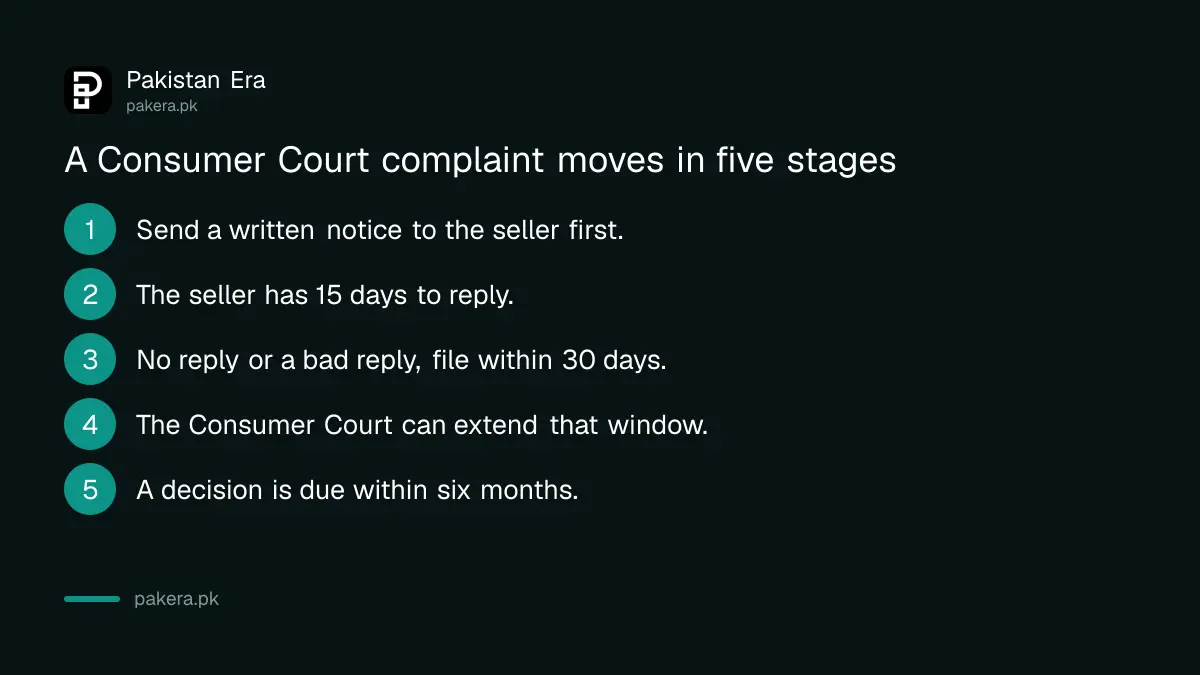
- Send a written notice to the seller stating the defect and the remedy you want.
- Wait fifteen days for a reply, or note that none came.
- File your claim with the Consumer Court within thirty days of the problem arising.
- Ask the Court for an extension if you missed that window for a good reason.
- Expect a decision within six months of the seller being summoned.
The law was not written with a marketplace in mind
Punjab and Sindh's Acts name a manufacturer, a trader and a service provider. Neither names a digital platform, an online marketplace or an e-contract, because both were passed before large scale online retail existed here.
The federal Ministry of Commerce's 2019 e-commerce policy framework said as much itself, flagging the absence of platform specific rules and proposing that online sellers register with SECP. That proposal has not become binding law, so it is not something you can cite against a seller today.
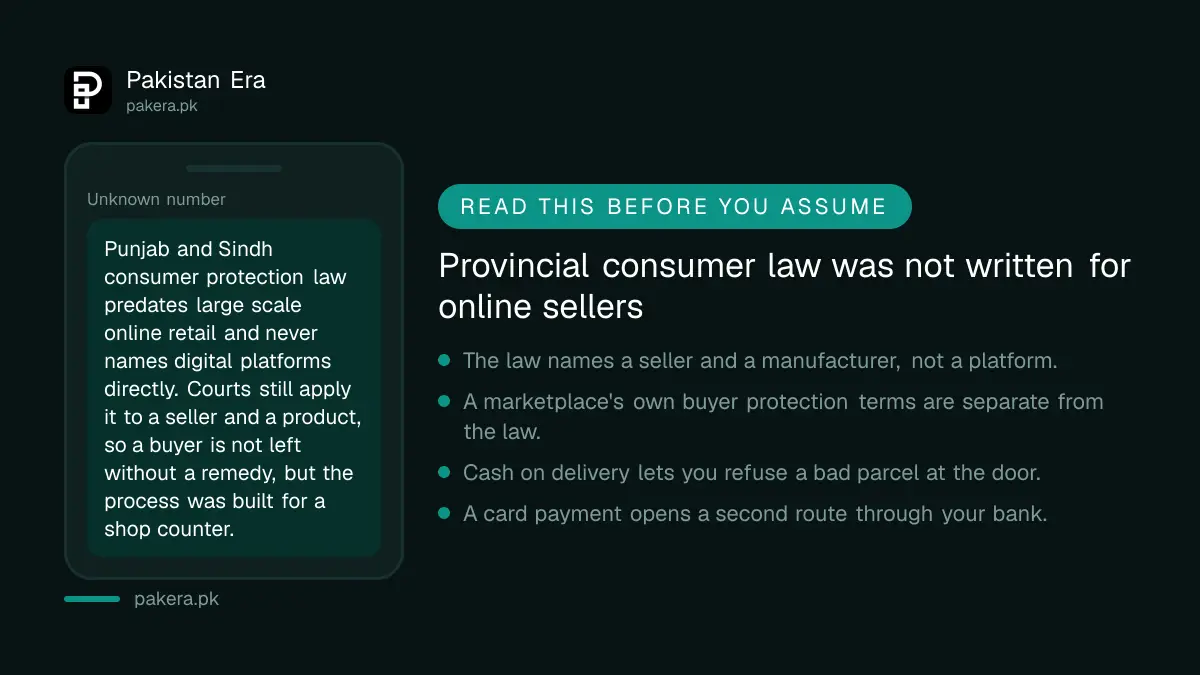
Practically, this means your strongest everyday protection is still cash on delivery: refuse a damaged or wrong parcel at the door and the courier takes it back unpaid. A marketplace's own buyer protection terms, separate from any law, are often faster than a Consumer Court for a straightforward refund.
A seller who ignores an order can be fined or jailed
Section 32 sets real consequences. A seller who ignores the defect or disclosure rules faces up to two years in jail or a fine up to Rs 100,000, on top of whatever damages the Court awards you. Ignoring the Court's own order carries a separate one to three year term.
| Situation | What follows |
|---|---|
| Seller ignores a proven defect | Up to 2 years jail or a fine up to Rs 100,000 |
| Seller ignores the Court's order | 1 to 3 years jail, fine Rs 5,000 to Rs 20,000 |
| Your claim is upheld | Refund, replacement, repair, damages, costs |
| Your claim is found frivolous | You can be fined up to Rs 10,000 |
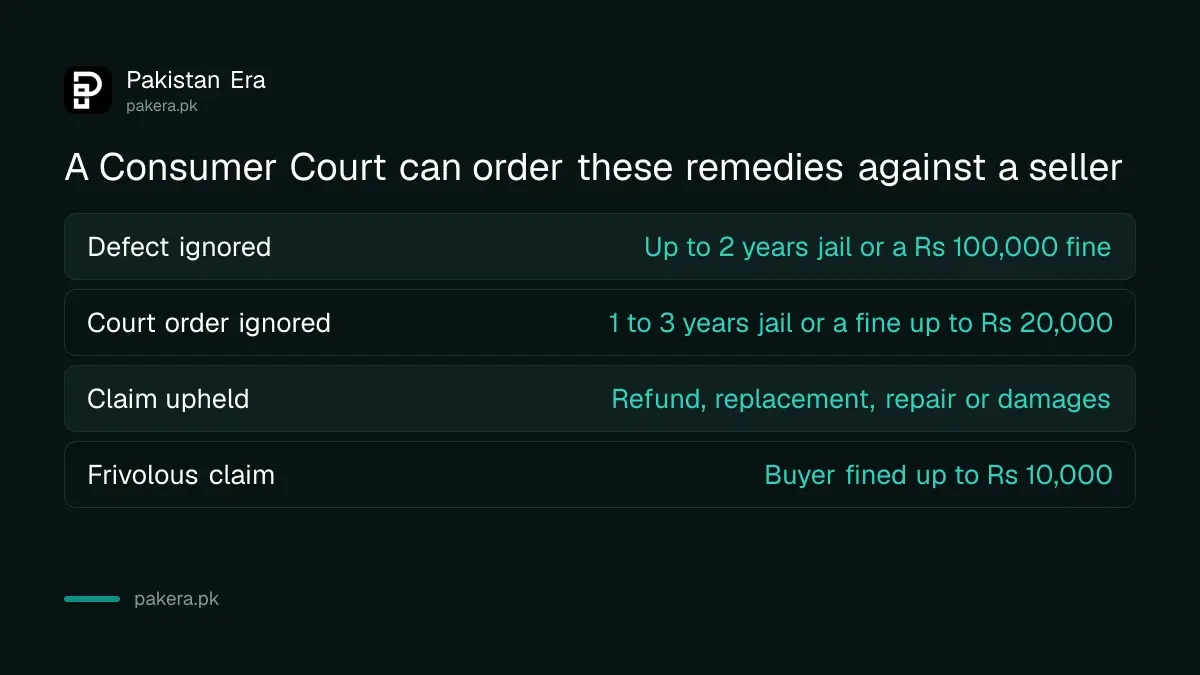
That last line matters. Do not file to pressure a seller over a change of mind; the law protects you against a genuine defect, not buyer's remorse, and a Court can see the difference.
Paying by card or wallet opens a separate route
If a seller refuses a legitimate refund and you paid by card, you are not limited to the Consumer Court. Your issuing bank's own dispute process can reverse a charge for goods never received or materially not as described, on a timeline the State Bank sets separately from provincial consumer law.
Paid through a wallet instead and sent money to the wrong place by mistake, rather than a seller dispute, that is a different problem with its own fix. Selling online yourself rather than buying brings its own obligations, starting with registering as an online seller before you list anything.
Frequently asked questions
Can a seller refuse to state its return policy before I buy?
No. Section 20 of the Punjab and Sindh Acts makes disclosure before the sale a legal duty, not an option the seller can skip.
Do I have to write to the seller before filing a complaint?
Yes. A Consumer Court will not hear your claim unless you first sent written notice and the seller failed to reply properly within fifteen days.
How long do I have to file after a problem shows up?
Thirty days from when the problem arose, extendable by the Court for good cause, but never beyond sixty days past the end of any warranty period.
Does Pakistani consumer law name online marketplaces directly?
No. Both provincial Acts predate large scale online retail and speak of a seller and a manufacturer, so courts apply the same rules to an online sale without a platform specific clause.
Is cash on delivery a legal right or just a convenience?
It is a payment method a seller chooses to offer, not a right the law creates. It works as protection only because you can inspect the parcel and refuse it before paying.
What can a Consumer Court actually order?
Repair, replacement, a refund of the price paid, compensation for proven loss, and in serious cases a fine or jail term against the seller.
About the author

Technology Journalist & Multimedia Producer
Ahmad Ali is a technology journalist and multimedia producer at Pakistan Era, joining the team in October 2026. He covers consumer technology and digital life for Pakistani readers, combining research with hands-on product testing.