How a Freelancer Files an Income Tax Return in Pakistan
FBR taxes a freelancer's foreign client income at 0.25 or 1 per cent, not the normal slabs. See which income counts, the rate that applies, and the IRIS steps.

A freelancer's income tax return in Pakistan splits into two tracks on the same form. Money from a foreign client, banked properly, gets taxed at a flat 0.25% if you're registered with PSEB, or 1% if you're not, with no slabs involved. Money from a Pakistani client, paid in rupees, is ordinary business income and follows the normal slab rates. File both on iris.fbr.gov.pk using your CNIC as your NTN.
Most freelancers here earn from both directions at once, a Fiverr client in Germany one week and a local shop owner's website the next, and the return doesn't let you treat that income as one pile. Get the split wrong and you either pay far more tax than the law asks for, or file something FBR reopens later.
We checked FBR's own press release on the IT sector's tax treatment on 5 October 2026. It states plainly that IT and IT-enabled export income gets a rate "a quarter of the 1% export tax rate provided to all other exporters," which is where the 0.25% figure actually comes from, straight from FBR, not a tax blog.
Freelance income is not one category under the tax law
Section 154A of the Income Tax Ordinance taxes export proceeds of IT and IT-enabled services at source, through the bank that receives the money. That's a completely different mechanism from the normal income tax slabs that apply to a Pakistani client paying you in rupees for the same kind of work.
The deciding factor isn't whether you call yourself a freelancer. It's whether the money is foreign exchange, earned by exporting a service, and received through an authorised bank. A graphic designer with one client in Lahore and one in London is running two different tax treatments in the same month, even though the work looks identical from the desk.
Foreign client income gets 0.25% or 1%, depending on PSEB registration
FBR's own statement on the matter is direct: the reduced 0.25% rate goes to exporters registered with the Pakistan Software Export Board, and everyone else exporting IT or IT-enabled services pays 1%. Both numbers are final tax, meaning the bank deducts it at the point the money lands and there's no further slab calculation on top.
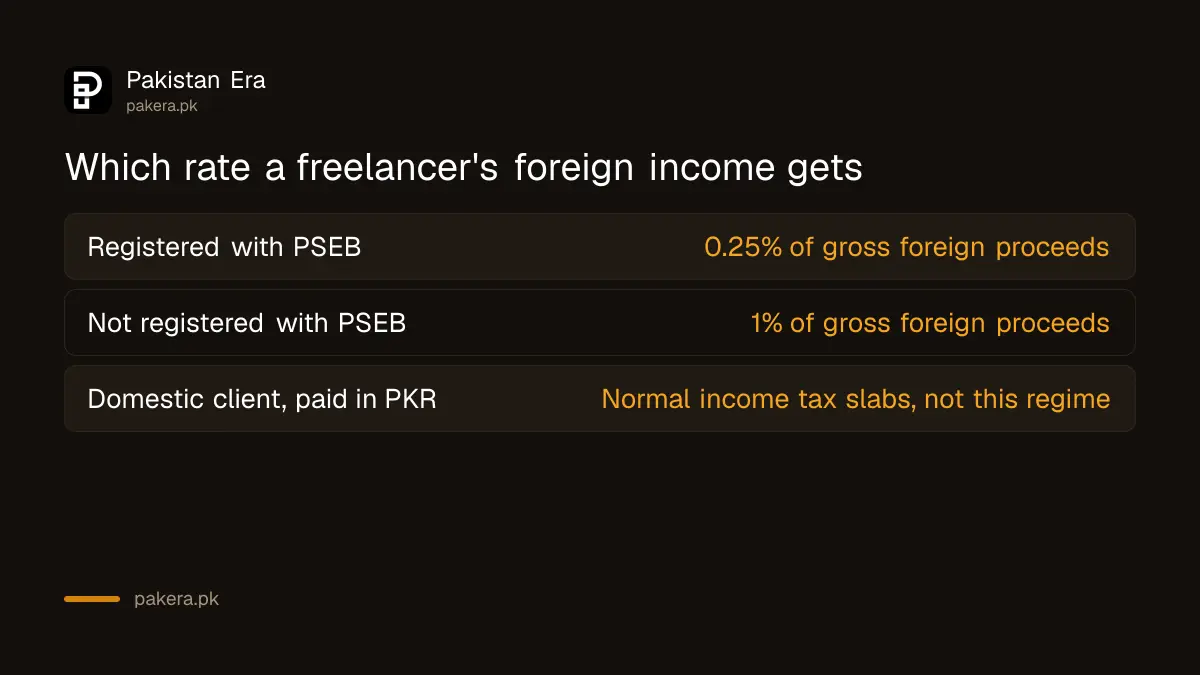
That gap is the whole reason PSEB registration matters so much for anyone earning seriously from foreign clients. A freelancer pulling in a few thousand dollars a month pays four times less tax on it registered than unregistered, and neither figure looks anything like the 20% or higher that a slab rate could reach at that income level.
If you haven't registered yet, PSEB registration and the 0.25% rate is a separate step with its own fee and paperwork, which we've covered on its own rather than repeating here, since it's a registration process and not a filing one.
A Pakistani client paying you in rupees is not export income
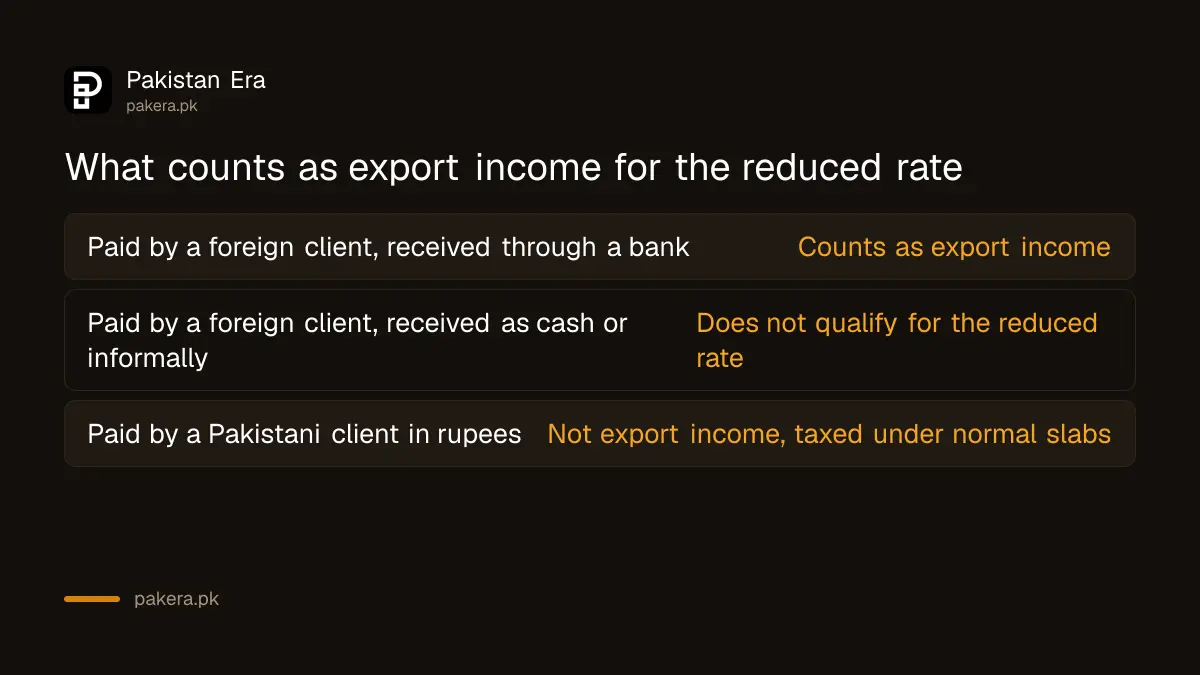
This is where people trip up. Section 154A talks about export proceeds realised in foreign exchange through an authorised dealer. A local client transferring rupees from their own Pakistani bank account doesn't meet either condition, foreign currency or an export transaction, so it simply isn't covered by the 0.25%/1% regime at all.
That income goes in as ordinary business income and gets taxed on the normal slab rates that apply to your total taxable income for the year. It isn't a lesser version of freelance income or a technicality. It's a different tax question with a different answer.
| Income source | Tax treatment |
|---|---|
| Foreign client, PSEB-registered, banked properly | 0.25% final tax on gross proceeds |
| Foreign client, not PSEB-registered, banked properly | 1% final tax on gross proceeds |
| Foreign client, paid informally or in cash | Does not qualify for the reduced rate |
| Pakistani client, paid in rupees | Normal income tax slabs on business income |
Keep the two income streams apart in your own records
Don't wait until you're sitting in front of the IRIS form to work out which rupee came from where. Keep a simple running log through the year: client name, currency, bank credit date, and whether it landed through a formal banking channel or not.
- Log every foreign payment with the date it hit your bank account.
- Keep the bank's own credit advice or statement entry for each one.
- Log domestic client payments separately, even if they come through the same account.
- Total each category only at year end, not month by month.
- Carry both totals into the matching sections of the IRIS return.
Filing on IRIS means two entries, not one
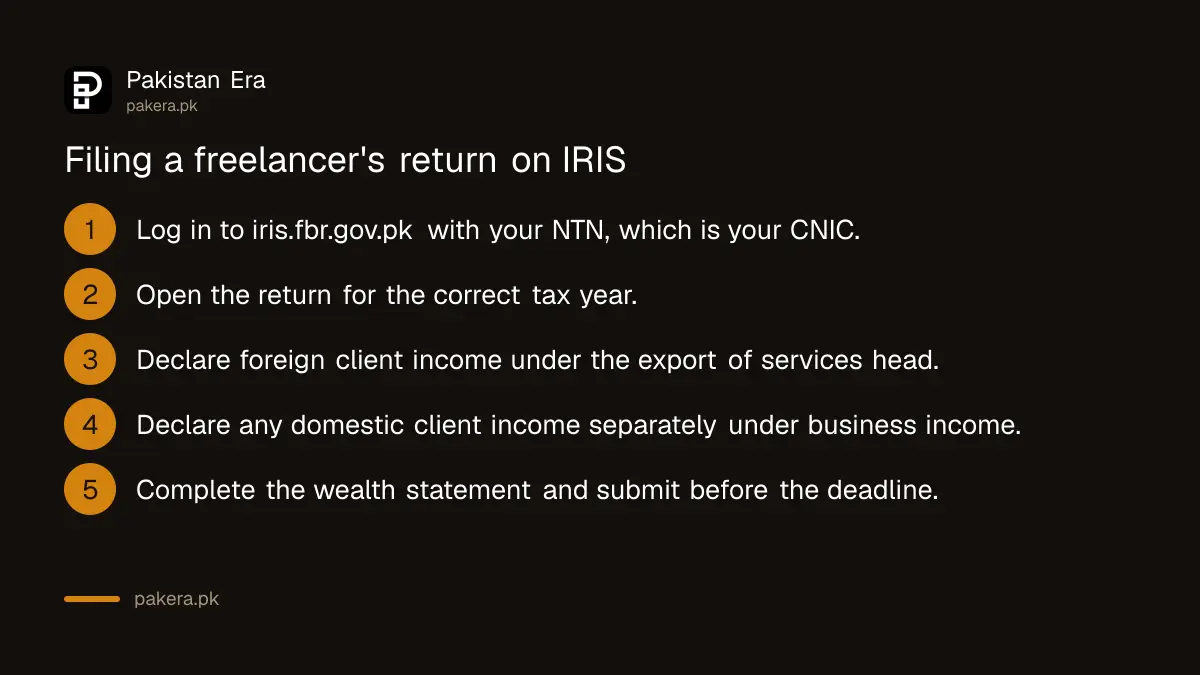
Once your records are split, the filing itself is mechanical. Log in to iris.fbr.gov.pk with your NTN, which for an individual is your CNIC number, and open the income tax return for the right tax year. Foreign export proceeds get declared under the export of services treatment, separate from the business income section that carries your domestic client earnings.
You still complete a wealth statement either way. FBR requires it from anyone filing a return, regardless of which rate applied to which part of your income, so don't skip it on the assumption that final-tax income is exempt from that requirement.
If the portal itself is the problem on deadline day, login errors on IRIS 2.0 have their own fixes, and worth checking before you assume the issue is with your own entries.
The broader rules on filing deadlines and the late surcharge apply to every filer, not just freelancers, and are worth a look too if you're filing for the first time this year, since missing the window costs more than it used to.
Registering with PSEB is a separate decision from filing your return
You can file a return without ever registering with PSEB. You'll simply pay 1% instead of 0.25% on your export proceeds until you do. For anyone earning a meaningful amount from foreign clients, that difference adds up fast enough that registering is usually worth the one-time effort.
We've kept the registration process, its reported fee and the banking channel condition on its own page, because that's a different task from filing a return and deserves its own walkthrough rather than a rushed summary here.
Common questions
Do I pay the same tax rate on all my freelance income?
No. Foreign client income, banked properly, gets 0.25% or 1% final tax. Domestic client income follows normal slab rates.
What makes income count as export income for the reduced rate?
It has to come from a foreign client and be received through an authorised banking channel, not cash or an informal transfer.
Do I need PSEB registration to file a tax return as a freelancer?
No. You can file without it, but you'll pay 1% instead of 0.25% on your foreign export proceeds until you register.
Is a wealth statement required even if most of my income is final tax?
Yes. FBR requires a wealth statement from filers regardless of which tax regime covered their income.
What NTN do I use as an individual freelancer?
Your CNIC number is your NTN for an individual filer on the IRIS portal.
How we verified this
What we checked, where we read it, and what we could not confirm.
We read FBR's own press release clarifying the IT sector's tax treatment on fbr.gov.pk on 5 October 2026, which confirms the 0.25% rate for PSEB-registered exporters as a quarter of the 1% rate for other exporters. The banking channel condition and the regime's extension to 2029 are reported consistently with our existing PSEB registration article and were not independently re-verified on a government page during this check. IRIS filing steps are described at the general process level; we have not quoted specific annexure numbers we did not verify directly on the live portal.
About the author

Senior Writer, Public Services and Technology
Shahid joined us in 2024 as an author. He is a senior contributor to Pakistan's leading technology websites. He writes detailed articles, mostly covering his expertise in the latest tech, mobiles, apps, gadgets, and step-by-step guides. His ideology is to help people understand the latest trends and explain complex methods through very easy-to-understand guides.